Meeting the Requirements for a Hardship License in Florida
Unlock the requirements for a hardship license in Florida. Our guide explains eligibility, the application process, and required documents after a suspension.
Losing your driver's license in Florida can feel like your world has ground to a halt. If you're wondering about the requirements for a hardship license in Florida, you're asking the right questions. A hardship license is essentially a restricted permit that lets you drive for essential needs—like getting to work, school, or the doctor—while your regular license is suspended.
Your eligibility, and how long you'll have to wait, comes down to one thing: the reason for your suspension. Whether it was for a DUI or for racking up too many points on your record, the path forward is different for everyone.
What Is a Florida Hardship License and Do You Qualify?
Let's be clear: a Florida hardship license isn't a get-out-of-jail-free card. It won’t restore your full driving privileges. Think of it more like a lifeline, a restricted permit with very strict rules about where and when you can drive so you can keep your life on track while serving your suspension. Getting a handle on these rules is the first step.
The state offers two main types of hardship licenses, and the one you get determines exactly what that lifeline covers:
Business Purposes Only (BPO): This is the one most people get. It allows you to drive for anything necessary to maintain your livelihood. That includes the commute to and from work, any driving required as part of your job, getting to school, attending church, and traveling for crucial medical appointments.
Employment Purposes Only: This license is much more restrictive. It only permits you to drive to and from your job. That’s it. No side trips to the grocery store or the doctor's office.
Common Reasons for Suspension
Your chance of getting a hardship license is directly tied to why your license was suspended in the first place. The most common culprits are DUI convictions, refusing a breathalyzer test, or piling up too many points from traffic tickets. Each of these situations has its own specific waiting periods and mandatory courses you have to complete. A DUI, for instance, almost always requires finishing a DUI school program before you can even think about applying.
You can learn more by checking out our guide on what to do about a suspended license in Florida.
For an administrative suspension right after a DUI arrest, first-time offenders with a BAC over .08 have to go 30 days without any license before they can qualify for a hardship reinstatement. If you refused to take the test, that waiting period jumps to 90 days. And for a second refusal or multiple DUIs, there's no eligibility at all.
Qualifying often comes down to proving that not being able to drive creates a true, significant burden on your life. The Florida Department of Highway Safety and Motor Vehicles (DHSMV) will review your application to decide if your need is genuine. This makes it absolutely critical to prepare your paperwork carefully and make sure you meet every single state requirement.
To give you a clearer picture, here’s a quick breakdown of the general eligibility rules for some of the most common suspension reasons.
Florida Hardship License Eligibility at a Glance
This table summarizes the core eligibility requirements based on the reason for your license suspension.
Reason for Suspension | Eligibility Period | Required Course |
|---|---|---|
Too Many Points | May be eligible immediately | Advanced Driver Improvement (ADI) Course |
First DUI (BAC over .08) | 30-day "hard" suspension (no driving at all) | DUI School Level I |
First DUI Refusal | 90-day "hard" suspension (no driving at all) | DUI School Level I |
Second DUI or Refusal | Ineligible for hardship license | Not applicable |
Remember, this is just a general guide. The specifics of your case can change things, which is why it's so important to get the details right from the start.
Navigating the Hardship License Process in Miami-Dade County
While the core requirements for a hardship license in Florida are the same statewide, applying for one in a massive metro area like Miami-Dade County presents unique challenges. The laws don't change, but the sheer volume of cases means that being prepared and precise isn't just a good idea—it's absolutely essential.
Securing a hardship license here means you have to know the local landscape. Your first move is figuring out which Bureau of Administrative Reviews (BAR) office will handle your hearing. In a county with over 2.7 million people, these offices are constantly busy. Showing up at the wrong one or with a stack of incomplete paperwork will get you sent to the back of the line, causing significant delays.
Proving Your Need in a Bustling Metropolis
One of the unique hurdles for Miami-Dade applicants is proving you genuinely need a car. The hearing officers are very familiar with the county's public transit, like the Metrorail and Metrobus. Because of this, you have to build a solid case that explains exactly why those options just won't work for your situation.
For instance, you'll need to show that:
Your job requires you to travel to multiple sites that aren't on a direct bus or train route.
Your work shifts start or end when public transit isn't running.
You're the only person who can take a child or dependent to school or critical medical appointments, and public transport is too slow or unavailable.
Just saying "I need to drive" won't cut it. You have to draw a clear line connecting your need to drive with your ability to earn a living or handle essential family duties. You need to give them a compelling reason why a hardship license is the only way forward.
It's a common misconception that license suspensions only happen after serious driving offenses. The reality is, a simple traffic ticket you couldn't pay can easily snowball into a suspension. This is the exact situation for over 700,000 Floridians. A shocking 75% of suspensions are tied to unpaid fines and fees, not dangerous driving.
Local Hearings and What to Expect
The administrative hearing is your chance to make your case. In Miami-Dade, this is a formal review where a hearing officer goes through your application, checks every document, and listens to why you need a restricted license. They will look closely for proof you've enrolled in required courses (like ADI or DUI school) and verify that you've paid all your fees.
Because of the packed dockets, these hearings move fast. This is where an attorney who knows the local system can be a game-changer. They can assist with organizing your documents, help you clearly explain your need, and ensure every detail aligns with what Miami-Dade hearing officers look for.
If you're considering professional help, you can learn more about when it's worth hiring a lawyer vs. paying the traffic ticket in Miami-Dade. That level of preparation can make a significant difference. This is an attorney advertisement.
Your Step-by-Step Guide to Applying for a Hardship License
Trying to get a hardship license in Florida can feel like you're staring at a mountain of paperwork and confusing rules. But if you break it down into a few key steps, the process becomes much more manageable. Think of it as a checklist—getting it right from the start is the best way to avoid frustrating delays or an outright denial from the DHSMV.
The whole thing kicks off with figuring out exactly where you stand. From there, it's about enrolling in the right course, gathering your documents, and finally, making your case at a hearing.
Step 1: Confirm Your Eligibility and Suspension Type
Before you even think about filling out a form, you need to lock down two critical pieces of information: are you actually eligible, and why was your license suspended in the first place? The requirements for a hardship license in Florida are incredibly specific and change depending on your offense.
For example, the path for a suspension due to too many points is completely different from one for a DUI conviction. Pull out your official suspension notice from the DHSMV. That document is your road map—it will tell you the exact reason for the suspension and how long it lasts. This also dictates your mandatory "hard suspension" period, which is the time you absolutely must wait before you can even apply.
Step 2: Enroll in the Correct Driver Course
Once you know your suspension type, your very next move is to sign up for the state-required driver course. This is non-negotiable. You can't even submit your application without proof of enrollment.
For Point-Related Suspensions: You'll need to complete a 12-hour Advanced Driver Improvement (ADI) course.
For DUI-Related Suspensions: You must enroll in a state-approved DUI School. Level I is for a first offense, while Level II is for anyone with prior offenses.
Signing up for the wrong course is a surprisingly common mistake, and it will get your application kicked back to you immediately. Make sure you hold on to your enrollment receipt or certificate—you’ll need it for the next step.
Step 3: Prepare Your Application and Gather Documents
Now it’s time to get your paperwork in order. You’ll need to fill out the official Application for Hardship License (Form HSMV 78306). Be meticulous here. Any missing information or a simple mistake can set you back weeks.
Along with the completed form, you'll need to round up these supporting documents:
Proof you're enrolled in the correct ADI or DUI course.
A valid ID.
Proof of Florida residency, like a recent utility bill or your lease.
The required application fee.
Getting a hardship license is often just one piece of a much larger puzzle to get your full driving privileges back. Understanding the overall steps to get your license back after a DUI can give you a better sense of the entire journey. While that resource is for another state, the general roadmap is conceptually the same.
This flowchart gives you a simplified look at how to navigate the administrative process in a busy place like Miami-Dade.
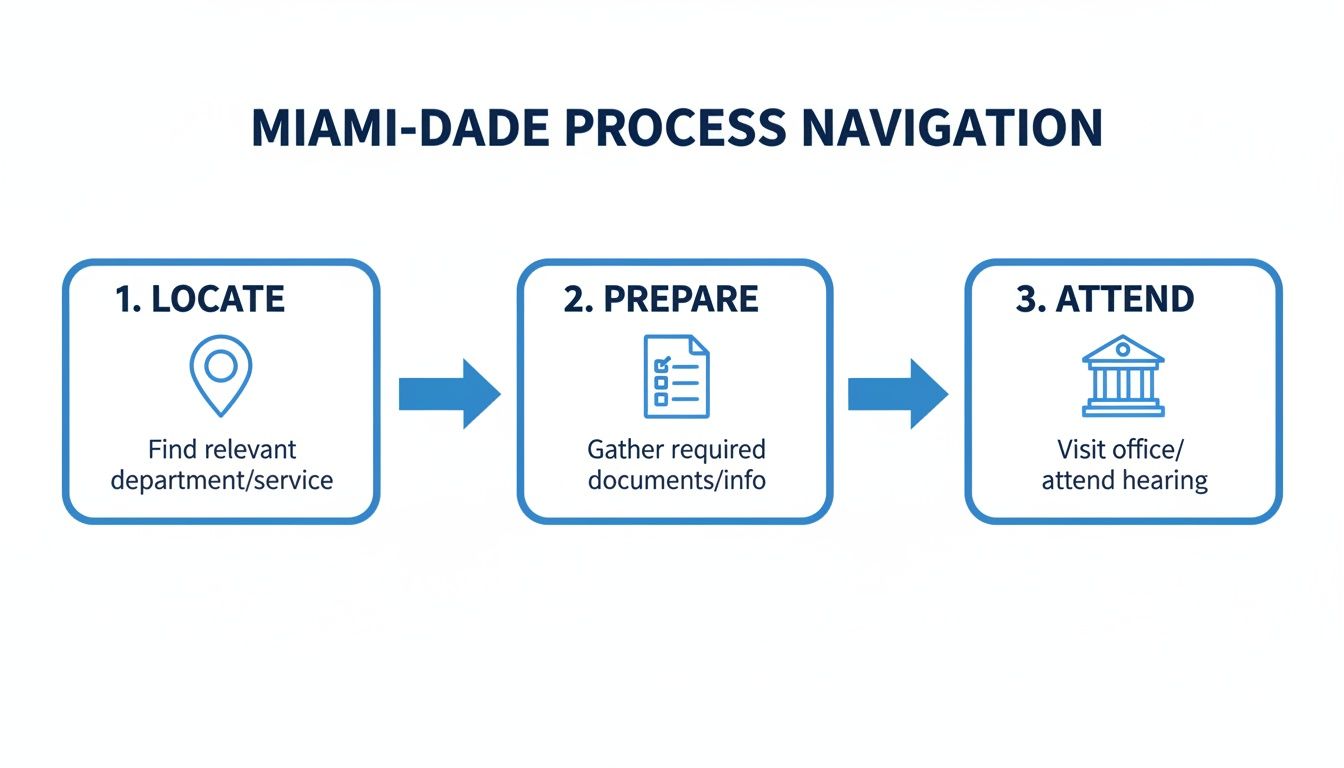
It really highlights the importance of having a clear plan: find the right office, get all your documents ready before you go, and show up to your hearing prepared to present your case.
Step 4: Schedule and Attend Your Hearing
With your application packet ready to go, the final step is scheduling a hearing at a Bureau of Administrative Reviews (BAR) office. At this hearing, an officer will go through your file and ask you to explain exactly why you need a hardship license. You need to be able to clearly show how not being able to drive creates a major problem for your livelihood—things like getting to work, attending school, or making it to essential medical appointments.
Having all your ducks in a row for this meeting is absolutely essential. If you’re worried about this final, crucial step, our guide on how to reinstate a suspended license in Florida offers some extra insights. Your best chance at getting approved is to present a case that is well-organized, honest, and compelling.
Gathering Your Required Documents and Course Certifications
Getting the green light for a Florida hardship license comes down to being incredibly organized. This isn't just about filling out a form; you're building a complete package where every single piece of paper matters. One missing document can get your application tossed out, sending you right back to square one.
Think of it as making your case to the hearing officer. You need to show them you've checked every box the state requires. That process starts with enrolling in the right driver safety course—and which one you need depends entirely on why your license was suspended in the first place.
Differentiating Between ADI and DUI School
Enrolling in the correct program is a non-negotiable first step. Proof of enrollment is mandatory for your application, and these courses are definitely not interchangeable.
12-Hour Advanced Driver Improvement (ADI) Course: This one is for drivers who lost their license because they racked up too many points from traffic tickets.
DUI School (Level I or Level II): This program is required for anyone with a DUI-related suspension. Level I is for a first offense, while Level II is for those who have prior DUIs.
Once you’ve signed up, you’ll get a certificate or receipt. Hold onto that document—it’s your golden ticket and the first item you’ll need for your application.
Your Essential Document Checklist
With your course enrollment proof in hand, it's time to assemble the rest of your documents. You want to walk into that hearing so prepared that the hearing officer immediately sees you're taking this seriously.
A meticulously organized folder can make a huge difference. You'll generally need the following items:
Proof of Course Enrollment: The original certificate or receipt from your ADI or DUI school.
Completed Application Form (HSMV 78306): Fill this out completely and accurately. An incomplete form is one of the fastest ways to get rejected.
Valid Identification: Your state ID, a passport, or another government-issued photo ID will work.
Proof of Florida Residency: A recent utility bill, lease agreement, or bank statement with your name and current address is perfect.
Application and Administrative Fees: You’ll have to pay these on the day of your hearing, so come prepared.
The table below breaks down exactly what you'll need based on the reason for your suspension. Use it as a final checklist before your hearing.
| Document Checklist for Florida Hardship License Application |
| :--- | :---: | :---: |
| Document Type | Required for Point Suspension | Required for DUI Suspension | | Proof of ADI Course Enrollment | Yes | No | | Proof of DUI School Enrollment | No | Yes | | Completed Form HSMV 78306 | Yes | Yes | | Valid Photo Identification | Yes | Yes | | Proof of Florida Residency | Yes | Yes | | Application and Administrative Fees | Yes | Yes |
Having every document ready and in order shows the hearing officer you are responsible and ready to comply with the state's requirements.
Remember, a hardship license is a lifeline, but it comes with strict rules. This includes paying the $12 filing fee and submitting a perfect Form HSMV 78306.
It’s also crucial to make sure you meet all the other state requirements. This often includes passing a DMV vision test, so be ready for that. Before you even head to the hearing, it's a good idea to double-check your official driving record to confirm all the details of your suspension are correct. You can learn more by reading our guide on how to check your driving record.
How a Traffic Attorney Can Help with the Process
Trying to navigate the Florida DHSMV administrative process on your own can be a frustrating and intimidating experience. The paperwork is precise, the deadlines are non-negotiable, and one small mistake can get your application flat-out denied. That forces you to serve your full suspension with no driving privileges at all. This is where getting help from a law firm that focuses on traffic defense can make all the difference.
An attorney’s first job is to confirm you’re even eligible for a hardship license in the first place. They’ll dig into the details of your suspension—whether it’s from too many points or a DUI—and map out the right path forward. That simple first step can save you from wasting time and money on an application that was never going to succeed.
Ensuring Accuracy and Presenting a Strong Case
One of the top reasons for denial is something as simple as incomplete or incorrect paperwork. A single missed signature or the wrong course certificate is enough to sink your entire application. A traffic defense attorney acts as your final checkpoint, making sure every form is filled out perfectly and that you have all your supporting documents in order, from your ADI course certificate to proof of residency.
A huge part of the hearing is explaining why you need to drive. Vague statements just won’t cut it. Legal counsel helps you frame this need in a clear, compelling way that hearing officers are trained to look for. They’ll help you build a case that shows a genuine hardship, directly connecting your ability to drive with your need to keep your job or handle essential family duties.
Our goal is to protect your license and record. We understand the administrative hurdles involved in meeting the requirements for a hardship license in Florida and are prepared to guide you through each step. Past results do not guarantee future outcomes.
With an office in Broward and experience handling traffic matters across Florida, we know how to navigate this complex administrative process. We understand what local hearing officers, from Miami-Dade to the Panhandle, expect to see in a successful application. You can learn more about the benefits of professional guidance in our article on hiring traffic ticket lawyers. Having an advocate in your corner provides clarity and confidence when your ability to drive is on the line. This is an attorney advertisement.
Common Questions About Florida Hardship Licenses
When your license is on the line, a lot of questions pop up. The process for getting a hardship license can feel a bit confusing, so let's clear up some of the most common things people ask. Think of this as a quick guide to nail down the key requirements for a hardship license in Florida.
How Long Do I Have to Wait to Apply?
That waiting period before you can even think about applying for a hardship license is what’s known as "hard suspension" time. It's not the same for everyone. The clock starts ticking based on why your license was suspended in the first place.
If your suspension came from racking up too many points, there's some good news. You can often apply for a hardship license almost immediately after enrolling in the required 12-hour Advanced Driver Improvement (ADI) course. For most point-based suspensions, there's no mandatory wait.
DUI-related suspensions, however, are a completely different story. The rules are much stricter.
First-Time DUI (BAC over .08): You're looking at a full 30 days of absolutely no driving before you're eligible to apply.
First-Time Refusal to Submit to a Test: The wait is even longer. You'll have to sit tight for 90 days with no driving privileges at all.
Second or Subsequent Offenses: For more serious violations, like a second DUI or another refusal, you might not be eligible for a hardship license whatsoever and will have to face a much longer revocation period.
What Does a Business Purposes Only Restriction Really Mean?
The "Business Purposes Only" (BPO) restriction is the most common type of hardship license, but don't let the name fool you. It covers a lot more ground than just driving for your 9-to-5 job. Under Florida law, a BPO license lets you drive for any reason necessary to "maintain livelihood."
The state has a pretty specific definition of what that includes:
Driving to and from work.
Any driving you have to do on the clock for your employer.
Getting to and from school or educational classes.
Driving to necessary medical and dental appointments for yourself or a dependent.
Traveling to and from religious services.
It's absolutely critical to understand what a BPO license does not cover. Any driving for social or recreational reasons is off-limits. Trips to the gym, a friend's house, or a concert are strictly forbidden and can get your license revoked.
Can I Get a Hardship License if I Am Unemployed?
While having a job makes the case for a hardship license pretty straightforward, it's not the only way to qualify. You can still get one even if you're unemployed. The key is proving you have another essential need for driving that you can't meet with any other form of transportation.
For example, you might still qualify if you need to:
Attend school or a vocational training program.
Get to regular medical treatments, like dialysis or physical therapy.
Act as the only caregiver for a dependent who needs rides to school or medical appointments.
In situations like these, you'll need to bring solid documentation to convince the hearing officer. This means things like school enrollment forms, a detailed letter from a doctor, or other official records that clearly show a genuine, unavoidable hardship.
Past results do not guarantee future outcomes. The decision to grant a hardship license rests solely with the DHSMV hearing officer, who evaluates each case based on its individual merits and the documentation provided.
What Happens if I Get a Ticket on a Hardship License?
Getting a new traffic ticket while driving on a hardship license is one of the worst mistakes you can make. The consequences are severe. If you violate any traffic law or break the specific rules of your permit (like driving outside approved hours or purposes), your hardship license can be revoked on the spot.
If that happens, you'll be forced to serve the full remainder of your original suspension with zero driving privileges. On top of that, you'll be facing new fines, penalties, and potentially an even longer suspension for the new violation. Driving with extreme caution and following every single rule isn't just a suggestion—it's essential.
Navigating the administrative maze to get your driving privileges back is a challenge. If you have questions about your specific situation or need guidance, Ticket Shield, PLLC is here to help. Our practice focuses on traffic and DUI defense across all 67 Florida counties. Contact us for a free consultation to understand your options. This is an attorney advertisement. Office in Broward. Submitting information via our forms does not create an attorney-client relationship.