What Is Criminal Speeding in Florida and Why It Matters
What is criminal speeding in Florida? Learn the legal thresholds, penalties, defenses, and how to protect your license with experienced traffic defense.

In Florida, criminal speeding is not a single magic number. It usually becomes a criminal case when the conduct fits reckless driving under §316.192 or, in narrower situations, unlawful speed under §316.187, and the consequences go far beyond a fine.
You probably got pulled over thinking this was just another traffic stop. It isn't. If the officer wrote the citation the wrong way, or if your speed put you in a school zone, a business district, or another dangerous setting, you may be looking at points, insurance fallout, and even a criminal record if you handle it badly.
Table of Contents
The Moment You Realize This Is Not a Normal Ticket
The blue lights come on, you pull over, and the officer walks back with a citation that looks routine. That's the trap. Plenty of drivers convince themselves they can just pay it and move on, but Florida speeding stops can carry a much heavier shadow when the facts line up the wrong way.
A routine ticket is a nuisance. A criminal speeding allegation can become a case file, a court date, and a problem that follows you into background checks, insurance renewals, and job applications. That's the danger, not the few minutes on the side of the road.
Why drivers get burned by the “I'll just pay it” mindset
People pay traffic tickets because they want the headache gone. That instinct is understandable, but it's often expensive. In Florida, what looks like a small citation can still trigger license points, higher premiums, and a paper trail that your insurer, employer, or licensing board can find later.
Practical rule: if the citation or the officer's explanation suggests extreme speed, a school zone, reckless conduct, or a criminal charge, stop treating it like a parking ticket.
You also need to think about timing. The next 30 days matter because that's when decisions get made about whether to fight, how to respond, and whether you let the state define the case for you. Once you pay or plead without a plan, you've lost your advantage.
Drivers in gig work, CDL holders, and people with professional licenses have even less room to be casual. A single bad decision can hit revenue, routing apps, and renewal status at the same time. If you want a plain explanation of how this kind of offense is classified, read are speeding tickets misdemeanors before you do anything else.
Understanding Florida's Criminal Speeding Definition
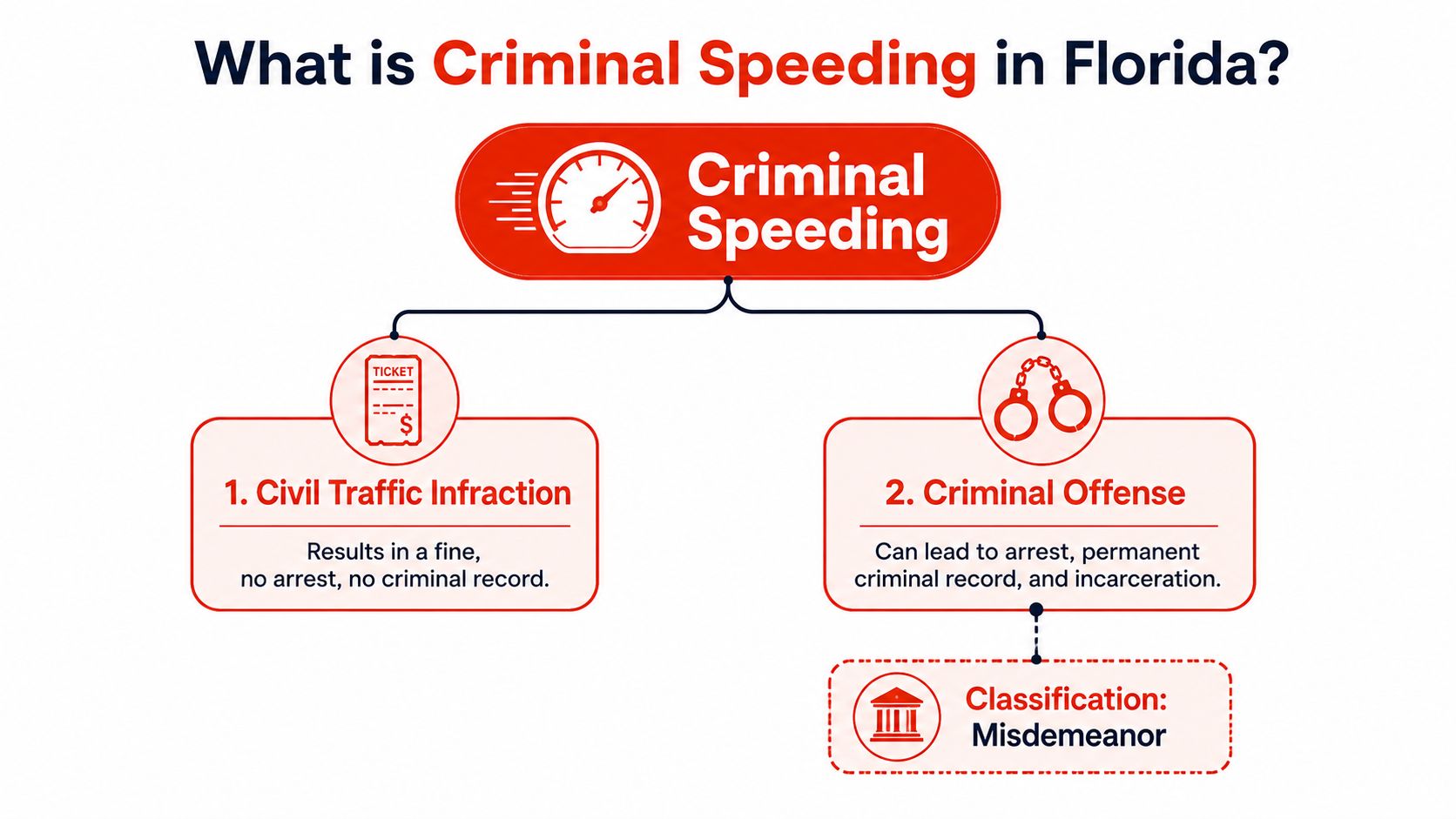
A normal speeding ticket is a civil traffic matter. Florida can turn the same driving event into a criminal case when the facts show more than a routine mistake. At that point, you are not just dealing with a fine. You are facing court, possible arrest exposure, and a criminal record that can show up later on background checks, insurance renewals, and job applications.
A civil citation hurts your wallet. A criminal speeding case can damage your name, your job, and your clean record.
Florida does not use one single label for every bad speed case
Florida does not have one neat standalone offense called “criminal speeding” that covers every high-speed stop. The state usually reaches for §316.192, reckless driving, when the speed and surrounding facts show willful or wanton disregard for safety. In narrower situations, §316.187 and the related speeding rules still matter because the citation has to fit the right road, the right zone, and the right legal theory.
For you, the difference is plain. A 10-over ticket is a civil problem. A citation tied to dangerous speed, a school zone, or conduct that looks reckless is a criminal problem. The wording on the citation matters, but the facts matter more.
Why the statute matters more than the number on the speedometer
The officer's citation, the zone, and the underlying conduct control your exposure. If you were moving fast but the state can only prove a civil speeding violation, you are in one lane. If the facts point to reckless conduct, you are in another lane entirely.
Read the statute, not just the number. A citation under §316.192 means the state is accusing you of criminally dangerous driving, not ordinary speeding. That distinction drives the entire case.
That difference also reaches into your working life. If you drive for Uber, Lyft, DoorDash, or a fleet employer, the fallout can hit fast, from account problems to route restrictions and job consequences. For a useful breakdown of are speeding tickets misdemeanors, read it before you decide how to handle the citation. Fleet drivers should also look at how CSA speeding points affect fleets because the score impact can follow you long after the stop ends.
The Florida Statutes That Turn Speed Into a Crime
Florida traffic law starts with a basic rule. §316.183 says you must drive at a speed that is reasonable and prudent for the conditions. That's the foundation. If the road is wet, visibility is poor, traffic is dense, or the setting is sensitive, the speed itself can become the problem even before anyone starts arguing about a hard number.
Then comes §316.187, which handles unlawful speed. That's where ordinary speeding citations live. The point is not subtle, if you exceed the posted limit, you can get cited for a moving violation. That is still serious because it feeds points, insurance hikes, and repeat-offender exposure.
Where civil speeding ends and criminal conduct begins
§316.192 is the statute that changes everything. Reckless driving in Florida is not just “driving fast.” It is driving with willful or wanton disregard for safety. That is a criminal allegation, and it's the provision prosecutors use when speed is tied to dangerous behavior instead of a routine overage.

Here is the clean way to think about it. §318.18 sets the civil fine structure for most speeding tickets. That's traffic-court territory. A reckless-driving charge sits outside that schedule because it is a criminal offense, not a simple fine-and-forget citation.
If the citation reads like a criminal allegation, don't assume it can be handled like a civil ticket. The paper controls the battlefield.
Florida speeding statutes at a glance
Statute | What It Covers | Civil or Criminal |
|---|---|---|
§316.183 | Basic speed rule, reasonable and prudent for conditions | Civil infraction when violated |
§316.187 | Unlawful speed, ordinary speeding ticket framework | Civil infraction |
§316.192 | Reckless driving, dangerous conduct with willful or wanton disregard | Criminal offense |
A driver blasting down I-95 at a far-higher-than-ordinary speed, or weaving through a school zone at dismissal time, is not in ordinary ticket territory. Prosecutors look at the whole picture. If the conduct looks reckless, they can charge it as a crime, not just a traffic infraction.
For a tighter Florida-specific explanation of why some citations become criminal cases, read what is a criminal traffic violation. That distinction is the difference between a payment and a defense strategy.
Real Penalties and Hidden Consequences You Face
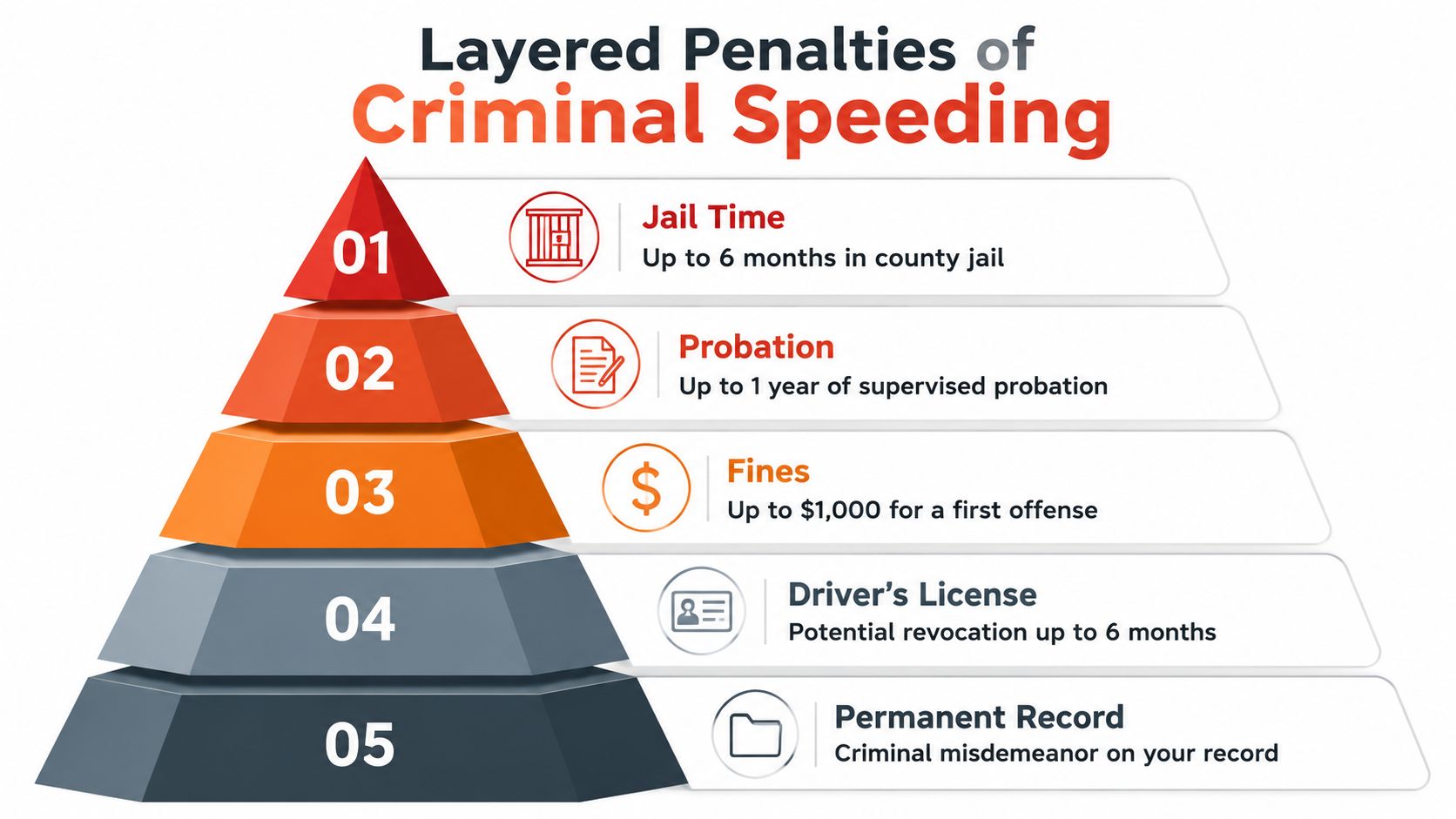
The punishment in a criminal speeding case hits hard from the start. A first reckless-driving misdemeanor can carry up to 90 days in jail under Florida law, along with fines, probation, and court-imposed conditions. If you are driving for work, trying to keep your license clean, or protecting a background check, that charge reaches far beyond the stop itself.
Do not treat this like a simple traffic inconvenience. Once the case is filed, the risk spreads into places drivers miss until it is too late.
The sentence is only part of the bill
A criminal speeding case can leave you with supervised probation, mandatory driving school, and a permanent misdemeanor record that shows up on background checks. Even when the case ends in a result that avoids conviction, you can still be left explaining the arrest or charge later.
Insurance is where a lot of drivers get blindsided. One speeding case can change what your carrier thinks of you, and the question is worth reading further in will insurance go up after a speeding ticket. If you are shopping for ways to limit the fallout, start with tips to reduce auto insurance premiums. Even when a case ends with a withhold, an insurer can still treat the stop as a warning sign.
Practical rule: if you care about your record, do not stop at asking whether the ticket gets dismissed. Find out how the outcome will look to insurance, employers, and Florida licensing authorities.
Collateral damage people forget
Florida's point system can turn one bad stop into a license problem if the charge sticks or if the case is reduced the wrong way. Gig drivers can lose access to work platforms. Commercial drivers can run into qualification problems. Military personnel and veterans can face clearance questions that have nothing to do with whether they were polite at the stop.
A withhold of adjudication helps, but it does not erase the event. It is better than a conviction, yet it can still leave a trail that matters later. For a Florida-specific explanation of offense classification, see Florida-specific explanation of offense classification.
That is why you fight these cases with a plan. You are protecting your license, your income, and the record that employers, insurers, and platform checks will see later.
How Police Measure Speed and Where Their Cases Break
Every criminal speeding case starts with measurement. If the officer cannot prove the speed reliably, the case gets weaker. Florida officers typically rely on radar, lidar, or pacing, and each method has a failure point if the device is used badly or the facts are messy.
Radar is the oldest and most common tool. It can be affected by reflective surfaces, nearby traffic, or a calibration problem. Lidar is more precise in many situations, but it needs a clear line of sight and good aiming. Pacing depends on the officer keeping a steady distance behind your vehicle, which is harder to do than people think on crowded roads.
Why the evidence matters more than the accusation
A citation is an allegation. It is not a verdict. That matters because a lawyer can attack the measurement, the setup, and the paperwork before anyone starts talking about punishment.
Florida defense work often includes pulling the supporting records, asking how the device was used, and checking whether the officer's observation matches the written report. If the story doesn't line up, the case becomes easier to challenge. If you want a technical overview, read how do radar speed guns work.
Bottom line: if the speed reading can't be trusted, the state's whole case gets shaky.
Bodycam footage, dashcam footage, and in-car radar readouts can also matter. Those records can help show where the stop happened, what the traffic looked like, and whether the officer had a clean shot at your vehicle. I do not trust a speeding case until I've seen the evidence that supposedly proves it.
The practical lesson is simple. Don't confess to the number just because the citation says it. The state still has to prove how it got there.
Defenses That Work in Florida Criminal Speeding Cases
The first thing I look at is the charging document. If the officer cited the wrong statute, missed the threshold, or described the wrong zone, that can create a real opening. Florida criminal-speeding cases often turn on whether the state fit the facts into the law it chose.
Next comes the measurement itself. Radar logs, lidar records, and pacing assumptions are all vulnerable. Calibration gaps, operator mistakes, chain-of-custody problems, and sloppy note-taking can all weaken a case. If the officer can't explain the speed reading clearly, the prosecution may be forced to rethink the charge.
Defense angles that actually matter
Challenge the Charging Document: If the statute, threshold, or location is wrong, the case may not be properly charged.
Dispute the Speed Measurement: Radar and lidar have to be used correctly, and pacing has to be believable.
Attack the Zone: School crossings, business districts, and posted-limit distinctions matter in Florida.
Push for Reduction: A lawyer can often negotiate for a lesser traffic offense, traffic-school eligibility, or a withhold of adjudication.
A lawyer-led defense can also focus on intent. Reckless driving requires more than a bad number on a speedometer. If the facts show ordinary haste instead of willful disregard for safety, that difference can matter a lot in court. For a plain-language guide to that process, read how to beat a speeding ticket.
Automated apps and ticket mills can't do any of that work in front of a judge. They can't cross-examine the officer, subpoena calibration records, or push back when the state overreaches. If your case is serious, you need direct attorney access, not a chatbot and a waiting queue.
Why a Lawyer-Led Firm Protects You Differently
A lawyer-led firm changes the experience immediately. You talk to your attorney by phone or text, not a random call-center operator reading from a script. That matters because a criminal speeding case needs judgment, not automation.
Ticket Shield, PLLC handles Florida traffic defense with direct attorney communication and a strategy built around the actual charge, not a template response. In serious traffic matters, that kind of contact matters more than polished intake forms. You need someone who can read the citation, identify the exposure, and decide whether the case should be fought, reduced, or resolved.
What separates real defense from ticket-mill processing
Direct communication: You speak with your attorney, not a middleman.
Courtroom strategy: The response is built around the statute and the evidence.
Clear pricing: The firm uses value-driven pricing, with transparent starting fees.
Statewide reach: Florida drivers in all 67 counties can be represented without having to work through a maze of automated messages.
A good defense also starts with speed. The sooner your lawyer sees the citation, the better the odds of protecting your record, your insurance, and your license. That is especially true when the charge could be handled as reckless driving under Chapter 316 instead of an ordinary traffic infraction.
Practical rule: if the goal is No Points, don't hand your case to a system that can't talk to the officer, the clerk, or the court.
Your Next Move to Keep No Points on Your License
Do not pay the citation yet. Do not assume the court will treat it like a routine ticket. And do not wait until the deadline is staring you in the face before you get legal eyes on the charge.
If the stop involved high speed, a school zone, reckless conduct, or any language that sounds criminal, you need a real defense plan now. The goal is simple, protect the license, control the damage, and keep the case from spilling into your insurance and employment.
Visit TicketShield.com for a free consultation and speak directly with an attorney about a defense built to pursue No Points on your license. No middlemen. No chatbots. No ticket mill shortcuts.