What Is a Criminal Traffic Violation: Penalties & Defense
Charged with a serious offense? Learn what is a criminal traffic violation in Florida. Understand harsh penalties & how a lawyer can protect your record.
A criminal traffic violation is a crime charged through a traffic stop. In Florida, that can mean court, jail exposure, a suspended license, and a record that follows you into job applications, insurance renewals, and professional screening.
You get pulled over on the way to a delivery, a client meeting, or your second shift. A few minutes later, the stop is no longer about a ticket. The officer says criminal citation, mandatory court, misdemeanor, or arrest, and your week changes fast.
That charge can hit long before you ever stand in front of a judge. If you drive for Uber, Lyft, DoorDash, or Instacart, a pending case can threaten your access to work. If you hold a professional license or rely on employer background checks, one bad decision during the stop or one missed court date can create problems that cost far more than any fine. Insurance can spike. Income can stop. Employers and platforms do not wait for your side of the story.
If you're asking what is a criminal traffic violation, the answer is simple. Florida treats it as a crime rather than a civil infraction. That puts you into the criminal system, with prosecutors, court dates, and consequences that can keep showing up after the case feels over.
Many of these cases begin with an ordinary stop for a light, registration issue, or driving behavior. Then the contact expands. More questions. Field sobriety exercises. A vehicle search. A criminal charge. Once that happens, you need a defense strategy from day one, not an app, not an automated form, and not the assumption that paying something online will make it disappear.
Start with the immediate steps in what to do when you get a ticket. Then talk to a lawyer who handles Florida criminal traffic cases and can protect your license, your record, and your ability to keep earning.
Table of Contents
How Is a Criminal Violation Different From an Infraction?
A civil ticket usually costs money. A criminal traffic charge can cost you your record.
That distinction matters because Florida doesn't handle these cases the same way. A civil infraction is usually resolved through a fine, points, traffic school, or a hearing. A criminal traffic charge goes through criminal court and can expose you to jail, probation, and a permanent criminal record.
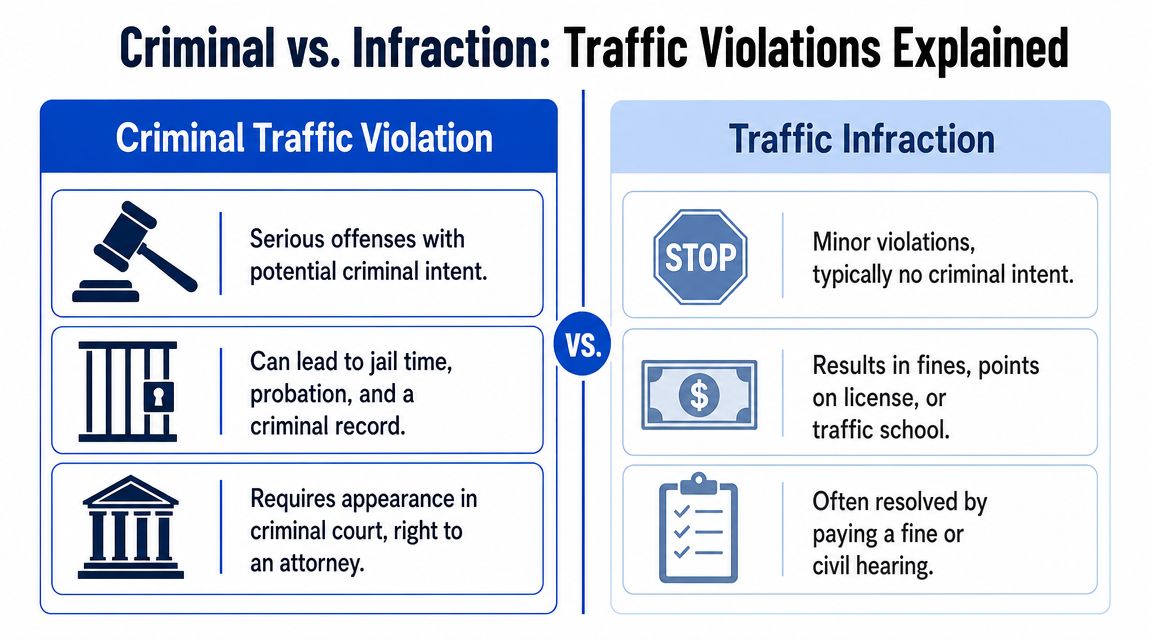
Why the legal standard matters
The biggest legal difference is proof. Criminal traffic violations are classified as misdemeanors or felonies and require proof beyond a reasonable doubt, while civil infractions use a lower standard, described in the cited legal analysis as more likely than not (civil and criminal traffic violations explained).
That isn't technical trivia. It's a significant advantage. It means the prosecutor has a heavier burden, and your defense lawyer has more room to challenge weak evidence, inconsistent officer observations, bad stop procedures, and missing proof.
Practical rule: If the charge can give you a criminal record, never treat it like a payable ticket.
A lot of drivers get into trouble because they confuse a traffic matter with a criminal matter. They think, "I'll just handle this myself." That's exactly how people walk into avoidable convictions.
If you're trying to understand the lower-level side of the system, read what is a traffic infraction. It helps clarify why your case is in a different category altogether.
Civil infraction vs. criminal traffic violation in Florida
Factor | Civil Traffic Infraction | Criminal Traffic Violation |
|---|---|---|
Classification | Non-criminal traffic matter | Misdemeanor or felony |
Burden of proof | Lower civil standard | Beyond a reasonable doubt |
Court process | Often payable or handled in traffic court | Criminal court appearance required |
Possible penalties | Fine, points, traffic school | Jail, probation, fines, suspension, criminal record |
Long-term impact | Driving record consequences | Background check, employment, housing, insurance consequences |
Some drivers also learn the hard way that a minor equipment issue or maintenance problem can start the chain. If you're trying to stay ahead of avoidable stop reasons, basic upkeep matters. Even a simple guide on how often to get car inspected can help you reduce unnecessary exposure to roadside encounters.
A criminal traffic charge isn't serious because the officer sounded serious. It's serious because the law treats you like a criminal defendant, not just a driver with a citation.
What Are Common Criminal Traffic Offenses in Florida?
Florida has several traffic offenses that are crimes from the start. Others become criminal because of what happened during the stop, whether there was an injury, or whether the state claims you knowingly violated the law.
Nationally, criminal traffic violations make up about 10% to 20% of tickets but create outsized consequences, and in Florida a first DUI under Florida Statute 316.193 is a first-degree misdemeanor punishable by up to 1 year in jail and a $1,000 fine, while reckless driving is also a criminal charge (traffic safety review discussing criminal traffic violations).
Reckless driving under Florida Statute 316.192
Reckless driving is one of the most common criminal traffic charges I see mishandled.
Under Florida Statute 316.192, reckless driving is treated as a criminal offense because the state claims you drove with willful or wanton disregard for safety. That usually means the officer alleges more than a simple mistake. Speeding aggressively, weaving, racing behavior, hard lane changes, or driving that allegedly endangered others can trigger it.
Florida-specific material in the verified data states reckless driving under Statute 316.192 is a criminal misdemeanor with up to 90 days jail and a 6-month suspension in Florida, and many drivers charged with it need the case reduced out of the criminal category. If that's your charge, read what is reckless driving in Florida.
DUI under Florida Statute 316.193
A DUI charge changes your life fast.
You might have been stopped for drifting, speed, a taillight, or an expired registration. Minutes later, you're outside the car answering questions and performing exercises on the roadside. Then the case becomes criminal. Under Florida Statute 316.193, DUI is not a traffic inconvenience. It's a misdemeanor or, in some cases, a felony.
The issue isn't only the possible sentence. It's also the record, the license consequences, the insurance shock, and the professional fallout that follows a conviction.
DWLS and leaving the scene
Some charges catch people off guard because they don't "feel" criminal.
Driving while license suspended can become criminal when the state claims you knew about the suspension. Leaving the scene of a crash, commonly called hit and run, is another charge people underestimate. They panic, leave, and only later realize the state may treat that decision as a crime instead of a simple traffic error.
Vehicular homicide is an even more severe example. Verified legal analysis identifies Florida Statute 782.071 as a felony-level traffic-related offense involving reckless driving causing death. That's far beyond a ticket. It's a life-changing criminal prosecution.
If the officer charged you with DUI, reckless driving, DWLS, or leaving the scene, stop thinking in terms of "ticket defense." Start thinking in terms of record protection.
What Are the Penalties and Hidden Consequences?
The court penalty is only the first hit. The lasting damage often starts after the hearing is over.
A criminal traffic conviction can put points on your record, suspend your license, and leave you carrying a criminal history that doesn't disappear when you pay the case off. That record can follow you into job applications, apartment screenings, security reviews, and insurance renewals.

The punishment you see in court
A criminal traffic case can bring jail, probation, fines, mandatory court appearances, and license consequences. If you miss court, the problem usually gets worse, not better. Verified data notes that failure to appear can trigger an arrest warrant and automatic license suspension under Florida clerk guidance discussed in the cited legal analysis.
For sentencing exposure, the details matter. DUI, reckless driving, and crash-related charges all carry different risks depending on injury, prior history, and how the prosecutor files the case. But the unifying point is simple. This is not payable paper.
Some drivers would rather pay quickly and move on. In a criminal traffic case, that can be the decision that creates the longest damage.
The fallout that hits after court
The verified data is blunt on this point. A criminal traffic conviction can add points to your driving record. Reckless driving adds 4 points, and insurance premiums can rise by over $1,000 annually. For gig drivers, a single conviction can trigger immediate deactivation from platforms like Uber and Lyft (civil vs. criminal ticket consequences).
That matters even more if driving is how you pay rent.
If you drive for Uber, Lyft, DoorDash, or similar platforms, the problem isn't just the courtroom. The problem is interruption of income. Verified data also highlights Florida gig workers as an underserved group because a single criminal ticket can threaten account access and destabilize work immediately. Professionals with employer driving requirements face the same kind of pressure. Military personnel can also face clearance problems when a criminal record enters the picture.
If you're concerned about hiring screens, read do traffic tickets show up on background checks. That's where many people realize the case has a much longer tail than they expected.
Here’s a short explanation of why you have to think beyond the court date:
Professional and financial damage happens fast
For a busy professional, one conviction can trigger internal reporting requirements, higher insurance costs, and pressure from an employer who doesn't want risk on the road.
For a gig worker, the timeline is harsher. You may be deactivated before your case is fully resolved. That's why the goal in many cases isn't just "less punishment." The goal is to avoid a criminal disposition if the facts and law give your lawyer room to fight for a reduction or dismissal.
What Is the Criminal Process and How Do You Fight Back?
You get pulled over on the way to work, or between app deliveries, and by the end of the stop you are holding paperwork that puts you in criminal court. That is when the true risk starts. A criminal traffic case can disrupt your job, your license, your insurance, and your schedule long before a judge decides anything.
For drivers in Miami-Dade, the process often begins at the Richard E. Gerstein Justice Building. The setting is formal because the stakes are real. A careless plea, a missed court date, or a bad statement to law enforcement can hand the prosecutor evidence and limit your options early.

As noted earlier, Florida treats criminal traffic charges differently from ordinary tickets because they can carry jail exposure and a permanent criminal record. Charges such as DUI or reckless driving are prosecuted in criminal court. That changes how you should respond from the first day.
What usually happens after the stop
The process usually follows this path:
The stop or arrest. The officer claims a legal reason for the stop and builds the criminal allegation from what he says he observed, what you said, and any testing or search that followed.
Booking or release on a notice to appear. Some drivers are taken to jail. Others are released with paperwork ordering them into criminal court.
Arraignment. This is the first formal court date. The charge is announced and a plea is entered.
Pretrial proceedings. Your lawyer gets the evidence, reviews body camera footage, examines reports, files motions, and pressures the state where the case is weak.
Resolution or trial. A good case may be reduced, diverted, or dismissed. A bad offer should be rejected and prepared for trial.
Where the defense actually starts
Your defense starts before the first courtroom argument. It starts with shutting up and preserving facts.
A lawyer needs to examine whether the stop was legal, whether the officer's observations match the video, whether any search was lawful, whether testing was done correctly, and whether the state can prove every element of the charge. In Florida, that often means close review of statutes in Chapter 316, including 316.192 for reckless driving and 316.193 for DUI. If the state cannot prove a required element, the charge should be challenged hard.
This matters even more if you drive for income. A weak criminal case can still wreck your week if you handle it badly. Court dates interfere with routes, shifts, client meetings, and employer reporting rules. A lawyer-led defense looks at the whole problem early, not just the next hearing date.
The smartest early move is simple. Say as little as possible to the officer, then get a lawyer involved fast.
Immediate steps to take
Stop discussing the facts. Do not explain what happened to police, coworkers, passengers, or your employer in texts or emails.
Calendar every deadline. Court dates, license issues, and any compliance requirements can move fast.
Save every paper and digital record. Keep the citation, bond documents, tow paperwork, crash exchange form, and any notice affecting your license.
Write down your timeline now. Note where you were, what the officer said, what you were asked to do, who was present, and what happened in what order.
Get a lawyer to review the charge immediately. Automated reminders and generic advice will not spot a bad stop, a flawed affidavit, or a defense worth pressing. A lawyer will.
Why Is a Lawyer Your First and Most Important Call?
You get charged on the way to work. By lunch, you are wondering whether you will miss shifts, lose app access, trigger an employer report, or end up with a record that follows you long after court is over. That is the moment to call a lawyer.
Criminal traffic charges create pressure outside the courthouse fast. Gig drivers can lose delivery or rideshare income while the case is still new. Nurses, contractors, CDL holders, military personnel, and licensed professionals can run into reporting problems, scheduling conflicts, and hard questions from employers or insurers. Delay makes all of it worse.
A lawyer’s job starts before the first hearing. Your lawyer reads the charging document closely, checks the statute, looks for defects, and gives you direct answers about what to do next. That matters when you need real guidance on appearance requirements, license exposure, work risks, and whether the case should be challenged, negotiated, or prepared for trial.
For drivers comparing options, traffic ticket lawyers handling Florida criminal traffic cases should offer legal analysis, strategy, and direct attorney communication. Ticket Shield, PLLC handles these cases statewide, and the firm states that clients communicate directly with their attorney by phone or text rather than through an automated app or intake layer.
Efficiency still matters. If you are driving for income or trying to keep a professional license clean, every unnecessary court date costs money, time, and control. The main reason to hire counsel, though, is legal protection. You want a defense aimed at the result that protects your future: avoiding points where possible, avoiding a criminal record where possible, and avoiding a rushed plea that creates bigger problems with work, insurance, or background checks.
Treat the charge like a threat to your record and your paycheck now. Quick, lawyer-led action gives you the best chance to contain the damage before the case starts making decisions for you.
If you want a No Points strategy and a direct review of your Florida criminal traffic charge, visit Ticket Shield, PLLC for a free consultation.