
Stop Sign Video Guide to Fight Your Florida Ticket
Learn how stop sign video from dashcams and cameras is used in Florida cases, how to preserve it, and how to fight your ticket to protect your record.

You're leaving a Florida stop-sign intersection when an officer pulls you over. You remember stopping, but the officer says your wheels never fully stopped or that you entered before yielding. A citation follows, and now a short dashcam clip, patrol recording, or traffic camera video may determine whether the case rests on competing memories or objective evidence.
Don't assume any video automatically clears you. A persuasive clip must show the legally relevant sequence, preserve its original context, and answer both parts of the Florida rule. The practical question isn't whether a camera captured your car. It's whether the footage proves where you stopped, whether you stopped completely, and whether you yielded before entering or crossing the intersection.
Table of Contents
Why Your Stop Sign Video Can Make or Break Your Florida Case
Protect Your License and Pursue No Points With Ticket Shield
Why Your Stop Sign Video Can Make or Break Your Florida Case
A stop-sign citation often develops in seconds. You approach the sign, brake quickly, stop near the line, check traffic, and proceed. From the driver's seat, the maneuver feels complete. From an officer's angle, a tree, another vehicle, the signpost, or the slope of the road may make the stop look different.
That difference matters because stop-sign violations are a high-volume safety issue, not an unusual roadside dispute. A major U.S. study identified nearly 700,000 police-reported motor-vehicle crashes annually at stop signs, with about one-third involving injuries, and reported that stop-sign violations accounted for about 70% of crashes at stop signs (the national stop-sign crash study). A citation may begin with one brief maneuver, but its legal consequences can reach your driving record and insurance situation.
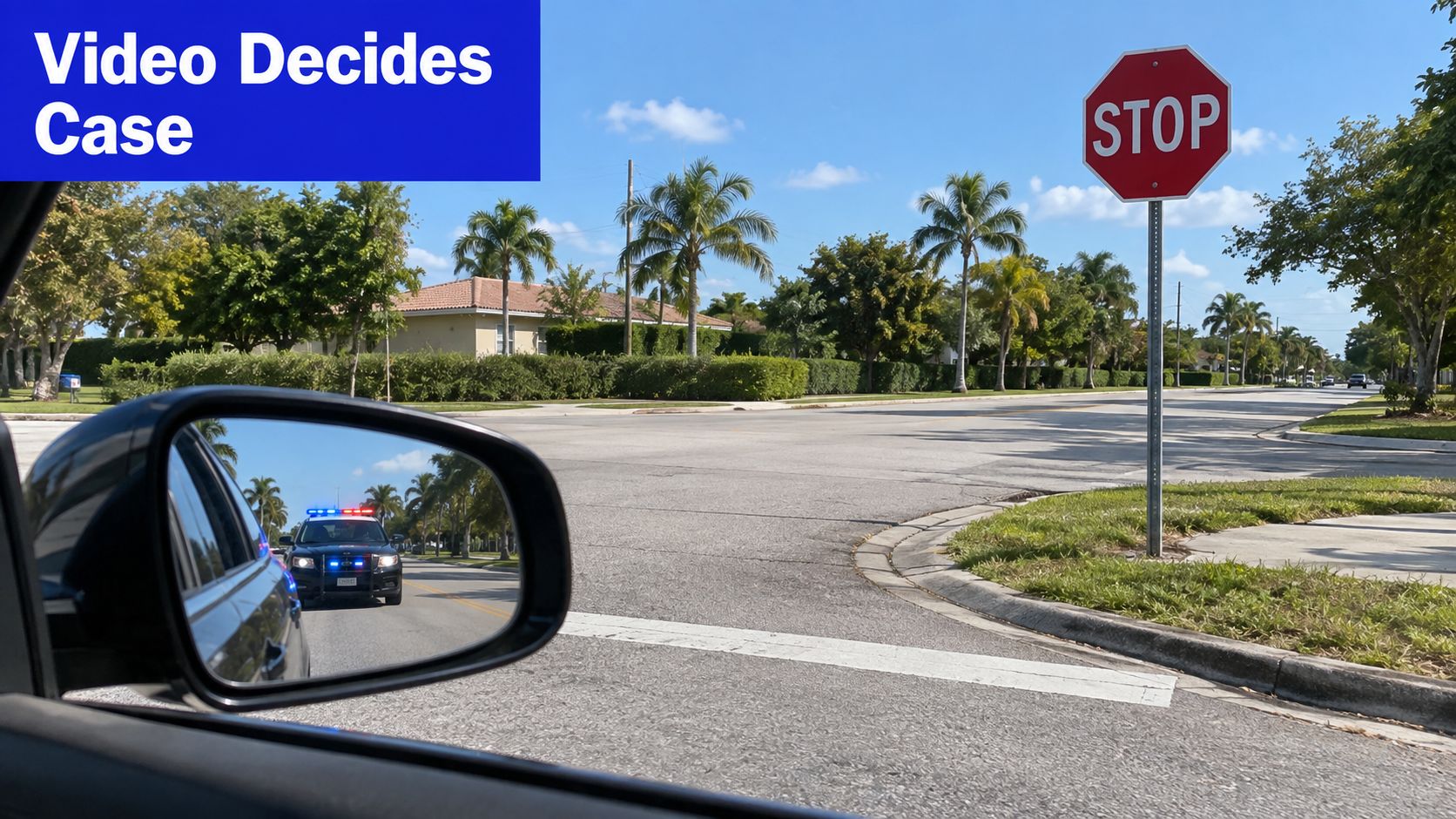
The footage must answer the right questions
Your video can help when it shows the entire event rather than a convenient freeze-frame. A reviewer should be able to identify:
Your vehicle: The clip should make clear which car is involved.
The stopping point: The line, crosswalk, or intersection entrance should be visible.
Vehicle movement: The footage should show braking, complete cessation, and movement afterward.
Traffic conditions: The viewer should see vehicles that may have affected your duty to yield.
Camera perspective: The angle should explain what the driver and officer could see.
The difference between suggestive and persuasive evidence is context. A single image of your car beside a stop sign may show location, but it may not show whether the wheels stopped before the required point. A sequence can show the approach, the stop, the position of the vehicle, and the decision to proceed.
Protective rule: Never send only the clip that makes you look favorable. Preserve the complete event first, then let counsel decide what portion should be presented.
Florida drivers also face a legal classification that deserves attention. A violation of Florida Statute §316.123 is a noncriminal traffic infraction punishable as a moving violation under Chapter 318, as reflected in the statute summary (Florida Statute §316.123 classification). That isn't a parking-style issue. It can affect your license record and the way an insurer evaluates your driving history.
A direct review with a Florida traffic defense lawyer is more useful than uploading a clip to an automated app and accepting a generic response. A lawyer can compare the video with the citation, officer notes, scene layout, and applicable statute before deciding whether the evidence supports dismissal, negotiation, or a hearing strategy.
What Florida Law Requires at a Stop Sign Intersection
Florida Statute §316.123 supplies the governing rule. When a stop sign controls an intersection, you must stop at the clearly marked stop line. If there's no stop line, you must stop before entering the crosswalk. If there's neither a stop line nor a crosswalk, you must stop at the point nearest the intersecting roadway where you can see approaching traffic before entering the intersection (Florida's Chapter 316 statutes).
That sequence gives you a practical way to review your own stop sign video. Don't ask only, “Did I slow down?” Ask, “Where did my vehicle stop in relation to the legally required stopping point?”

Match the video to the stopping hierarchy
Use the video to identify the applicable stopping location:
A marked line controls first. If the line is visible, determine whether the front of your vehicle stopped before it. A clip that shows your wheels, bumper, and line together is particularly useful.
A crosswalk controls when no line exists. The video should show whether you stopped before entering that marked pedestrian area.
The intersection entrance controls when neither marking exists. Look for the nearest point where you could see approaching traffic without entering the intersection.
A complete stop is required. Rolling slowly isn't the same as stopping. The footage should show the vehicle come to a full cessation before proceeding.
The duty continues after the stop. Section 316.123 requires you to yield the right-of-way to a vehicle already in the intersection or to a vehicle approaching closely enough to create an immediate hazard while you move across or within the intersection (Florida's post-stop yielding rule).
Review both the stop and the yield
Create two timestamps in your notes. The first should identify the moment your vehicle fully stopped and its position relative to the line or crosswalk. The second should identify when you proceeded and what traffic was present.
That distinction can expose a weak assumption in the citation. An officer may focus on the apparent stop while the footage shows a full stop followed by a lawful yield. Or the clip may show a complete stop but reveal that the vehicle proceeded into an immediate hazard. Don't argue one part while ignoring the other.
A plain-language explanation of Florida stop-sign requirements can help you understand the rule, but it can't replace a review of the actual footage and intersection geometry. The legal analysis depends on what the video captures and what it fails to capture.
How Dashcam and Traffic Camera Footage Is Really Judged
Stop sign video should be judged as a continuous event, not as a single frame. A frame may show the sign, your vehicle, or the stop line, but it usually can't establish motion, complete cessation, or the timing of your yield by itself.
One published U.S. dashcam method treated the problem as a sequence-level video pipeline. Trained on 8,931 dashcam videos, it reported an area under the precision-recall curve of 94% and processed a full 16-second video in 2.4 seconds on CPU (the published dashcam video method). The practical lesson is clear. A useful system needs temporal context, because the suspected violation emerges from motion before and after the sign.
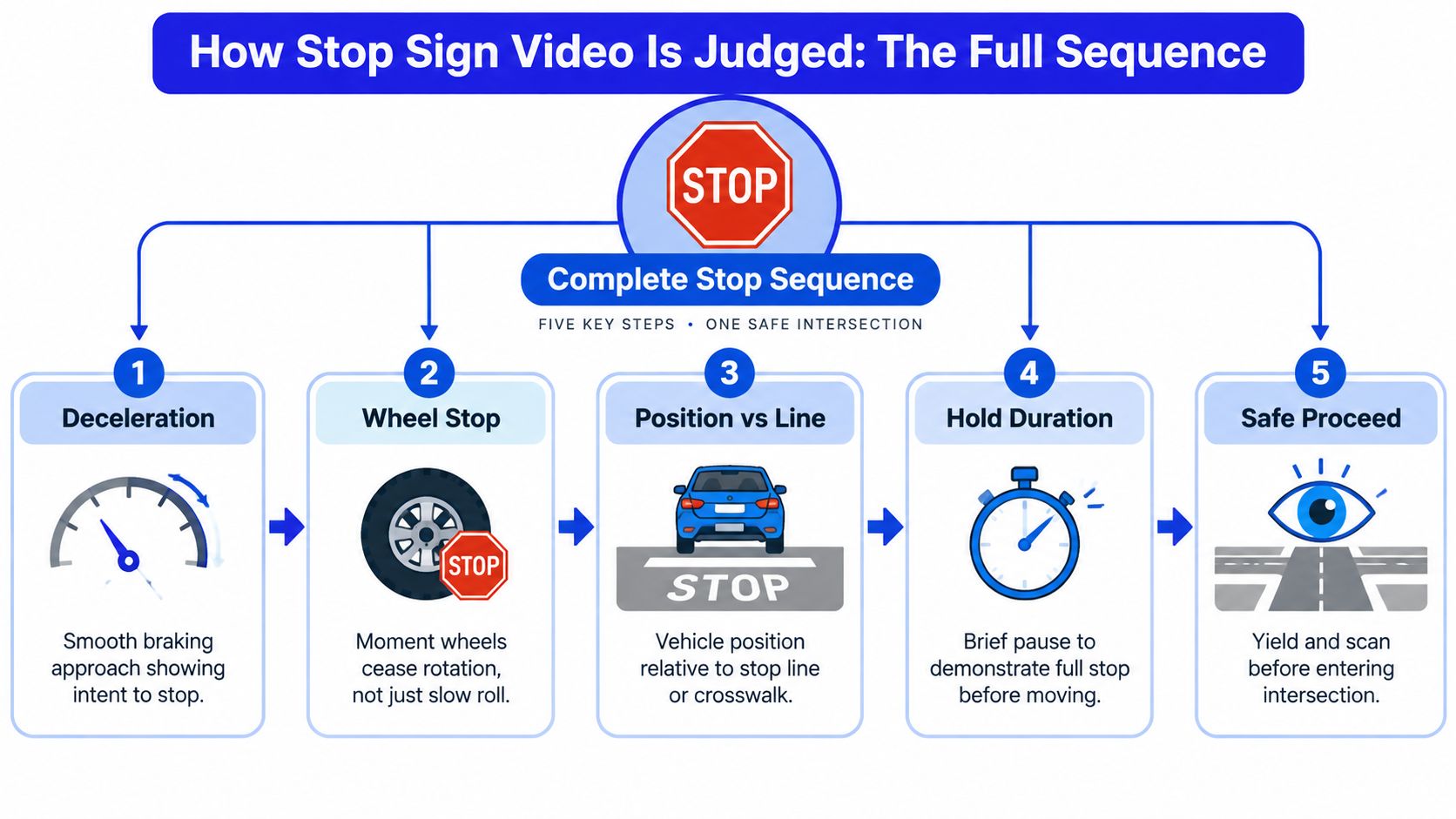
Look for the complete maneuver
A strong review follows the vehicle through five connected moments:
Approach: Does the vehicle decelerate as it reaches the sign?
Wheel stop: Does the vehicle stop completely, rather than continue creeping?
Position: Is the vehicle before the line, crosswalk, or proper intersection point?
Pause: Does the clip show a meaningful stop before movement resumes?
Proceeding: Does the driver scan and yield before entering?
The sign itself may be partially hidden, distant, or visible only briefly. That doesn't automatically defeat the video. A clip may still show the intersection layout and vehicle behavior clearly enough to establish what happened.
Separate frame noise from event evidence
Traffic-sign evaluations demonstrate why raw frame counts can mislead. In one real-world evaluation, stop signs produced 67 true positives, 795 false positives, and 426 misses across 537 processed frames, with a per-frame detection rate of 13.59% and 1.41 false positives per frame, while the reported per-sign detection rate was 100% (the traffic-sign video evaluation). Those figures show that a system can appear noisy at the frame level while still identifying the sign event.
For your case, that means you shouldn't measure the clip by asking whether every frame is perfect. Ask whether the full event clearly establishes the vehicle, stopping point, movement, and surrounding traffic. Event-level clarity matters more than isolated-frame perfection.
Common weaknesses include:
Occlusion: A parked vehicle or vegetation hides the line or front wheels.
Distance: The camera angle makes the stopping position impossible to identify.
Lighting: Glare, darkness, or shadows obscure markings and motion.
Brief visibility: The sign appears, disappears, and never establishes the intersection context.
Missing continuity: The clip begins after braking or ends before the vehicle proceeds.
An automated flag is not a legal conclusion. It's a screening result. Human review still needs to determine whether the footage proves the elements that matter under Florida law.
How to Capture and Preserve Admissible Stop Sign Video
Preservation begins immediately. Dashcams commonly record in loops, so new driving can overwrite the relevant file. Traffic-camera footage may also be retained under an agency's system rather than on your device. If you wait, you may lose the original sequence or make it harder to establish what the file contained when you received it.
Lock the complete event
Use this workflow:
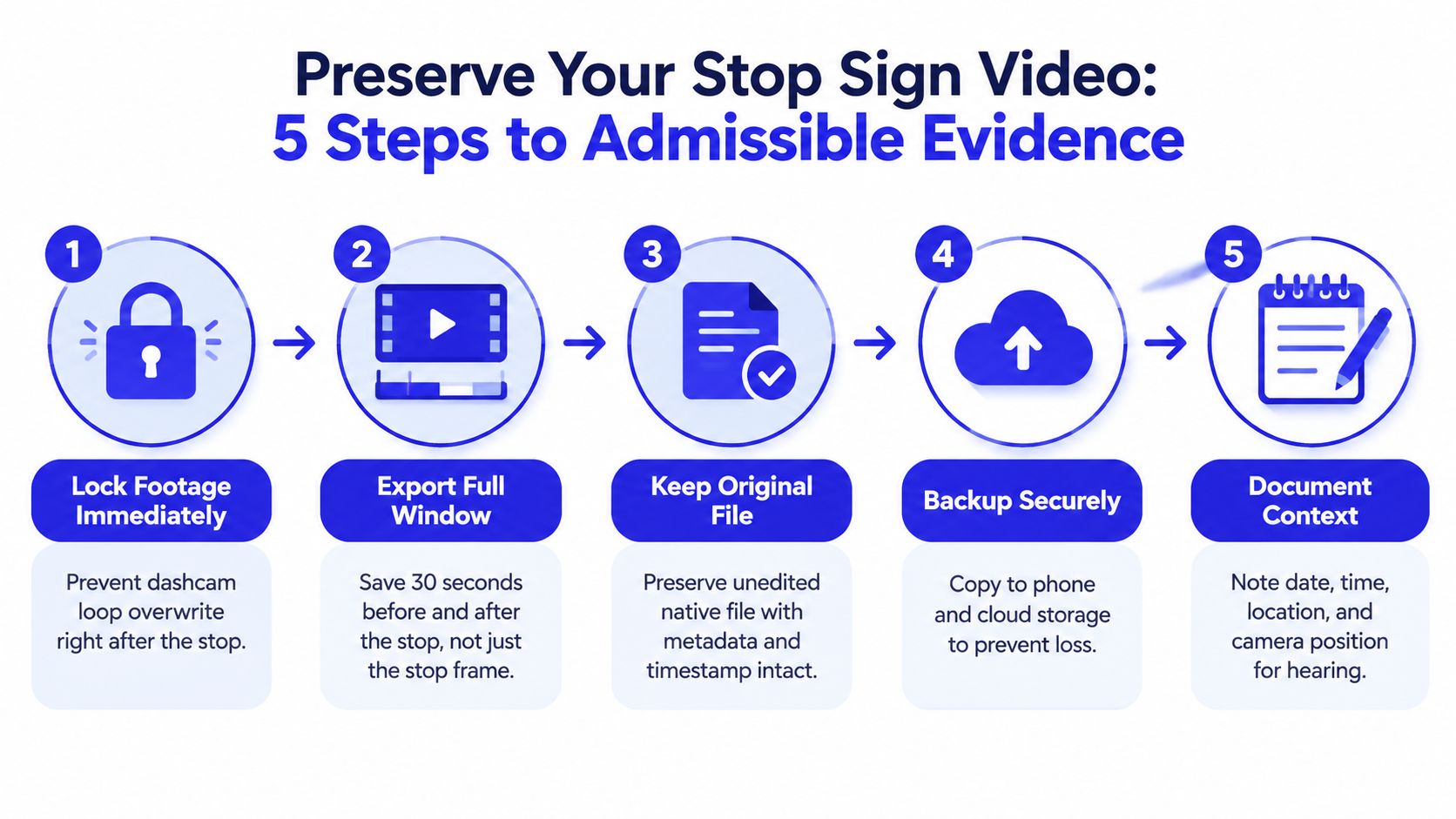
Lock the file immediately. Protect the dashcam recording from loop overwrite. Don't edit it in the camera app.
Export the full event window. Save the approach and departure, not merely the instant beside the sign. The provided preservation graphic recommends retaining surrounding context rather than a trimmed snippet.
Keep the native original. Preserve the original file, timestamp, metadata, and file name. Make a working copy for viewing.
Back it up securely. Store a duplicate in another location, such as secure cloud storage or a separate device.
Write down the context. Record the date, time, location, direction of travel, camera position, and how you obtained the footage.
Don't add filters, captions, music, speed changes, or color correction to the original. Don't re-encode it merely to make it easier to send. Those actions may alter information that a lawyer, court, or opposing reviewer needs to assess.
Document what the camera could see
Take separate photographs of the intersection from the driver's approach. Capture the stop sign, pavement markings, crosswalk, sight lines, nearby obstructions, and camera position. Don't rely on memory to explain why a line was difficult to see or why approaching traffic appeared late.
A practical preserving digital evidence guide can help you organize file copies, notes, and documentation without altering the original. Your lawyer can then determine which materials matter and which should stay out of the presentation.
The same approach applies when the footage comes from a government traffic camera. Request the full recording, not only a selected excerpt, and preserve the communication showing when and how you requested it. A guide to Florida traffic camera footage can help you identify the types of records worth asking about.
Here is a practical test: could another person understand the clip without your narration? If not, preserve additional angles, photographs, and notes. A video that needs a long explanation may still help, but the unexplained gaps become part of the defense problem.
How to Use Stop Sign Video to Fight Your Ticket in Florida
Don't begin by sending the video to the agency or posting it online. Begin with a legal review. Your objective is to connect each part of the footage to the exact allegation and then identify what the clip proves, what it disproves, and what it cannot establish.
Build a short evidence map:
Question | What to identify in the footage |
|---|---|
Did you stop where required? | The line, crosswalk, or nearest lawful stopping point |
Did your vehicle fully stop? | Deceleration followed by complete cessation |
Did you yield? | Traffic already present or approaching closely enough to create an immediate hazard |
Can the viewer trust the sequence? | Original file, continuous context, clear camera perspective |
Challenge the officer's perspective
Your defense may focus on visibility rather than accusing the officer of dishonesty. Compare the officer's stated location with the camera's angle. Identify whether another vehicle, signpost, landscaping, darkness, rain, glare, or road curvature blocked the view. If the officer saw only part of the maneuver, the complete clip may create reasonable doubt about the observation.
Request and review the available materials through proper Florida procedures. That may include the citation, officer notes, patrol video, body-worn camera footage, and relevant intersection footage. Your own dashcam can become far more persuasive when counsel compares it with the state's evidence instead of presenting it in isolation.
Present the clip without overclaiming
A clean presentation is stronger than an emotional one. Don't say, “The video proves everything,” if the line is partially hidden. Identify the precise point the footage establishes, such as a complete stop before the visible crosswalk, and acknowledge any limitation.
Direct lawyer access matters. Ticket Shield, PLLC uses a lawyer-led model in which clients can communicate directly with their attorney by phone or text, rather than relying on middlemen, corporate answering services, or automated chatbots. That lets counsel ask focused questions about the file, the intersection, and the defense instead of routing your evidence through a ticket mill workflow.
A Florida stop-sign dismissal strategy should be built around the actual record. Don't make admissions in messages, alter the file, or contact the officer to argue your version. Preserve the evidence, meet every deadline, and let counsel decide whether a hearing, negotiation, or another response best protects your license.
Protect Your License and Pursue No Points With Ticket Shield
Your stop sign video is only useful if you protect it quickly and evaluate it under Florida law. The key issues are specific: where the vehicle stopped, whether it came to a complete stop, and whether the driver yielded before moving through the intersection.
A citation under §316.123 is a noncriminal traffic infraction treated as a moving violation under Chapter 318 (the classification of a Florida stop-sign violation). That makes the defense decision important even when the traffic stop felt minor. Review the likely license consequences in this Florida stop-sign points guide, then act before footage is overwritten or deadlines pass.
Ticket Shield, PLLC offers lawyer-led Florida traffic defense with direct attorney communication by phone or text. The firm can review your stop sign video, compare it with the citation and available records, and pursue a strategy focused on dismissal, reduced penalties, and No Points on your license.
Visit Ticket Shield, PLLC for a free consultation about your Florida stop sign video. Get direct lawyer review focused on protecting your license and pursuing the ultimate goal, “No Points” on your license.

