Breathalyzer Test Accuracy: A Florida Driver's Defense
Worried about breathalyzer test accuracy in a Florida DUI? Learn how these devices fail and how our attorneys challenge flawed results to protect your record.

Breathalyzer tests can be wrong, and in Florida they can be challenged. A breath result is not a conviction. The machine estimates alcohol using assumptions, and your defense starts by attacking the science, the officer's procedure, and the legal foundation of the test.
You were likely scared, frustrated, and exhausted when the officer handed you the paperwork. Maybe you blew over the limit. Maybe you thought one reading settled everything. It doesn't.
A DUI case built on a breath test is still a case that can be fought. In Florida, these prosecutions depend on a machine, an operator, and a procedure. If any part breaks, the state's evidence gets weaker fast.
You also need to move quickly. Your license, your record, and your advantage all depend on early action. If you're already dealing with the fallout, start by understanding Florida implied consent law and then focus on the part most drivers miss. Breathalyzer test accuracy is a legal issue, not just a scientific one.
Table of Contents
Your Guide to Challenging Breathalyzer Results in Florida
A breath test number looks powerful because the state wants it to look final. It isn't final. It is one piece of evidence, and often a vulnerable one.
If you're staring at a DUI charge right now, your first job is to stop assuming the machine got it right. Your second job is to treat the case like a technical fight. That means reviewing the stop, the officer's observations, the timing, the breath procedure, the maintenance history, and the legal paperwork that supports the machine.
Practical rule: A bad breath result doesn't end your case. It tells your lawyer where to start digging.
Florida DUI cases often move through serious courthouses with serious consequences, from the Richard E. Gerstein Justice Building in Miami to the Orange County Courthouse in Orlando. But the pressure of the setting doesn't change the basic truth. The government still has to prove the breath test was collected and admitted the right way.
Why drivers lose ground early
Many people make the same mistakes in the first day or two after arrest:
They trust the printout: They assume a machine reading can't be challenged.
They forget details: They don't write down when they last ate, used mouthwash, burped, coughed, or spoke with the officer.
They hire the wrong help: They end up in automated apps or ticket mills where they never speak directly to the lawyer handling the case.
That last mistake matters. A DUI charge isn't a parking issue and it isn't a speeding ticket with extra paperwork. You need a lawyer-led defense. You need direct access to your attorney by phone or text. You don't need a middleman or chatbot relaying your facts badly.
What a real defense looks like
A real defense starts with a blunt question. Why should anyone trust this machine in your case? If the answer depends on assumptions, shortcuts, or sloppy procedure, the result can be attacked.
That is how experienced Florida DUI defense works. Not with slogans. With records, motions, cross-examination, and a plan.
How Do Breathalyzers Actually Work in Florida
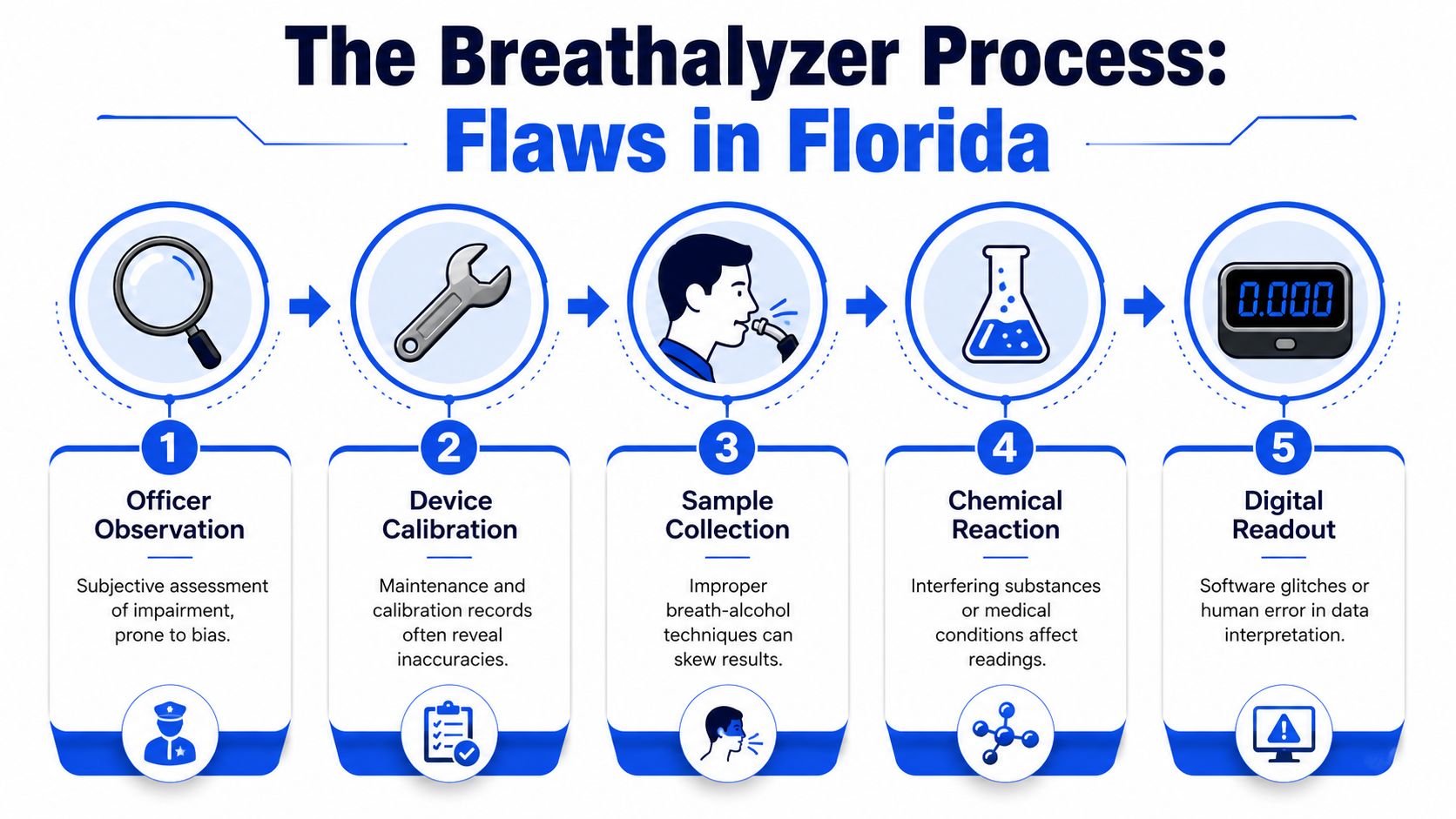
A breathalyzer doesn't draw your blood. It doesn't directly measure alcohol in your bloodstream. It takes your breath sample and uses a legal formula to estimate what your blood alcohol level might be.
Why the machine is estimating, not measuring
Under Florida Statute § 316.1932(1)(b), a legally valid breath-alcohol level must be calculated as grams of alcohol per 210 liters of breath. That is a fixed legal ratio. It is not a direct blood measurement.
This matters more than most drivers realize. The machine is built on a legal assumption about the relationship between alcohol in your breath and alcohol in your blood. Human bodies don't all behave the same way. Body chemistry, breath temperature, and physiology can affect that conversion.
The breath machine is not reporting what is inside your blood. It is reporting what the device inferred from your breath.
Why that matters in a Florida DUI case
If a case depends on an estimate, the defense attacks the estimate. That is where breathalyzer test accuracy becomes central.
A Florida prosecutor may present the reading as clean and objective. A defense lawyer sees multiple places where that number can drift. The officer has to obtain the sample correctly. The machine has to function correctly. The operator has to follow approved procedure. The reading has to reflect deep lung air rather than contamination. The state then has to lay the legal foundation to admit it.
The key weakness built into the process
The machine assumes the sample represents the right kind of breath and the right biological conditions. If it doesn't, the output may look precise while being wrong.
That is why the defense never treats the result as sacred. We treat it like any other state evidence. We test it. We challenge it. We look for the gap between what the machine printed and what happened on the roadside or in the breath room.
What the state hopes you won't question
The state benefits when drivers think the number speaks for itself. It doesn't. A machine can only process the sample it receives and the assumptions it was programmed to use.
In court, that distinction matters. If the reading came from a flawed estimate or a contaminated sample, the number becomes much less persuasive.
What Causes a Breathalyzer Test to Be Wrong
A breath test can be wrong for reasons that have nothing to do with actual impairment. Some errors come from contamination. Others come from your body. Others come from the environment around you.
Mouth alcohol can spike a result
One of the biggest problems is mouth alcohol. Breath machines are supposed to measure deep lung air, not alcohol lingering in the mouth or throat.
The presence of mouth alcohol from recent use of mouthwash, breath fresheners, or even asthma inhalers can skew results upward significantly. Medical News Today's overview of breath testing notes that Listerine contains 26.9% alcohol and can increase readings for between 5 and 10 minutes, with detectable effects lasting up to 18 minutes after use.
That means a reading can reflect residue, not true blood alcohol.
If you used mouthwash, had reflux, burped, or regurgitated before the test, your lawyer should treat that as a serious defense issue.
Medical conditions and environmental fumes can trigger false positives
Some drivers get hit by a second category of error. The machine may react to substances that aren't beverage alcohol in the ordinary sense.
The documented problems include acid reflux, diabetes, and high-protein diets. Those conditions can produce compounds that a breath device may mistake for ethanol. The same concern applies to environmental exposure. Gasoline fumes, paint, lacquer, paint remover, and cleaning solvents can interfere with readings, especially if the testing conditions were sloppy or the defense doesn't force the issue.
Older models are more vulnerable to interfering compounds, while newer infrared and electrochemical devices are designed to reduce that problem, as summarized in the Breathalyzer reference overview. That doesn't mean the problem disappears. It means the defense has to identify what device was used and how it was maintained.
Common Sources of Breathalyzer Inaccuracy
Error Source | How It Inflates Your Reading | Potential Defense Angle |
|---|---|---|
Mouthwash or breath spray | Leaves residual alcohol in the mouth | Attack observation period and contamination risk |
Asthma inhaler | Can leave substances that affect the sample | Question whether the officer asked about recent use |
Acid reflux or regurgitation | Brings alcohol vapor from the stomach into the mouth | Argue the sample was not true deep lung air |
Diabetes or high-protein diet | May create compounds that distort the reading | Present medical history and expert testimony |
Gasoline, paint, or cleaning fumes | Interfering compounds can affect sensor response | Investigate recent environmental exposure |
Elevated body or breath temperature | Can increase measured breath alcohol | Challenge the assumption that the legal ratio fit your body |
Why this matters to your defense
A breath number can look clean on paper while being dirty in reality. The machine can't tell the difference between a biologically fair sample and a compromised one unless the procedure and surrounding facts are examined carefully.
That is why your medical history, your recent activities, and even your surroundings matter. A defense lawyer should ask what you ate, what you drank, whether you used mouthwash, whether you have reflux, whether you were sick, and whether you had been around fumes. Those aren't side issues. They go straight to the reliability of the reading.
How Reliable Are Police Breathalyzers in the Real World
Police breath test evidence is only as trustworthy as the technology, the sample, and the procedure. In real life, that combination is less stable than commonly believed.
The data shows wide variation
A 2014 NIH diagnostic accuracy study found huge differences among consumer breathalyzer devices. One single-use device, the Dräger Alco-Check, reached 94.7% sensitivity, while another single-use device, the Alcosense Single, showed only 26.3% sensitivity. The study's report is available through the National Institutes of Health archive.
That low-sensitivity result matters because it shows how badly breath testing technology can vary. According to the same study, that device gave false reassurance to nearly one in four people who were over the legal limit.
I don't cite that study to say a police machine equals a convenience-store gadget. I cite it because it destroys blind faith in breath technology. If one breath device can perform that badly, no defense lawyer should accept any machine result without demanding records and context.
A related issue appears in field evaluations. If you're also dealing with roadside observations, review field sobriety test accuracy with the same skepticism. Officers often stack subjective observations on top of a machine reading and call that certainty. It isn't certainty.
Real world conditions make accuracy worse
Even when a breath device classifies drivers into similar categories at a high rate, real-world conditions still distort outcomes. Humidity, temperature, body temperature, and mouth alcohol can all change the reading. Research summarized earlier in this article also notes that at-home devices can underestimate peak blood alcohol, while some conditions can lead to overreporting.
Here is a useful breakdown of the problem:
Why police-grade doesn't mean infallible
Police machines are regulated. That helps. It does not make them immune from operator mistakes, bad samples, or legal defects in the way the evidence is introduced.
Courts don't convict machines. Courts admit evidence offered by people. If the people failed to follow the rules, the machine's number can be weakened or excluded.
That is the right mindset. Respect the evidence, but don't surrender to it.
How We Challenge Breath Test Results in Florida Courts
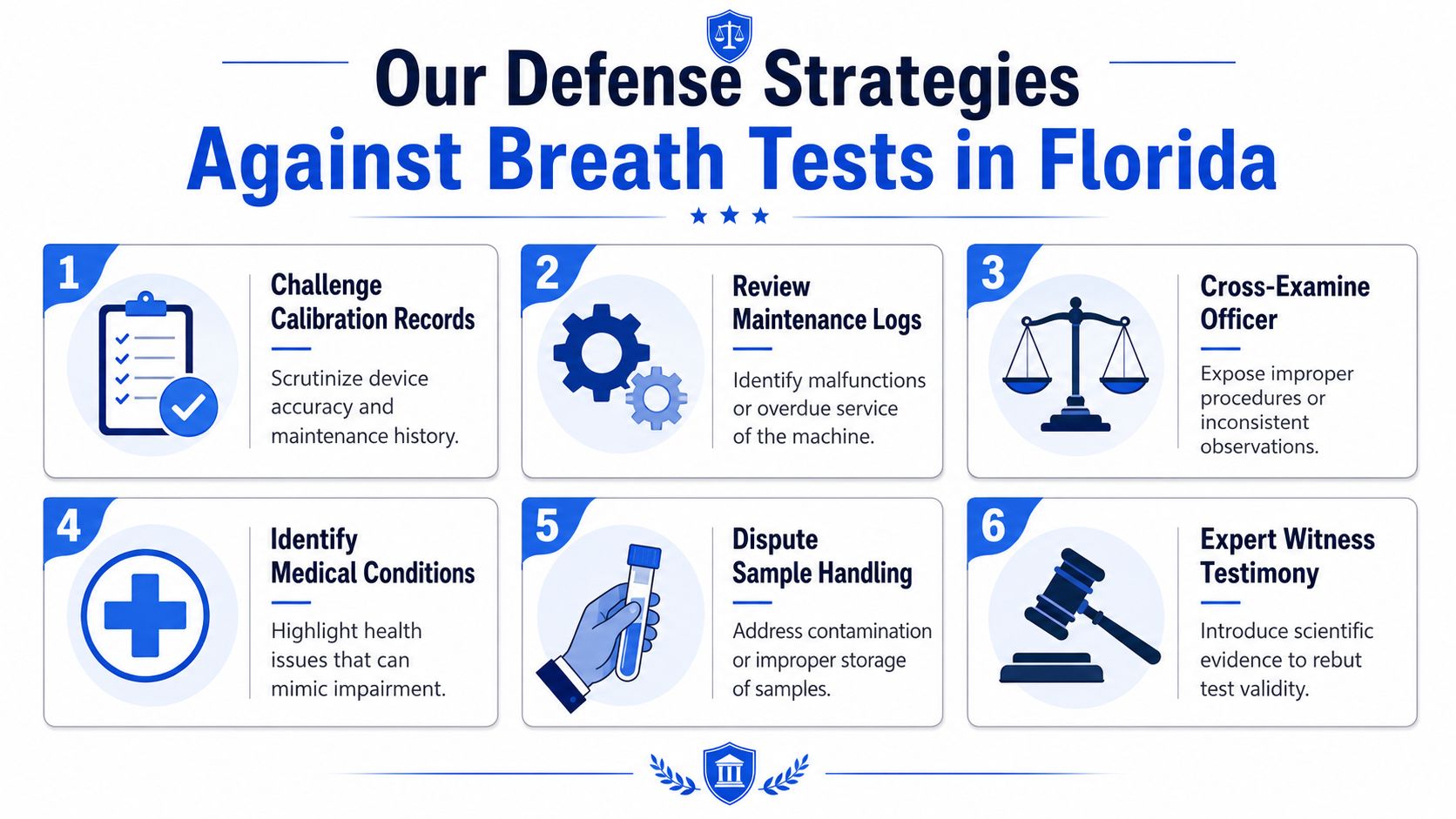
Breath test cases are won by forcing the state to prove every technical requirement. If they skip one, we press on it. Hard.
At the Edgecomb Courthouse in Tampa and in courtrooms across Florida, the fight usually starts with the same question. Was this breath test legally valid under Chapter 316?
The statute gives us pressure points
Under Florida Statute § 316.1934(3), a valid breath test must be performed by an individual holding a valid permit issued by the Department of Law Enforcement. Any result from an unpermitted operator or unapproved device is legally inadmissible.
That gives the defense a direct route to suppression. If the operator lacked the proper permit, if the device was not approved, or if the approved procedures were not followed, the state may lose the breath result entirely.
When we litigate these issues, we often do it through a motion to suppress evidence. That motion forces the court to examine whether the government gathered and handled the breath evidence in a way Florida law allows.
What we look for in court files and records
A serious DUI defense does not stop at the arrest report. We go after the paper trail and the technical file.
Records that can expose the weakness
Operator permit records: If the person running the test lacked a valid permit, that is a major admissibility problem.
Device approval records: The machine used must be an approved device under Florida rules.
Maintenance and calibration logs: These records can reveal missed service, malfunctions, or unexplained gaps.
Procedure compliance documents: The officer must follow approved testing procedure, not a shortcut.
Arrest and observation details: If the officer ignored contamination risks, the sample itself may be unreliable.
A breath test challenge is rarely one dramatic moment. It is usually a methodical teardown of records, assumptions, and shortcuts.
Cross-examination matters
The officer may sound confident on direct examination. Confidence doesn't fix a missing permit, a flawed observation period, or a device history full of questions.
Cross-examination lets the defense press on what the paperwork doesn't say clearly. Did the officer notice reflux symptoms? Did the officer ask about inhaler use? Did the officer document anything that could contaminate the sample? If the answer is no, the printed number loses force.
Florida DUI defense is technical work. Done right, it turns the state's strongest-looking evidence into a contested issue the judge cannot ignore.
What Are Your Immediate Next Steps After a DUI Arrest
Do not sit on this. Time helps the state if you waste it.
A DUI arrest creates two urgent problems at once. The criminal case starts moving, and your license is at risk. If you haven't looked at dui license suspension in Florida, do that immediately.
Immediate Steps to Take
Write down everything today: Note what you drank, when you drank, when you last ate, whether you used mouthwash, whether you burped, coughed, or had reflux, and what the officer said.
Preserve receipts and records: Save bar tabs, restaurant receipts, rideshare logs, pharmacy records, and anything showing timing or medical issues.
List every medical factor: GERD, diabetes, fever, inhaler use, diet changes, and recent illness all matter in a breath test case.
Do not explain the case to friends by text: Casual messages create evidence that can be misunderstood later.
Get the paperwork together: Keep the citation, bond papers, impound documents, and any printout tied to the breath test.
Talk directly to a lawyer fast: In a DUI case, automated apps and ticket mills hurt you. You need a lawyer-led defense where you can speak directly with your attorney by phone or text, not through a call center or chatbot.
The goal is simple. Protect your license. Protect your record. Build the defense before memories fade and records disappear.
If you take only one step today, make it that last one.
Frequently Asked Questions About Florida Breath Tests
Can I still fight the case if I blew over the limit
Yes. A reading over the legal limit does not end the case. The defense can challenge the stop, the officer's procedure, the operator's credentials, the device records, and the reliability of the sample itself.
If you want the legal threshold in context, review Florida's legal blood alcohol level. Then stop thinking of that number as automatic guilt. It is a target the state still has to support with admissible evidence.
Should I have refused the breath test
That depends on the facts, and it has to be analyzed under Florida law, not with internet folklore. Refusal can create separate problems, especially for your license. Taking the test can create evidence that may still be challenged. Either way, the case needs immediate review.
The important point is this. Regret doesn't help. Strategy does.
Does a valid machine printout end the case
No. A printout is only as strong as the foundation behind it. If the state cannot show lawful operation, approved procedure, and reliable collection, the result can be attacked.
What if the officer said the machine was calibrated
That statement is not enough by itself. The defense should verify the records, not trust the summary.
Can medical issues really matter that much
Yes. In many breath cases, medical conditions and contamination issues are the difference between a number that looks persuasive and a number that should never have been trusted.
If you're facing a Florida DUI, don't hand your case to an automated app or a ticket mill. Get a lawyer-led defense where you can speak directly with your attorney by phone or text, and where the goal is simple: protect your license, protect your record, and fight for No Points wherever the law allows. Visit Ticket Shield, PLLC now for a free consultation.