What Is Implied Consent Law? a Florida Driver's Guide
Pulled over in Florida? Understand what is implied consent law, the severe penalties for refusing a DUI test, and your immediate defense options. Act now.

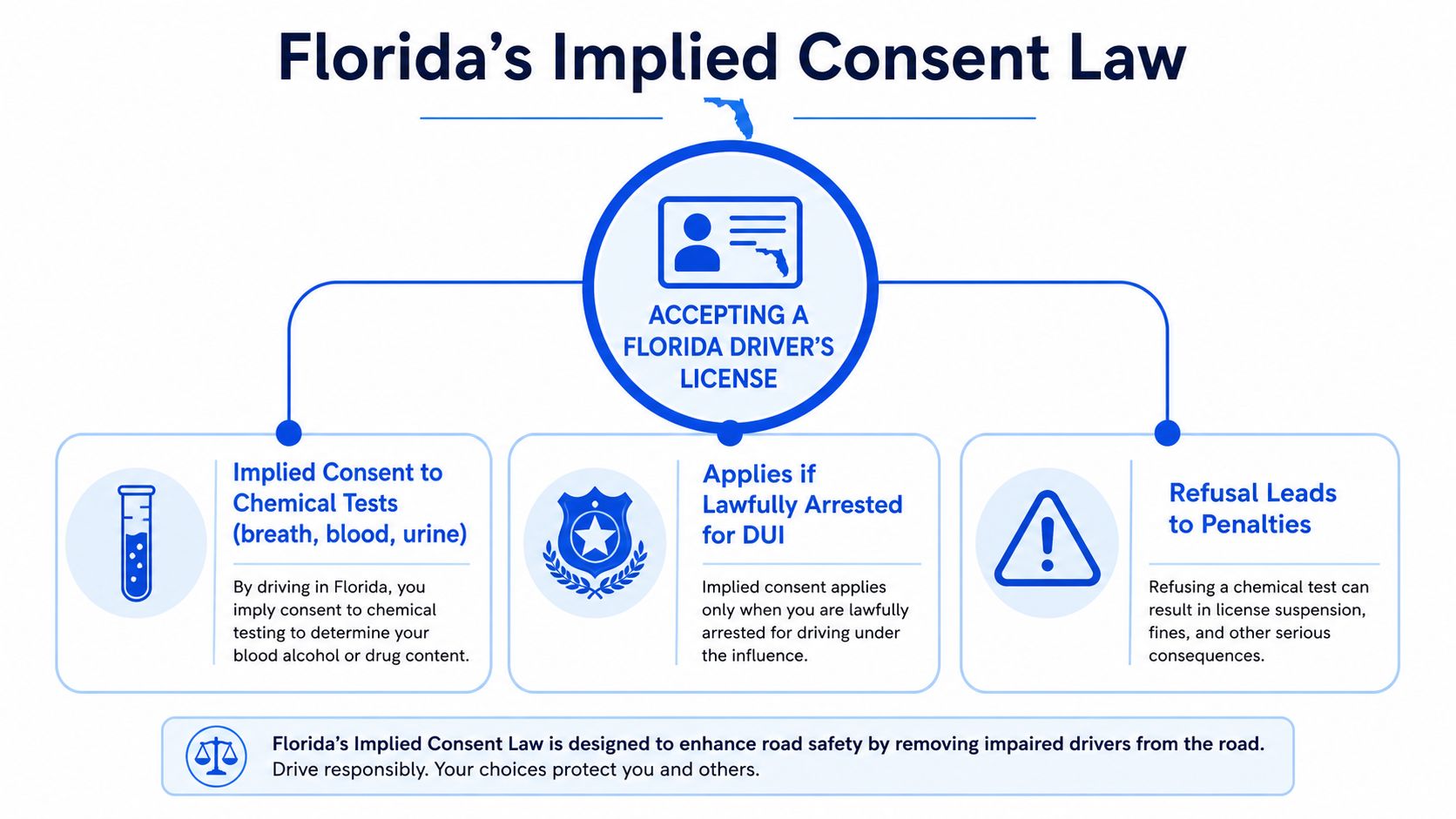
Florida's implied consent law means that by driving in Florida, you've already agreed to chemical testing after a lawful DUI arrest under Florida Statute § 316.1932. Refusing can trigger immediate license consequences and, depending on the circumstances, separate criminal exposure.
Blue lights are behind you. Your stomach drops. The officer starts asking questions, and within minutes you may have to make a choice that affects your license, your record, and your freedom.
That choice happens fast. The consequences don't.
If you're reading this after a stop or arrest, treat this as a protective briefing. You do not have time for bad advice from friends, roadside opinions, or automated apps that can't think strategically in real time. You need direct legal judgment. If you're trying to find a criminal defense lawyer, start with someone who handles Florida DUI cases and can respond immediately, not a middleman or chatbot.
A DUI case in Florida often turns on moments. What the officer said. What you said back. Whether there was a lawful arrest. Whether the warning was properly read. Whether the test request matched the law. Those details can matter later at places like the Orange County Courthouse in Orlando, long after the roadside pressure is over.
Table of Contents
What Exactly Is Florida's Implied Consent Law
Florida's implied consent law is not a form you sign at the roadside. It's a condition attached to the privilege of driving.
Under Florida Statute § 316.1932, every person who drives in Florida has impliedly consented to alcohol and controlled substance testing when an officer has reasonable cause to believe the person was driving under the influence and lawfully arrests them, as summarized in this discussion of Florida Statute § 316.1932.
What did you agree to when you got a Florida license
You agreed in advance. That's the point.
Florida treats driving as a privilege with conditions. One of those conditions is that if you are lawfully arrested for DUI, the state can require a chemical test under the implied consent framework. You don't get to treat that agreement like a contract you cancel in the middle of an arrest.
Practical rule: Implied consent isn't about whether you feel like cooperating in the moment. It's about a legal condition that attached when you accepted the privilege to drive.
If you want a deeper look at the DUI statutes that shape these cases, review Florida DUI statutes explained.
When does the law actually apply
Many drivers find this confusing. A traffic stop alone does not automatically trigger everything.
The officer needs a lawful basis to arrest you for DUI before the implied consent consequences come into focus. That sequence matters. If the arrest was not lawful, or if procedure broke down, that can become a serious defense issue later.
Here is the clean version:
Driving in Florida: The implied agreement already exists.
Reasonable cause develops: The officer believes you were driving under the influence.
Lawful arrest occurs: This is the key trigger point.
Chemical test is requested: Breath, urine, or in some situations blood.
That's the answer to what is implied consent law in Florida. It is a pre-existing legal obligation tied to your driving privilege, activated after a lawful DUI arrest under Chapter 316.
How Is Implied Consent Triggered During a DUI Stop
At the roadside, drivers often think the important moment is when the officer first asks, “Have you been drinking?” It isn't. The critical legal moment comes later.
The implied consent issue becomes serious after the officer claims there is enough for a lawful DUI arrest. That distinction matters. If you're trying to understand the stop itself, this guide on what counts as a traffic stop in Florida helps frame how the encounter begins.
What has to happen before the warning matters
The officer does not get to skip procedure.
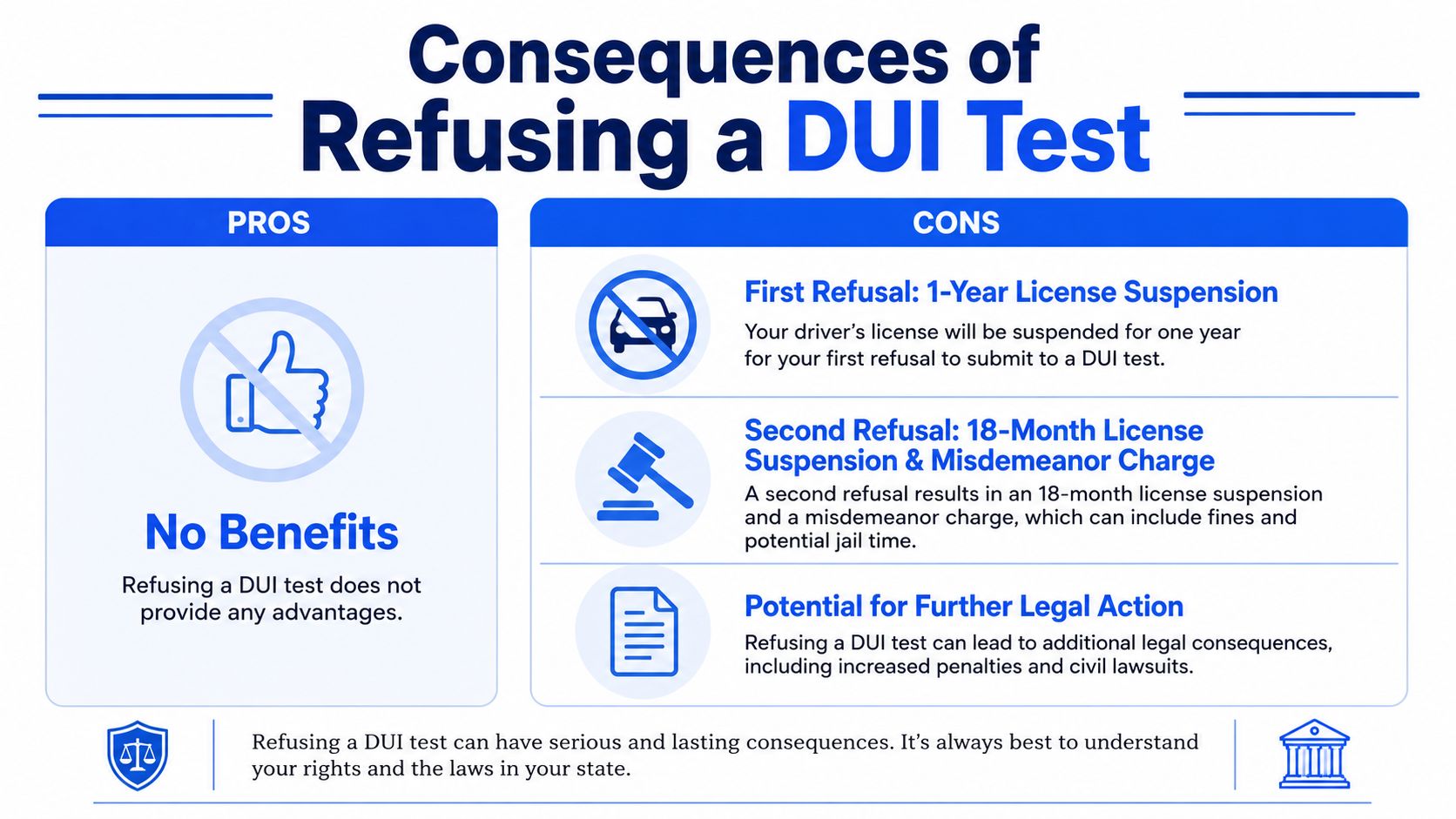
Florida law requires the officer to read a specific implied consent warning before imposing refusal consequences. That warning includes language such as “Refusal will result in the suspension of your driving privilege for one year (or 18 months for repeat offenses)”, as described in this article on Florida implied consent warnings.
That scripted warning matters for one reason. It puts you on notice that this is not just a casual request. It is a legally loaded decision.
Once that warning is read, you are no longer making a simple roadside choice. You are stepping into a separate legal problem if you refuse.
What kinds of chemical tests can an officer request
In Florida, the request may involve a breath test, urine test, or in narrower circumstances, a blood test.
The type of test usually depends on the facts the officer claims to be dealing with. Alcohol allegations often lead to breath testing. Controlled substance allegations may lead to urine testing. Blood draws raise separate constitutional issues and do not fit neatly into the same box as ordinary implied consent requests.
That distinction matters because not every demand by law enforcement is automatically valid just because the words “implied consent” are used. The legal basis, the arrest, the warning, and the test requested all have to line up.
Drivers get hurt when they assume refusal erases the case. It doesn't. Drivers also get hurt when they assume officers can do anything they want. They can't. Both mistakes are dangerous.
What Are the Penalties for Refusing a Chemical Test
You are standing on the shoulder of the road. The officer asks for a breath or urine test. You have seconds to decide, and that choice can trigger two separate problems at once. One hits your license through an administrative suspension. The other can put you in criminal court.
What happens if you refuse instead of submit
Refusing a lawful chemical test in Florida can cost you your driving privilege fast. As noted earlier, the warning read during a DUI arrest advises that a refusal can lead to a license suspension for a first refusal and a longer suspension for a repeat refusal.
Florida law now raises the stakes beyond the license issue. A legislative update from the Florida Law Enforcement Liaison Program notes that, effective October 1, 2025, a first refusal to submit to a breath or urine test is a second-degree misdemeanor, and a second refusal is a first-degree misdemeanor, as explained in the Florida Law Enforcement Liaison Program implied consent update.
That is the part drivers miss. The DUI case and the refusal penalty do not rise or fall together. You can fight the DUI and still lose your license through the administrative process. You can also face a separate misdemeanor allegation tied to the refusal itself.
For a closer look at the administrative side, review how Florida DUI license suspension works.
Here is the plain-English breakdown:
Administrative penalty: Your license can be suspended even if you are never convicted of DUI.
Criminal penalty: Refusal can become a separate misdemeanor charge under the 2025 law update.
Evidence problem: The state can still build a DUI case with driving pattern evidence, officer observations, body camera footage, statements, and testimony about the refusal.
Call a DUI lawyer immediately after release. Do not wait to see how the paperwork shakes out.
A short video can help you understand how refusal decisions unfold in practice.
How does refusal compare to taking the test
This decision is not about finding a risk-free option. It is about understanding which problem you are creating in real time.
Issue | Submit to test | Refuse test |
|---|---|---|
Chemical evidence | The state may obtain a measurable result | The state may not have a test result, but it can still pursue DUI |
License consequences | Depends on the facts and the procedure used | Refusal triggers a separate license suspension process |
Separate criminal issue | No refusal-based charge | Refusal can create misdemeanor exposure under the 2025 update |
Immediate fallout | The case centers on the test result and stop | The case can split into a DUI fight and a refusal fight |
Hard truth: Refusal can turn one roadside decision into two legal battles.
What Common Myths About Implied Consent Put You at Risk
A lot of DUI damage starts with one sentence from a friend, a forum, or a video clip. The law is less forgiving than the internet.
Do you get to call a lawyer before deciding
Many drivers think they can delay the testing decision until they speak with counsel. That is a dangerous assumption.
Material discussing implied consent explains that the framework denies a right to attorney representation during BAC test administration, and also notes that refusal can be admitted as evidence in many jurisdictions while impairment charges can still proceed without a BAC result, as summarized here in this overview of implied consent law consequences.
That doesn't mean a lawyer can't help you. It means the testing decision is often forced on a short timeline before you get legal advice.
Does refusal stop the DUI case
No. It doesn't.
The prosecution may still rely on driving pattern evidence, officer observations, field interactions, body camera footage, statements, and refusal-related evidence. A missing breath result may block one path, but it does not shut down the whole case.
Drivers lose leverage when they act on the myth that “no test means no case.”
Another common misunderstanding involves blood draws. Florida's implied consent law under Section 316.1932 is not the same thing as forced blood draw authority. A separate Florida DUI analysis explains that Section 316.1933 is not part of implied consent law and is unconstitutional to the extent it authorizes forced blood draws without exigent circumstances under the Fourth Amendment. See this discussion of Florida Statute section 316.1933 and forced blood draw limits.
The broader legal principle behind all of this is simple. Driving is treated as a privilege, not a right, and states can suspend licenses for refusal rather than force a blood draw in ordinary circumstances, as discussed in this review of the legal foundation of implied consent.
What Are Your Immediate Steps After a DUI Arrest
The first hours matter. The wrong move can lock in damage. The right move can preserve defenses.

What should you do in the first hours
Use this checklist. Don't overcomplicate it.
Stay silent about the facts: Give identifying information if required, but don't explain where you were, what you drank, or why you think you were fine.
Write everything down fast: Time of stop. What the officer said. Whether field exercises were requested. Whether the implied consent warning was read. Whether body camera or dash camera seemed active.
Protect the license issue immediately: Florida DUI cases can involve a short deadline to challenge an administrative suspension. Move fast.
Save every document: Citation, notice of suspension, bond paperwork, towing paperwork, and any property receipt all matter.
Stop texting people details: Casual messages become evidence. Keep your communications limited and strategic.
Get legal help now: Waiting hurts. Evidence doesn't get cleaner with time.
If you want a practical overview of post-arrest procedure, start with what happens after a Florida DUI arrest.
For readers who value learning how silence protections work in other legal settings, the UCMJ Lawyer Directory's Article 31 guide is a useful example of why invoking your rights early matters, even though your DUI case is governed by Florida law.
Immediate advice: The officer is building a case. You should be preserving a defense.
How a Florida DUI Attorney Can Protect Your Record
A strong DUI defense is not just “fight the breath test.” That's too narrow. A real defense examines every link in the chain.
What can actually be challenged in a DUI case
An experienced Florida DUI attorney looks at issues such as:
The reason for the stop: If the stop was unlawful, later evidence may be vulnerable.
The arrest decision: Implied consent depends on a lawful arrest. That is not a minor detail.
The warning procedure: If the required warning was mishandled, refusal consequences may not be as simple as the state claims.
The test process: Machine operation, timing, observation period, and paperwork can all matter.
The distinction between consent and force: Blood evidence raises different constitutional issues than ordinary breath testing.
For a broader view of strategic challenges, read Florida DUI defense approaches.
Why direct lawyer access matters immediately
Drivers often make another expensive mistake. They hand a serious Florida traffic or DUI matter to an automated app, a case manager, or a high-volume ticket mill and hope for the best.
That is not protection. That is outsourcing judgment.
When your license, record, and future are on the line, you should be able to speak directly with your attorney by phone or text. You need legal advice specific to the exact facts of your stop, your arrest, your paperwork, and your deadlines. Not canned responses. Not chatbot language. Not a middleman relaying messages.
If your case lands in a courthouse like the Richard E. Gerstein Justice Building in Miami or the Edgecomb Courthouse in Tampa, details will matter. Fast analysis matters more.
The goal is simple. Protect your driving privilege. Protect your record. Fight for the outcome that does the least damage, including a path aimed at avoiding points and pushing for a dismissal where the facts and law support it.
Visit Ticket Shield, PLLC for a free consultation. If your priority is protecting your license and pursuing a No Points outcome wherever possible, act now and get direct access to your attorney by phone or text.