Traffic Lawyer Tampa Protects Your License and Record
Need a traffic lawyer Tampa drivers trust? Learn Hillsborough court process, points, and how Ticket Shield fights for No Points. Free consult.

You've just been stopped on a Tampa road. The citation is in your hand, the deadline is approaching, and paying it may look like the fastest way to make the problem disappear. It isn't that simple. A payment can resolve the court transaction while creating consequences on your Florida driver record, including points, insurance exposure, or a path toward suspension.
That's why searching for a traffic lawyer Tampa service at this moment matters. Your ticket isn't only a bill. It belongs to the Hillsborough County court system, while your driving consequences are tracked through the Florida Department of Highway Safety and Motor Vehicles, or FLHSMV. Those systems interact, but they aren't the same file.
A protective defense plan must account for both. Before you pay, review the practical consequences described in Florida traffic ticket cost guidance, then determine whether your priority is a hearing, a negotiated resolution, traffic school, or clearing an existing license problem. The right choice depends on the citation, your current points, and any unresolved court or administrative hold.
Table of Contents
The Real Cost of Points Suspensions and Insurance in Florida
Why Attorney Led Defense Protects You Better Than Paying or Using an App
Ticket Shield in Tampa Strategic Defense at Edgecomb Courthouse
Your Next Steps to Fight Your Tampa Ticket and Keep No Points
Why a Tampa Ticket Is More Than a Fine
Paying closes one task and may open another
You pay a Tampa civil traffic citation, and the court transaction may be finished. The consequences can continue through your Florida driving record. Payment generally accepts responsibility for the violation, which can affect points, insurance exposure, and suspension eligibility before anyone reviews the evidence or classification of the allegation.
FLHSMV publishes statewide uniform traffic citation statistics covering every year from 2011 through 2023. The records show the scale of Florida's citation system (FLHSMV citation statistics). Your Tampa matter remains local, however. The Hillsborough County court file controls the immediate court deadline and disposition.
Tampa defense requires a two-record review
The Hillsborough court record contains the citation and the court's disposition. Your FLHSMV record reflects licensing consequences. Those are separate systems. A lawyer who examines only the ticket can miss a prior point, unpaid matter, failure to appear, or existing suspension that changes the correct defense and reinstatement order.
Your case may also involve more than a civil infraction. Florida law separates civil traffic violations, criminal traffic allegations, and administrative license issues. Driving while suspended without knowledge is treated as a noncriminal moving violation. Knowledge of the suspension can support a misdemeanor charge, while repeat or habitual traffic offender circumstances may reach a third-degree felony under Florida Statute 322.34.
Protective rule: Base your decision on the disposition's effect on your license, record, and insurance, not on the fine printed on the citation.
The George E. Edgecomb Courthouse is the center of Hillsborough County's county-court process. Traffic matters move there alongside other county-court cases, with local deadlines and procedures that require attention. Your defense should address the court result first, then the FLHSMV record and any reinstatement requirements. Paying through a ticket mill or automated app may process the citation, but it does not give you direct lawyer access or confirm that both systems were reviewed.
What a Traffic Lawyer in Tampa Handles Under Florida Law
A Tampa traffic lawyer starts with the statute and classification, not a generic promise to “take care of” your ticket. Florida Statute 316.187 authorizes the Florida Department of Transportation to establish reasonable and safe speed limits after an engineering and traffic investigation. It also sets maximum limits of 70 mph on limited access highways, 65 mph on certain divided highways outside urban areas, and 60 mph on other roadways under DOT authority (Florida Statute 316.187).
Those limits matter because a speeding allegation must be analyzed against the roadway, posted limit, measured speed, and statutory category. Violations of applicable speed limits are moving violations punishable under Chapter 318. Florida Statute 316.1926 separately addresses a driver who exceeds the speed limit by 50 miles per hour or more under the specified statutes, requiring a moving-violation citation under Chapter 318 (Florida Statute 316.1926).
The point band changes the defense decision
Florida assigns 3 points for unlawful speed of 15 mph or less over the posted limit and 4 points for unlawful speed of 16 mph or more over the limit. Speeding in excess of 50 mph over the limit also carries 4 points under the FLHSMV point schedule (Florida point suspension rules).
That difference can change the value of a defense. A reduction from a 4-point classification to a 3-point classification may affect how quickly you approach a suspension threshold. A dismissal or a resolution that avoids points can protect you more effectively than a modest reduction in the fine.
The lawyer's work goes beyond speeding
A Florida traffic lawyer may evaluate speeding, careless driving, reckless driving, driving while suspended, proof issues, and related license consequences. The lawyer should identify whether the allegation is civil, criminal, or administrative before recommending a response.
Use the Florida traffic lawyer overview as a starting point, but don't treat general information as a case decision. The citation's statute number, your driving history, and your existing compliance status control the strategy.
The Real Cost of Points Suspensions and Insurance in Florida
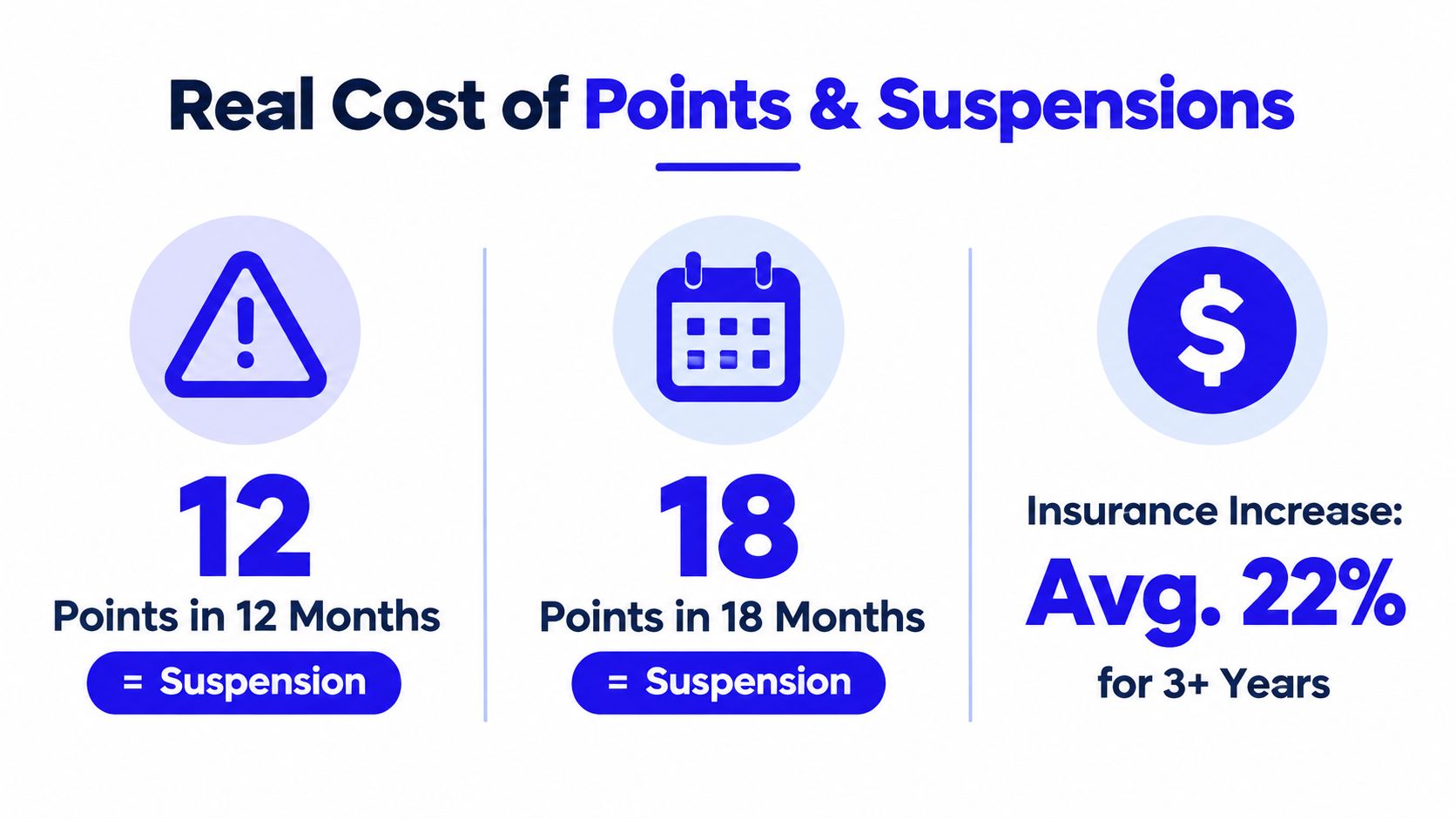
The fine is immediate. The license consequences can be broader and longer lasting. Florida's point system can suspend a license at 12 points within 12 months, 18 points within 18 months, or 24 points within 36 months. The corresponding suspension periods are 30 days, 3 months, and 1 year, respectively, under Florida's licensing framework (Florida Statute 322.27).
A single 4-point speeding event consumes more of your available margin than a 3-point event. That's why a traffic lawyer should review your existing record before discussing whether to pay, elect traffic school, negotiate, or contest the citation. The same ticket can carry a different practical risk for a driver with a clean record than for someone already near a threshold.
Insurance makes the fine comparison incomplete
Independent industry analyses commonly estimate that a 3-point ticket can raise insurance premiums by roughly 20% to 30%, with higher-point violations potentially causing larger increases. Those estimates are cited in the broader discussion of Florida point consequences alongside the statutory suspension rules (Florida license suspension statute).
The exact effect depends on the insurer, policy, driver, and underwriting decision. The point is practical: a citation can affect recurring insurance costs over the 3-year points lifecycle used in Florida licensing and insurance systems. A resolution that avoids adjudication or points may therefore be more valuable than one that only lowers court costs.
A citation should be priced by its full exposure, not by the amount printed in the payment section.
Hillsborough cases carry local financial weight
A Tampa-area traffic-lawyer report cited 94,072 tickets issued in 2020, including 16,398 criminal offenses and 77,674 noncriminal violations. It also cited 16,826 speeding tickets and estimated that Hillsborough County collected approximately $10,014,900 in civil fines from 66,766 cases that paid or were found guilty (Tampa traffic-lawyer report).
Those figures show why routine citations deserve careful handling. A Tampa traffic ticket enters a substantial courthouse operation, and your personal risk depends on the disposition, your existing record, and whether the licensing consequences have been resolved correctly.
For a clearer explanation of how points can affect your license, review Florida driving license points before choosing a resolution.
How the Tampa and Hillsborough County Traffic Process Works
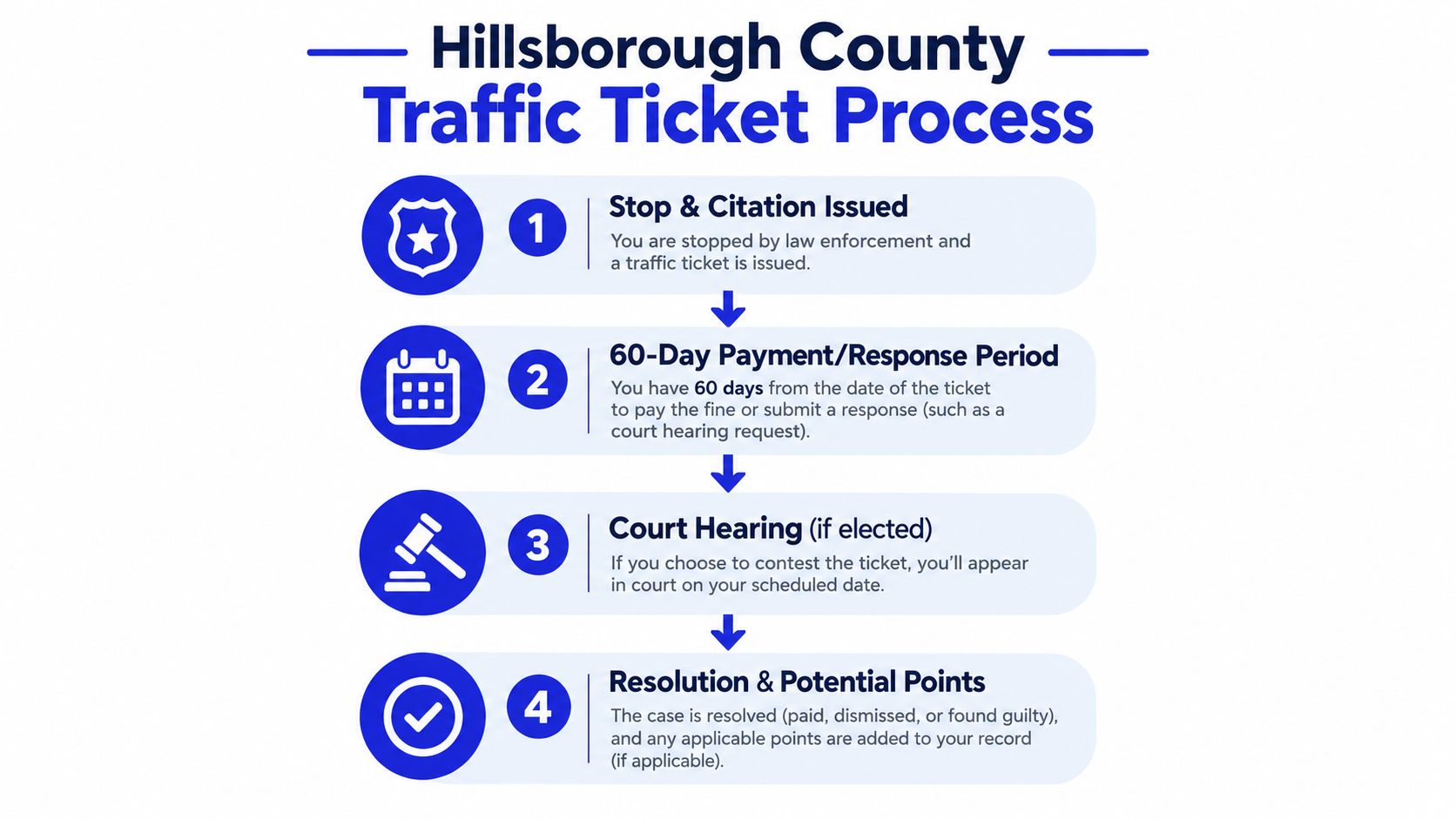
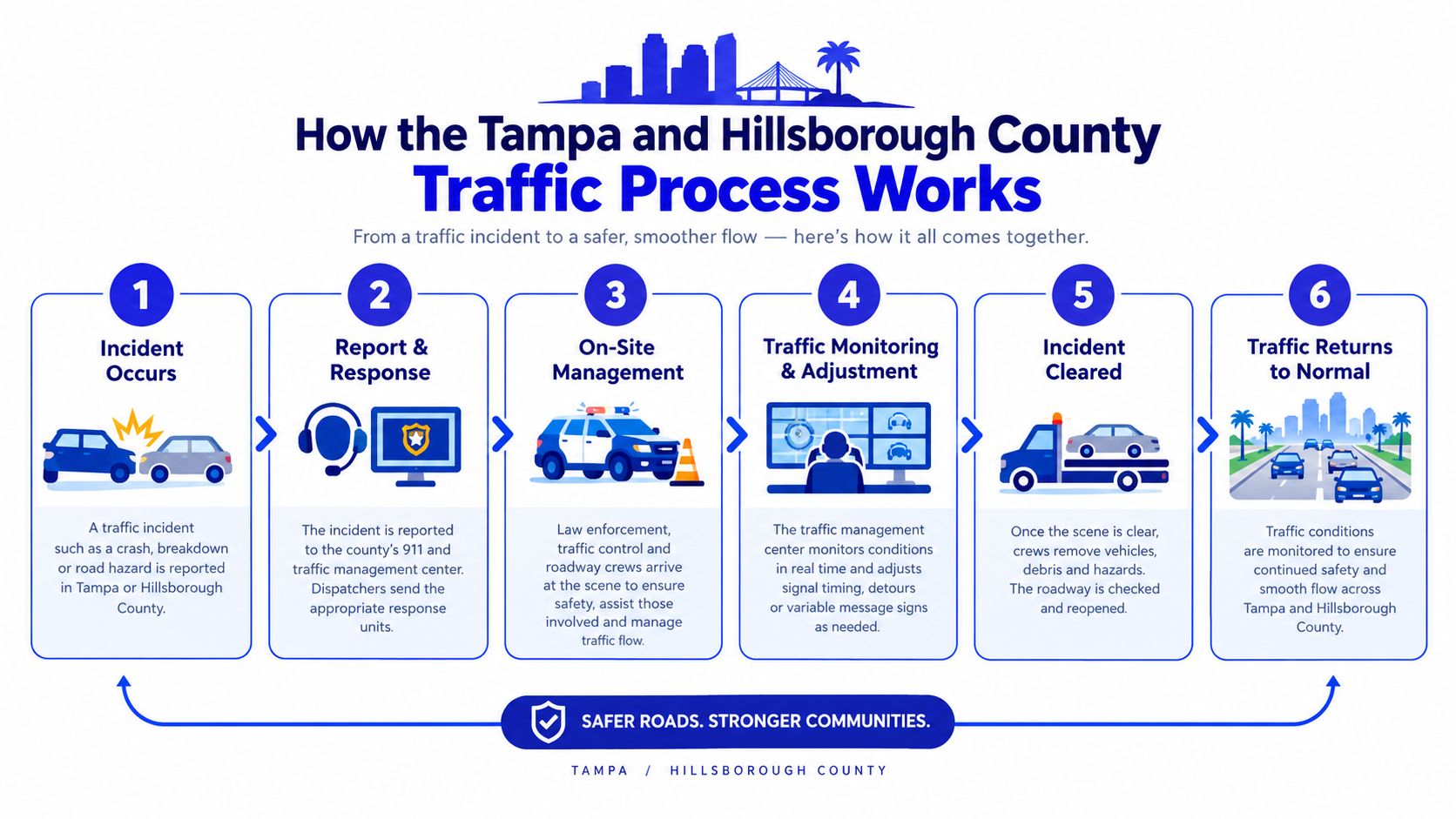
A Tampa traffic ticket creates two separate tasks: resolve the court case and verify what appears on your FLHSMV driving record. Hillsborough County's clerk portal operates 24/7. You can use it to find a citation, pay, elect traffic school, submit insurance, license, or registration proof, or request a hearing online, by phone, or by mail. The portal gives you access to options, not legal judgment. Review Tampa traffic court guidance before choosing one.
Start with the deadline
Civil traffic tickets in Hillsborough County carry a 60-calendar-day payment period because a 30-day extension is automatic. Late or suspended fees can follow. Treat the date on the citation as an action deadline.
Use this sequence:
Read every field on the citation. Confirm the alleged statute, violation description, issue date, court information, and any instruction requiring a hearing or special response.
Check the Hillsborough Clerk portal. Confirm that the citation appears, review the available responses, and save confirmation of anything you submit.
Check the FLHSMV record separately. A court payment or disposition does not establish that your license is clear. Another hold, suspension, or reinstatement requirement may remain.
Choose a response before the deadline. Paying, traffic school, submitting proof, and requesting a hearing produce different consequences. Do not select an option automatically.
Prepare for Edgecomb Courthouse when a hearing is required. The George E. Edgecomb Courthouse handles Hillsborough County traffic matters. A lawyer should review the citation, evidence, procedural issues, and possible resolution before the hearing.
Confirm the final disposition. Verify that the court file shows the intended result, then confirm that the FLHSMV driver record reflects accurate information.
Resolve the right problem in the right order
A suspended license can change the priority. Fighting a new citation may not come first if an older court hold, failure to appear, unpaid ticket, points issue, child-support matter, or another non-ticket problem blocks reinstatement.
Clear the court requirement, identify every FLHSMV condition, and complete reinstatement in the required order. Give your lawyer every notice, prior citation, and out-of-state record issue before selecting a plea or hearing option. A court resolution and a restored license are separate outcomes, and both require confirmation.
Why Attorney Led Defense Protects You Better Than Paying or Using an App
Paying is fast, but it gives you no investigation. An automated app may provide a convenient intake process, but convenience isn't the same as direct legal analysis. A lawyer-led defense gives you a person responsible for reviewing the citation, assessing the point risk, managing the court file, and considering the FLHSMV consequences.
The choice in practical terms
Factor | Paying the Ticket | Automated App or Ticket Mill | Ticket Shield Lawyer Led Defense |
|---|---|---|---|
Communication | You handle the process yourself. | Communication may pass through middlemen, corporate answering services, or automated chatbots. | You can communicate directly with your attorney by phone or text. |
Record review | No strategic review before disposition. | Often begins with standardized intake. | Reviews the citation, case posture, and license consequences together. |
Defense strategy | None after payment. | May apply a routine process to a broad caseload. | Can evaluate dismissal, reduction, proof issues, and point avoidance. |
Court handling | You remain responsible for deadlines and appearances. | Service depends on the provider's process. | The lawyer manages the legal response and court obligations. |
License protection | Points may follow the disposition. | Results vary by case and resolution. | The objective is to protect your driving privilege and pursue a no-points outcome where legally available. |
A ticket mill model can feel impersonal because your questions may never reach the attorney handling the case. An app can help transmit information, but it can't replace a direct conversation about your prior points, suspension history, employment needs, or an unresolved court hold.
Direct access matters: You should know who is evaluating your citation and how to reach that lawyer when the facts change.
Attorney-led representation may also reduce the need for you to appear personally. Ticket Shield reports that over 99% of its clients avoid court appearances, according to the publisher's stated service information. That figure is a firm-specific claim, not a guarantee for every case, so ask what attendance requirements apply to your citation.
Before relying on an app, read the limits of using a speeding-ticket app. Your ticket is a legal matter, not a customer-support ticket.
Ticket Shield in Tampa Strategic Defense at Edgecomb Courthouse
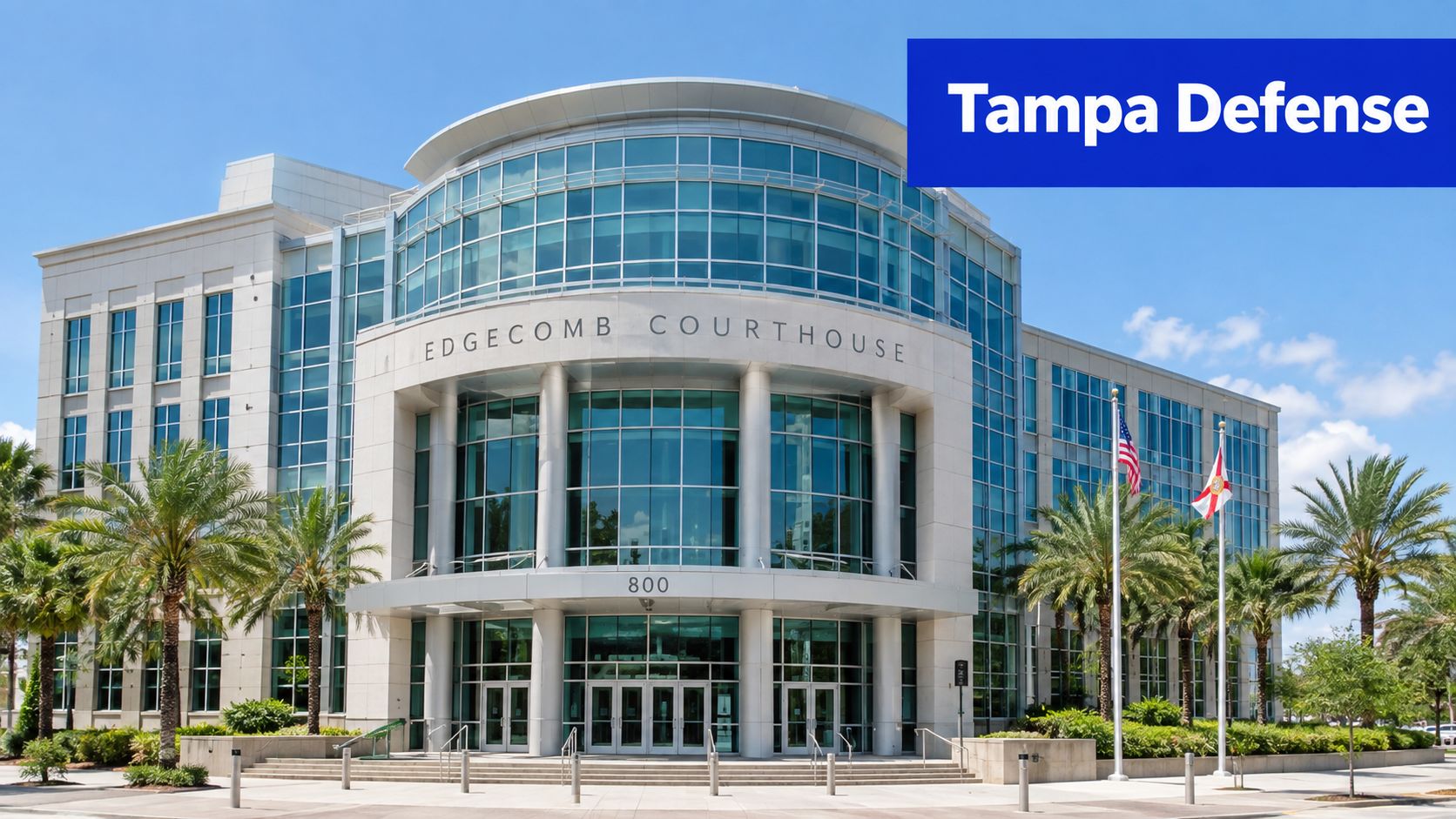
Ticket Shield, PLLC is a Florida traffic defense firm that handles matters statewide across all 67 Florida counties, including Hillsborough County. The firm states that its team brings 25+ years of experience, includes former prosecutors, and appears at major Florida courthouses, including the George E. Edgecomb Courthouse in Tampa.
A local case needs more than a local slogan
Hillsborough's traffic docket is large, deadline-driven, and connected to a statewide licensing system. A firm working in Tampa should be prepared to examine the citation, identify the governing Florida statute, communicate with the court, and address the driver-record consequences that follow from the disposition.
Ticket Shield states that its pricing starts at $39.99, with transparent, cost-effective options based on the matter. The fee doesn't determine the result, and no lawyer can promise dismissal or no points in every case. The responsible question is whether the service gives you clear scope, direct attorney access, and a strategy suited to your record.
Direct communication is the differentiator
Ticket Shield's stated model lets clients communicate directly with their attorney by phone or text, without middlemen. That matters when you discover an old suspension, receive a new notice, or need to explain facts that a form doesn't capture.
The firm's role should be measured by the work performed: reviewing the citation, pursuing an appropriate resolution, protecting deadlines, and coordinating court and licensing issues. If your objective is to avoid points, say that clearly during the initial consultation.
Your Next Steps to Fight Your Tampa Ticket and Keep No Points
Act before the deadline narrows your choices. Don't pay first and investigate later. Save the citation, photograph every page, and record the date and location of the stop while the details remain clear.
Use this immediate checklist
Preserve the citation: Keep the original and a digital copy. Make sure the statute number and response date are readable.
Check both systems: Look up the case through the Hillsborough Clerk and review your FLHSMV driver record separately.
List prior issues: Include points, unpaid citations, failure-to-appear notices, license holds, reinstatement paperwork, and any out-of-state record that could affect Florida status.
Avoid casual admissions: Don't discuss the facts with anyone who isn't your lawyer or authorized representative.
Ask about the point outcome: A lower fine isn't enough if the disposition still creates points or leaves a suspension unresolved.
Confirm closure: After resolution, verify the court disposition and the resulting driver-record status.
If your concern is insurance rather than suspension, you may also benefit from this explanation of minor violation forgiveness explained. Insurance treatment varies, so use it as background while your lawyer focuses on the legal disposition and your Florida driving record.
Suspended drivers need a different order of operations. First identify the cause of the suspension. Then determine whether a Hillsborough court must clear a case, whether FLHSMV requires reinstatement steps, and whether the new citation creates a separate criminal or civil problem. Fighting the new ticket without clearing the underlying hold can leave you unable to drive lawfully.
Out-of-state drivers and recent Florida residents should disclose every prior jurisdiction and license status during the consultation. A Florida citation can become more complicated when another record, registration issue, or court obligation is involved.
Your goal should be specific: No Points on your license, when the facts and law permit that result. Don't let a ticket mill, chatbot, or rushed payment decision choose your strategy.
Ticket Shield, PLLC provides lawyer-led Tampa traffic defense with direct attorney communication by phone or text, including help with court handling and license-record protection. Visit Ticket Shield, PLLC for a free consultation now, and take the first step toward pursuing No Points on your license.