
Traffic Lawyer in Florida: How to Protect Your Record
Learn how a traffic lawyer in Florida fights citations, DUI, and license points. See real defenses, county notes, and how to keep no points on your record.

You just got pulled over, and now you're staring at a ticket that feels routine. It isn't. A traffic lawyer in Florida doesn't just fight paper, they fight the chain reaction that starts with points, insurance, and a record that follows you long after the stop is over. If you're tempted to just pay it and move on, understand this first, paying is often the most expensive decision you can make.
In Florida, traffic enforcement is heavy and concentrated. State agencies wrote 2.64 million traffic tickets in 2022, and six major counties accounted for 56% of all citations, about 1.49 million tickets (Florida traffic ticket hotspot data). That volume matters because it means drivers like you are dealing with a system built for speed, not for your convenience.
Table of Contents
What That Ticket Really Costs You
You're on the shoulder, hands still on the wheel, and the officer is walking back to the car. If you tell yourself that paying the ticket later will be the easy path, you're already making a bad business decision. In Florida, paying a civil traffic ticket is treated as a guilty plea in practical terms, and that plea can trigger points, a conviction on your driving history, and a premium increase that keeps charging you long after the stop is forgotten.
The fine on the face of the citation is only the beginning. A driver also has to think about court costs, the record effect, and what insurers do when they see a moving violation. That's why a lawyer doesn't treat the ticket as a piece of mail, they treat it as a financial event that can spill into the next few policy periods.
Practical rule: if the charge can be attacked, negotiated, or reduced, you should look at defense before you look at the payment envelope.
A defense lawyer is usually trying to push the case into a better lane, dismissal, withhold of adjudication, or a reduction to something that doesn't hit your record as hard. That matters because one ticket can be cheap today and expensive for years. If you want the plain-English version of what those fines can look like, review the details in this Florida speeding fines guide, then ask whether paying now saves you money later.
The key move is to stop thinking about the ticket as an administrative nuisance. It is a tradeoff between a quick payment and a longer, messier cost structure. In most cases, “just pay it” is the most expensive answer in the stack.
Your First 72 Hours After a Florida Ticket or Arrest
The clock starts the moment the officer hands you the citation or takes you into custody. Florida traffic cases move on deadlines, and Chapter 318 controls many civil traffic choices, including whether you contest the citation or handle it another way (Florida Statute Chapter 318 and lawyer appearance). Miss the deadline, and you invite a default conviction, extra fees, and a separate license problem that should have been avoidable.
The three choices you actually have
Pay the ticket, and you are usually taking the same practical path as a guilty plea. If you qualify, elect traffic school and keep the case from hitting your record the hard way. If the charge can be fought, plead not guilty and force the state to prove the stop, the citation, and the legal theory behind it.
A written plea closes the case faster than most drivers expect. So does silence when a deadline passes. Out-of-state drivers need to be especially careful, because many assume they must come back to Florida in person, when a lawyer may be able to handle the court appearance and the filing for them. If you need to confirm the plate and the driver record tied to a stop, a Florida license plate lookup can help you verify the vehicle information before you act.
One citation can stay cheap on paper and still cost you more later through insurance increases, points exposure, or a license hold that follows you into work and daily life. That is why the first day matters. Gather the citation, read the exact charge, and check the deadline. On the second day, decide whether you are paying, electing school, or contesting the case. On the third day, call a lawyer if the charge can affect your record, your insurance, or your ability to drive for a living.
A citation is a clock. If you wait until the last minute, you are not buying time, you are buying risk.
If you want a plain checklist for the first response steps after a stop, read the what to do when you get a ticket guide. Then act. Hesitation is how a manageable citation turns into a missed chance to protect your license.
Common Florida Traffic Violations and Their Real Consequences
Florida drivers usually get into trouble with the same cluster of violations. Some stay civil. Some can escalate into criminal exposure. That difference matters, because a civil ticket can still cost you in points and insurance, while a criminal traffic charge can threaten your license, your job, and your clean record at the same time.
The violations drivers see most often
Speeding under Florida Statute 316.187 is the classic one, and it is one of the most common triggers for defense work. Red-light and stop-sign cases are also frequent, along with careless driving, reckless driving under Florida Statute 316.192, DUI under Florida Statute 316.193, and driving while license suspended. Each one carries a different legal posture, and a lawyer should be reading the citation for both the charge and the downstream exposure.
A careless-driving reduction can be worth a lot because it may keep the case from looking like a serious moving violation to insurers. Reckless driving and DUI are different animals. Those are not just tickets with a higher price tag, they're upgrade paths into criminal court where the defense has to get sharper fast.
Violation | Florida Statute | Driver License Points | Typical Outcome Range |
|---|---|---|---|
Speeding | 316.187 | Varies by speed and charge | Dismissal, reduction, or plea |
Red-light or stop-sign violation | Chapter 316 traffic signal rules | Varies by citation type | Plea, reduction, or dismissal |
Reckless driving | 316.192 | Criminal exposure, not just points | Dismissal, reduction, or plea |
Careless driving | Chapter 316 traffic rules | Moving violation consequences | Reduction often sought |
DUI | 316.193 | Criminal case, not a routine ticket | Defense, suppression issues, or resolution |
Driving while license suspended | Chapter 322 | Serious licensing exposure | Contest, reduction, or criminal defense |
For a deeper look at how points attach to these violations, review the Florida traffic violation points guide. Then look at your own citation and ask the question, not “How much is the fine?”, but “What does this do to my record and my insurance?”
How Florida Traffic Cases Resolve
Real case data beats guesswork. In a statewide dataset of 403,226 traffic offense cases across 66 counties from 2023 to 2025, analysts found a 45.4% guilty rate, a 4.1% dismissal rate, and adjudication withheld in 34.7% of cases (Florida traffic offense case data). The most common ending is still a conviction, but there is a real path to keeping the case from becoming a formal loss on your record.
A convicted defendant in that dataset received an average sentence of 2.9 months and an average fine of $300. The annual trend also moved in the wrong direction for drivers, with the guilty rate rising from 44.8% in 2023 to 47.3% in 2025. That is the part drivers miss when they think paying fast is the safe move. The court system is not handing out favors just because the citation feels minor.

What those numbers mean for your case
A dismissal is the cleanest finish. A withhold of adjudication is better than a conviction, but it is still a case outcome that stays in the system. If your goal is to protect your insurance profile and keep your record from taking a hit, that difference matters.
A lawyer's job is to push the case toward dismissal or a withhold, because that is where the long-term cost usually stays lower. A traffic ticket can look cheap until you factor in insurance fallout and license problems, which is why you should read how lawyers get traffic tickets dismissed before you decide to just pay and move on.
Points, Suspensions, and the Habitual Traffic Offender Trap
Florida's point system turns a small citation into a real license problem fast. Once the points stack up, the state can suspend your privilege to drive. You need to understand the thresholds before you decide to treat another ticket like a nuisance.
The suspension ladder
12 points in 12 months can trigger a 30-day suspension. 18 points in 18 months can trigger a three-month suspension. 24 points in 36 months can trigger a twelve-month suspension. That is the part drivers miss when they focus only on the fine and ignore the effect on their record.
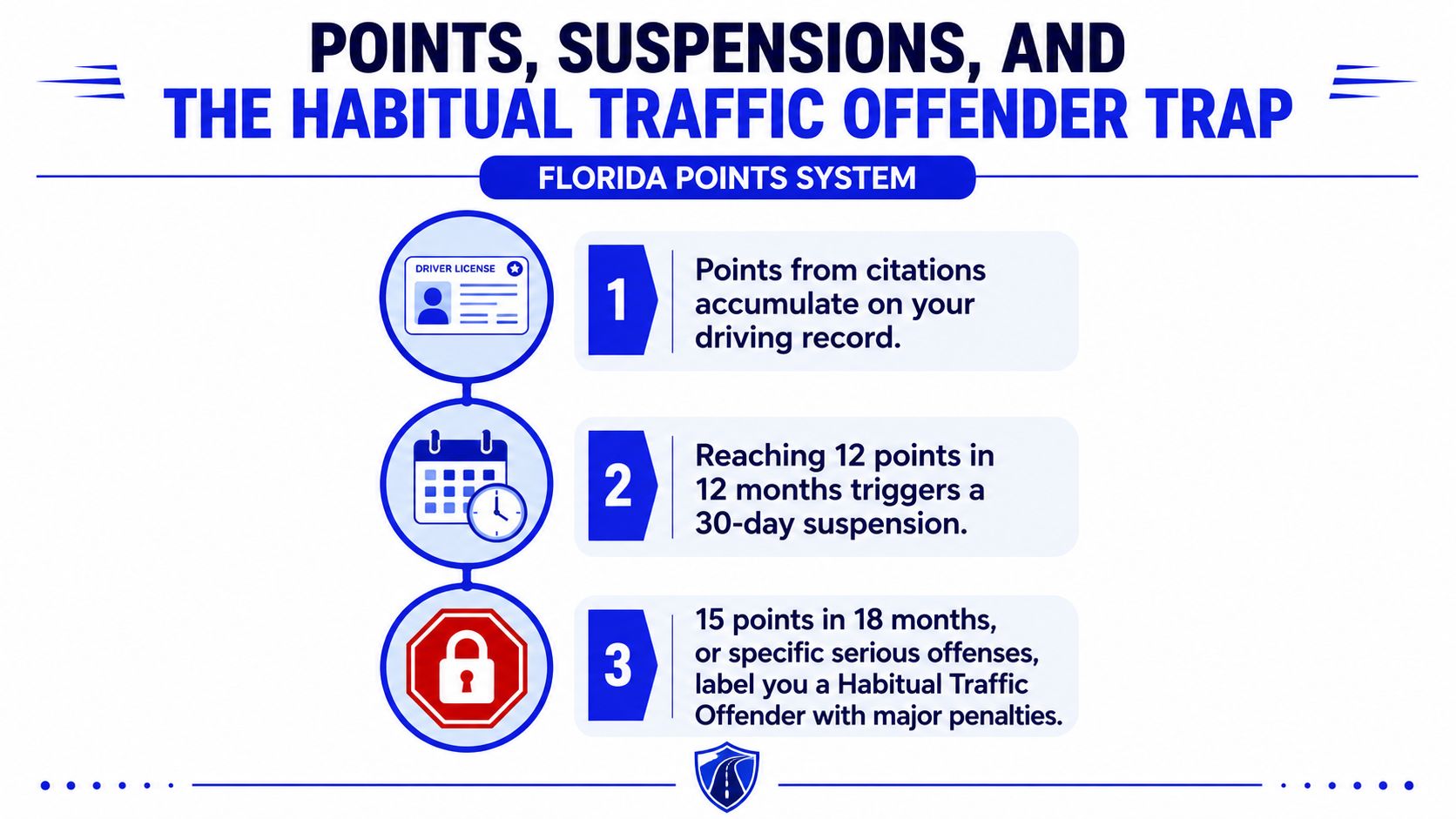
The Habitual Traffic Offender designation is worse. Florida can classify a driver as a habitual traffic offender after three or more qualifying convictions within five years or 15 moving-traffic convictions in five years, and the revocation can last five years. That level of exposure does not just create an inconvenience, it can shut down a driver's mobility and, for a commercial driver, damage earning power immediately. For a closer look at how the label works, review the habitual traffic offender overview.
Why this matters more than the ticket price
The first fight is usually the cheapest one. A case that is handled well at the start can keep points off the record and keep the next citation from landing on top of a bad history. Let one conviction pile up on another, and the state starts seeing a pattern instead of an isolated mistake.
If you hold a CDL, the stakes rise even faster. A conviction in a personal vehicle can still threaten the job, because the license problem does not stay neatly separated from your work life.
Protect the first ticket hard. The second one doesn't look like an accident anymore.
If you want a practical breakdown of the designation, read the habitual traffic offender explainer. Then treat the next citation like part of a larger record, because that is how the state will read it.
Why a Dedicated Florida Traffic Lawyer Beats a Ticket Mill
Not every legal service is built to fight. Some are built to route. That difference shows up fast when you're a driver who needs a real answer, not a chatbot, a script, or a call-center handoff.
Florida Bar certification is one way to separate serious criminal-traffic experience from surface-level advertising. For criminal trial law, the Bar requires at least five years of practice, 30% or more substantial involvement in criminal trial law during the prior three years, 25 contested criminal cases, 20 jury trials to verdict, 15 felony trials, and 10 trials as lead counsel (Florida Bar criminal trial certification requirements). Those are hard filters. They show actual courtroom depth, not just a polished website.
Direct access changes the experience
A lawyer-led firm should let you speak directly with the lawyer by phone or text. If you're pushed through a middleman, you lose speed and precision. That matters most in DUI, reckless driving, and suspended-license cases, where the charge can change fast and the defense has to keep up.
Ticket Shield, PLLC uses a lawyer-led model with direct attorney access by phone or text, no middlemen. That's the right structure for drivers who need decisions, not delays. It also lines up with the technical reality of traffic defense, because these cases often turn on procedure, negotiation, and fast response rather than generic forms.
If a case is serious or repeat exposure, weak representation costs more than the fee you were trying to save. A traffic mill can collect your payment and still leave you with the same points problem, the same insurance problem, and the same license risk. A dedicated lawyer is there to change the outcome, not just process the paperwork.
How to Choose the Right Traffic Lawyer in Florida
Ask direct questions and expect direct answers. If a lawyer can't tell you how they handle your exact charge, you're not dealing with a real defense plan, you're dealing with marketing.
What to verify before you hire
What to Verify | Why It Matters | Red Flag |
|---|---|---|
Experience with your exact violation | Speeding, DUI, reckless driving, and suspended-license cases don't behave the same way | “We handle everything” with no specifics |
Written fee agreement | You need to know what you're paying for | Verbal only, no paperwork |
Standard fee structure for routine matters | Routine traffic cases should be priced predictably | Open-ended billing with no explanation |
Ability to appear in court for you | You may not need to be there personally | You're told to attend everything yourself |
Direct attorney access by phone or text | Fast questions need fast answers | Only a call center or chatbot answers |
County familiarity | Local procedure varies by courthouse and clerk | No knowledge of the county where the ticket was issued |
Serious-case credentials when needed | Criminal traffic needs more than general traffic work | No certification, no trial background |
Florida drivers in Miami-Dade, Broward, Palm Beach, Hillsborough, Orange, and Duval should care about local court culture, because procedure and expectations differ by county. If you want a broader framework for picking counsel, the guide on how to find the right criminal defense counsel gives a useful checklist mindset, even though your traffic case still needs Florida-specific handling.
Bottom line: if the lawyer won't answer your questions plainly, keep looking.
Ticket Shield, PLLC starts at $39.99 across all 67 Florida counties, which gives you a value-driven entry point without the runaround. That's not the main reason to hire, but it is a clear signal that you should expect price transparency, direct communication, and county-level familiarity from anyone you trust with your record.
Your Next Step Toward No Points on Your License
The choice is simple. Paying the ticket is usually the most expensive move because it can lock in the record problem, the points problem, and the insurance problem all at once. The smarter move is to push for dismissal, a withhold, or a reduction that protects your license instead of feeding it into the system.
A traffic lawyer in Florida should not sound vague about what happens next. You want a lawyer-led firm, direct attorney access, a fee structure you can understand, and a plan aimed at the win, No Points on your license. That's the outcome that keeps your driving record cleaner and your long-term costs lower.
Ticket Shield, PLLC handles traffic defense across all 67 Florida counties and works to keep most clients out of court. If your charge can be fought, reduced, or resolved without adding points, that's the path you should be taking right now, not after the deadline has passed.
Visit TicketShield.com for a free consultation and make “No Points” the goal before your ticket turns into a license problem.
Ticket Shield, PLLC gives Florida drivers lawyer-led traffic defense built to protect records, licenses, and insurance rates. If you got a ticket, don't hand the state an easy win, visit Ticket Shield, PLLC and get a free consultation before you decide to pay.

