What Is a Habitual Traffic Offender?
What is a habitual traffic offender? Learn Florida HTO law, penalties, consequences, and how an attorney can protect your license.
A habitual traffic offender in Florida is a driver whose record triggers a mandatory state designation under Florida Statute §322.264, usually after repeated serious convictions or too many moving violations in five years. If you're close, acting now can protect your license and future.
You probably didn’t plan to be here.
A speeding ticket under Chapter 316, maybe under Florida Statute 316.187, felt manageable. Then another citation came in. Then a court date got pushed. Then a license issue popped up. Most drivers don’t realize the state is tracking all of it together, not as isolated mistakes, but as a pattern that can put them on the road to Habitual Traffic Offender status.
That’s the trap. You think each case stands alone. Florida doesn’t.
If you’ve had multiple tickets, a prior suspension, or a DUI-related issue, you need to stop treating traffic court like an errand. A guilty plea, a paid ticket, or a missed chance to challenge a citation can build the record that leads to a devastating result. If you’re worried about how old tickets can affect your future, review how traffic tickets can show up on background checks. Then deal with the risk before it hardens into a license crisis.
Table of Contents
The Unseen Danger of Multiple Traffic Tickets
Why drivers miss the warning signs
Most HTO problems start with ordinary behavior. You get cited. You pay one ticket online. You miss another deadline because work got in the way. You tell yourself you’ll clean it up later.
That approach is dangerous in Florida.
The state doesn’t care that the tickets happened in different cities or in different years. Your driving record brings them together. A speeding case in one county, a suspension-related charge in another, and a few moving violations under Chapter 316 can stack into something far more serious than fines.
Practical rule: If you’ve had more than one traffic case in the last few years, stop assuming the next one is minor.
This gets worse when drivers rely on convenience instead of strategy. They use automated apps, low-touch services, or they click “pay” because it feels faster. But speed is not protection. If your record is already trending in the wrong direction, passive handling can become the reason you lose your license.
Why waiting is the worst move
The state usually doesn’t announce this risk early enough for your comfort. By the time many drivers realize they’re in danger, they’re already reacting to the consequences instead of preventing them.
That’s why urgency matters. If your record includes multiple moving violations, a prior DUI issue, or driving while suspended allegations, your next decision matters more than the last one. You need someone reviewing the whole record, not just the newest citation.
At the Edgecomb Courthouse in Tampa and in courtrooms across Florida, traffic cases move quickly. Your life doesn’t. Your job, insurance, and daily mobility can all take a hit long after the hearing ends.
Use this moment correctly. Treat every open ticket as a threat to your long-term driving privilege, not just a short-term inconvenience.
What Legally Defines a Habitual Traffic Offender in Florida?
What the law actually looks for
You do not become a habitual traffic offender because one officer writes one bad ticket. You get there because the state sees a pattern on your record and counts convictions inside a five-year window.
Florida uses two main paths. One path is repeated serious driving-related convictions. The other is a high number of moving violation convictions. If your history fits either path, the state can classify you as an HTO and move toward revoking your license.
That is why passive ticket handling is dangerous. An app can process a payment. It cannot review your full driving history, spot an HTO trigger before it hits, or build a defense strategy across multiple counties. A lawyer can.
If you are already watching points pile up, study how convictions affect your license under Florida’s traffic ticket point system. Points are not the whole problem, but they often signal that your record is moving in the wrong direction.
Routine vehicle issues matter too. Avoidable stops create avoidable citations, and those contacts can add pressure to an already weak record. That is one reason understanding vehicle safety inspections still matters.
Florida's HTO Qualifying Offenses
Read the rule this way.
Offense Type | Description |
|---|---|
Major convictions path | Three or more qualifying major convictions within five years can trigger HTO status. |
Major offense example | DUI |
Major offense example | Voluntary or involuntary manslaughter resulting from the operation of a motor vehicle |
Major offense example | Any felony where a motor vehicle is used in the offense |
Major offense example | Driving while license is suspended or revoked |
Major offense example | Failure to stop and render aid after a crash |
Major offense example | Operating a commercial motor vehicle while disqualified |
Moving violations path | Fifteen moving violation convictions within five years can also trigger HTO status if they count under Florida law. |
Why this definition matters before the designation is final
Drivers in trouble often focus on the newest ticket and ignore the record behind it. That is a serious mistake. Florida does not judge your risk by the story you tell yourself about each case. Florida counts what ended up as convictions.
A paid ticket can count against you. A no-contest plea can count against you. A case handled without a record review can become the conviction that pushes you into HTO territory.
This is the point where strategy matters most.
Before the designation is finalized, a lawyer can examine old cases, identify which open charges create the greatest risk, and try to prevent another qualifying conviction from landing on your history. That work has to happen early. Automated services do not appear in court with a plan for your full record. They do not coordinate county to county. They do not protect you from the cumulative effect of one more conviction.
If you have multiple prior tickets, a suspended license history, or any serious traffic-related charge, get your record reviewed now. Waiting turns a preventable licensing problem into a revocation case.
What Are the Consequences of an HTO Designation?
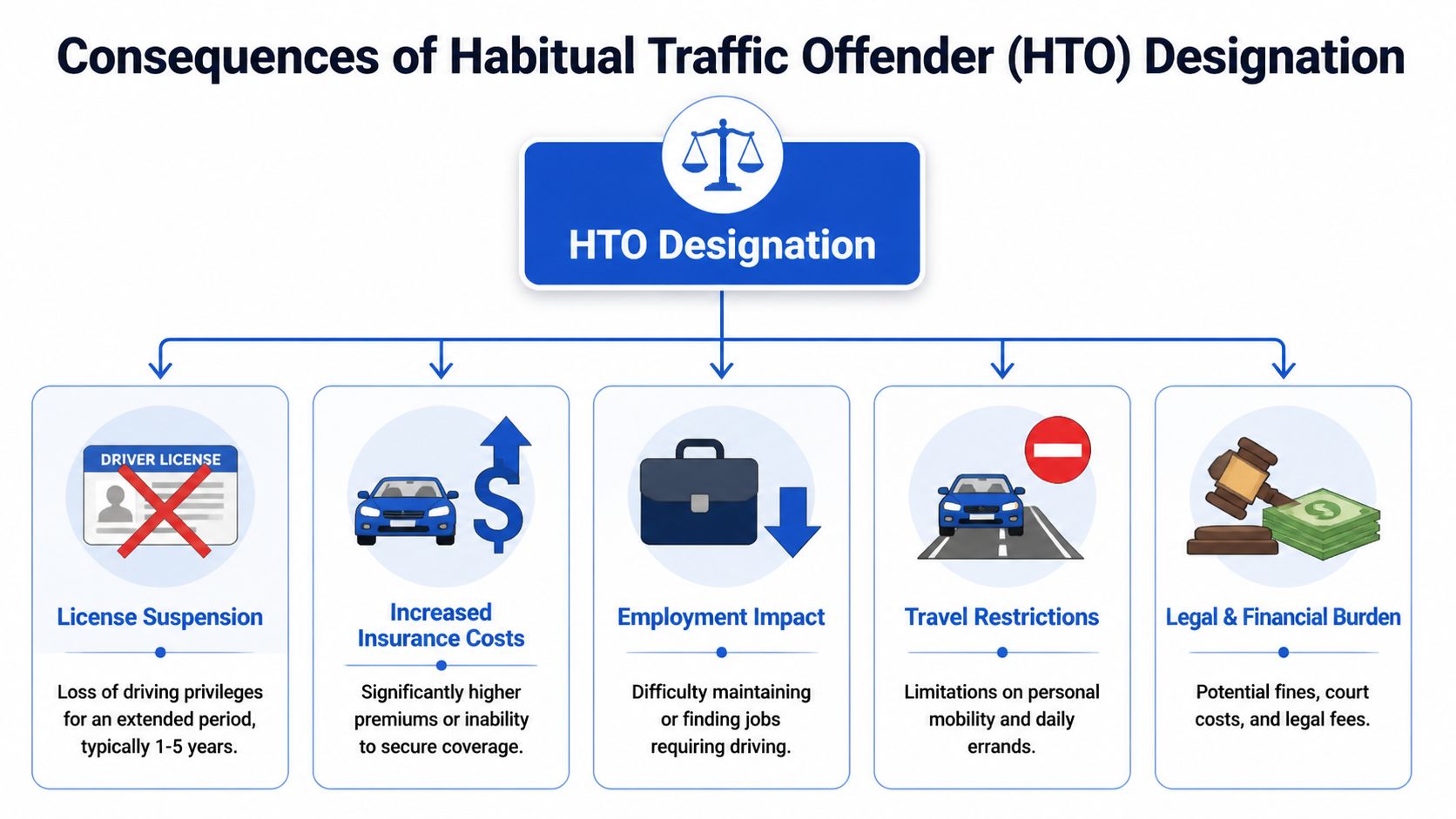
What happens to your license and record
You get pulled over on an ordinary day, and the officer tells you your license is revoked because Florida has tagged you as a habitual traffic offender. At that point, the problem is no longer a simple ticket problem. You are dealing with a long-term loss of driving privileges and the risk of criminal charges if you keep driving.
An HTO designation puts your license at risk in the most serious way short of a permanent loss. Florida can revoke your driving privilege for years, and driving after that revocation can expose you to felony prosecution. That kind of record can follow you long after the traffic cases that triggered it are over.
Read that again. A traffic history can turn into a criminal case.
If your license is already hanging by a thread, review what a driver license suspension can do to your record and daily life. HTO status goes further because the state is not pausing your privilege to drive. It is taking it away.
How an HTO label can hit your job and insurance
A revoked license can wreck your work life fast. If you commute, drive for a living, carry tools between job sites, or have children who rely on you for transportation, the loss of legal driving privileges hits every part of your week.
Insurance problems usually follow. Carriers view this kind of record as high risk. That can mean sharply higher premiums, trouble getting covered, or both.
The court date is only part of the danger. A greater threat is what happens after the convictions stack up and the state acts on your full record.
Drivers often wait until the revocation notice arrives. That is backwards. The right move is to get ahead of the designation before your options shrink and before a manageable traffic case becomes a threat to your job, your mobility, and your future.
Can You Fight an HTO Designation Before It Happens?
The window to act is before the record locks in
Yes. In many cases, that’s the smartest time to fight.
HTO status doesn’t come out of nowhere. It grows out of convictions that hit your Florida record. That means your best chance to protect yourself is often before the next case becomes final. Once you understand that, your strategy changes. You stop asking, “How fast can I close this ticket?” and start asking, “How do I keep this from becoming another qualifying conviction?”
That’s the right question.
If you’re trying to stop the process early, start by learning how lawyers work to get a traffic ticket dismissed. Dismissal is not always available, but strategic defense starts with challenging the citation, the evidence, and the way the case is being charged.
What strategic defense looks like
A real defense is fact-specific. It can include contesting the stop, challenging the officer’s observations, attacking the legal sufficiency of the charge, or negotiating for an outcome that avoids the kind of conviction that pushes you toward HTO status.
Sometimes the most important result is not dramatic. It’s quiet. It’s preventing one more qualifying strike from being added to your record.
Here are the moves that matter before designation becomes official:
Do not plead guilty casually: A quick plea may solve today’s inconvenience and create tomorrow’s revocation problem.
Ask whether adjudication can be withheld: In the right case, keeping a conviction off the record can be more valuable than shaving down a fine.
Force a review of the evidence: If the state’s proof is weak, that weakness should be exposed before you hand over a conviction.
Look at the full record, not one file: A single ticket can’t be evaluated in isolation when your license is at stake.
A protective traffic defense is not about “handling” a citation. It’s about controlling what reaches your driving record.
At the Broward County Judicial Complex in Fort Lauderdale, this kind of record-based strategy matters because small errors compound when drivers keep resolving cases one by one without a unified plan. If you’re close to the line, every new case needs to be treated like a licensing emergency.
Why Is a Lawyer Better Than an App for This Fight?

An HTO risk is not a form submission problem
Automated apps are built for volume. HTO prevention is built on judgment.
An app can collect payment, move data, and send updates. It cannot sit with your record, identify where the danger is building, and make a strategic decision about whether this case should be fought, negotiated, or positioned to protect you from long-term consequences. An HTO issue is not administrative. It is legal.
The same goes for ticket mills that rely on middlemen, generic workflows, or client silence. If your future depends on avoiding one more qualifying conviction, you need legal analysis, not automation.
Direct lawyer access changes the outcome
Lawyer-led representation matters because HTO risk depends on nuance. The difference between a manageable traffic matter and a licensing disaster can turn on the exact charge, the exact court outcome, and the exact way your history is reviewed.
That’s why many drivers choose direct communication over a faceless process. If you’re comparing options, this breakdown on why to choose a local lawyer over apps gets to the heart of it.
A real attorney can do what an app can’t:
Review your full exposure: Not just the current citation.
Negotiate with purpose: The target is record protection, not quick closure.
Answer the hard question: “If I resolve this today, what does it do to my license later?”
Adapt in real time: Court developments don’t fit neatly into software scripts.
If you're at risk of HTO status, handing your case to a chatbot-style system is a gamble with your license.
The drivers who do best in these situations usually act before the state finalizes the pattern. They don’t outsource judgment. They get counsel.
What Are Your Immediate Next Steps If You Are at Risk?
You get one more ticket, pay it online to get it over with, and then the state treats that payment as another conviction on a record that was already too close to the line. That is how drivers lose their licenses without realizing the full extent of the danger until the notice arrives.
If you think you may be close to HTO status, stop making quick decisions. Start protecting your record with a defense plan built around prevention. The goal is to stop the next qualifying result before the state locks in the designation. An app cannot do that. A lawyer can.
Immediate steps to take
Do not pay any open ticket before a lawyer reviews it. In many cases, payment ends the fight and puts another harmful result on your record.
Order your Florida driving record now. You need dates, case outcomes, and the full history. Guessing will hurt you.
List every pending case and every deadline. Court dates, payment elections, and compliance requirements can close off better options fast.
Flag any prior suspension, revoked license, or failure-to-appear issues. Those cases often create more exposure than drivers expect.
Check when each prior case was resolved. Timing can decide whether a case counts toward the pattern.
Do not assume traffic school fixes the problem. It may help in some situations, but it does not erase every conviction risk.
Get a Florida traffic defense attorney involved before the next court action. Early intervention gives your lawyer room to negotiate, amend, contest, or contain the damage.
Busy courts will not slow down because your license is on the line. Clerks process cases. Systems update records. Your employer, your insurance company, and any platform that depends on your driving status will react after the damage is done.
Act before that happens.
If you drive for work, every pending case is a threat to your income. If you drive your children to school, get to medical appointments, or commute across Central Florida, your license is part of your family’s stability. Treat it that way. Get your record reviewed, stop resolving tickets blindly, and put a lawyer between you and the next mistake.
Frequently Asked Questions About HTO Status
Can I get a hardship license if I'm labeled HTO
Maybe later, not at the start.
If Florida designates you as a habitual traffic offender, you should expect serious limits on driving privileges. A hardship license is not an immediate escape hatch, and treating it like one is a mistake. The better strategy is to keep the designation from being finalized in the first place. That is where a lawyer can still protect your record, your job, and your ability to drive.
Does traffic school stop an HTO designation
Traffic school does not automatically protect you from HTO status.
HTO exposure turns on the convictions and qualifying case outcomes on your record. In some situations, traffic school may help with points or case handling, but it does not erase every conviction risk. If you are close to HTO status, relying on an app or a quick online election is reckless. You need someone reviewing the actual charge, the timing, and the possible outcome before anything is entered against you.
Should I just pay the ticket and move on
No.
If you are at risk of HTO status, paying a ticket can be the decision that pushes your record over the line. Fast is not safe. Cheap is not safe either. A lawyer may be able to contest the ticket, negotiate a better result, or stop a qualifying conviction before it hits your driving history.
Can I challenge the cases that led me here
Sometimes. But your best chance to protect yourself is before the next case closes.
Once a conviction is entered and reported, your options usually get narrower, slower, and more expensive. Lawyer-led defense works before the system locks in the damage. Automated services process tickets. They do not build a defense strategy, appear in court with judgment, or spot the one case that must be handled differently to keep you from HTO status.
What’s the safest move if I think I’m close
Stop making solo decisions about your tickets.
Get your Florida driving record reviewed by a traffic defense attorney before you pay anything, plead to anything, or miss another deadline. If HTO status is even a possibility, delay hurts you. Visit Ticket Shield, PLLC for a free consultation. You speak directly with a Florida lawyer by phone or text, not a middleman and not an app. The goal is simple. Protect your license before the state takes it.