Navigate Tampa Traffic Court: Protect Your License
Facing Tampa traffic court? Understand your options, Edgecomb Courthouse procedures, and how to protect your license. Get strategic advice.

Do not just pay that ticket. A guilty plea locks in consequences. You have 30 days to act in Hillsborough County, and the right strategy can protect your license, your record, and your schedule at Tampa Traffic Court.
You're probably reading this with a citation on the passenger seat, a court date on the paper, and one bad question in your head. Should you just pay it and move on?
That's the mistake I see every week.
A Tampa traffic ticket isn't just a bill. It can affect your license, your record, your insurance, and in some cases your job. If you drive for work, hold a security-sensitive position, or cannot afford court confusion at the Edgecomb Courthouse, you need to treat this seriously from day one.
Table of Contents
What Happens After a Tampa Traffic Ticket
The moment you get cited, the clock starts running. The paper in your hand is not just a notice. It is the start of a legal deadline, and if you handle it casually, you give away an advantage you may never get back.
Hillsborough County is busy. In 2020, the Tampa area saw 94,072 traffic tickets issued, and 16,398 of those were criminal offenses, which means about 17.4% involved criminal charges rather than simple civil infractions, according to this Hillsborough County traffic citation report. That should tell you something important. Tampa Traffic Court is not a minor side room where everything gets waved through. It is a high-volume court system handling serious consequences every day at the Edgecomb Courthouse.
What does that mean for you
If your citation is civil, you may still be facing points, insurance problems, and a mark on your driving history. If your citation is criminal, the stakes rise fast. Criminal traffic offenses in this jurisdiction commonly include DUI, reckless driving, driving with a suspended license, and leaving the scene of an accident.
Protective advice: The worst first move is assuming your ticket is routine just because the stop felt routine.
Florida traffic enforcement sits inside Chapter 316, and common violations can carry more risk than drivers expect. A speeding allegation, for example, ties directly to Florida Statute 316.187, which governs unlawful speed. Once you plead guilty or miss a deadline, you stop defending and start reacting.
Why drivers get into trouble quickly
People commonly do one of three things wrong after a ticket:
They pay immediately because they want the problem gone.
They wait too long because they think they have time.
They try to go through the courthouse unprepared and learn procedure the hard way.
If you've just been cited, start with a practical action plan and review what to do when you get a Florida ticket. Then make a decision based on defense, not panic.
What Are Your Immediate Steps in the Next 30 Days
This part is simple. You have a hard deadline, and missing it creates a bigger problem than the original citation.
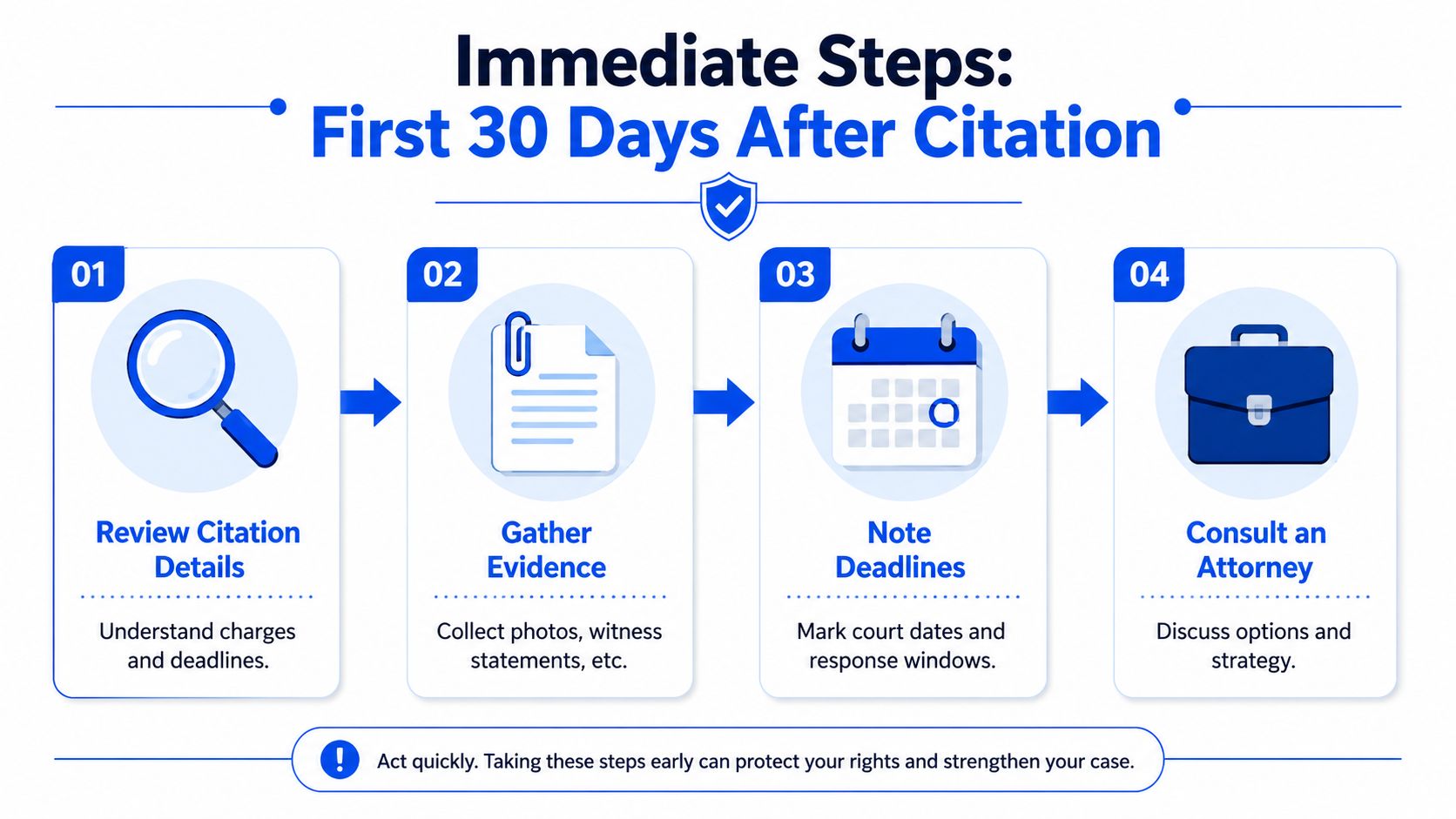
In Hillsborough County, you must notify the court within exactly 30 days from the date the ticket was issued whether you intend to pay, request traffic school, or set a court date, and failing to act can result in a license suspension, as explained in this Hillsborough County traffic school deadline guide.
What should you do first
Start by slowing down and reading the citation line by line. Check the alleged offense, the county, the deadline, whether a court appearance is marked, and whether the officer noted radar, lidar, crash involvement, or an enhanced speed allegation.
Then verify the citation information. If anything on the ticket is unclear, use a reliable Florida citation number lookup guide and confirm what you are dealing with before you make any election.
Immediate steps to take
Read the charge carefully. Don't assume all traffic tickets are the same. Some carry simple civil exposure. Others trigger mandatory appearances or criminal consequences.
Mark the 30-day deadline now. Put it in your phone, your calendar, and your reminders. Missing this window can lead to a suspended license.
Preserve evidence early. Save dashcam footage, photos, location details, weather conditions, and witness names while they're still available.
Check whether court is mandatory. If your citation requires an appearance, you need a plan immediately, not a week before court.
Do not plead guilty out of convenience. A fast payment can become a long-term record problem.
Get legal advice before electing traffic school. That choice can feel safe, but it can also waste a better defense position.
Keep every document together. Citation, proof of insurance, registration, notes from the stop, and any related correspondence should stay in one folder.
Missing the first deadline often creates the second problem. Once your license is at risk, your options narrow.
If you do nothing else in the first month, do this. Act before the court acts on you.
Should You Pay Plead Guilty or Fight Your Ticket
Most drivers reduce this decision to one thought. What's the easiest way out?
That's the wrong standard. The right question is which option gives you the strongest chance to protect your record.
Speeding is the clearest example. It is the dominant violation in this area. Speeding citations account for more than 40% of all traffic citations issued statewide, and with 94,072 tickets issued in the Tampa area in 2020, that implies over 37,600 speeding citations in the area, according to this Tampa speeding violations overview. If your ticket involves speed, you are not dealing with some rare technicality. You are dealing with one of the most aggressively enforced categories in Florida, often under Florida Statute 316.187.
Why paying is usually the worst choice
Paying the ticket feels efficient. Legally, it is usually a plea.
That means you stop contesting the allegation. You give up the opportunity to challenge the officer's observations, the device used, the wording of the citation, and the circumstances of the stop. You also lose the chance to push for dismissal, reduction, or a result that protects your record more effectively.
Traffic school can be useful in some situations. But it is not the automatic smart move people think it is. It's an election with consequences, and it may close off a better strategy.
A ticket is not just about today's fine. It is about what goes on your record and what stays there.
Plea Option Consequences in Tampa
Outcome | Pay the Ticket (Plead Guilty) | Elect Traffic School | Fight with an Attorney |
|---|---|---|---|
Speed of resolution | Fast, but final | Moderately fast | Slower, but strategic |
Chance to challenge the allegation | None | Very limited | Strongest opportunity |
Chance to pursue dismissal | None | Usually no | Yes |
Record protection | Weak | Sometimes helpful, depending on the case | Strongest path |
Insurance protection | Uncertain | Better than pleading guilty in some cases | Best chance if points are avoided |
Court stress | Low upfront | Moderate | Can often be managed professionally |
Which option usually gives you leverage
If your goal is No Points, paying is usually the wrong move. If your goal is keeping the matter off your record as cleanly as possible, a defense strategy gives you the most room to work.
Before you choose convenience over advantage, read a side-by-side comparison of paying a ticket versus hiring a traffic lawyer. Then decide based on outcome, not speed.
How Does the Tampa Traffic Court Process Work
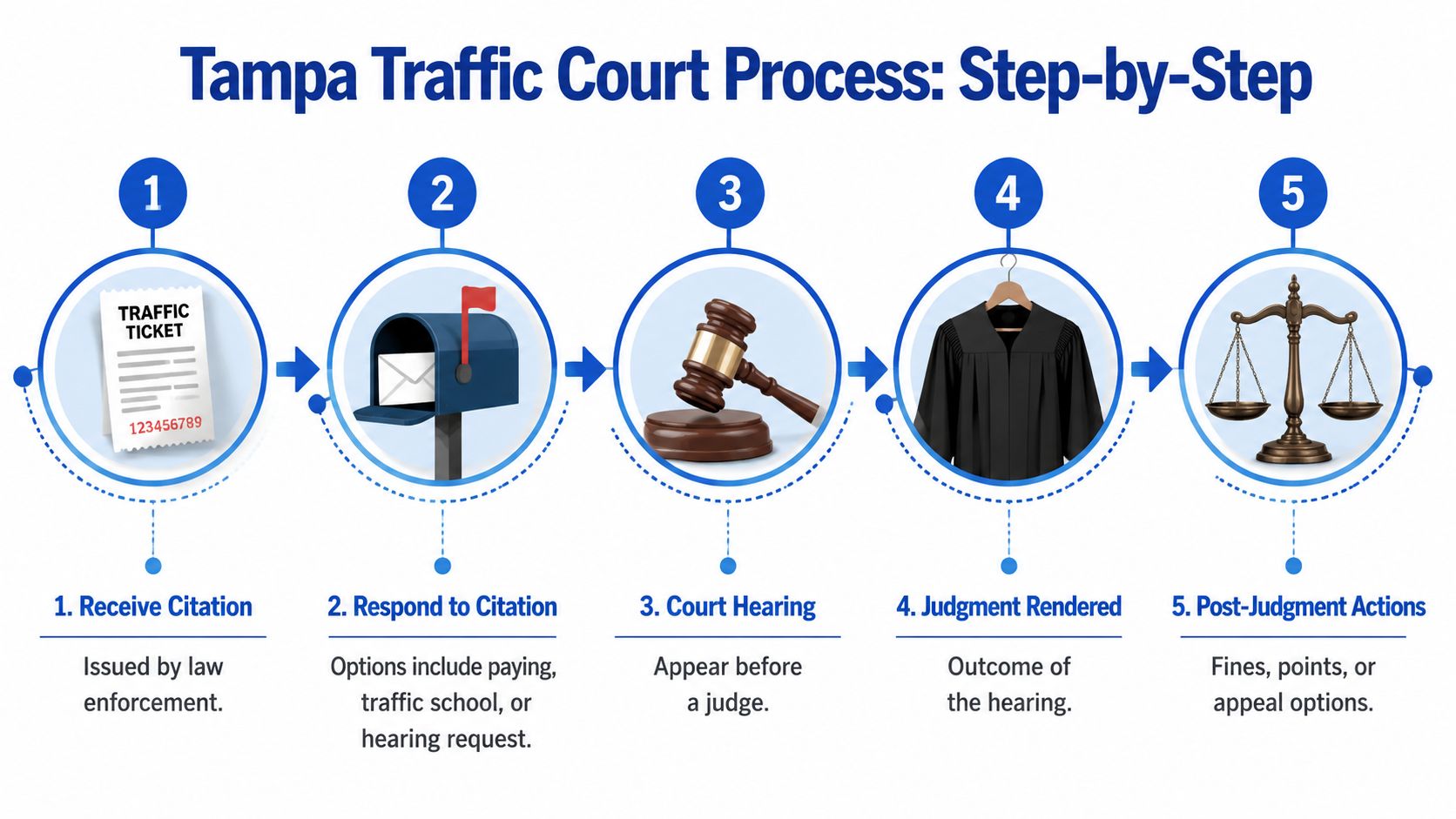
For most Hillsborough County traffic cases, your court experience runs through the Edgecomb Courthouse. It is manageable if you know the sequence. It becomes stressful when you don't.
What happens at the Edgecomb Courthouse
If you appear in person, get there early. Hillsborough County guidance for traffic court appearance warns that you should arrive at least 15 minutes early to clear security and find the right courtroom, and the judge typically reviews the infraction, your driving history, and the testimony of both parties before ruling, as discussed in this Hillsborough County traffic court appearance video.
The actual informal hearing is often short. At the Edgecomb Courthouse, the judge typically issues a ruling within 10 to 15 minutes, but you should still expect 1 to 3 hours total for security, check-in, and waiting because cases are heard in calendar order, according to this Florida traffic court process guide focused on Edgecomb hearings.
When can a lawyer appear for you
This is where procedure matters. In many traffic matters, an attorney can appear by affidavit and legally stand in for you. That same Edgecomb guidance notes that attorneys can appear in a way that enables over 99% of clients to avoid court appearances entirely.
That matters if you work by the hour, drive for a living, care for a family member, or cannot spend half a day in court waiting for a brief ruling.
Court may be brief. The disruption to your life usually isn't.
If you want a clearer picture of the day itself, review what to expect in Florida traffic court before your hearing date.
How Do You Prepare for a Hearing
Walking into Tampa Traffic Court unprepared is how drivers lose cases they might have defended.
Preparation is not dramatic. It is disciplined. You need the right documents, the right posture, and the right evidence. If you are contesting a speed allegation, details matter more than emotion.

What should you bring and how should you act
Bring every document tied to the stop and the vehicle. That usually includes your citation, license, registration, proof of insurance, any photos, any video, and any notes you made right after the stop.
Your presentation matters too. Dress professionally. Speak only when it is your turn. Answer the judge directly. Do not interrupt the officer. Do not argue with the bench. A hearing is not the place for frustration. It is the place for organized facts.
What evidence can actually help
If your speeding ticket involved radar or lidar, you have a real procedural tool. In Hillsborough County, you are entitled to request the device's calibration and maintenance records before your hearing, and failure by the prosecution to provide those records can result in dismissal, according to this Hillsborough County radar and lidar defense guide.
That is not a loophole. It is basic proof. The state has to show the device was reliable.
Use a preparation checklist like this:
Collect your documents. Keep the citation, license, registration, and insurance together.
Write your timeline. Note where you were, traffic conditions, weather, lane position, and exactly what the officer said.
Request technical records if speed was measured. Radar and lidar cases should not be defended blindly.
Identify witnesses early. Waiting until the hearing date is too late.
Stay disciplined in court. Judges listen better to drivers who are organized and restrained.
Courtroom reality: The judge is deciding whether the state proved its case, not whether you felt the stop was unfair.
Why Is a Lawyer Your Strongest Defense
A real defense is not the same thing as navigating forms.
That's the biggest difference between a lawyer-led strategy and the automated apps or ticket mills that push volume, scripts, and middlemen. If you want a quick upload portal and generic updates, those systems exist. If you want legal judgment, direct communication, and someone who can assess risk, that requires a lawyer.

What a real defense lawyer does that an app cannot
A defense lawyer looks for timing issues, evidentiary weaknesses, officer availability problems, negotiation openings, and procedural defects. A chatbot cannot do that with judgment. A middleman cannot stand up in court and protect your record.
One of the clearest examples is Florida's speedy trial rule. Florida Rule of Traffic Court 6.325 requires Hillsborough County defendants to be brought to trial within 180 days from service of the citation, and if trial does not occur within that window, the case is subject to dismissal for a speedy trial violation, as explained in this Florida Rule 6.325 speedy trial overview.
That kind of rule matters because strategy is often procedural before it is dramatic.
Why strategy matters more than convenience
A lawyer can decide whether to negotiate early, whether to challenge the basis of the stop, whether to contest the proof, and whether to push timing. An app can collect your payment and send status updates. Those are not the same service.
This is also where a lawyer-led firm matters. With Ticket Shield, PLLC, clients speak directly to their attorney by phone or text. Not a call center. Not a chatbot. Not a case runner passing messages back and forth. That direct access matters when you have a deadline, a mandatory appearance, or a job that depends on your driving record.
If you're weighing your options, start with a practical review of what a Tampa traffic citation lawyer actually handles.
Here's a short explanation that reinforces why legal strategy beats guesswork:
You do not hire a traffic lawyer because the form is confusing. You hire one because the consequences are real.
Frequently Asked Questions for Tampa Drivers
Can gig drivers risk any points
If you drive for Uber, Lyft, DoorDash, or another platform, your record is part of your income. Even one traffic case handled poorly can create problems that are far more expensive than the ticket itself. If driving pays your bills, treat every citation like a business threat.
Your best move is fast evaluation. Don't assume traffic school is good enough. Don't assume paying is harmless. Protect the record first.
What if you are in the military
If you are stationed at MacDill AFB or work in a role where background reviews matter, a traffic matter should be handled carefully and discreetly. Civil traffic citations and criminal traffic charges do not carry the same weight, but neither should be ignored.
If the citation is more serious than simple speeding, get legal advice early. Delay only makes the paper trail worse.
Can you avoid appearing in person
Possibly, yes. Recent data discussed through Justia indicates that 65% of courts in Florida now allow remote hearings for traffic cases if requested early, but the process is not clearly documented for Tampa, according to this Florida traffic remote hearing discussion.
That matters for pregnant drivers, elderly residents, people without reliable transportation, and anyone with work or medical barriers. If you need remote accommodation, request it early and do not assume the court will solve it for you at the last minute.
Is help available for Spanish speakers
It should be. Traffic court is stressful enough in your first language. If Spanish is your primary language, get representation that communicates clearly and directly. Misunderstanding a deadline, a plea election, or a court requirement can create avoidable damage.
The right lawyer should explain your options in plain language, answer your questions directly, and keep you from making a rushed decision that hurts your record.
Protect your record and fight for No Points. Visit Ticket Shield, PLLC for a free consultation.