Citation Number Lookup Florida: A 2026 Driver's Guide
Lost your ticket? Our citation number lookup Florida guide shows you how to find your ticket details online or by phone to protect your license. Act fast.
TL;DR: If you lost your Florida ticket, don’t wait. Your deadline runs from the day the officer issued it, even if the citation number isn’t online yet. Search the right county portal fast, then act quickly to protect your license, points, and insurance.
You’re probably here because you got a ticket, misplaced the paper, searched online, and found nothing. That’s where drivers get hurt. They assume no result means no case. It doesn’t.
Florida traffic enforcement runs at a massive scale, and the system is built around deadlines, not convenience. If your citation involves speeding under Florida Statute 316.187 or another Chapter 316 violation, the risk isn’t just the fine. It’s points, insurance fallout, missed election deadlines, and possible license problems if you wait too long.
Table of Contents
Why Finding Your Citation Number Is an Urgent First Step
Losing the ticket doesn’t pause anything. The court doesn’t care that the paper slid under your seat, got wet, or vanished after a stressful stop. Your problem starts the moment the officer hands you the citation.
That’s why citation number lookup florida isn’t a minor administrative task. It’s the first move in defending yourself. If you don’t find the citation fast, you can’t verify the court, the charge, the response deadline, or the options tied to your case.
Florida officers issued about 3 million Uniform Traffic Citations in 2024, a 5.6% increase from the prior year, according to Florida ticket volume data. High volume creates pressure on county systems and more opportunities for drivers to fall behind.
Why the missing number matters so much
Without the citation number, you’re operating blind. You may not know:
Which court has the case if you were stopped outside your home county
What violation code appears on the official record
Whether the clerk has processed it
When your deadline expires
A lot of drivers focus only on the fine. That’s a mistake. The greater damage often comes later through points, insurance consequences, and escalating penalties if you miss required action. If you’re already worried about unpaid-ticket consequences, read whether you can get a warrant for unpaid tickets in Florida.
Practical rule: If you’ve lost the ticket, treat that as a legal deadline problem, not a paperwork problem.
Immediate steps to take
Check the paper trail first: Look at the glove box, console, wallet, email, and any photo you might have taken after the stop.
Write down the stop details: County, city, road, officer’s agency, and date of stop matter when you start searching.
Stop waiting for mail: Delays happen. Mail isn’t a defense.
Start the lookup the same day: If the first search fails, keep pushing. Don’t assume the system will catch up before your deadline does.
The driver who acts early keeps options open. The driver who waits usually gives them away.
Where Can I Find My Citation Number Online
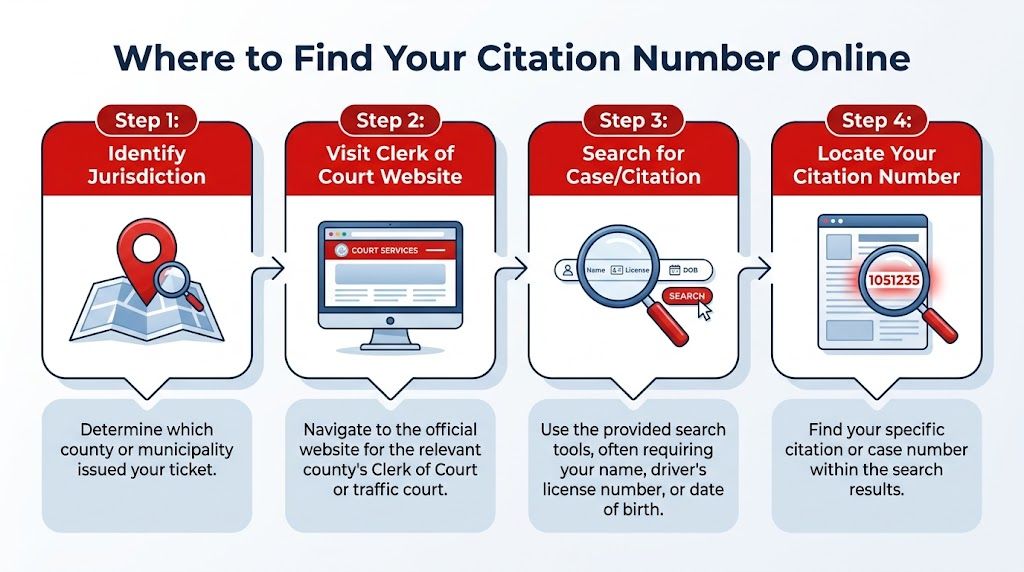
Florida doesn’t run one simple statewide court portal for traffic tickets. It uses a decentralized clerk system across 67 counties, each with its own website and search method, as explained in this Florida citation lookup guide. That means your first job is identifying the correct county.
If you got stopped in Orlando, start with Orange County, not your home county. If you got cited on the way to Fort Lauderdale, the county of issuance controls. Jurisdiction comes first.
What information should you have ready
County clerk systems usually ask for overlapping identifiers. Before you start, gather:
Your full legal name: Use the same format that appears on your license.
Your date of birth: Clerk systems often narrow results with DOB.
Your Florida driver’s license number: This is often the strongest search tool.
The county of the stop: Don’t guess. Confirm it.
Any partial ticket details: Agency name, statute number, or approximate issue date can help.
Some counties also use citation formats that are easy to mistype. If the paper ticket is wrinkled or photographed poorly, recheck every character.
What does a real county search look like
Take Orlando as the example. If the stop happened in Orange County, go to the Orange County Courthouse traffic or clerk portal and search using your driver’s license number or personal details. If the result appears, open the case carefully and confirm the charge, issue date, and deadline before doing anything else.
Don’t rush straight to payment. First make sure you understand what you’re looking at. A citation can contain details that change how you should respond.
Here’s the simple workflow I recommend:
Identify the issuing county
Use that county’s Clerk of Court traffic search
Search by driver’s license number first if available
Cross-check your name and birth date
Save screenshots of every result
Write down the citation number exactly as shown
Search results are only useful if you preserve them. Screenshot the case page, the deadline, and the listed options before you click away.
If you still have the paper citation but can’t make sense of the codes and layout, review how to read a Florida traffic citation. That will help you match what’s on the paper to what appears in the clerk system.
Common online lookup mistakes
Drivers lose time by making basic errors:
Searching the wrong county: The stop location matters more than where you live.
Entering a nickname: Use your legal name.
Misreading characters: An alphanumeric citation can fail because one letter or number is off.
Relying on one search field only: If citation number search fails, try license-based search.
Assuming a city police stop belongs to a city website: Traffic case processing usually flows through the county clerk.
If you’re using citation number lookup florida tools online, precision matters. One wrong character can make a live case look invisible.
What If the Online Search Fails
People often fall into a trap. They search. Nothing comes up. They feel relieved for a day or two. Then the deadline gets closer, or worse, passes.
A failed search does not mean the ticket disappeared. Florida citation systems often take 2 to 14 days to show a citation online, according to guidance on Florida ticket lookup delays. That lag creates a dangerous gap between issuance and visibility.

Why no results can be dangerous
The clock doesn’t wait for the database. If the officer issued the citation, your legal problem exists whether the clerk has posted it yet or not.
That’s especially serious if your work depends on your license. Delivery drivers, rideshare drivers, and professionals who need a clean record can’t afford to sit on a false negative.
No online result is not a green light. It’s a warning that the system may be behind you.
Some counties explicitly tell drivers to search again later because the citation may not have been submitted yet. That advice is better than silence, but it doesn’t solve your deadline problem.
What should you do instead of waiting
If the county portal fails, switch to a manual follow-up plan right away.
Call the Clerk of Court traffic division: If your ticket is in Broward, think in terms of the Broward County Judicial Complex and the county traffic clerk handling the case.
Contact the issuing agency: Florida Highway Patrol, a sheriff’s office, or local police department may confirm basic citation details.
Use alternate search inputs: Try driver’s license number, citation number if partially known, and vehicle plate if the portal allows it.
Check again on a schedule: Search periodically during the processing window instead of once.
Keep a written log: Note dates, times, and who you spoke with.
A short troubleshooting table helps:
Problem | Likely issue | Best response |
|---|---|---|
No search result | Clerk hasn’t processed the citation yet | Recheck and call the traffic clerk |
Citation number rejected | Character error | Re-enter carefully and compare letters versus numbers |
Wrong county portal | Jurisdiction mismatch | Search the county where the stop occurred |
Only a notice appears | Different citation type | Confirm whether it’s a court citation or separate notice |
Mistakes I see stressed drivers make
The worst move is passive waiting. The second worst move is guessing and paying the wrong item.
If you searched and found nothing, do this next:
Don’t assume you’re safe
Don’t stop tracking the date of issuance
Don’t rely on one app or automated checker
Don’t wait until the last week
If a court date or required response is approaching and you’re still in the dark, review what happens if you miss a court date in Florida traffic court. The point is simple. Delay strips away options.
Are There Other Ways to Check My Florida Driving Record
Yes. If the county search is unclear, use a broader check through FLHSMV. Florida’s driver record tools can show citations tied to your license, which makes them useful when a county portal is unhelpful or you’re not fully sure where the case landed.
This is a verification tool, not a one-stop solution. It can help you confirm that something has hit your driving record, but county-level action still controls payment, elections, and case handling.
When should you use the FLHSMV check
Use it when:
You lost the ticket and don’t trust your memory of the county
You’ve searched locally and still can’t confirm the case
You want to see whether a citation has attached to your driving history
You’re dealing with more than one ticket
Florida’s system also allows lookups using different identifiers in some contexts, including driver’s license number, citation number, or license plate. That can help when one search path fails but another works.
For a broader records review, see how to check your Florida driving record for points.
Are red light camera notices different
Yes. Don’t lump them together with ordinary traffic citations.
Red light camera matters often follow a separate path and may require lookup through ViolationInfo.com using the notice number rather than the standard county citation workflow. If you keep searching a clerk portal for something that began as a camera notice, you can waste valuable time.
That distinction matters in practice:
Standard moving citation: Usually tied to county clerk traffic systems
Camera-based notice: Often starts outside the normal clerk search path
Driver history issue: May show up at the state record level after processing, but action still depends on the correct channel
Use the state record to verify. Use the county or notice-specific system to act.
If your case is in Hillsborough County, for example, the official handling still runs through the local court structure tied to places like the Edgecomb Courthouse. State records can inform you. They don’t replace the local process.
I Found the Citation Number, Now What
Now the main decision starts. Finding the number solves the identification problem. It does not solve the legal problem.
Florida Statute 318.14(4)(a) requires you to pay or elect a defensive option for a civil traffic infraction within 30 calendar days from the date of issuance, as stated in Florida civil traffic infraction guidance. Miss that deadline and you can face late fees and license suspension risk.

What are your actual legal options
Most drivers face three choices after locating the case.
Pay the ticket
This is the fastest option. It’s also often the worst for your record because payment is typically treated as an admission that closes the case, not a strategy that protects you.Elect traffic school
This can make sense in some situations, but it still costs time and money, and it isn’t a universal fix. It also doesn’t erase the fact that you had to deal with the citation in the first place.Fight the ticket
This is the only route aimed at avoiding the conviction consequences that drivers usually care about most.
Which choice protects your record
If your goal is No Points, don’t look at this as a fine-management exercise. Look at it as record protection.
Paying is convenient. Convenience is expensive when it leads to points, insurance consequences, or a preventable mark on your history. Traffic school can be useful in some circumstances, but it’s still a limited tool, not a shield against every outcome.
A quick comparison makes that clear:
Option | Immediate convenience | Record protection focus |
|---|---|---|
Pay | High | Low |
Traffic school | Moderate | Limited |
Fight | Lower at the start | Strongest strategic path |
The right response depends on the charge, your prior record, and what the court file says. If you’ve just located the number and need a practical next move, review what to do when you get a Florida ticket.
The ticket isn’t resolved because you found it. It’s resolved when you choose the option that protects your license instead of simply closing the file.
Automated apps and ticket mills fall short. They push volume. They don’t replace legal judgment. A real defense requires someone to read the citation, evaluate the court, spot procedural opportunities, and decide whether the smartest move is challenge, mitigation, or another targeted response.
Conclusion: Dont Let a Lost Ticket Decide Your Fate
A lost ticket can turn into a missed deadline fast. That’s the actual threat. Not the missing paper. Not the temporary confusion. The threat is letting Florida’s clerk delays and county-by-county systems push you into inaction.
You now know the right sequence. Identify the county. Search the correct clerk portal. Follow up if the system shows nothing. Verify through your driving record when needed. Then make a decision that protects your license, not just your wallet.
For drivers in Miami-Dade, that may mean dealing with a case tied to the Richard E. Gerstein Justice Building. In Orlando, it may mean checking the Orange County Courthouse process. The courthouse changes. The rule doesn’t. Act early, document everything, and don’t confuse delay with safety.
If your ticket involves Chapter 316 conduct such as speeding under 316.187, careless driving, equipment issues, or another traffic infraction, the smart move is immediate control. Lost paperwork should never decide the outcome of your case.
If you want a lawyer-led Florida traffic defense team that handles the search, the court process, and the strategy with a direct line to your attorney by phone or text, contact Ticket Shield, PLLC for a free consultation. Skip the chatbot and middleman approach. Protect your license. Fight for the No Points outcome.