How to Check My Florida Driving Record for Points and Protect Your License
Learn how to check my Florida driving record for points using the FLHSMV portal for about $2.75–$3.00, and review your 12-, 18-, and 36-month totals.
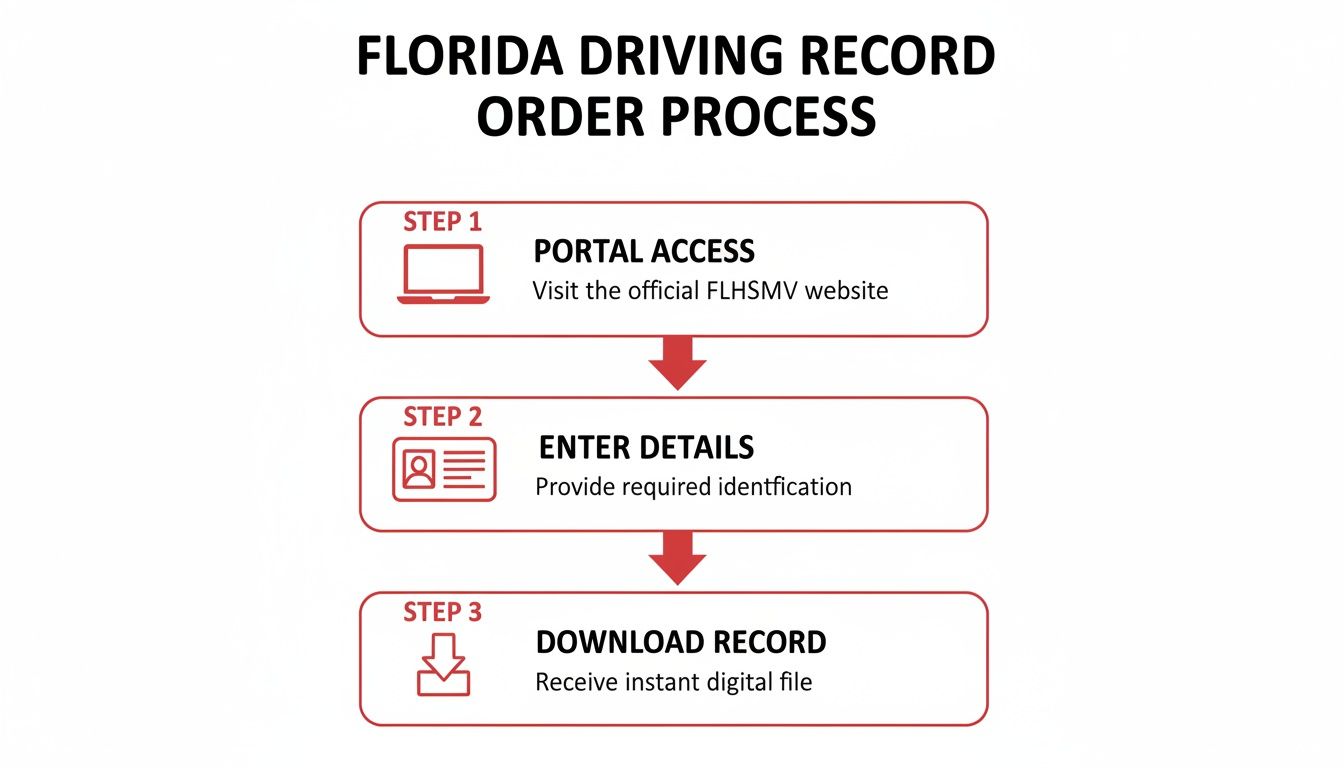
To check your Florida driving record for points, you must order your official driving history directly from the Florida Highway Safety and Motor Vehicles (FLHSMV) online portal. This is the only document that matters. Do not rely on unofficial third-party sites for this critical information.
You received a traffic ticket. Now what? Waiting for a suspension notice from the state is risky. Every Florida driver should understand what is on their official record.
Do not trust third-party background check websites. Their reports are often outdated, incomplete, and useless for legal matters. You must get your official document from the source: the Florida Department of Highway Safety and Motor Vehicles (FLHSMV). This is the only report a judge or prosecutor will see. It details every conviction and the points on your license.
If you only remember one thing from this guide, make it this: there are two different things you can do online, and drivers constantly confuse them. The free FLHSMV Driver License Check tells you whether your license is currently valid, suspended, or revoked. It does not show your full points history. The paid official driving record order shows convictions and points. Start with the free status check if you just got a ticket or a suspension notice; order the paid record when you need to see exactly what is on file.
How do I get my official Florida driving record?
You have a few ways to request your record. Your choice depends on how quickly you need it.

The online portal is the fastest and most direct path. The data you get is the same information law enforcement, judges, and insurance companies use. An unofficial report provides a false sense of security. If you are concerned about a suspension, you must also know how to check if your license is suspended. Choosing a lawyer to interpret that record is a separate challenge, and you can read more from HeyAtty to weigh what matters before you hire anyone.
Here is a quick comparison of the official methods.
What are the methods to get my official Florida driving record?
Method | Cost (Approximate) | Delivery Time | Best For |
|---|---|---|---|
Online (FLHSMV Portal) | $2.75 - $3.00 | Instant (Downloadable PDF) | Speed and convenience; getting your record immediately. |
Mail Request | $2.50 - $3.00 | 2+ weeks | Drivers who do not need the record urgently. |
In-Person (Tax Collector) | $2.50 - $3.00 + service fee | Instant (Printed copy) | Getting a physical copy the same day. |
The online portal is the clear winner for most drivers. It is fast, cost-effective, and gives you the official document you need in minutes.
How we verified the official Florida process
Before trusting any walkthrough, you should know where it came from. We built this guide by reviewing the FLHSMV's own pages on points and point suspensions, the Driver License Check tool, the record-order options listed on its site, and the governing statutes, including Florida Statute § 322.27, which sets the point-suspension thresholds, and § 318.14, which governs the Basic Driver Improvement election. We treated FLHSMV pages and the Florida Statutes as the official answer and used third-party summaries only for context, never as the source of a rule.
What would disqualify a source for us? Any site that quotes point values without citing the statute, claims a course can erase existing points, or patches together outdated fee schedules. In our experience handling thousands of Florida traffic cases, the details that trip drivers up are almost always the ones a generic blog got wrong: which record type shows points, which date starts the suspension clock, and how often you can elect driver improvement.
Why must I check my driving record right now?
There are four practical reasons to pull your record instead of waiting for the state to act. First, confirm whether points from a recent ticket have posted, since convictions can appear weeks after you paid. Second, verify that a ticket you paid closed without a surprise conviction. Third, see whether you are approaching one of the suspension thresholds. Fourth, understand what insurers and employers will see, because points raise premiums and can affect jobs that require driving.
Consider this hypothetical example: you pay a ticket in January, assume the matter is over, and never notice that the court reported a conviction with points attached. Months later, a second ticket pushes your rolling total over the limit. By the time FLHSMV mails the suspension notice, the first conviction has already counted against you. According to FLHSMV data, Florida law enforcement issues millions of traffic citations annually, many for non-criminal moving violations that add points — which is exactly why avoiding a license suspension for points in FL starts with knowing your current total, not reacting to a notice.
A single conviction adds points to your license for at least 36 months. Understanding how to check points on your license helps you stay ahead of these rolling windows.
How do I use the FLHSMV online portal?
Start with the free tool. FLHSMV's Driver License Check shows the current status of your license — valid, suspended, or revoked — at no cost. It is the right first step after any ticket or suspension notice, but it will not show you your convictions or point totals. That requires ordering an actual record. Knowing how to check points on license for free means using this status tool first, then paying only when you need the full history.
FLHSMV separately sells three record types — a 3-year, a 7-year, or a complete driving history — through the portal or driver-license service centers per FLHSMV's points and suspensions page. For checking points, order the complete record. The 3-year and 7-year versions truncate history, and a conviction older than the window you bought can still be counting toward a 36-month rolling total. Expect roughly $2.75–$3.00, with the official PDF available immediately after payment.
What information will I need?
Have this information ready before you begin:
Your Florida driver's license number
Your date of birth
The last four digits of your Social Security number
A valid credit or debit card for the processing fee
Common problems and how to handle them
Portal cannot find your record: double-check that you entered the license number correctly, without dashes.
Payment declines: use a standard credit or debit card.
Wrong record type ordered: if you bought a 3-year record and cannot find an older conviction, order the complete history before drawing conclusions.
No internet access or payment issues: a local tax collector's office or driver-license service center can print your record the same day for a similar fee.
As you review your record, our guide on how to check driving records can provide more context.
How do I read and understand my Florida driving record?
Your official FLHSMV report is filled with legal codes. It is not a user-friendly document. You must decipher it to understand where you stand. Learning how to check how many points i have on my license requires reading the conviction dates carefully.
Focus on the “Violations/Convictions” section. Each entry lists the citation date, conviction date, the specific offense code, and the court's final disposition. Two fields decide everything:
Citation date: when the officer wrote the ticket. It does not affect your point totals.
Conviction date: when the court reported the guilty finding. This date officially starts the clock for point accumulation, and it can land weeks or months after the citation.
Many drivers get a false sense of security from a ticket's citation date, only to have the conviction posted later and push a rolling total over a threshold.
How do I calculate my point totals?
Count the points attached to every conviction within three rolling windows: the last 12, 18, and 36 months. The state applies escalating thresholds under § 322.27, so one conviction can appear in all three totals simultaneously.
Point values are set by Florida statute. Confirmed examples include reckless driving, which carries 4 points, a stop sign violation, which carries 3 points, and a red light ticket issued by an officer, which carries 4 points. Always verify specific offenses against the official FLHSMV points schedule or the relevant statutes, such as § 316.187.
Here is a worked example. Suppose you were convicted of a 4-point speeding offense in March, a 3-point stop-sign case in June, and a 3-point careless driving conviction in September. Within any 12-month window spanning those three months, you carry 10 points — no suspension yet, but two points from anything else puts you at the 30-day threshold. Because all three convictions occurred within 18 months, your 18-month total is also 10. And once you cross 12 points inside 12 months, the earlier points still count toward the 18- and 36-month tiers, which carry longer suspensions.
One more nuance: an entry can remain visible on your complete history far longer than it counts toward a suspension window. Insurers reviewing your record may charge against a violation that no longer threatens your license. Speeding convictions add points on your license under § 316.187's schedule, and the difference between what the statute counts and what an insurer sees is exactly why we check the full document with our clients rather than eyeballing the most recent lines.
What are Florida's license suspension point thresholds?
Knowing Florida's point thresholds is the first step in protecting your license. The state uses a strict, tiered system where points lead directly to suspensions.
These are the lines you cannot cross:
12 points within a 12-month period results in a 30-day suspension.
18 points within an 18-month period results in a 3-month suspension.
24 points within a 36-month period results in a 1-year suspension.
A license suspension is a common threat. In a single recent year, 15,944 drivers were suspended for 12 points, 3,536 for 18 points, and 3,612 for 24 points. Review the official report on Florida's strict point system enforcement for yourself.
It only takes a couple of tickets to push you over these limits. You need to understand precisely how many points can suspend a license.
What should I do after finding points on my record?
You checked your record and found points. What you do next depends entirely on whether the case that produced them is still open or already closed.

If the ticket is still open — you have not paid, attended court, or missed the deadline — you still control the outcome. Your options are to contest it, negotiate a reduced or non-points disposition, or, if eligible, elect a Basic Driver Improvement (BDI) course under § 318.14 to keep points off. Do not pay the fine: paying is an admission of guilt that guarantees the conviction and locks in the points.
If the conviction is already posted from a closed case, the realistic goals change. A BDI course cannot erase points already on your record, and neither can any other course. What remains is management: confirm the conviction date so you know exactly when the points fall out of each rolling window, watch your totals against the suspension tiers, and contest any future ticket aggressively so new points never stack on top. If a posted conviction looks erroneous — wrong offense code, a disposition you never agreed to — that is worth legal review, because correcting a reporting error can change your point math.
What to do — and what not to do
Do:
Preserve every document: the citation, receipts, court filings, and correspondence.
Note the deadline on an open ticket and respond promptly according to the instructions on your citation.
Gather proof that matters to your case: insurance records, dashcam footage, or calibration disputes, depending on the charge.
Get legal review before any payment or election, especially for a second or third ticket in the same rolling window.
Do not:
Pay a ticket just to "get it over with" — that is how points get locked in.
Elect BDI as a reflex if you may need it for a more serious charge later; Florida limits how often you can use it.
Assume the courthouse and FLHSMV will fix their own reporting errors without being asked.
At Ticket Shield, PLLC, you speak directly with your attorney via phone or text. Points from a conviction stay on your record for at least 36 months, raising insurance rates and affecting employment. You can read more about how points can impact your license over time to understand why a swift, strategic defense is critical.
Can I call to check if I have points on my license in Florida?
Yes, but be realistic about what a call will get you. FLHSMV's customer service line can confirm your license status and general record information, but it is generally used for status inquiries. For an authoritative answer about whether you have points and how many, the complete record you order online or through a tax collector is the evidence you need. If you call FLHSMV, have your license number, date of birth, and the last four of your SSN ready, and confirm the agency's specific policy for detailed point inquiries.
Have questions about your Florida driving record?
Once you pull your record, you will have questions. This is especially true if you found unexpected points. Here are answers to common questions from our dedicated traffic defense team.
How long do points stay on my Florida license?
Points from a conviction count against you for 36 months (3 years). During that time, they accumulate and can lead to a suspension. The violation itself remains on your complete driving history much longer. This is what insurance companies review when setting your premiums.
Can I take a driving course to remove points?
No. This is a common misconception. You cannot take a course to remove points that are already on your record from a past conviction. For certain new tickets, you may be eligible to elect a Basic Driver Improvement course to avoid points. Florida law is strict and limits how often you can use this option. It is a preventive measure, not a cure.
Will checking my own driving record hurt my license?
Absolutely not. When you request your own official driving record from the FLHSMV, it is a "soft inquiry." It has zero negative impact on your license status or insurance rates. It is a smart, protective step every Florida driver should take regularly.
Found points on your record? Visit TicketShield.com for a free, confidential consultation to see how we fight for a "No Points" outcome.