How Many Points to Suspend a License in Florida?
Need to know how many points to suspend license in Florida? It’s 12 in 12 months for 30 days, 18 in 18 months, and 24 in 36 months.
In Florida, accumulating 12 points within a 12-month period is the threshold that triggers a driver's license suspension. However, that's only the first tier. The Florida Highway Safety and Motor Vehicles (FHSMV) imposes longer suspensions for drivers who accumulate more points over extended periods, reflecting a pattern of traffic violations.
How We Verified Florida License Suspension Rules
We checked this article against the current Florida Highway Safety and Motor Vehicles rules on points and point suspensions, then cross-checked the timing rules against Florida-specific ticket and point guidance already published on this site. In our review of FHSMV materials, the most important issue was making sure the article answers the suspension question using the same conviction-based framework the state uses—not a simplified ticket-date estimate.
We also treated older or generic point-system explanations as unreliable if they blurred the difference between the date you were cited and the date you were convicted, mixed Florida law with another state's system, or skipped the rolling 12-, 18-, and 36-month windows entirely. Those are the shortcuts that usually create confusion.
One point we see drivers misunderstand most often is timing: points are assessed from the date of conviction, and multiple rolling periods can overlap at the same time. That means a driver can underestimate risk even when each individual ticket seems manageable on its own. Where this article gives examples, they are practical illustrations checked against current FHSMV thresholds and our own Florida point-system coverage, not guesses about how a judge or prosecutor will handle a specific case.
How Florida's License Point System Works
If you want the short answer, Florida uses three suspension thresholds: 12 points in 12 months = 30-day suspension, 18 points in 18 months = 3-month suspension, and 24 points in 36 months = 1-year suspension, according to the FHSMV point-suspension rules. Florida also states that points remain on the driving record for at least five years from the date of conviction, so even when the suspension window has passed, the violation history can still matter.
The part that trips people up is the clock. Florida counts these windows from the date of conviction, not the day the officer handed you the ticket. Each conviction starts its own timeline, so the state is looking at rolling periods that can overlap. In our review of FHSMV rules, that conviction-date issue was the easiest place for a reader to get a wrong answer from a generic article.
That also means a suspension can happen faster than drivers expect. You do not need a huge stack of tickets. A few lower-point moving violations close together can be enough. For example, three separate speeding convictions worth 4 points each within 12 months would total 12 points and put you at the 30-day suspension threshold. For a more detailed look at how specific violations contribute to your total, you can learn more about the Florida traffic ticket point system in our in-depth guide.
The Three Tiers Of License Suspension
Florida's system is built to detect repeat violations over time, not just punish one bad day. The state reviews your record across rolling 12-, 18-, and 36-month periods, which is why several ordinary citations can create a much bigger problem than drivers expect.
Florida License Suspension Point Thresholds
Points Accumulated | Timeframe | Suspension Period |
|---|---|---|
12 points | Within 12 months | 30-day suspension |
18 points | Within 18 months | 3-month suspension |
24 points | Within 36 months | 1-year suspension |
These are the established rules the FHSMV follows. As shown, the penalties become progressively more severe as more points are accumulated.
It is important to remember that the timeline begins on the date of conviction for the violation, not the date the ticket was issued. Each conviction establishes its own timeline, which can make tracking your point status complicated. For a more detailed look at how specific violations contribute to your total, you can learn more about the Florida traffic ticket point system in our in-depth guide.
Key Takeaway: In Florida, the first suspension tier starts at 12 points in 12 months. Because the periods roll forward from conviction dates, several common moving violations can trigger a suspension even when none of them seems major by itself. Our goal is to protect your license and record. Past results do not guarantee future outcomes.
Attorney Advertisement. Office in Broward.
How Traffic Violations Add Points to Your Record

Points are added to your license as a direct consequence of a traffic conviction. The process begins when an officer issues a ticket and becomes official once the Florida Highway Safety and Motor Vehicles (FHSMV) records the conviction in your driving history.
A critical detail many drivers overlook is that paying a traffic ticket is legally equivalent to pleading guilty. This action concludes the case and automatically instructs the FHSMV to add the corresponding points to your record. There is no trial or negotiation—just a conviction and the associated penalty.
Every time you pay a fine, you are moving one step closer to a potential license suspension.
Point Values for Common Florida Violations
The FHSMV assigns point values based on the seriousness of the violation. For self-checking purposes, it helps to group common citations by whether they usually add 3, 4, or 6 points. Florida's official point chart appears on the FHSMV suspension and points page.
Common 3-point violations
Speeding less than 15 mph over the limit: 3 points
Running a stop sign: 3 points
Running a red light: 3 points
Careless driving: 3 points
Improper lane change: 3 points
Unlawful use of a wireless device in a school or work zone: 3 points
Common 4-point violations
Speeding 15 mph or more over the limit: 4 points
Running a stop sign or red light that causes a crash: 4 points
Passing a stopped school bus: 4 points
Reckless driving: 4 points
Common 6-point violations
Speeding that results in a crash: 6 points
Leaving the scene of a crash with property damage over $50: 6 points
Any moving violation that results in a crash and serious added consequences can escalate quickly
Understanding these values is important. See how speeding ticket points work for a breakdown.
How 12 Points Can Happen Faster Than You Think
In practice, the first suspension threshold is not hard to reach if the tickets are close together. We see drivers assume they are safe because they have only two or three cases, but the point value of each one matters.
Two simple examples show how quickly a Florida license can get to 12 points:
4-point speeding + 4-point speeding + 4-point speeding = 12 points
3-point stop sign + 3-point red light + 6-point crash-related offense = 12 points
If those convictions all land within a 12-month rolling period, that is enough for a 30-day suspension. A driver does not need a DUI or a felony traffic case to hit the first tier.
The Snowball Effect of a Single Ticket
Consider a common scenario: you receive a ticket for driving 16 mph over the speed limit. To save time, you pay the fine online. By doing so, you have accepted a conviction and added 4 points to your license.
Your insurance provider may see this new conviction during a policy review. They might reclassify you as a higher-risk driver, leading to an increase in your premiums. A few months later, another minor ticket adds more points to your record, placing you closer to a suspension.
This illustrates how a single decision to pay a fine can initiate a chain reaction, impacting your finances through insurance hikes and jeopardizing your driving privileges by moving you closer to suspension thresholds.
This highlights the importance of strategically handling every citation to prevent points from accumulating.
What 3 or 4 Points on Your Florida License Actually Mean
Three or four points do not suspend your license by themselves, but they matter because they are the building blocks of most Florida point suspensions. A 3-point ticket usually means a standard moving violation such as a stop-sign, red-light, or lower-range speeding conviction. A 4-point ticket often signals either higher-speed conduct or a violation tied to a crash.
In practical terms, 3 points means you are one ordinary moving violation conviction closer to trouble than you were before. 4 points is more serious because three 4-point convictions in one 12-month period add up to the 12-point threshold. We find that drivers tend to dismiss 4 points as “just one ticket,” when it is one-third of a suspension in the first rolling window.
The other issue is duration. In Florida, points count toward suspension for up to 36 months under the state's rolling suspension windows, and the underlying record entry can remain visible longer. FHSMV states that points remain on the driving record for at least five years from conviction on its official points page. So while 3 or 4 points are not an automatic crisis, they should change how carefully you handle the next citation.
Stricter Rules for CDL Holders and Young Drivers
Not all drivers are subject to the same rules under Florida's point system. For professional drivers with a Commercial Driver's License (CDL) and young drivers under 18, the state enforces stricter standards. This approach is based on the principles of professional responsibility and the inexperience of young drivers, both of which necessitate a higher level of accountability.
For these drivers, a violation that might be a minor issue for a typical motorist can quickly escalate, leading to faster suspensions or disqualifications. If you are a professional driver, a teen, or the parent of a young driver, it is essential to be aware of these different standards.
Commercial Driver's License (CDL) Holders
A CDL is more than just a license; it is a professional credential. Consequently, Florida holds commercial drivers to a much higher standard. A violation that a regular driver might consider minor can have career-altering consequences for a CDL holder.
For example, certain serious traffic offenses can trigger a one-year disqualification of a CDL on the first offense, regardless of whether the driver was operating a commercial or personal vehicle. These are major violations, including:
Driving a commercial vehicle with a blood alcohol level of .04% or higher.
Leaving the scene of an accident.
Using a commercial vehicle to commit a felony.
Even a common offense like a speeding ticket carries greater weight. Accumulating just two "serious traffic violations" within three years can lead to a 60-day disqualification. A third violation in that same period increases the penalty to a 120-day disqualification. For a professional driver, this means months without income. We handle criminal traffic matters across Florida and understand the professional stakes involved. You can learn more about the unique challenges in our guide to CDL speeding tickets.
Young Drivers Under 18
Florida’s Graduated Driver Licensing (GDL) laws are designed to introduce teenagers to the responsibilities of driving gradually. A key component of this system is a more stringent approach to point accumulation, intended to correct risky behavior early.
For any driver under the age of 18, the number of points required to lose full driving privileges is significantly lower.
If a driver under 18 accumulates six or more points on their record within a 12-month period, their license is automatically restricted to "Business Purposes Only" for one full year. If additional points are accrued during the restriction period, the restriction is extended by 90 days for each new point.
This means a single ticket for speeding 15 mph over the limit (4 points) combined with another for running a stop sign (3 points) would be sufficient to trigger this year-long restriction. Our practice focuses on traffic and DUI defense, with the objective of protecting your license and record. Past results do not guarantee future outcomes.
Attorney Advertisement. Office in Broward.
When Your License Can Be Suspended Instantly
While Florida’s point system can lead to a suspension over time, certain serious offenses can result in an immediate suspension, regardless of a driver's prior record. These violations are considered so severe that the state does not wait for points to accumulate.
In these cases, both the court and the Florida Highway Safety and Motor Vehicles (DHSMV) can take swift action to remove a driver from the road. This is a separate process from a points-based suspension, and it is vital to understand how it operates.
Offenses That Trigger Immediate Suspension
Some on-road offenses are serious enough to bypass the point system entirely. A conviction for one of these violations often results in a direct, court-ordered suspension of driving privileges. This is not a warning but a direct penalty for a single, severe error in judgment.
Common examples that can trigger an immediate suspension include:
Driving Under the Influence (DUI): Any DUI conviction includes a mandatory license suspension.
Leaving the Scene of an Accident: Fleeing an accident, particularly one involving injury or death, is a felony that leads to immediate license revocation.
Reckless Driving: A conviction for reckless driving can result in the court ordering a license suspension.
This flowchart illustrates how different driver categories are treated under Florida law, highlighting the stricter rules for young and commercial drivers.
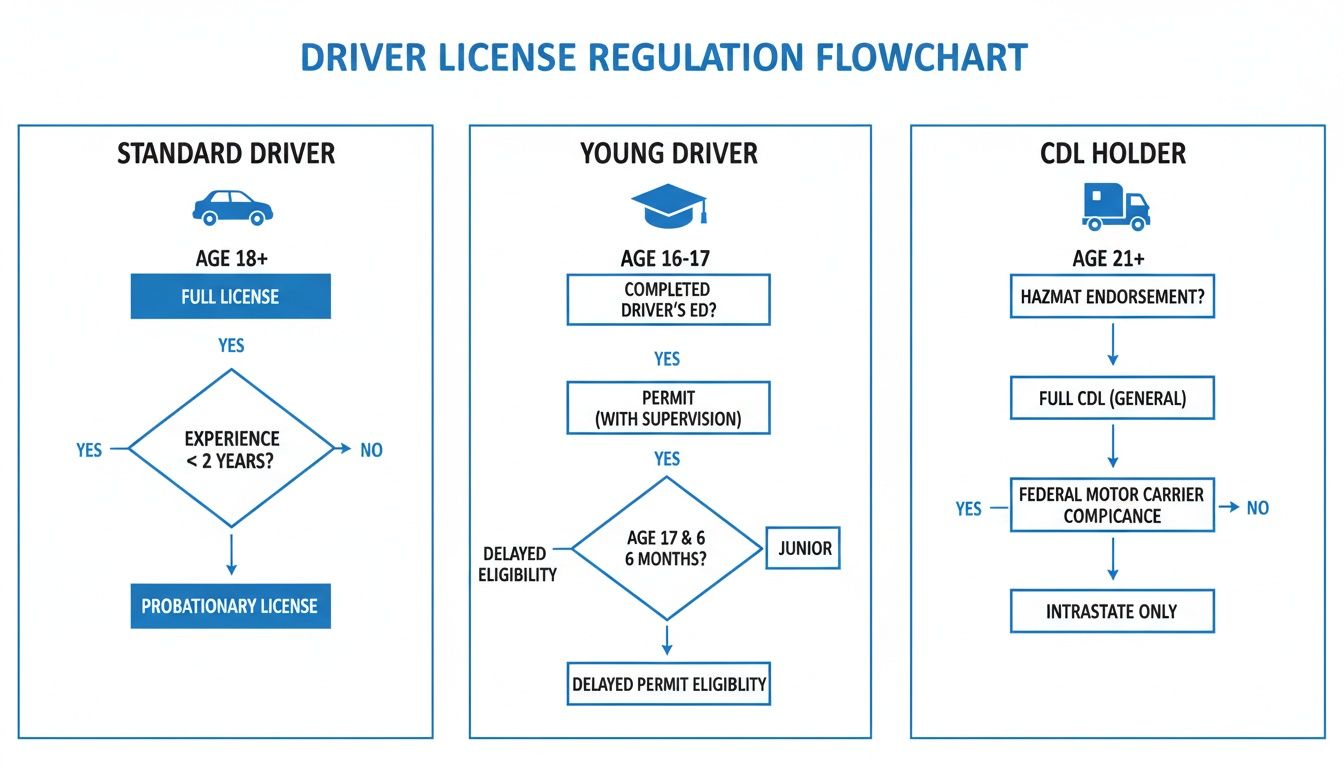
As shown, the regulations are not uniform. The state applies a much higher standard of conduct to CDL holders and young drivers.
The Two-Track DUI Suspension Process
A DUI charge in Florida is particularly complex because it initiates two separate suspension processes simultaneously. Understanding this dual-track system is critical, as it requires defending your license on two different fronts.
Administrative Suspension (DHSMV): This process begins at the time of the DUI arrest. If you refuse a breathalyzer test or provide a sample with a blood alcohol concentration over the legal limit of .08, the arresting officer will confiscate your physical license. You will be issued a temporary permit, but you have only 10 days from the arrest date to request a formal review hearing to challenge this administrative suspension.
Court-Ordered Suspension (Criminal Court): This suspension occurs only if you are later convicted of the DUI charge in criminal court. It is a separate penalty from the administrative action taken by the DHSMV.
It is possible to win the administrative hearing and retain your license, only to have it suspended later by the court upon conviction—and the reverse is also true. These must be treated as two independent legal battles.
Navigating the administrative process requires immediate action within the strict 10-day window. You can learn more about the specifics of an administrative license suspension hearing to understand these critical first steps. Our goal is to protect your license and record. Past results do not guarantee future outcomes.
Attorney Advertisement. Office in Broward.
Proactive Strategies to Protect Your Driving Record

A traffic ticket is the start of a legal process, not the final word. Paying the fine is equivalent to a guilty plea and guarantees that points will be added to your record. A proactive approach, however, can help you manage your driving record, avoid insurance increases, and keep your license from being suspended.
If You Just Got a Ticket
A useful first sequence is straightforward:
Check your current driving record so you know whether this new citation would leave you at 3 or 4 points—or push you toward 12, 18, or 24.
Review whether traffic school is still available for this ticket and whether you have already used your election recently.
Watch every deadline on the citation so you do not lose options by waiting too long.
Weigh contesting the ticket more seriously if the added points would put you near a suspension threshold.
In our experience reviewing Florida point situations, the biggest mistake is treating every ticket the same. A 3-point ticket feels very different when your record is otherwise clean than when you are already sitting at 9 points.
Electing Traffic School to Withhold Points
One of the most common options is to elect to attend a driver improvement course, often called traffic school. For eligible citations, completing a state-approved course allows you to pay the civil penalty while the state withholds adjudication.
In simple terms, this means you are not formally convicted of the offense. no points are added to your license.
However, this option has strict limitations:
You can only elect to attend traffic school five times in your lifetime.
You can only use this option once in any 12-month period.
That makes traffic school a limited resource, not an automatic choice every time. Using one of your five lifetime elections can be worth it when the ticket would otherwise add points that materially raise your risk. It may be less valuable when the citation is minor, your record is clean, or another strategy offers a better result. We generally view traffic school as most useful when it keeps a driver from climbing into the next risk category rather than as a reflex move on every case.
Contesting Your Ticket in Court
Another proactive strategy is to contest the ticket in court. While this does not guarantee a win, it creates the opportunity for several positive outcomes. By challenging the citation, you require the state to prove its case against you.
An attorney can attend court on your behalf and work toward several objectives:
Seek a Dismissal: If the ticket contains errors or the issuing officer fails to appear, the case may be dismissed.
Negotiate a Reduction: It may be possible to negotiate a plea to a lesser offense that carries no points, such as a non-moving violation.
Contesting a ticket is usually most worth the effort when the added points would push you close to 12, 18, or 24, when the violation carries a higher point value, or when the insurance consequences are likely to outweigh the cost of defending the case. Our practice focuses on traffic and DUI defense, and our primary goal is to protect your license and record. Past results do not guarantee future outcomes.
How a Traffic Defense Attorney Can Assist You
Navigating Florida's traffic laws after receiving a ticket can be a confusing and stressful experience. The paperwork, deadlines, and court procedures can be overwhelming for those unfamiliar with the system. A professional who focuses on traffic defense can provide assistance.
When Legal Help Matters Most
Legal help tends to matter most when the stakes are higher than a routine fine. That usually includes drivers who are already close to 12 points, CDL holders facing disqualification exposure, drivers under 18 who are nearing a restriction, and anyone dealing with a citation that carries a high point value or a DUI-related administrative deadline.
Those situations are different from a low-risk first ticket because the downside is not just the citation itself. It can be the loss of driving privileges, missed work, higher insurance costs, or damage to a commercial driving career.
What an Attorney Actually Reviews
A lawyer handling a Florida traffic case typically reviews the citation, the driver's current record, prior point totals, filing and hearing deadlines, the officer's basis for the stop, and whether the charge creates room for a non-moving resolution or a withheld adjudication where available. In DUI-related administrative matters, timing is especially important because the deadline to act is short.
The realistic goals are usually specific: dismissal where the case has a weakness, reduction to a non-moving violation to avoid points, or another outcome that prevents the conviction from adding to a suspension-risk total. That is more useful than making broad promises, because the best result depends on the charge, the county, and the driver's record.
Representation and Negotiation
An attorney acts as your advocate within the legal system. They represent your interests in court and negotiate directly with prosecutors. With an understanding of local court procedures and traffic laws, they can identify weaknesses in a citation or find opportunities to secure a more favorable outcome.
This can lead to several positive results:
Negotiating for Lesser Charges: We often work to negotiate a moving violation down to a non-moving violation, which means no points are added to your record.
Arguing for a Dismissal: If procedural errors are found or the state's evidence is weak, we will argue to have the ticket dismissed.
Fighting the Ticket in Court: If negotiation is not the optimal path, an attorney can formally contest the citation and challenge the state’s evidence at a hearing.
By handling your case from start to finish, an attorney helps you avoid not only fines and points but also the insurance rate increases that often follow a conviction. Past results do not guarantee future outcomes.
Attorney Advertisement. Office in Broward. Submitting information via our forms does not create an attorney-client relationship. All consultations are confidential.
Your Questions About Florida's Point System, Answered
Here are answers to some of the most common questions Florida drivers have about license points and suspensions.
Can I Get Points Removed From My Florida License?
Florida does not have a system to remove points once they are on your record. After a conviction is recorded and points are added, those points remain on the record for the established retention period.
The only effective strategy is proactive: prevent the conviction from occurring in the first place. This can be achieved by successfully contesting the ticket or, if eligible, electing traffic school to receive an "adjudication withheld," which keeps points off your record.
How Long Do Points Stay on My Florida Record?
Points from a single ticket are counted toward a license suspension for 36 months (three years) from the date of conviction. However, the violation itself may remain visible on your driving record for a much longer period, often five to ten years.
This is why a ticket from four years ago could still be affecting your insurance rates, even if the points no longer pose a suspension risk.
How Can I Check How Many Points I Have?
The most accurate way to check your point total is to obtain your official driving record from the Florida Highway Safety and Motor Vehicles (DHSMV) website.
This report provides a complete breakdown of every traffic conviction and the associated points, offering the clearest picture of your current driving status.
Do Out-Of-State Tickets Add Points to My Florida License?
Yes, in most cases, they do. Florida is a member of the Driver License Compact, an agreement among states to share information about traffic violations.
If you receive a ticket for a moving violation in another member state, that state will report the conviction to Florida. The FLHSMV will then typically add points to your license as if the ticket were issued in Florida.
Important Note: The information provided is for educational purposes and does not constitute legal advice. Past results do not guarantee future outcomes. Submitting information does not create an attorney-client relationship.
If you are trying to decide what to do next, start with the practical pieces: confirm your current point total, compare the new ticket's likely point value, and check whether this conviction would move you toward a 30-day, 3-month, or 1-year suspension window. That gives you a much clearer basis for deciding whether to pay, elect traffic school, or fight the citation.
Facing a traffic ticket can be a stressful process, but you do not have to handle it alone. At Ticket Shield, PLLC, our practice focuses on traffic and DUI defense throughout Florida. We manage court appearances and legal procedures on your behalf. Our goal is to protect your license and your record.