Florida Speeding Ticket Points And How To Handle Them
Florida speeding ticket points are usually 3 or 4, with 6 if a crash is involved. See when points apply and how to avoid them.

A speeding ticket in Florida does more than just hit you in the wallet—it adds speeding ticket points to your driver's license. The Florida Highway Safety and Motor Vehicles (FLHSMV) keeps a running tally of these points, and if you are not careful, they can lead to a license suspension and insurance rate hikes.
Knowing how this system works is the first step in keeping your driving record clean.
How We Reviewed Florida Speeding Ticket Points Rules
This article is based on Florida-specific sources, not generic traffic advice. In our review of Florida's published rules, we checked the FLHSMV points and suspension schedule, clerk and court guidance on driver improvement school, and Florida procedures that require a court appearance for more serious speeding cases. We also compared those rules against the citation scenarios drivers most often ask about: paying the ticket, electing school, contesting the case, and resolving a charge without a moving violation conviction.
We see drivers misunderstand one issue more than any other: points are not usually created at the roadside. They are generally added after a conviction or after you pay the citation, because payment is treated as an admission. If Florida changes its point schedule, school-election limits, or mandatory-hearing procedures, that would change the practical advice in this article.
What The Florida Points System Means For You
In Florida, a speeding ticket usually adds points only after a conviction or payment of the citation. The standard point values are 3 points for driving 15 mph or less over the limit, 4 points for driving more than 15 mph over, and 6 points if the speeding conviction involved a crash, according to FLHSMV's points schedule.
That direct answer matters because many drivers assume the officer "gave" them points at the stop. In practice, points are generally not added if the case is dismissed, if the charge is reduced to a non-moving violation, or if you use an eligible traffic school election that keeps the moving violation points off your record. Paying the ticket is different: Florida treats payment as an admission, so the conviction is processed and the points follow.
Understanding the Point Values
Florida's system is simple on paper and unforgiving in practice. A single low-level speeding conviction typically means 3 points; crossing the 15 mph-over line usually raises that to 4; and a crash-related speeding conviction jumps to 6. For a more detailed look, you can learn more about how points accumulate on a Florida license.
We think the most useful way to read the chart below is not just as a fine schedule, but as a risk schedule. One 3-point ticket may be manageable. A 4-point ticket with older violations already on your record can change the decision you should make next.
Florida Speeding Ticket Points At A Glance
This table gives you a quick snapshot of how many points you can expect for different speeding offenses.
Speeding Violation (MPH Over Limit) | Points Assessed |
|---|---|
15 MPH or less | 3 Points |
16 MPH or more | 4 Points |
Speeding that results in a crash | 6 Points |
Leaving the scene of a crash with property damage of more than $50 | 6 Points |
Those values match Florida's published point schedule through FLHSMV. Florida court and clerk procedures also generally treat a paid civil traffic citation as a conviction, while eligible drivers may be able to elect school under Florida Statute 318.14 or local clerk procedures to avoid the point assessment in qualifying cases.
Attorney Advertisement. Office in Broward.
The True Cost Of Speeding Ticket Points
The fine printed on the citation is only the obvious cost. In Florida, the practical consequences depend on whether the ticket adds 3 points, 4 points, or 6 points—and on how close you already are to the state's suspension thresholds.
What 3 Points Mean In Practice
A 3-point speeding conviction usually means you were 15 mph or less over the limit. By itself, that does not suspend your license. Still, it becomes part of the cumulative record Florida uses to suspend drivers who reach 12 points in 12 months, 18 points in 18 months, or 24 points in 36 months, as listed by FLHSMV.
In our review of common ticket outcomes, 3 points is where many drivers underestimate the problem. One 3-point case can seem minor, but it materially narrows your margin for error if another moving violation follows.
What 4 Points Mean In Practice
A 4-point speeding conviction usually means the allegation was more than 15 mph over the limit. One 4-point ticket alone will not suspend a Florida license. But yes, 4 points are bad in the practical sense that they push you one-third of the way to a 12-point suspension trigger in a single case.
This is the point level we see misunderstood most often. Drivers hear "not suspended" and assume "not serious." The better way to think about it is accumulation: one 4-point ticket plus two more ordinary moving violations in the same 12-month window can put your license at risk.
What 6 Points Mean In Practice
A 6-point speeding conviction is usually tied to a crash. That is a major jump. It places you halfway to Florida's first suspension threshold in a single event, and it is the kind of record entry insurers are unlikely to treat as routine.
We avoid quoting made-up premium percentages because they vary by carrier, driving history, and market. What can be said confidently is simpler: a moving violation conviction, especially one connected to higher speed or a crash, gives insurers a documented reason to re-rate your policy. We break down that connection in our guide on how speeding tickets impact Miami insurance rates.
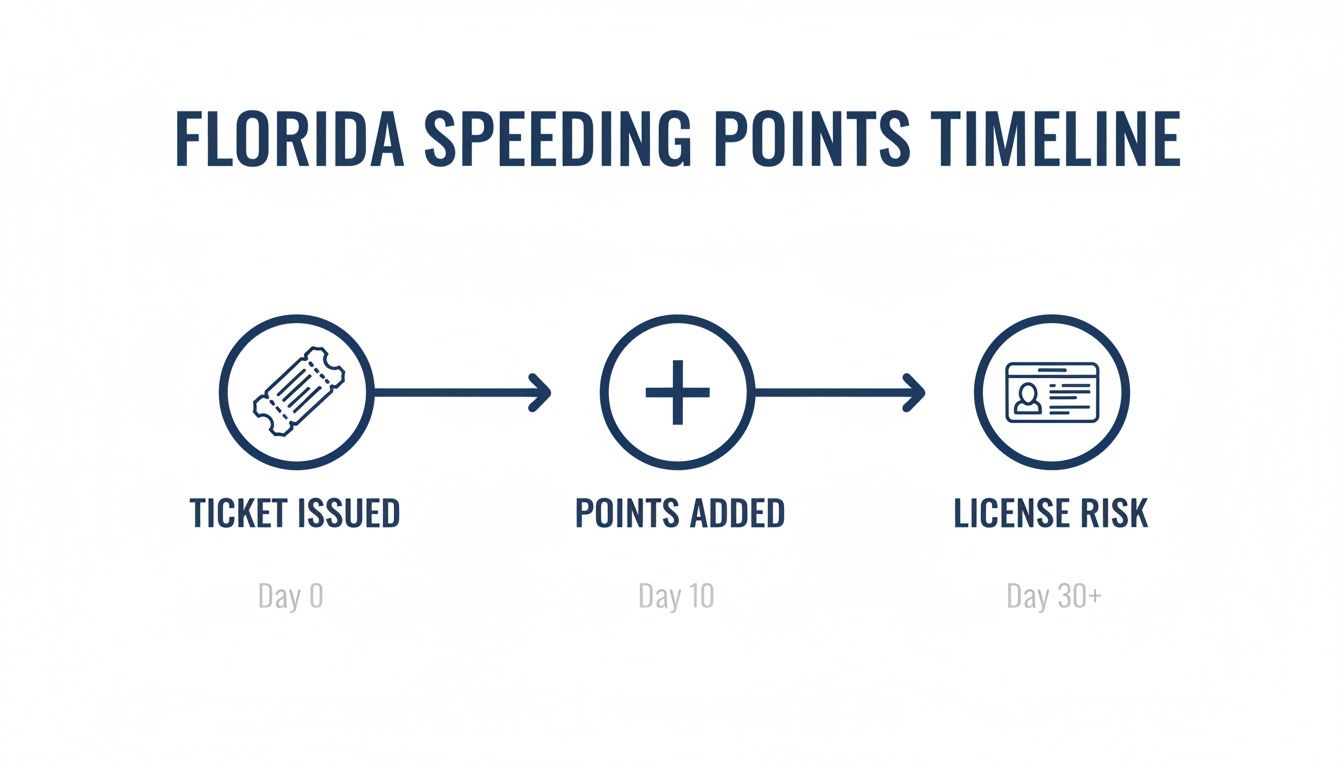
This timeline shows just how fast a simple ticket can escalate into a major problem for your license.
Florida’s Path to License Suspension
Florida uses a cumulative point system with hard thresholds. Under the state's published rules, these are the key suspension triggers:
12 points within 12 months gets you a 30-day suspension.
18 points within 18 months leads to a 3-month suspension.
24 points within 36 months triggers a 1-year suspension.
Those thresholds come directly from FLHSMV's suspension guidance. The practical takeaway is straightforward: one 4-point speeding ticket does not suspend you, but three 4-point moving violations within a year can.
A license suspension is more than just an inconvenience. It can interfere with your job, your family responsibilities, and your daily life, creating a domino effect of logistical and financial headaches.
Simply paying a ticket is admitting you're guilty. It ensures you get the points and can start the chain of insurance and suspension risk. Contesting a ticket can lead to a dismissal, a reduction, or another resolution that avoids a moving violation conviction.
How Points Are Assigned For Different Offenses
Florida does not treat every speeding case the same way, and drivers make better decisions when they separate point values from everything else that can make a citation more serious. In our view, the clearest way to understand the system is to break it into three buckets: standard speeding, speeding tied to a crash, and situations that affect fines or court handling without automatically changing the point total.
Standard Speeding Violations
For most Florida speeding tickets, the point assignment is based on how far over the limit the allegation is:
3 points for speeding 15 mph or less over the limit.
4 points for speeding more than 15 mph over the limit.
That breakdown is listed on the FLHSMV points table. A one-mile-per-hour difference can move a case from 3 points to 4, which is why the exact speed alleged on the citation matters.
Speeding Tied To A Crash
If the speeding conviction involved a crash, the point total increases to 6 points under the same FLHSMV schedule. This is not just a larger number on paper; it changes the risk profile of the case immediately because one conviction places you halfway to a 12-point suspension threshold.
When a crash is involved, we generally view the case as less suitable for a casual pay-and-move-on decision. The higher point exposure alone makes a closer review worthwhile.
Situations That Change Fines Or Court Handling
Some speeding cases are more serious because of where they happened or how fast the officer says you were traveling, even if the baseline point bracket remains 3 or 4. School zones and work zones can bring heavier fines and tougher court treatment. And if the citation alleges 30 mph or more over the speed limit, many Florida courts require a mandatory appearance instead of a simple mail-in or online resolution, as reflected in Miami-Dade Clerk traffic guidance and similar county procedures.
That distinction matters. A school-zone case may still carry the standard speeding point value after conviction, but it is often handled less casually by judges. A 30-plus case may not increase the point number by itself, yet it changes what you can do procedurally and may limit routine options.
Resolutions That Do Not Result In Points
Not every speeding ticket ends with points on your license. If you successfully contest the citation and obtain a dismissal, no moving violation points are assessed. The same is often true if the charge is reduced to a non-moving violation. In eligible cases, a driver may also elect a basic driver improvement course under Florida Statute 318.14 and Florida Highway Safety traffic school guidance, which can prevent points from being added for that citation.
The key is that the no-points result usually depends on how the case is resolved, not on the officer's original allegation alone.
Special Cases: What CDL Holders and Out-of-State Drivers Need to Know
A Florida speeding ticket is a headache for anyone, but for commercial drivers and visitors from other states, it can be a genuine issue. For these individuals, the consequences of a citation go beyond a fine and some points.
If you drive for a living, that ticket isn't just an inconvenience—it's a threat to your job. The federal rules for Commercial Driver's License (CDL) holders are strict, and a single mistake can put your career on the line.
If you're visiting, don't make the mistake of thinking that what happens in Florida stays in Florida. Thanks to a nationwide agreement, that ticket will almost certainly follow you home and affect your license.
The High Stakes For CDL Holders
For a professional driver, a speeding ticket is a different matter. Certain violations are flagged as “serious violations” under federal law, and receiving one starts a countdown toward a CDL disqualification. A disqualification means you can't work.
Speeding is a major one. Getting caught going 15 MPH or more over the speed limit in your commercial vehicle counts as a serious violation.
Here’s what that means:
Your First Serious Violation: This is your warning.
A Second Serious Violation (within 3 years): You’re looking at a mandatory 60-day disqualification of your CDL.
A Third Serious Violation (within 3 years): The penalty doubles to a 120-day disqualification.
Losing your commercial license for months can be devastating. The standards are unforgiving, which is why it's critical to contest every ticket. To get a better handle on the specifics, check out our deep dive into CDL speeding tickets in Florida.
Our goal is to protect your license and record. For a CDL driver, this means fighting to prevent a conviction that could trigger a federal disqualification and put your career at risk. Past results do not guarantee future outcomes.
Out-Of-State Drivers And The Driver's License Compact
If you're visiting Florida and get a speeding ticket, it’s tempting to ignore it once you cross the state line. That's a mistake that could get your license suspended back home.
Nearly every state, including Florida, is part of the Driver's License Compact. This is an agreement between states to share information about traffic violations.
This is how it plays out:
You get a speeding ticket in Florida.
Once you're convicted (which happens if you pay the fine), Florida’s DMV reports it to your home state's DMV.
Your home state then treats that ticket as if it happened there, applying its own rules for speeding ticket points and penalties.
If your state has a tougher point system than Florida, the points from that one ticket could be enough to trigger a suspension. Paying the fine is a guaranteed conviction, which ensures it gets reported. The only way to address that is to handle the ticket here in Florida.
Your Three Options After Getting A Speeding Ticket
After a Florida speeding ticket, your next move usually falls into one of three paths: pay it, elect traffic school if eligible, or contest it. The right choice depends less on the fine amount and more on four outcomes that matter long term: whether points are added, whether a conviction appears on your record, how much insurance exposure you create, and whether Florida even lets you use that option in your type of case.
Option | Points Added? | Conviction On Record? | Likely Insurance Exposure | Key Eligibility Limits |
|---|---|---|---|---|
Pay the fine | Usually yes | Usually yes | Higher, because the moving violation is resolved as a conviction | Not available as a simple choice in every mandatory-court case |
Elect traffic school | Usually no, if permitted and completed | Often resolved without adjudication points, but the citation still exists in court records | Lower than a straight conviction, but not always invisible to insurers | Generally limited to once every 12 months and five times in a lifetime under Florida rules |
Contest the ticket | Not if dismissed; not if reduced to a non-moving violation; yes if convicted | Depends on the result | Often the best chance to reduce insurance fallout because it creates the possibility of no conviction or a reduced charge | Some serious speeding cases require a court appearance and a formal defense strategy |
Option 1: Pay The Fine And Accept The Points
Paying is the fastest option, but it is also the most final. In Florida, payment is typically treated as an admission, which means the speeding conviction is entered and the matching points are assessed under the FLHSMV point schedule.
This option is easiest administratively and often worst for the record. If you already have prior points, paying can move you materially closer to a suspension threshold, and it gives your insurer a completed moving violation to rate.
Option 2: Elect Traffic School To Avoid Points
Florida allows many drivers to elect a basic driver improvement course to avoid the point assessment for an eligible non-criminal moving violation. The general limits are important: the election is commonly available only once in a 12-month period and no more than five times in a lifetime, as reflected in Florida Statute 318.14 and state traffic school guidance.
Traffic school is often a practical middle ground, but it is not the same as winning the case. You still pay the citation and course costs, and some insurers may still evaluate the underlying event differently than a full dismissal. We usually view this as strongest for otherwise clean drivers who qualify and want a predictable no-points outcome.
Option 3: Contest The Ticket In Court
Contesting is the only option that can end in a dismissal, a not-guilty finding, or a negotiated reduction to a non-moving violation that carries zero points. It also matters more in serious cases, including higher-speed allegations and crash-related citations.
If the ticket alleges 30 mph or more over the limit, many Florida courts require a court appearance rather than a routine pay-or-school election, as local procedures such as the Miami-Dade traffic division explain. In those cases, the decision may be less about preference and more about how to defend the case effectively.
Hiring an attorney whose practice focuses on traffic defense is an effective way to proceed. A lawyer can appear in court for you in many cases, test the state's evidence, negotiate for a reduction, and pursue an outcome that avoids points when the facts support it. To learn more about this process, check out our guide on how to fight a speeding ticket in Florida.
Which Option Fits Best?
Drivers with prior points usually have the most to lose from a quick payment, because even a 3-point or 4-point conviction can push them toward suspension territory. CDL holders often need to think beyond Florida points because federal serious-violation rules can affect the right to work, as outlined by the Federal Motor Carrier Safety Administration. Out-of-state drivers should assume the case can follow them home, so the "I'll deal with it later" approach is usually the wrong one.
How A Traffic Attorney Can Defend Your Record
Fighting a speeding ticket is a right every driver in Florida has. Choosing to contest that citation is the only way to have a chance at avoiding speeding ticket points, fines, and the insurance hikes that can follow.

Working with a law firm that focuses on traffic defense provides an advantage. You get an advocate who knows the local court system, the prosecutors, and the common procedural mistakes that can get a ticket thrown out. Our practice handles criminal traffic matters across Florida.
Strategic Legal Defense in Action
When you hire an attorney, you’re putting a professional in your corner to manage the case. In most instances, we can appear in court for you, which means you don’t have to miss work.
Our first move is to meticulously review the state's evidence. We’re looking for any weakness, which involves a deep dive into the details, including:
The Officer's Citation: We scrutinize the ticket for errors, missing information, or inconsistencies that could make it legally invalid.
Equipment Calibration Logs: We can request and analyze the maintenance records for the speed measurement device—the radar or laser gun—used to clock your vehicle. If that device wasn't properly calibrated, the reading may be unreliable.
Procedural Compliance: We ensure the officer followed every legal procedure during the traffic stop and when they wrote the ticket. Any misstep can be used in your defense.
Pursuing The Best Possible Outcome
An attorney can open a dialogue with the prosecutor to negotiate a better resolution. A common goal is to get the charge reduced from a moving violation to a non-moving one, like faulty equipment. A non-moving violation carries zero points and usually isn't reported to your insurance company.
Our goal is to protect your license and record. While past results do not guarantee future outcomes, a strategic defense is the most effective tool for mitigating the negative consequences of a speeding ticket.
Another potential outcome is getting the ticket dismissed completely. If we find major flaws in the state’s case or a violation of your rights, we can file a motion to have the case thrown out. The trust and communication between a client and their lawyer are critical, a foundation explained well in this resource on Attorney Client Privilege Rules Explained.
Every case is different, and the right strategy depends on the specific facts. But by contesting the ticket, you give yourself the best possible chance to keep your record clean and avoid the long-term financial sting of a conviction. Take the first step by getting a Free Consultation to talk about your case.
Attorney Advertisement. Office in Broward. Submitting information via our forms does not create an attorney-client relationship.
Frequently Asked Questions
Do I get points on my license for speeding in Florida?
Usually, yes—but not at the moment the ticket is written. In Florida, points are generally added after a conviction or after you pay the citation, because payment is treated as an admission. If the case is dismissed, reduced to a non-moving violation, or resolved through an eligible no-points school election, points may not be added.
What do 3 points on your license mean in Florida?
Three points usually means a speeding conviction for 15 mph or less over the limit. One 3-point ticket does not suspend your license by itself, but it counts toward Florida's cumulative suspension system. If you add enough other moving violations within the relevant time window, those points can contribute to a suspension.
How bad are 4 points on your license in Florida?
Four points usually means the allegation was more than 15 mph over the limit. One 4-point ticket alone will not suspend your license, but it is still significant because it uses one-third of the 12-point threshold that can trigger a 30-day suspension within 12 months. It also creates a stronger insurance-risk signal than many drivers expect.
Does paying a speeding ticket automatically add points?
In most Florida cases, yes. Paying the ticket is generally treated as admitting the violation, which allows the conviction to be entered and the corresponding points to be assessed. That is why paying is often the fastest option administratively and the most damaging option for the record.
How long do points count in Florida?
For suspension purposes, Florida generally counts points over a 36-month lookback period tied to the conviction date, using the 12/18/24-point thresholds published by FLHSMV. The conviction itself can remain on your driving record longer, which is one reason insurance consequences can outlast the suspension-counting timeframe.
Will a Florida speeding ticket affect an out-of-state license?
Often, yes. Florida reports convictions through interstate systems, and your home state may apply its own rules after receiving that information. The exact point consequence depends on your state's laws, but the safer assumption is that a Florida conviction can follow you home.
Understanding Florida’s point system can be overwhelming, but you don't have to figure it out alone. Ticket Shield, PLLC handles traffic cases in all 67 Florida counties, and our goal is to protect your driving record and prevent your insurance from going up. For a free, no-obligation consultation to talk about your ticket, visit us at Ticket Shield.