How to Fight a Speeding Ticket in Florida
Discover how to fight a speeding ticket in Florida with this guide on legal defenses, court procedures, and finding the right help to protect your record.
So, you see those flashing blue and red lights in your rearview mirror. Your heart sinks. Before you know it, you're holding a Florida speeding ticket and wondering what to do next.
The most critical thing to understand is that you have a 30-day window to make a decision. This isn't something you can just ignore. In Florida, you have three basic choices: pay the fine, go to traffic school, or plead not guilty and fight it. How you act in these first few moments and days can make all the difference.
Your First Moves After Getting a Florida Speeding Ticket
That feeling of stress and confusion when an officer hands you a citation is completely normal. But a snap decision made in that moment can lead to points on your license, a spike in your insurance rates, and a blemish on your driving record for years. A calm, calculated approach is your best bet from the start.
First things first: stay cool and professional during the stop. Hand over your license, registration, and insurance when asked, but don't volunteer information or admit you were speeding. Anything you say can be noted by the officer and used against you later. It’s simple—be polite, but say as little as possible.
Document Everything Immediately
As soon as the officer drives away, pull over safely and start taking notes. Your memory will be sharpest right then, and these details can become the foundation of a solid defense if you decide to contest the ticket.
Where did it happen? Get specific. Note the highway, street, and nearest mile marker or cross-street. Were you on a hill? Going around a curve? Near a busy intersection?
What was the weather like? Jot down if it was raining, foggy, or excessively windy. Bad weather can interfere with the accuracy of radar and laser speed guns.
How was traffic? Was it bumper-to-bumper or wide open? In heavy traffic, an officer can easily mistake your car for another one.
Where was the officer? Pinpoint where the police car was when you first saw it. Was it clearly visible, or tucked away behind a bridge or billboard?
This quick bit of record-keeping could be key to your case. For a deeper dive into the entire process, check out our guide on what happens when you get a speeding ticket.
Understanding Your Three Core Options
Florida law is clear: you have 30 days to respond to your ticket. Doing nothing is the worst possible choice, as it will result in a suspension of your driver's license. You have to pick one of three paths, and each comes with its own set of consequences.
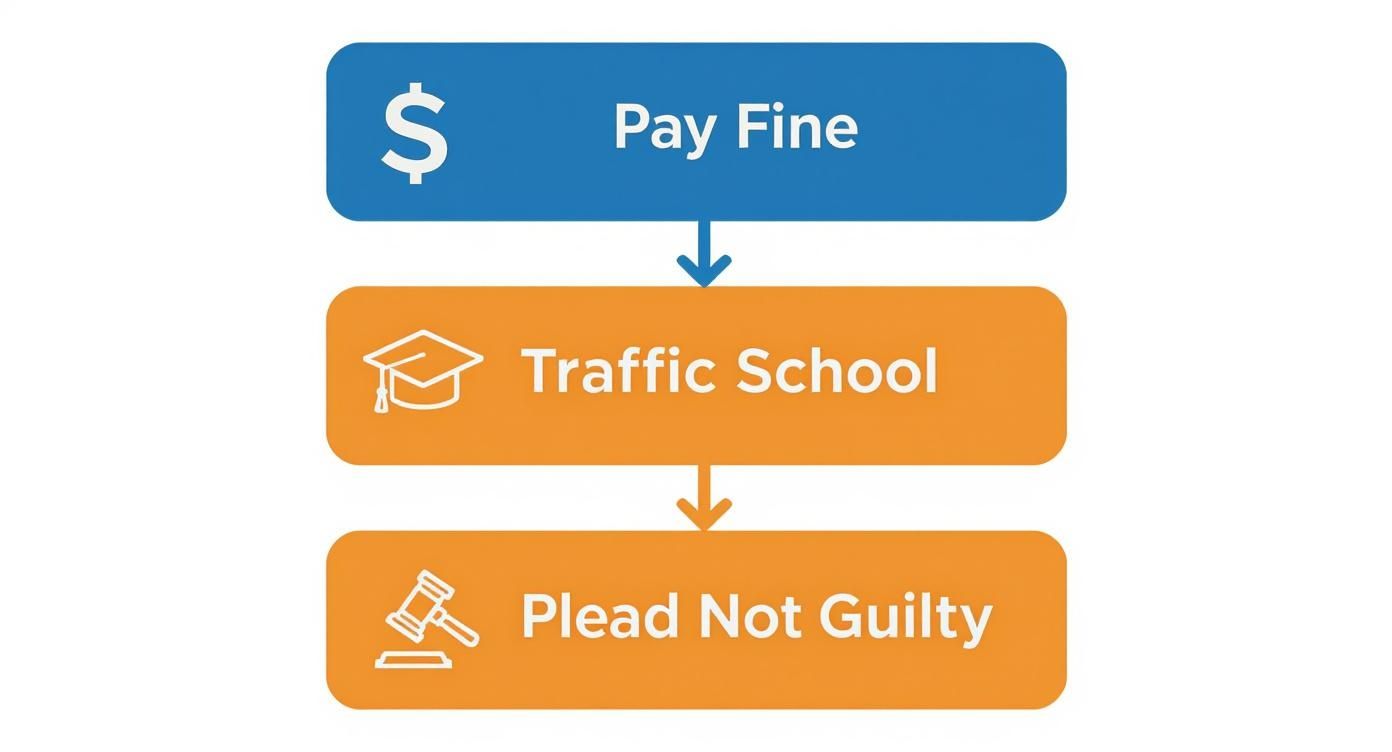
This flowchart breaks down your choices. While just paying the fine seems easiest, fighting the ticket is the only path that gives you a shot at getting it dismissed completely, avoiding all the negative fallout.
When deciding, you need to understand what you're up against. Florida law enforcement has increased its focus on speeding. For example, between 2022 and 2024, Miami-Dade County saw a 32% increase in speeding tickets issued, while Lee County saw a 135% jump. This is happening statewide. With scrutiny this high, choosing the right strategy is more important than ever.
To help you weigh your choices, here’s a quick breakdown of what each option entails.
Your Three Options for a Florida Speeding Ticket
Option | What It Means | Immediate Consequences | Long-Term Impact |
|---|---|---|---|
Pay the Fine | You are admitting guilt to the violation as charged. | You pay the full fine amount listed on the citation. | Points will be added to your license, likely causing a significant insurance rate increase for 3-5 years. |
Elect Traffic School | You plead "no contest" and agree to complete a state-approved driving course. | You pay the fine plus the cost of the school. | You avoid getting points on your license, but you can only use this option a limited number of times. |
Plead Not Guilty | You are formally challenging the ticket and requesting a court hearing. | You don't have to pay the fine upfront, but you will need to prepare for court. | This is your only chance to have the ticket dismissed, avoid fines, and prevent points and insurance hikes. |
Ultimately, your decision should be based on protecting your driving record and your wallet in the long run.
Key Takeaway: Your initial response sets the stage for the entire case. The 30-day deadline is absolute, and choosing to plead not guilty is the only way to challenge the state's evidence against you and seek a dismissal. Our goal is to protect your license and record.
Attorney Advertisement. Office in Broward.
The True Cost of a Florida Speeding Conviction
Most drivers think of a speeding ticket as a one-and-done hassle. You pay the fine, maybe complain to a friend, and then you move on. But that’s a huge, and often expensive, misunderstanding. The real cost of a speeding conviction in Florida isn't just the number printed on that citation; it's a ripple effect that can hurt your finances and driving record for years.
The fine itself is just the beginning. Understanding the long-term damage is the first step in realizing why fighting your ticket is often a smart move. From license points that put you on the state's radar to insurance premiums that quietly impact your wallet, the stakes are much higher than you think.
How Insurance Companies See a Conviction
Your insurance provider is one of the first to find out about that conviction. To them, a moving violation isn't a simple mistake—it's a red flag. It’s a data point that tells them you’re a riskier driver to insure, making you statistically more likely to get into an accident. To offset that risk, they hike your premiums.
And that increase isn't temporary. You could be stuck with higher rates for three to five years. So while the ticket itself might have been a couple of hundred dollars, the insurance hikes can easily cost you over $1,000 during that time.
Past results do not guarantee future outcomes. While every case is unique, fighting a ticket is the only way to seek a dismissal and prevent this predictable and painful insurance hike. Our goal is to protect your license and record from these long-term financial hits.
The Florida Driver's License Point System
Beyond the hit to your bank account, a conviction directly threatens your legal right to drive. Florida uses a point system to track violations and flag drivers who are becoming a danger on the road. Every moving violation conviction slaps points onto your license.
Speeding less than 15 mph over the limit? That’s typically 3 points.
Going 15 mph or more over the limit will usually add 4 points.
If your speeding leads to a crash, you could be looking at 6 points.
These aren't just imaginary numbers; they have very real consequences. The Florida Department of Highway Safety and Motor Vehicles (FLHSMV) will automatically suspend your license if you rack up too many points too quickly. You can get a full breakdown by checking out our guide on the Florida traffic ticket point system.
The Suspension Thresholds You Need to Know
The whole point of the system is to take risky drivers off the road, and the state is strict about it. Here’s what it takes to lose your license:
12 points in a 12-month period = 30-day suspension.
18 points in an 18-month period = 3-month suspension.
24 points in a 36-month period = 1-year suspension.
When you look at the big picture, the penalties are designed to be a deterrent. Speeding is a factor in 20% of all U.S. accidents, so Florida doesn't mess around. Fines can jump to $1,000 in a school or construction zone, and a conviction can raise insurance rates by an average of 22%. It’s clear that just paying the ticket is rarely the best option.
How to Build a Strong Defense Strategy
Fighting a Florida speeding ticket isn't about getting lucky—it's about smart preparation and a solid defense. Building a strong case goes way beyond just telling a judge, "I wasn't speeding." You have to dig into the evidence the state plans to use against you and find the weak spots.
Every traffic stop follows a certain procedure, and if the officer deviates from it, that can be the opening you need.
The entire case against you usually hinges on one thing: how the officer clocked your speed. Whether they used a radar gun, a LIDAR (laser) device, or simply paced your car, each method has strict rules and well-known flaws. A strong defense almost always starts by questioning the reliability of that speed measurement.
This isn't just about showing up for your court date. It's a methodical process of gathering your own evidence and formally demanding to see the state's evidence through a process called "discovery."
Challenging the Speed Measurement Device
More often than not, the best defenses poke holes in the accuracy of the speed measurement device. Florida law enforcement uses a few different technologies, and none of them are perfect.
Radar (Radio Detection and Ranging): Radar guns can be tricked. They send out a wide radio wave that can bounce off multiple cars at once (an error called "beam spread") or get interference from bad weather and even other electronics.
LIDAR (Light Detection and Ranging): This is the laser gun. It's more precise than radar, but its accuracy completely depends on a perfectly steady hand. If the officer's hand shakes even slightly, it can create a false high reading—a defense called a "sweep error."
Pacing: This is when an officer follows you to match your speed and then looks at their own speedometer. It’s incredibly prone to human error, from not keeping a consistent distance to having an uncalibrated speedometer.
For any of these methods, the state has to prove two things: the device was properly calibrated, and the officer was certified to use it. A key part of a legal strategy is to demand those records.
A lot of people think the number on a radar or laser gun is the final word. The reality is that Florida law puts the burden on the state to prove the device was tested and the officer was trained. If they can't produce that proof, the case can be weakened.
Gathering Your Evidence and Requesting Discovery
While the state has to prove its case, having your own evidence file puts you in a much stronger position. Start with the notes you took right after you were pulled over—the location, weather, traffic, and exactly what you remember happening.
Next, you or your lawyer need to file a formal "request for discovery" with the court. This is a legal move that forces the prosecutor to hand over all the evidence they have on you.
Here's what is typically requested in discovery:
A full copy of the citation, front and back.
The officer’s sworn police report or notes.
Calibration and maintenance logs for the specific speed measurement device used.
The officer’s training certificate for that device.
Any available dash-cam or body-cam video.
This isn't just paperwork; it's where one might find the ammunition for your defense. If the calibration log shows the device was overdue for service, or if the officer’s training certificate is expired, you've got a powerful argument.
Identifying Procedural Errors and Other Defenses
Beyond the speed reading, a great defense scrutinizes the entire process for mistakes. A simple typo on the ticket probably won't get it dismissed, but a pattern of sloppy work can make the officer's testimony seem less credible.
Here are a few other angles to look at:
Mistaken Identity: Was traffic heavy? It’s entirely possible the radar gun tagged a different car. This is where your notes about the scene become incredibly important.
Officer Fails to Appear: You can't bank on it, but it happens. If the officer who wrote the ticket doesn't show up for the final hearing, the state often has no case. Without their testimony, a motion for dismissal can be made immediately.
Contradictory Evidence: Do you have a dash-cam? If your footage contradicts the officer's report, it can be a game-changer. Testimony from a passenger in your car can also help build your case.
Ultimately, the goal is to create reasonable doubt. By systematically picking apart the state's evidence—from the device's accuracy to the officer's paperwork—you can build a defense that protects your license and your driving record. Our practice focuses on traffic and DUI defense, and our goal is to protect your record.
Navigating the Florida Traffic Court Process
Let's be honest, stepping into a Florida traffic court can feel intimidating. But a little knowledge goes a long way in turning that uncertainty into confidence. Knowing the key stages, who's who, and how things unfold can be the difference-maker.
The whole process kicks off the moment you tell the Clerk of Court you're pleading not guilty. You have to do this within the 30-day window after the officer hands you the citation. Once your plea is in, the court system will set a hearing date and send you the details in the mail.

This hearing is your shot. It's your chance to present your side, question the officer, and challenge the evidence. Whether you go it alone or have an attorney from a firm like ours handle it, preparation is everything.
The Courtroom Environment and Key Players
When you walk into the courtroom, you’ll notice a few key people. Knowing their roles is crucial.
The Judge or Hearing Officer: This is the person in charge. They listen to both sides, make sure the rules are followed, and deliver the final verdict. Always, always address them as "Your Honor."
The Citing Officer: The officer who wrote your ticket is the state's main witness. They'll get up and explain why they pulled you over and how they clocked your speed.
You (The Defendant): This is your case. You have the right to speak, show your own evidence, and ask the officer questions.
A word of advice: professionalism is non-negotiable. Dress respectably, speak clearly, and never interrupt the judge or the officer. Your conduct absolutely plays a role in how your argument is received.
The Structure of a Traffic Hearing
While every judge has their own style, most non-criminal traffic hearings follow a pretty standard playbook. You can generally expect it to go down like this:
Case Called: The clerk or judge will call your name. You’ll step up to the defendant's podium or table.
Officer's Testimony: The officer goes first. After being sworn in, they'll state the facts of the case from their point of view.
Cross-Examination: This is your turn to ask the officer questions. It’s the perfect time to probe into the details—like the radar gun's last calibration date or if their view was obstructed.
Your Testimony and Evidence: Now you get to tell your side of the story. If you have photos, dash-cam footage, or diagrams, this is when you present them.
Judge's Ruling: After hearing from both sides, the judge makes the call. They could find you guilty, not guilty, or withhold adjudication—which often means no points, but you might still owe a fine or have to attend traffic school.
Key Insight: The cross-examination is where many cases are won or lost. The goal isn’t to argue. It's to ask sharp, specific questions that poke holes in the state's case.
Throughout this process, being able to handle formal court correspondence is a small but important skill. Every interaction with the court should be handled professionally.
Don’t be surprised if it takes a while to get your day in court. The timeline from when you plead not guilty to your hearing can be several weeks, sometimes even months, depending on the county. This actually works in your favor, giving you plenty of time to build your defense, collect your evidence, and decide if you want to bring in a legal professional.
Attorney Advertisement.
When You Should Hire a Traffic Ticket Attorney
Every driver in Florida can technically represent themselves in traffic court, but that’s not always the smartest play. Part of knowing how to fight a speeding ticket is recognizing when the stakes are too high to go it alone. Some tickets are more than just a fine—they’re a real threat to your license and your bank account.
Deciding to hire an attorney isn't admitting you did anything wrong. It's a strategic move. You're bringing in a professional who understands Florida traffic law to find the weaknesses in the state’s case, handle the paperwork, and fight to protect your record.
High-Stakes Scenarios That Warrant Legal Help
Some speeding tickets are in a different league. If you find yourself in one of these situations, getting a free consultation with a traffic lawyer is a sensible step.
High-Speed Violations: Were you ticketed for going 30 mph or more over the speed limit? In Florida, that’s a mandatory court appearance. A conviction can mean significant fines, a potential license suspension, and a notable spike in your insurance premiums.
Commercial Driver's License (CDL) Holders: For professional drivers, a ticket isn't just an inconvenience; it can affect your career. CDL holders play by a stricter set of rules and can't just take traffic school to make points disappear. A conviction could literally impact your job.
You Already Have Points on Your Record: If another ticket will push you over the edge into a license suspension (like hitting 12 points in 12 months), you absolutely have to fight it.
The Ticket Involves an Accident: Speeding plus a car crash is a serious combination. This is especially true if someone was injured. An attorney can help you navigate not just the ticket, but also any civil liability that could come your way.
What a Traffic Attorney Does for You
Hiring a firm that focuses on traffic cases means you're getting more than someone to just show up in court. In fact, an experienced attorney handles the whole process for you, and most of the time, you won’t even have to go to court yourself.
They start by filing all the required legal motions and paperwork, making sure you don't miss a deadline. Then, they demand to see the state's evidence—the officer's report, calibration logs for the radar or laser gun, and any dashcam or bodycam video. The attorney picks that evidence apart, looking for procedural mistakes and weak spots to build a defense designed to get the ticket dismissed or reduced to a less serious offense.
Confidentiality Notice: Please be aware that submitting information through our website's forms or contacting us for a consultation does not create an attorney-client relationship. This relationship is only formed after a formal agreement is signed.
Finding the Right Firm for Your Case
When you’re looking for help, find a law firm whose practice focuses on Florida traffic defense. Don't be afraid to ask direct questions during your consultation:
How many traffic cases do you handle in this specific county?
How will you keep me updated on my case?
Based on my situation, what are the possible outcomes?
Is your fee a flat rate for this kind of ticket?
Florida is aggressive about traffic enforcement. The Florida Department of Highway Safety and Motor Vehicles (FLHSMV) reported that officers handed out over 3 million traffic citations in 2024 alone, with speeding leading the charge.
With special enforcement campaigns like 'Operation Southern Slow Down' putting even more patrols on the roads, having a dedicated speeding ticket lawyer is a major advantage. While past results don't guarantee a future outcome, a strong, professional defense is your best shot at a positive one.
Your Top Questions About Fighting Florida Speeding Tickets
When you’re staring at a speeding ticket, your mind probably starts racing with questions. It’s a stressful situation, and knowing your options is the first step toward a better outcome. Here are some of the biggest concerns for Florida drivers.
Can I Just Take Traffic School to Get My Ticket Dismissed?
This is easily one of the most common myths out there. Electing traffic school—officially called a Basic Driver Improvement (BDI) course—does not get your ticket dismissed.
When you go this route, you’re actually pleading "no contest." That means you still have to pay the full fine for the ticket. The real benefit is that the court agrees to withhold adjudication, which keeps the conviction and, more importantly, the points, off your driving record. It’s a decent option to protect your license, but remember, you can only use it once every 12 months and just five times in your entire life.
What Happens If I'm an Out-of-State Driver with a Florida Ticket?
Thinking you can just drive home and forget about it is a huge mistake. Florida is part of the Driver License Compact, an agreement between most states to share info on traffic violations. So, that Florida ticket will absolutely follow you home.
Florida will report the conviction to your home state's DMV, which will then likely add points to your license according to its own rules. Ignoring it can get your driving privileges suspended here in Florida and could even lead to your home state suspending your license. You have to deal with it, either by working with the court directly or hiring a local Florida attorney to handle it for you.
Is It Really Worth Fighting a Ticket if the Officer Doesn't Show Up?
The officer’s presence at your final hearing is everything. If they don’t show up, the state usually has no witness and no way to prove its case. It’s at that moment an attorney will move to have the case thrown out. A no-show officer is pretty much the best-case scenario for a dismissal.
But here’s the reality check: never bank on the officer not showing up. It’s a gamble that doesn't usually succeed. Police officers are paid to be in court, and judges often reschedule if they have a valid reason for their absence. You need to walk into that courtroom fully prepared to fight the ticket on its merits.
How Long Do Speeding Ticket Points Stay on My Florida Record?
The points that put your license at risk of suspension stick around on your Florida driving record for five years. The conviction itself can stay on your permanent record for much longer, ready to be seen by insurance companies anytime they pull your history.
Florida's point system adds up fast. This is why fighting every single ticket matters. The suspension thresholds are unforgiving:
12 points in 12 months = 30-day suspension
18 points in 18 months = 3-month suspension
24 points in 36 months = 1-year suspension
Prospective clients may not obtain the same or similar results.
At Ticket Shield, PLLC, our practice focuses on traffic and DUI defense across all 67 counties in Florida. We are here to protect your license and seek the best possible outcome for your case. Don't just pay that ticket and accept the consequences. Get a free, no-obligation consultation to understand your real options by visiting https://www.ticketshield.com today.