Understanding Points For Your License In Florida
Learn how points for your license work in Florida, what they mean for your record, and the strategies drivers use to protect their driving privileges.
Getting a traffic ticket is stressful enough, but the phrase "points for your license" is where the real long-term trouble begins. Understanding what that actually means is the first step to protecting your driving record. In Florida, these points are basically demerits the state uses to track traffic violations, and if you get too many, you're looking at a suspended license and skyrocketing insurance costs.
Demystifying The Florida Driver License Point System
Think of Florida's driver's license point system as a scorecard for your driving habits, managed by the Florida Highway Safety and Motor Vehicles (FLHSMV). But this isn't a game you want a high score in. It's a system designed to flag drivers who repeatedly break traffic laws.
Every time you're convicted of a moving violation—meaning you pay the ticket or are found guilty in court—the FLHSMV adds a set number of points to your license.
The logic is simple: the more serious the violation, the more points you get. A minor speeding ticket for going a few miles over the limit on a road like Federal Highway in Broward County will add fewer points than something more serious, like reckless driving. These points stack up over time, and if you hit certain thresholds within a specific period, you’ll face serious penalties.
The whole point of the system isn't just to punish drivers. It’s meant to be a clear warning shot—a signal that continued unsafe driving will eventually cost you your privilege to be on the road.
How Points Lead To Penalties
The consequences of racking up points are tiered. A few points might not seem like a big deal at first, but they add up faster than you think and can trigger some major headaches.
The main penalties you'll face include:
Increased Insurance Premiums: This is the big one. Insurance companies see points as a direct measure of risk. Even a single ticket that adds points to your record can cause your rates to jump for the next three to five years.
License Suspension: The FLHSMV doesn’t mess around. If you accumulate too many points within a set timeframe, your license will be suspended.
License Revocation: For the most severe or repeated offenses, you could lose your license entirely, making it incredibly difficult to get back on the road legally.
The state has very specific thresholds for suspension. It’s not a vague warning; it's a hard and fast rule based on how many points you get and how quickly you get them.
Florida License Point Suspension Thresholds
Here’s a clear breakdown of how quickly points can lead to you losing your driving privileges. This isn’t a guideline—it's the law.
Points Accumulated | Time Period | Resulting Suspension Duration |
|---|---|---|
12 Points | Within 12 Months | 30-Day Suspension |
18 Points | Within 18 Months | 3-Month Suspension |
24 Points | Within 36 Months | 1-Year Suspension |
As you can see, it doesn't take much to find yourself without a license. Just a couple of serious tickets in a year could be enough to trigger that first 30-day suspension.
Understanding how each citation impacts your cumulative point total is absolutely essential. It’s why you have to be strategic with every single ticket. Just paying the fine is an admission of guilt, which results in points being added to your record. By exploring your options, you can work toward a more favorable outcome. To get a foundational overview, you can learn more about the Florida traffic ticket point system in our detailed guide. Protecting your license starts with understanding the rules and what's at stake every time an officer hands you a citation.
Common Violations That Add Points To Your Record
Not every traffic ticket is the same, especially when it comes to adding points to your license here in Florida. It’s a common misconception, but points don’t just magically appear when an officer hands you a citation. They only get added to your driving record after you’re officially convicted of a moving violation.
This conviction happens in one of two ways: you either pay the fine, which is legally an admission of guilt, or you are found guilty in court.
Imagine you're navigating I-595 during Broward County's infamous rush hour. One moment of distraction, and you could be looking at a careless driving ticket. Or maybe you’re in a hurry through a quiet Fort Lauderdale school zone and get cited for speeding. These everyday situations are exactly how points start piling up, putting your license in jeopardy.
Moving Violations Versus Non-Moving Violations
The state of Florida draws a clear line between two kinds of tickets: moving violations and non-moving violations. This distinction is everything when it comes to whether you’ll get points.
Moving Violations: These are the big ones. They happen while your car is in motion—think speeding, running a red light, or an improper lane change. Because they directly threaten traffic safety, these are the violations that come with points.
Non-Moving Violations: These are typically equipment-related, like a broken taillight, or administrative, like expired tags or a parking ticket. While they’ll still cost you money, they generally don’t add points to your record.
Knowing the difference is your first step in understanding the true risk of a ticket. A citation for an expired registration is a financial headache, but one for unlawful speed can have consequences that follow you for years.
Florida Traffic Violations And Corresponding Point Values
The Florida DHSMV assigns points based on how serious the violation is. The more dangerous the behavior, the more points you get. For anyone driving on the congested streets of Broward County, it's easy to see how a few bad days can lead to big trouble.
This table breaks down the point values for the most common traffic violations we see in Florida.
Violation Type | Points Assigned | Notes And Specifics |
|---|---|---|
Speeding | 3 points | 15 MPH or less over the speed limit. |
Speeding | 4 points | More than 15 MPH over the speed limit. |
Speeding Resulting in a Crash | 6 points | The highest single-point violation for speeding. |
Careless Driving | 3 points | A common citation in heavy traffic or fender-benders. |
Running a Red Light | 4 points | Includes running a stop sign or failing to yield. |
Moving Violation Resulting in a Crash | 4 points | For any non-speeding moving violation that causes an accident. |
As you can see, the points can stack up fast, making a license suspension a very real possibility. For a closer look at how speed specifically impacts your record, check out our guide on how speeding ticket points work in Florida.
This infographic from the state of Florida breaks down exactly how many points it takes to lose your license.
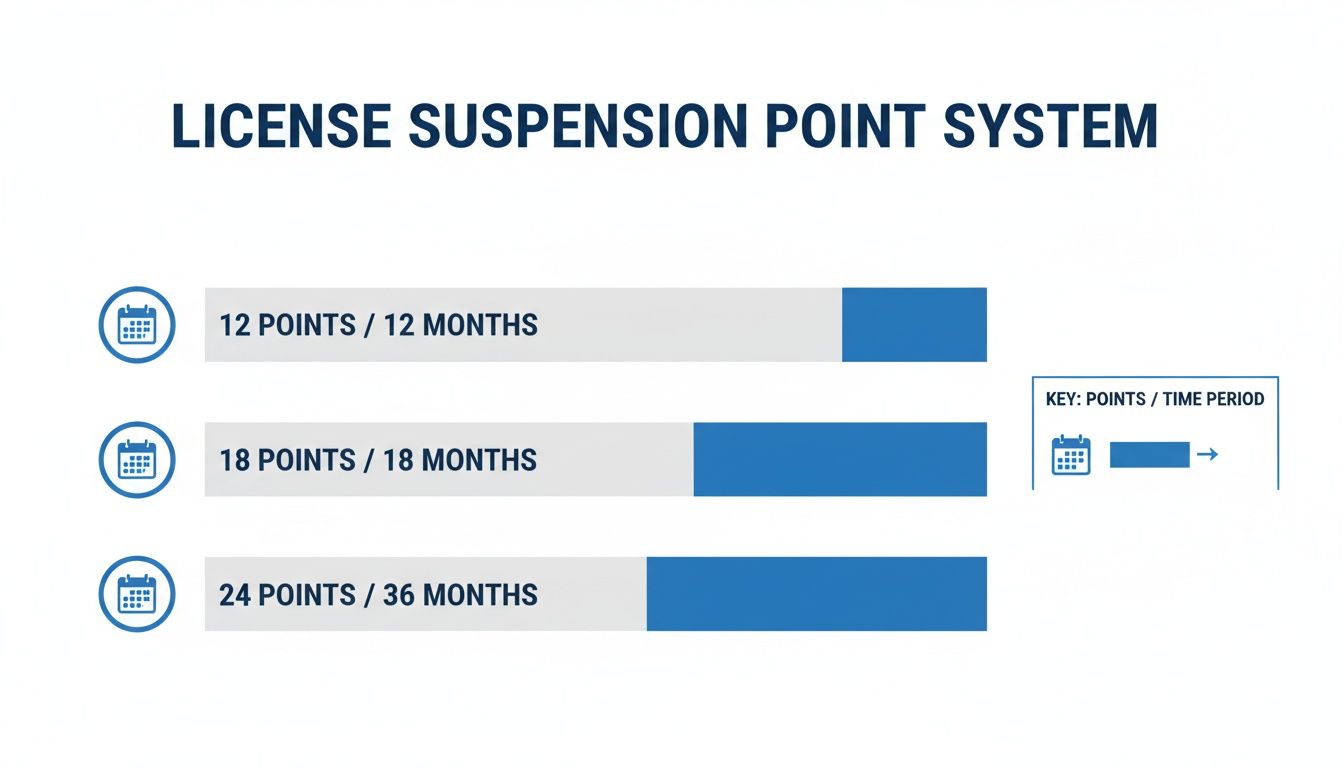
It’s a simple but unforgiving system. A couple of serious mistakes in a short period can easily get your driving privileges taken away for a month, three months, or even a full year.
The Real-World Consequences Of Accumulating Points
Getting points on your license isn't just about a bad score on your driving report. Think of it as the first domino to fall in a chain reaction that can seriously impact your finances, your freedom to drive, and even your job. The consequences are designed to get worse with each ticket, meaning every point carries more weight than the last.
The first hit is almost always to your wallet. Insurance companies see points as a giant red flag signaling risk. To them, a driver with points is statistically more likely to get into an accident, making you more expensive to insure. As a result, even one conviction for a moving violation can cause a painful spike in your auto insurance premiums.
And this isn't a one-time penalty. That rate hike can stick around for three to five years, costing you hundreds or even thousands of extra dollars over time. The more points you rack up, the higher your premium climbs, turning a single ticket into a long-term financial headache. You can get a clearer picture of this by reading our guide on how a speeding ticket can affect your insurance rates.
The Path To License Suspension
Beyond the hit to your insurance, the Florida Highway Safety and Motor Vehicles (FLHSMV) has its own set of direct and severe penalties. Florida's laws on this are crystal clear and leave no room for excuses. Once you hit a certain number of points within a specific timeframe, a license suspension is automatic.
Here are the thresholds you need to know:
12 points within a 12-month period triggers a 30-day suspension.
18 points within an 18-month period triggers a 3-month suspension.
24 points within a 36-month period triggers a 1-year suspension.
Losing your license, even for just 30 days, can throw your entire life into chaos. Suddenly, getting to work in Broward County, taking your kids to school, or running simple errands becomes a logistical nightmare. It’s a harsh reminder of why every single point counts.
The Habitual Traffic Offender Designation
For drivers who repeatedly commit serious traffic offenses, the state brings out the heavy artillery. Florida law has a special label for these individuals: Habitual Traffic Offender (HTO). This isn't just a title; it comes with a mandatory five-year revocation of your driver's license.
You can be branded an HTO if you rack up three or more convictions for major offenses—like DUI, driving with a suspended license, or leaving the scene of an accident—within a five-year period.
A five-year revocation is life-altering. It can slam the door on job opportunities and crush your personal freedom, making it incredibly difficult to get back on your feet. This is the state’s most serious non-criminal penalty for repeat offenders, and it highlights just how critical it is to take every single traffic ticket seriously from the start.
Ultimately, each traffic citation is a fork in the road. Simply paying the fine is an admission of guilt, resulting in points and setting all these consequences in motion. A strategic approach is an effective way to protect your driving record, your wallet, and your freedom to be on the road.
How to Proactively Defend Your Driving Record
Getting a traffic ticket in Florida doesn't mean it's game over. Too many drivers make the mistake of thinking their only move is to pay the fine, but doing that is a legal admission of guilt.
That simple action results in points for your license being slapped onto your record. This kicks off a domino effect of insurance hikes and pushes you one step closer to a potential suspension. The most important thing to remember is that you have options and can take proactive steps to defend your driving record.
A citation isn't a conviction; it's just an accusation. The way you respond to that accusation is what really determines the outcome. Instead of just accepting the consequences, you can explore strategies designed to protect your license and keep your record clean. Our goal is to protect your license and record.
Challenging the Ticket in Court
One of the most direct ways to fight points for your license is to challenge the ticket itself. This means pleading not guilty and having your case heard in court. While you technically can represent yourself, working with a law firm that focuses its practice on traffic matters provides a significant advantage.
An attorney will dig into the details of your citation, looking for procedural mistakes, inconsistencies, or weak evidence that could get the whole thing dismissed. They know the exact legal standards police officers have to meet when they write a ticket, from the calibration of their speed-detection gear to filing the paperwork correctly.
Better yet, an experienced attorney can often negotiate with the prosecutor or judge for you. The goal is always to find a more favorable outcome, which could look like:
A complete dismissal of the citation.
A reduction of the charge to a non-moving violation, which carries zero points.
An agreement for a "withhold of adjudication," meaning you're not formally convicted, which also avoids points.
This strategy puts the burden of proof back where it belongs—on the state—and gives you a real shot at avoiding the fallout of a conviction. Past results do not guarantee future outcomes, but a smart defense is always more effective than simply admitting guilt.
Electing to Attend a Driver Improvement Course
Another powerful tool in the Florida driver's toolbox is electing to attend a state-approved driver improvement course, which most people just call traffic school. By choosing this option, you can often get the adjudication withheld on your ticket. In plain English, that means no conviction shows up on your record and, most importantly, no points are added to your license.
But this option has some strict rules you need to know.
Eligibility for Traffic School: In Florida, you can elect to attend a driver improvement course to avoid points only once in any 12-month period and a maximum of five times in your lifetime. You have to make this choice with the Clerk of Court in the county where you got the ticket and pay the required fines and fees.
This is a fantastic strategy for a minor infraction because it keeps your record clean and prevents your insurance company from ever seeing the violation. It’s a proactive step that deals with the issue head-on while sidestepping the long-term pain of racking up points. You can read more about options in our guide on how to remove points from your driving record in Florida.
Understanding the Changing Landscape of Traffic Enforcement
It's also important to recognize how traffic enforcement is evolving. Automated speed enforcement systems are becoming a global trend as countries seek to reduce traffic fatalities. These tech advancements are aimed at creating fairer enforcement by cutting down on human bias in ticketing decisions.
However, these systems bring new challenges, especially with the rise of connected and autonomous vehicles. Cities and states are realizing these technologies can also provide useful traffic data to pinpoint high-risk intersections and guide infrastructure investments. For more insights on these automated enforcement trends, check out elovate.com.
At the end of the day, a traffic ticket is a serious matter with lasting consequences. Whether you choose to fight it in court or elect traffic school, taking action is always a better move than just paying the fine and accepting the points.
How To Check The Points On Your Florida License
Knowledge is power, especially when it comes to the number of points for your license. Not knowing where you stand can be stressful, leaving you to wonder if one more ticket is all it takes to trigger a suspension. Thankfully, Florida makes it easy to get an official look at your driving record so you can see exactly where you are.
The Florida Highway Safety and Motor Vehicles (FLHSMV) is your one-stop shop for this information. By pulling a copy of your driving record, you get a complete history of every violation and the points that came with them. This isn't just a good idea—it's a critical first step for any driver with a recent ticket who is unsure of their total point count.
Requesting Your Official Driving Record
The most direct way to get your hands on this information is through the official FLHSMV website. The whole process is designed to be straightforward, letting you securely access your record from the comfort of your own home.
You'll start at the official FLHSMV Driver License Check portal, which looks like this:

As you can see, you just need to pop in your Florida Driver License Number to pull up your history. This is a security measure to make sure only you can access your personal information, keeping your record private while giving you the details you need.
After entering your info, you'll be given a few options for the type of record you want. The FLHSMV offers a few different "views," each for a specific purpose. For a full rundown, check out our guide that details how to check your Florida driving record.
Choosing The Right Record Type
Not all driving records are created equal. When you request your history from the FLHSMV, you’ll need to pick from a few options that cover different timeframes.
3-Year Record: This is the one most people get. It shows all your moving and non-moving violations with points, plus any crashes, for the last three years. This is usually what insurance companies are looking at when they set your rates.
7-Year Record: This gives a much longer view and is often required for job applications, especially for commercial driving positions.
Complete Driver History: This is the whole enchilada. It shows everything—every violation, point, suspension, and any other mark on your license since the day you got it.
For checking your current points for your license and seeing if you're at risk of suspension, the 3-year record is almost always what you need. The points system works on a rolling 36-month (3-year) period, so this record gives you the clearest picture of where you stand right now. Knowing your exact number is the first step toward building a plan to protect your driving privileges.
Why You Should Consult A Traffic Ticket Attorney
That little piece of paper an officer hands you might seem like just a small fine, but as we've covered, the real cost of a Florida traffic ticket can spiral far beyond that initial amount. Just paying the ticket is a guilty plea, plain and simple. It results in points for your license, triggers an almost certain insurance hike, and pushes you one step closer to a suspension.
This is where hiring a traffic attorney stops being a reaction and becomes a strategic move to protect your driving record, your wallet, and your time.
Navigating The Complexities Of Traffic Court
A law firm that focuses its practice on traffic defense lives and breathes the local court system. Attorneys who handle these cases every day know the specific procedures, the prosecutors, and even the judges' tendencies in places like Broward County. That inside knowledge is invaluable when it comes to negotiating a better outcome for you.
The legal process can be intimidating and confusing. An experienced attorney takes that entire burden off your shoulders. We handle filing the correct paperwork on time, dealing with the clerk's office, and showing up in court for you. In most traffic cases, you won't even have to set foot in the courthouse, saving you from missing work and the stress of a hearing.
Our goal is to protect your license and record. We work to seek a favorable result, whether that means a full dismissal of the citation, a reduction to a non-moving violation (which carries no points), or securing a withhold of adjudication.
A Proactive Step To Protect Your Future
Even one ticket for a minor moving violation can have surprisingly expensive long-term consequences. The hit from increased insurance premiums alone can add up to hundreds, or even thousands, of dollars over the next few years. Hiring an attorney is an investment in protecting your driving record and your finances from that domino effect.
Instead of trying to figure out the system alone, you get a clear assessment of your situation and a professional advocate dedicated to defending your rights. While past results do not guarantee future outcomes, a strong legal defense is your most effective tool against the lasting impact of a conviction.
If you've received a traffic ticket in Florida, don't just accept the points. Take the first step toward a smarter defense.
Call Ticket Shield today for a free consultation.
Attorney Advertisement. Office in Broward. Prospective clients may not obtain the same or similar results. Submitting information through any form on this website does not create an attorney-client relationship.
Answering Your Top Questions About Florida License Points
The whole points system can feel a little confusing, and drivers ask us about it all the time. Let's clear up some of the most common questions you might have about your Florida license.
How Long Do Points Stay On Your License In Florida?
This is a two-part answer, and the difference is important. For the purpose of a license suspension, points from a ticket stay active on your Florida record for 36 months from the day you're convicted. The FLHSMV is looking at that rolling 3-year window to see if you've racked up enough points to trigger a suspension.
But here’s the part that hits your wallet: the violation itself sticks around on your full driving record for a lot longer. Insurance companies typically look back three to five years when they calculate your rates. So even after the points "expire" for suspension purposes, that old ticket can still be costing you money every month.
Do I Get Points For A Red Light Camera Ticket?
Usually, no. When you get a red-light camera ticket in the mail, it starts as a "Notice of Violation." If you pay that notice on time, it’s treated more like a parking ticket, and no points are added to your license. Simple as that.
The trouble starts if you ignore it. If you don't pay the initial notice, it can be escalated to a formal "Uniform Traffic Citation." If you’re then convicted in court on that citation, points absolutely can be added to your license. It’s a classic case of a small problem turning into a much bigger, more expensive one.
Will An Out-Of-State Ticket Add Points To My Florida License?
Yes, almost always. Don't fall into the trap of thinking a ticket you get on vacation just disappears. Florida is a member of the Driver License Compact, an agreement between most states to share driver information.
This means if you get convicted for a moving violation in another member state—say, Georgia or New York—that state will report it back to the Florida FLHSMV. Florida will then add the matching points to your license, just as if you got the ticket on I-95 in Broward County.
Ignoring an out-of-state ticket is a huge mistake. It will almost certainly find its way back to your Florida record and hit your insurance rates.
Facing a traffic ticket and the threat of points? Don't just pay it and accept the consequences. Ticket Shield provides experienced legal defense to protect your driving record and keep your insurance rates down.
Call us 24/7 for a free, no-obligation consultation to talk about your case. Let us handle the stress while you stay on the road.