
Suspended License Insurance Florida: Your 2026 Guide
Is your Florida license suspended? Discover suspended license insurance (SR-22/FR-44) requirements, costs, and how to get back on the road in 2026.

Yes. You can usually get suspended license insurance in Florida, but the primary danger is the long tail: high-risk premiums, strict proof requirements, and coverage lapses that can delay reinstatement. The smartest move is stopping the triggering violation before it locks you into years of added insurance cost.
You opened a letter from Florida Highway Safety and Motor Vehicles. Or a clerk, judge, or officer told you your driving privilege is suspended. Now you're trying to answer two questions fast. Can you still insure the car, and how bad is this going to get?
Drivers often make expensive mistakes. They cancel coverage, miss a filing requirement, let a financed car sit uninsured, or plead out the underlying case without thinking about what comes next. Then the insurance problem gets bigger than the ticket or charge that caused it.
If you're in Florida, this isn't just paperwork. It's a legal and financial threat tied directly to your license status, your household vehicle, and your future premiums under Chapter 316. If DUI is involved, Florida Statute 316.193 is the statute that can turn a bad arrest into a long insurance headache.
Table of Contents
Your License Is Suspended What Happens Next
The first problem is confusion. A suspended license doesn't always mean your car has to go uninsured. It also doesn't mean every insurer will handle you the same way. But if you guess wrong, you can create a second violation on top of the first.
Why this moment matters
A lot of suspensions aren't tied to dangerous driving alone. A peer-reviewed study found that limited state estimates suggest between 5% and 17% of all licensed drivers may have a suspended license at any given time, and the same study found 91% of suspensions were for non-driving-related events, with failure to pay a fine being the most common reason. It also found non-driving-related suspensions were seven times more common in low-income than high-income census tracts, which shows how easily an administrative issue can snowball into a license crisis (peer-reviewed suspension research).
That matters in Florida because many drivers assume the suspension is a side issue. It isn't. Once your license status changes, insurance, reinstatement, and any new traffic stop all become more dangerous.
Practical rule: Don't cancel your policy just because you can't legally drive today. First determine whether the vehicle still needs to stay insured for a spouse, family member, co-owner, or lender.
If you already have a suspension notice, move quickly. The right move may be restoring eligibility, protecting the vehicle, or attacking the underlying case before it hardens into a longer-term problem. If you need the Florida reinstatement roadmap, review how to reinstate a suspended license in Florida.
Immediate steps to take
Stop driving yourself: If your privilege is suspended, driving anyway can deepen the damage.
Pull your suspension paperwork: You need the exact reason for the suspension, not a guess.
Check the vehicle status: If someone else in your home still drives the car, the insurance decision is different.
Call your insurer before making changes: Ask whether the car can stay covered with another licensed household driver.
Protect the underlying case: If the suspension grew out of a traffic or DUI case under Chapter 316, your defense strategy should start immediately.
What Are SR-22 and FR-44 Filings in Florida

Drivers say "SR-22 insurance" or "FR-44 insurance" all the time. That wording causes trouble. These aren't insurance products you shop for like roadside assistance or rental reimbursement.
They are not insurance policies
An SR-22 or FR-44 is a filing. Think of it as a compliance certificate your insurer sends to the state to prove you're carrying the required coverage. You're not buying a new legal category of insurance. You're buying a policy that your insurer is willing to monitor and certify.
That distinction matters because people call the wrong company, ask for the wrong thing, and lose time. In a suspension case, delay costs you.
A simple way to think about it:
Filing | What it is | Why it matters |
|---|---|---|
SR-22 | Proof of financial responsibility filed by the insurer | Used when the state requires monitored proof of coverage |
FR-44 | A stricter financial responsibility filing used in serious cases | Commonly associated with DUI-related consequences in Florida |
Neither one | An insurance policy by itself | You still need an actual underlying auto policy |
Why the filing controls your reinstatement
One practical guide puts the key point plainly: a suspended license doesn't make insurance unavailable, but it forces you into high-risk channels, and the insurer must electronically file the SR-22 or FR-44 before the state reinstates your license. If that policy lapses, the insurer can file an SR-26, which cancels the proof and can restart the waiting period for reinstatement (high-risk filing explanation).
That's why I tell drivers not to think of suspended license insurance as a quote-shopping problem. It's a compliance problem first. If DUI is in the background, you also need to understand the insurance consequences early, not after court. Review how a DUI affects car insurance before you make any plea decision.
SR-22 and FR-44 filings are like monitored report cards your insurer sends to the state. You pay for the policy, and you also live under ongoing compliance surveillance.
Which Violations Trigger an SR-22 or FR-44 Requirement
Florida doesn't label every violation the same way. Some cases create fines and points. Others put you into the high-risk insurance system. If your case is already moving through a courthouse like the Richard E. Gerstein Justice Building in Miami, you need to know which category you're facing before you agree to anything.
When Florida treats you as a high-risk driver
In real life, filing requirements usually show up after serious driving-related events or after conduct that tells the state you present a financial responsibility problem. Common triggers can include:
Driving while suspended or revoked: The state already sees a compliance issue, and that raises the stakes.
Driving without required insurance after a crash or serious violation: Now the case isn't only about driving conduct. It's also about proof of future responsibility.
Accumulating severe traffic consequences: Repeated or more serious offenses can push a driver into a more dangerous category.
Habitual offender patterns: If your history starts to look chronic, the administrative fallout becomes more aggressive. If that risk applies to you, read what a habitual traffic offender designation means in Florida.
Not every suspended driver gets the same filing requirement. The exact trigger matters. So does the wording of the final disposition.
Why DUI creates a different level of exposure
For Florida drivers, Florida Statute 316.193 is the DUI statute that often changes the insurance conversation from painful to brutal. A DUI case doesn't just threaten your record. It can put you on a more demanding proof-of-insurance track and expose you to a much longer period of expensive monitoring.
That is why the legal defense has to target the charge itself. If the triggering conviction can be avoided, reduced, or strategically resolved, the insurance damage may also change. If you only focus on reinstatement paperwork after the fact, you've already surrendered the biggest advantage.
The courthouse outcome drives the insurance outcome. In serious traffic cases, the plea you accept can matter more than the filing fee you pay later.
What Is the Process for Getting and Keeping High-Risk Insurance
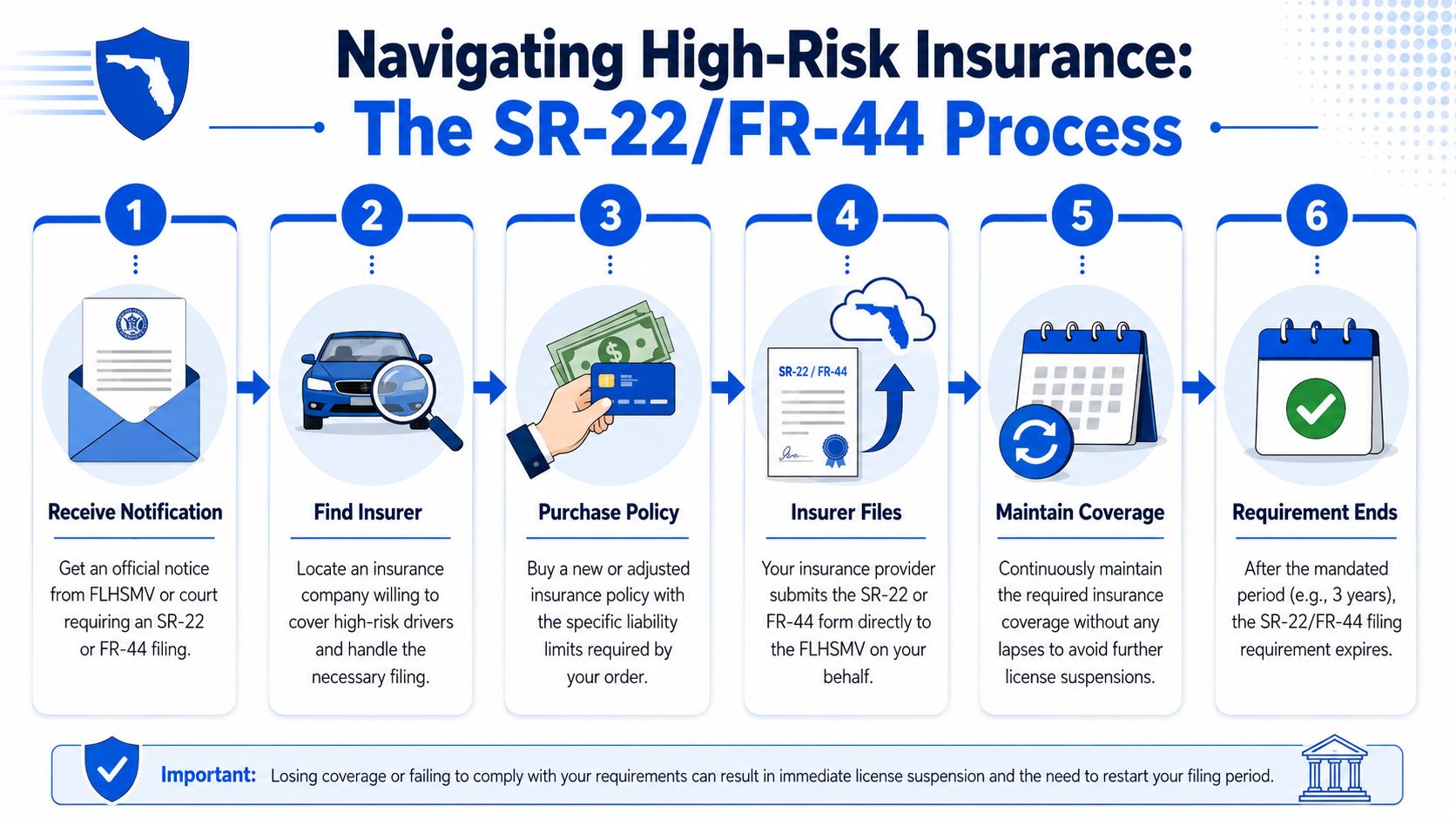
This is the part drivers underestimate. They think suspended license insurance is a one-time fix. It isn't. It's an ongoing obligation, and the price tag can outlast the memory of the stop, crash, or arrest that started it.
How the process usually unfolds
The basic path looks simple on paper.
You receive a notice: The state, court, or agency tells you that proof of financial responsibility is required.
You find a carrier willing to write the policy: Many standard carriers won't be your easiest option once your license is suspended.
You buy qualifying coverage: The policy has to meet the requirement tied to your case.
The insurer files the certificate: Your carrier sends the SR-22 or FR-44 electronically.
You maintain the policy without interruption: Many people often fail here.
You complete the required period: Only then do you get out from under the filing obligation.
That sounds manageable until cost enters the room. One industry analysis found that drivers with a clean record pay an average of $98 per month for liability coverage, while drivers with revoked driving privileges pay $140 per month, and full coverage for a suspended license can average roughly $226 to $269 per month depending on the state and circumstances. The same source reports that a suspended-license citation can raise average car insurance rates by more than 67%, and that SR-22 requirements often last three to five years (suspended license insurance cost analysis).
Where drivers get trapped
The trap isn't just the monthly bill. It's the duration and fragility of the arrangement.
A lapse resets progress: If the filing falls off because the policy cancels, you can lose time already served toward reinstatement.
The carrier pool shrinks: Fewer options usually means less pricing power and less flexibility.
The policy follows the requirement, not your mood: Even if you're not driving much, the compliance burden doesn't disappear.
The total cost compounds over time: A higher monthly premium stretched over years becomes a serious household expense.
Hard truth: In many cases, the expensive part isn't getting back on the road. It's staying compliant long enough to stay there.
For Florida families, this hits especially hard when one person loses driving privileges but the household still needs the vehicle for work, school, appointments, or deliveries. That creates pressure to cut corners. Don't. If the car remains in use, solve the policy structure correctly instead of hoping no one notices.
Strategic Alternatives to Long-Term High-Risk Insurance
A lot of online advice starts too late. It assumes the filing requirement is already locked in and your only job is to find a carrier. That's passive thinking. If the underlying case is still alive, the smarter move is to attack the event that triggers the years-long insurance burden.
Fight the trigger, not just the aftermath
Your first financial strategy is legal, not insurance-related. If a citation, criminal traffic charge, or DUI allegation is still contestable, your focus should be on avoiding the result that pushes you into long-term high-risk treatment.
That isn't abstract. A conviction under the wrong statute can keep costing you long after court ends. For many drivers, paying for an aggressive defense upfront is the more rational money decision because it may help avoid years of higher premiums, monitored filings, and reinstatement delays.
If your license is already affected, legal help can still matter. In Florida, a focused defense or restoration strategy may change how long the damage lasts or whether additional consequences stack. Review license restoration lawyer options in Florida if you're trying to protect both your record and your budget.
How to keep the household car insured
This is the issue most guides ignore, and it matters a lot more than people realize. Your suspended license does not automatically mean the vehicle itself has to become uninsured.
Guidance addressing suspended drivers explains that coverage can often be maintained on the car for other licensed drivers in the household, and some carriers allow the suspended person to be listed as an excluded driver, which can help protect a financed vehicle and allow family members to remain insured without forcing the suspended person onto a non-owner policy (household vehicle coverage guidance).
That leads to a better decision framework:
Your situation | Better question to ask |
|---|---|
You own the car but can't legally drive | Can the vehicle stay insured with another licensed household driver? |
A spouse or adult child still uses the vehicle | Can you be excluded while they remain covered? |
The car is financed | What coverage must stay in place to avoid violating lender requirements? |
You don't own a vehicle | Is a non-owner policy the right fit for reinstatement purposes? |
Don't assume your only option is to cancel the policy and start over later. That can create more damage than the suspension itself. If the car still serves the household, restructure the policy around lawful drivers and protect the asset.
How a Lawyer-Led Defense Protects Your License and Finances

If your case is headed into a place like the Orange County Courthouse in Orlando, you don't need an app pretending to be strategy. You need a real lawyer looking at the suspension trigger, the insurance fallout, and the fastest path to protecting your license.
Direct attorney access matters in license cases
The delivery model matters. Suspended license cases create moving parts. Court dates. DMV issues. insurance filings. vehicle-use questions. family-driver problems. automated apps and ticket mills tend to treat those as separate customer service tasks.
They're not separate. They're connected.
A lawyer-led defense means someone can assess whether the underlying allegation should be fought, whether a plea creates hidden insurance exposure, whether your household vehicle needs immediate policy changes, and whether a lapse could derail reinstatement. That's why direct communication matters. In these cases, delay and misunderstanding are expensive.
For drivers looking for that kind of help, a Florida suspended license lawyer review is the right place to start. Ticket Shield, PLLC handles Florida traffic and license defense with direct attorney communication by phone or text, which is materially different from platforms built around middlemen.
The goal is no points and no insurance spiral
The insurance company deals with consequences after the legal system labels you high-risk. Your lawyer's job is earlier and more valuable. Stop the label if possible. Reduce the charge if necessary. Protect the record. Avoid the domino effect.
Here is the bigger picture in plain language:
If the charge can be defeated, the insurance crisis may never fully form.
If the case can be resolved strategically, you may avoid the worst filing consequences.
If the car still needs to be insured, the policy can often be structured around lawful drivers instead of abandoned.
If you wait too long, the administrative side gets harder to fix cleanly.
A short explanation from our team may help if you're sorting through the stakes right now.
The right legal strategy isn't only about today's ticket or today's suspension notice. It's about preventing years of high-risk insurance costs from becoming your new normal.
If you're dealing with suspended license insurance in Florida, don't treat it like a simple quote problem. Treat it like what it is: a legal problem with insurance consequences. Ticket Shield, PLLC offers a free consultation focused on protecting your license, avoiding points, and stopping long-term insurance damage before it gets worse. Visit TicketShield.com now for a free consultation and fight for the No Points outcome.
