
Get Your License Back: Florida License Restoration Lawyer
Lost your driving privileges? Our Florida license restoration lawyer team helps you get your license back quickly in 2026. Expert legal help for suspensions &

You just found out your Florida license is suspended. Now every routine trip feels risky. Work, school, daycare pickup, medical appointments, all of it gets harder fast. If your income depends on driving, this problem can turn into a crisis in a single day.
TL;DR: A Florida license restoration lawyer helps you identify the exact suspension, meet every reinstatement condition, and avoid mistakes that trigger more delay. In Florida, this is not a paperwork errand. It's a legal process with deadlines, evidence requirements, and real consequences if you guess wrong.
At courthouses like the Edgecomb Courthouse in Tampa, drivers learn the hard way that license problems rarely fix themselves. A suspension can start as a traffic issue and become a work issue, an insurance issue, and a criminal issue if you keep driving without legal authority.
You need facts first. If you haven't confirmed your current status, start by checking if your license is suspended in Florida. Then act. Waiting usually makes this worse.
Table of Contents
Your Florida License Is Suspended Now What
First, stop treating this like a clerical problem. If Florida suspended your license, the state expects you to satisfy specific conditions before you drive again. If you guess, you can dig the hole deeper.
Florida drivers often focus on urgency alone. That's understandable. You need to get back to work, get your kids where they need to go, and keep your life moving. But urgency without strategy leads to bad decisions, especially in DUI-related cases under Florida Statute 316.193, where the license consequences can be severe.
What should you do in the first 24 hours
Confirm your status: Don't rely on memory, a ticket, or what someone at the clerk's office told you.
Find the reason: Suspension for points, DUI, missed court, unpaid obligations, and insurance issues do not follow the same path.
Stop driving blindly: Driving while suspended can create a separate criminal exposure and make restoration harder.
Preserve every document: Keep notices, citations, court paperwork, proof of school, proof of insurance, and receipts in one place.
Call a lawyer early: The right move at the start can save weeks or months of delay.
Practical rule: Your first job is not to explain why you need to drive. Your first job is to identify exactly what Florida says you must fix.
A suspension is manageable. A suspension plus a new charge for driving when you weren't legally allowed to drive is much harder.
Why Is Your Florida License Suspended
Florida suspends licenses for different reasons, and the reason controls the remedy. If you don't know the trigger, you can't build the right restoration plan.
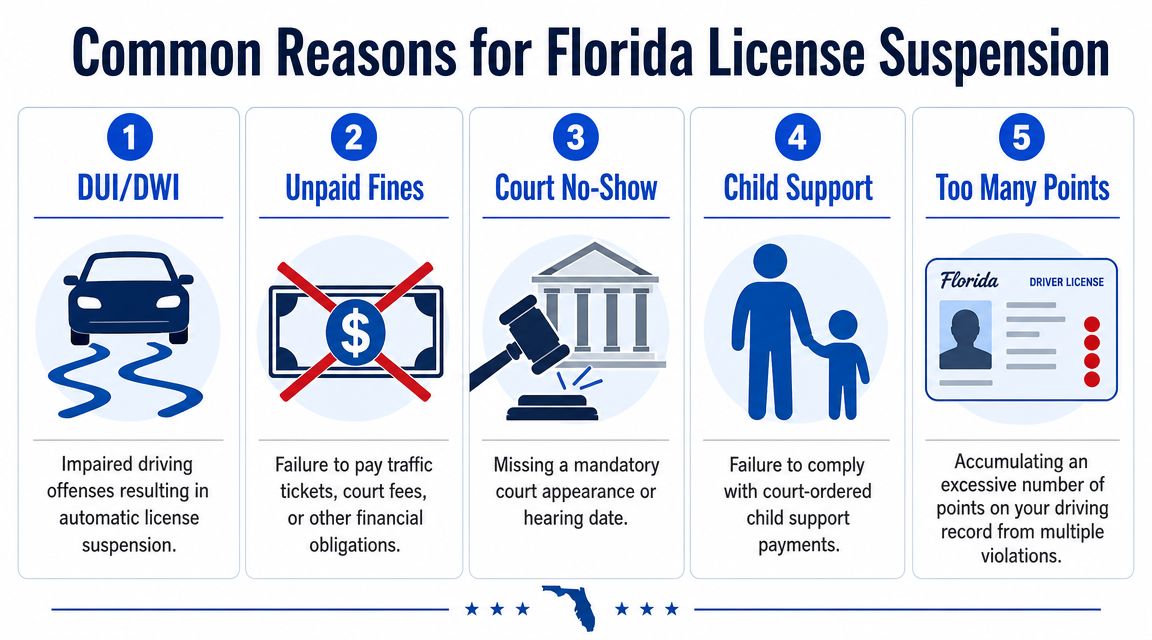
What are the most common suspension triggers
A common one is a DUI-related suspension. In Florida, DUI charges and convictions can affect your driving privilege under section 316.193. That's not a routine ticket problem. It can involve administrative action, court action, or both.
Another frequent trigger is a failure to appear or failure to comply with a court order. You miss court, miss a deadline, or ignore a required step, and the state can suspend your privilege until you clean it up.
Then there are financial responsibility issues, including lapses tied to insurance or other required compliance. Florida takes those seriously because the state wants proof that drivers on the road can lawfully operate and cover potential liability.
You also see suspensions from too many points and from unpaid fines or fees. These often start small and then spiral because people assume they can deal with it later.
How does the reason change the solution
The state's reason matters because each reason creates a different path. Some suspensions are lifted when you satisfy a clear condition. Others require hearings, proof of completion, or waiting periods.
Here's the quick diagnostic view:
Florida License Suspension Types at a Glance | ||
|---|---|---|
Reason for Suspension | Typical Path to Restoration | Key Challenge |
DUI under Florida Statute 316.193 | Satisfy court and administrative requirements, then seek reinstatement or hardship relief if eligible | Multiple decision-makers and high stakes |
Failure to appear or comply | Resolve the underlying case or compliance issue first | Old court dates and unresolved paperwork |
Insurance or financial responsibility issue | Show valid compliance and complete required reinstatement steps | Gaps in records or delayed reporting |
Too many points | Wait out the period or complete required steps if available | New violations while already at risk |
Unpaid fines or fees | Pay or otherwise resolve the balance and clear holds | Multiple agencies may be involved |
The state doesn't care that your job is on the line until you satisfy the legal condition that caused the suspension.
If you're trying to solve the wrong problem, you'll waste time. That's why a license restoration lawyer starts with the source of the suspension, not your preferred outcome.
Are You Eligible for License Reinstatement
Eligibility is not about whether you need to drive. It's about whether you've met the legal conditions to ask Florida for your privilege back.
What should you check first
Start with your official driving record and every notice tied to the suspension. You need the exact status, the listed cause, and any hold or reinstatement requirement attached to your file. If something is missing, stale, or inconsistent, fix that before you assume you're ready.
Then review whether you've completed everything Florida expects. That may include court compliance, school, proof of insurance, or other case-specific conditions. If your issue involved alcohol or controlled substances, your record needs to show compliance that matches the type of suspension.
For a practical overview of how counsel approaches this problem, review this guide on a driver license restoration attorney.
Who controls your case right now
Many drivers often make a damaging mistake. They assume every license problem is handled in one place. It isn't.
A license restoration process is often an administrative system with different deadlines and hearing rules, and in some cases a driver may need to act within 15 days of notice to fight a suspension through an administrative hearing that is separate from any court case, as described in this discussion of administrative hearing deadlines and separate license proceedings. The immediate lesson for Florida drivers is simple: identify whether your issue sits with a court, a DHSMV process, or both before you miss a critical date.
That matters if you drive for Uber, Lyft, deliveries, sales, home health, or any job where a suspended license cuts off income fast.
Check the file owner: Is this a court compliance problem, a DHSMV hold, or both?
Check the clock: Some deadlines are short, and once they pass, your options narrow.
Check the sequence: One unresolved hold can block the rest of the reinstatement process.
If you don't know who has the power to lift the suspension, you don't know where to fight.
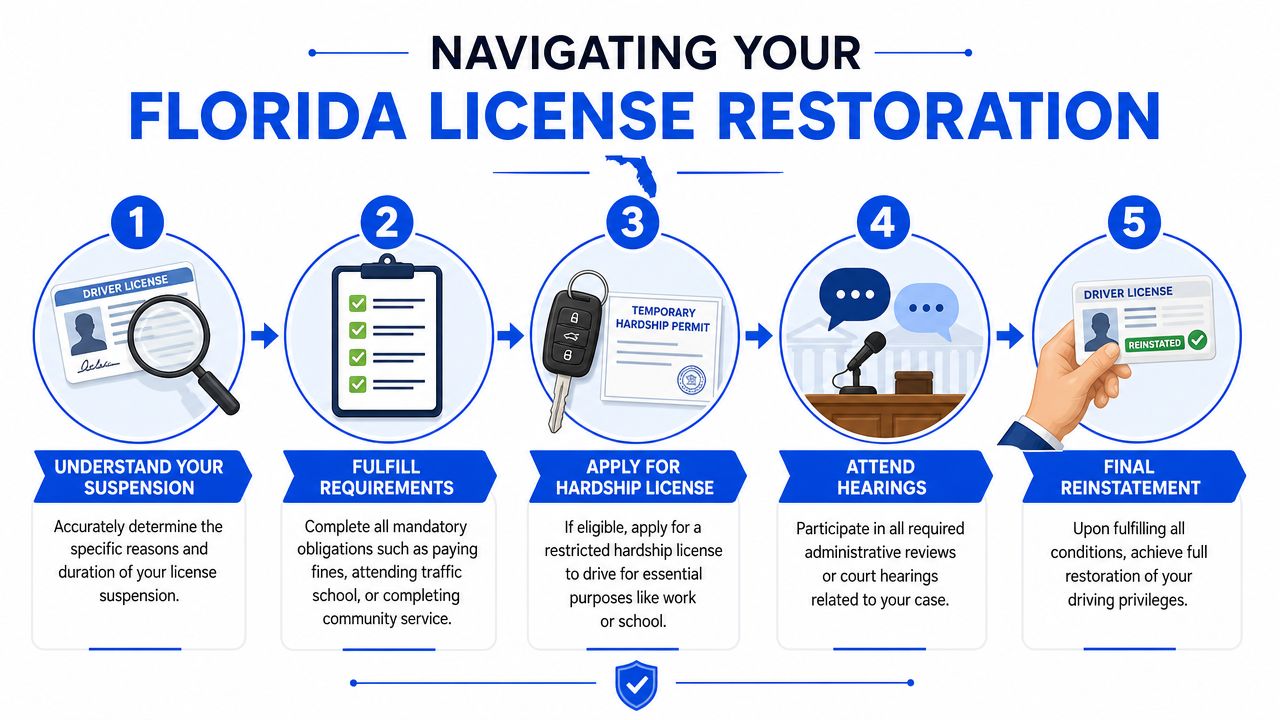
What Is the Florida License Restoration Process
The restoration process is not a single form. It's a sequence. The order matters, and weak proof can sink a valid case.
What documents matter most
A sound restoration workflow starts with records. One documented guide to reinstatement explains that the process usually begins by obtaining the driving abstract and all DUI or administrative records, then completing the required evaluation, education, and treatment before filing for a formal hearing, with hearing packet forms kept recent and, in one guide, dated within three months of submission, as outlined in this document-first reinstatement workflow guide.
That sequence makes sense in Florida too. You don't want to file first and discover later that your record, school proof, evaluation, or compliance documents are incomplete.
In cases involving alcohol-related revocations, the burden often turns on evidence. One restoration guide notes that a revoked driver may need a recent substance-abuse evaluation, 3 to 6 support letters, proof of program attendance, ignition-interlock final reports, and at least 12 months of abstinence for alcohol-related revocations, as described in this sobriety and support evidence overview. The larger point is what matters for you in Florida: restoration can fail on evidence quality alone.
What should you do immediately
Use a disciplined approach. Don't throw papers together and hope the hearing officer or clerk sorts it out for you.
Pull the record first: Your driving history tells you what Florida believes happened.
Match each requirement to proof: If the state requires completion, produce documentation that clearly proves completion.
Update stale paperwork: Old evaluations, old letters, and inconsistent records create doubt.
Organize for scrutiny: Every document should support the same timeline and the same theory of reinstatement.
Prepare for questions: If there's a hearing, your documents and your testimony must line up.
For a Florida-focused overview of the practical path, read how to reinstate a suspended license in Florida.
Why does the order matter so much
Because restoration is an evidence problem before it becomes a hearing problem. If your file is weak, no argument fixes that cleanly. A strong lawyer doesn't rely on charisma. A strong lawyer builds a record that survives review.
And if your suspension traces back to DUI conduct under 316.193, you should assume the state will look closely at compliance, safety, and credibility. That's why document quality matters so much.
How Does a License Restoration Lawyer Protect You
A license restoration lawyer protects you by doing what apps, intake centers, and volume-based ticket operations can't do. They identify the core issue, build the record, manage the deadlines, and stand between you and a system that doesn't forgive sloppiness.

Why isn't this a job for an app
Apps are built for intake and automation. License restoration cases are built around judgment. You need someone who can spot a bad timeline, a missing condition, a risky statement, or a hearing problem before it costs you another denial or another charge.
That's especially true when your license issue overlaps with a DUI, a pending traffic matter, or a court compliance problem. Florida procedure isn't forgiving. One wrong assumption can send you to the wrong office, miss the right deadline, or produce a filing that doesn't clear the hold.
Specialized firms in this niche report success rates as high as 97% to 98% in license appeal hearings, which shows the value of expert preparation even though outcomes are never guaranteed, according to this discussion of license appeal success rates and specialized preparation. That should tell you something important. Preparation is not optional.
What does direct lawyer access change
It changes speed and accountability. When your livelihood depends on driving, you can't afford to explain your case to a chatbot, then a call-center rep, then a case manager who never appears in court.
A lawyer-led model matters because you need legal analysis, not canned updates. Ticket Shield, PLLC handles suspended-license matters as a Florida law firm where clients communicate directly with their attorney by phone or text, which is a very different experience from automated apps or ticket mills. If you need help now, review the firm's Florida suspended license lawyer service.
A real lawyer tells you when not to file yet. That advice can save your case.
Law firms also need systems that preserve attorney access while counsel is in court or depositions. For firms balancing responsiveness with active litigation, this overview of support for lawyers during depositions is useful because it shows how to keep client communication moving without replacing legal judgment with automation.
Here's what a lawyer does in a restoration matter:
Diagnoses the file: Finds the true suspension source and every related hold.
Builds the theory: Decides whether the case calls for compliance cleanup, hardship strategy, hearing preparation, or all three.
Prepares the evidence: Reviews every document for consistency, completeness, and timing.
Protects your testimony: Helps you avoid statements that sound evasive, careless, or uninformed.
Coordinates the forums: If court and administrative processes both matter, counsel keeps them aligned.
A quick video can help you think about the practical side of license defense and restoration:
What Are the Common Pitfalls and Real Costs
The biggest mistake is assuming you can patch this together as you go. Florida license problems punish delay, guesswork, and incomplete compliance.
Which mistakes cause the most damage
Some drivers file before they're eligible. Others ask for hardship relief without understanding the restrictions that come with it. Many submit weak proof, show up unprepared, or keep driving while the problem is still unresolved.
Those are not harmless errors. They can trigger new court dates, longer delays, and a worse record.
Common trouble spots include:
Missing a deadline: Even a short delay can change your options.
Fixing only part of the problem: Paying one obligation doesn't remove every hold.
Using weak paperwork: Inconsistent records raise credibility issues.
Talking too much at the wrong time: A bad statement can damage a hearing or related case.
Ignoring the DUI angle: If your suspension ties back to 316.193, every step needs to account for that history.
What does delay really cost you
Legal fees are visible. The cost of a failed do-it-yourself attempt usually isn't. Lost workdays, rideshare expenses, account deactivation for gig drivers, family disruption, and insurance consequences often cost more than people expect.
You're not just paying to file papers. You're paying to avoid preventable mistakes that keep you off the road longer.
A cost-effective strategy is one that gets the diagnosis right early, protects your record, and avoids a second round of damage control.
Your Next Steps for License Restoration in Florida
You need a plan, not optimism. Start with the exact basis for the suspension, then clear every condition in the right order.
Can you get a hardship license
Maybe. It depends on why the suspension happened, whether you're legally eligible, and whether you've completed the steps Florida requires first. If hardship relief is even on the table, treat it seriously. It comes with rules, and violating those rules can make things worse.
For a practical overview, review how to apply for a hardship license in Florida.
How long does reinstatement take
There isn't one universal timeline. Some cases move after basic compliance. Others take longer because they involve court cleanup, administrative review, or proof that has to be gathered carefully. If your job depends on driving, that's exactly why you shouldn't wait to get the diagnosis right.
What if you live outside Florida
Florida holds can still block your driving privilege even if you've moved. The state where you live now may not issue or fully clear your privilege until the Florida issue is resolved. Out-of-state drivers often waste time because they assume distance changes the obligation. It doesn't.
What should you do today
Get your driving record and suspension notice together
Stop guessing about eligibility
Don't drive unless you are legally allowed to drive
Get legal advice before you file, speak, or appear
Treat this as a license-protection case, not a customer-service problem
If you want a direct, lawyer-led path focused on protecting your driving privilege and pursuing the No Points outcome wherever possible, visit Ticket Shield, PLLC for a free consultation.
