How to apply for hardship license in florida: A Step-by-Step Guide
Learn how to apply for hardship license in florida, with eligibility, the steps to file, and tips to avoid common mistakes.
If your driver's license has been suspended, figuring out how to apply for a hardship license in Florida is your first and most critical step toward getting back a piece of your life. This isn't a full license, but a restricted one that lets you drive for the absolute essentials, like getting to work or to a doctor's appointment. It ensures a suspension doesn't completely sideline you.
Understanding Your Options After a License Suspension in Miami-Dade
Losing your driving privileges in a massive, sprawling area like Miami-Dade County can feel like losing your independence. Public transport isn't always a realistic fix for a commute from Kendall to a job site in Downtown Miami. For many people, daily life depends on being able to drive.
That's where a Florida hardship license comes in. It’s a restricted driving permit that offers a legal path back onto the road for your most critical activities. This special license isn't a get-out-of-jail-free card; it’s a limited privilege granted by the Florida Highway Safety and Motor Vehicles (FLHSMV) only to people who can prove that a total loss of driving creates a genuine, significant hardship.
To give you a quick overview, here are the key things to know about the process.
Florida Hardship License Quick Facts
This table breaks down the essentials of what you'll be dealing with when you apply for a hardship license in Florida.
Requirement or Aspect | Description |
|---|---|
Eligibility | Depends on the reason for suspension. Not all offenses qualify immediately. |
License Types | "Employment Purposes Only" or the more flexible "Business Purposes Only." |
Application Process | Involves specific forms, supporting documents, and a hearing with the FLHSMV. |
Required Schooling | Most applicants must complete an Advanced Driver Improvement (ADI) course. |
Ignition Interlock | Often mandatory for DUI-related suspensions. |
Fees | Includes application fees, reinstatement fees, and administrative fees. |
Common Denials | Incomplete applications, failing to prove hardship, or ineligibility. |
Getting through this process means understanding every detail, starting with what kind of restricted license you might even qualify for.
Types of Florida Hardship Licenses
The state offers two main types of restricted licenses, and they come with very different rules on where and when you're allowed to drive. Knowing the difference is absolutely crucial before you even start your application.
Employment Purposes Only: This one is exactly what it sounds like—and it’s the most restrictive. It strictly allows you to drive to and from your job. If your work itself requires driving, this license will cover that, too. Nothing else.
Business Purposes Only: This license offers a bit more breathing room. It permits driving that’s necessary to "maintain your livelihood." That includes your work commute, but it can also cover driving for school, church, or essential medical appointments.
The type of license you might get often comes down to the reason your license was suspended in the first place. For instance, some DUI-related suspensions might only let you get the "Employment Purposes Only" license at first. You can learn more about the common reasons for a suspended license in Florida in our article and how to handle them.
Common Reasons for Suspension
A license can get suspended for all sorts of reasons, and each one has its own specific rules for hardship eligibility. Some of the most common triggers we see for suspensions in Miami-Dade and across Florida include:
Racking up too many points on your driving record from traffic tickets.
A conviction for Driving Under the Influence (DUI).
Failing to pay traffic fines or other court-ordered financial responsibilities.
Being labeled a Habitual Traffic Offender (HTO).
Navigating the requirements to apply for a hardship license in Florida can be complex. The goal of our firm is to protect your license and record. Remember, past results do not guarantee future outcomes.
Whether you're dealing with a suspension for unpaid tickets or something more serious, a hardship license might be the only legal way for you to keep driving. Building a strong application starts with figuring out which license fits your situation and making sure you meet the state's very strict criteria.
Attorney Advertisement. Office in Broward. Submitting information via this website does not create an attorney-client relationship. All legal questions should be directed to a licensed attorney.
First Things First: Are You Even Eligible for a Florida Hardship License?
Before you spend a single minute filling out paperwork, the most important thing you need to do is figure out if you're actually eligible for a hardship license in Florida. The Florida Highway Safety and Motor Vehicles (FLHSMV) has very strict rules, and simply needing to get to work isn't enough to qualify.
Your eligibility almost always comes down to two things: the reason your license was suspended and whether you’ve already served the required "hard suspension" period.
This is a mandatory waiting period where you absolutely cannot drive. No exceptions. The length of this hard suspension varies wildly depending on what got you into this situation in the first place.
First-Time DUI Conviction: You're looking at a 30-day hard suspension before you can even think about applying.
Refusing a Breathalyzer Test (First Offense): This one's tougher, requiring a 90-day hard suspension.
Too Many Points on Your License: The wait time depends entirely on how many points you racked up and over what period.
Habitual Traffic Offender (HTO): If you've been labeled an HTO, you're facing a five-year revocation. You might be able to apply for a hardship license, but only after serving one full year without a single driving offense.
Clearing the Decks: The Technical Requirements
Beyond the waiting game, there are other boxes you have to check. One of the quickest ways to get your application denied right out of the gate is having unresolved issues on your record. The FLHSMV won't even look at your application if you have outstanding traffic tickets, unpaid court costs, or any other unfulfilled court obligations.
Think of it this way: the state isn't going to grant you a special privilege to drive while you still have outstanding business with them. Getting your record completely clean isn't just a good idea—it's a non-negotiable first step.
For example, a construction worker in Hialeah might have a compelling case showing his truck is essential for getting to job sites all over Miami-Dade County. But that proof means nothing if he's got an old, unpaid speeding ticket from a different county hanging over his head.
You can learn more about the specific requirements for a hardship license in Florida in our guide.
A Reality Check on the Approval Process
It's important to go into this with realistic expectations. Applying for a hardship license might sound straightforward, but the statistics tell a different story.
Between 2015 and 2020, only about 5% of people who applied were actually granted a hardship license. That number should tell you just how tough the FLHSMV's process is. The most common reason for denial? Incomplete or inaccurate paperwork. Find out more about these hardship license statistics at drivereducators.com.
That incredibly low approval rate highlights why a complete and accurate application is so crucial. Every single detail, from proving your hardship to confirming you've met all the prerequisites, has to be handled with meticulous care. An experienced legal team can ensure your application is complete, accurate, and submitted correctly, which can be beneficial to your goal of protecting your ability to drive. Our practice focuses on traffic and DUI defense across Florida.
Navigating the Hardship License Application Process
So, you've confirmed you're eligible. Now comes the part where the rubber meets the road: preparing and submitting your application. This isn't just about filling out a form; it's about building a solid, compliant case for why the Florida Highway Safety and Motor Vehicles (FLHSMV) should grant you this restricted privilege.
Pay close attention here, because even tiny mistakes can get your application kicked back with an automatic denial.
The very first thing you have to do is enroll in the correct driver improvement course. This is non-negotiable. The right course depends entirely on why your license was suspended in the first place.
For suspensions from too many points or a Habitual Traffic Offender (HTO) status, you need to enroll in a 12-hour Advanced Driver Improvement (ADI) course.
For any DUI-related suspension, you must enroll in a state-approved DUI school.
You can't even start the application without proof of enrollment from one of these programs. That document is the foundation of your entire package.
Finding and Completing the Application Form
Once you have proof of your course enrollment, it's time to tackle the official paperwork. You're looking for Form HSMV 78306, the Application for Hardship/Administrative Hearing, which you can find on the FLHSMV website.
Accuracy is everything here. Double-check every single entry. Make sure your name, driver's license number, and the suspension details are perfect. A really common mistake we see is people being too vague about why they need the license. Be specific and be honest about your need to drive for work, school, or critical medical appointments.
This simple flowchart breaks down the core eligibility checks you must pass before you even touch the paperwork.
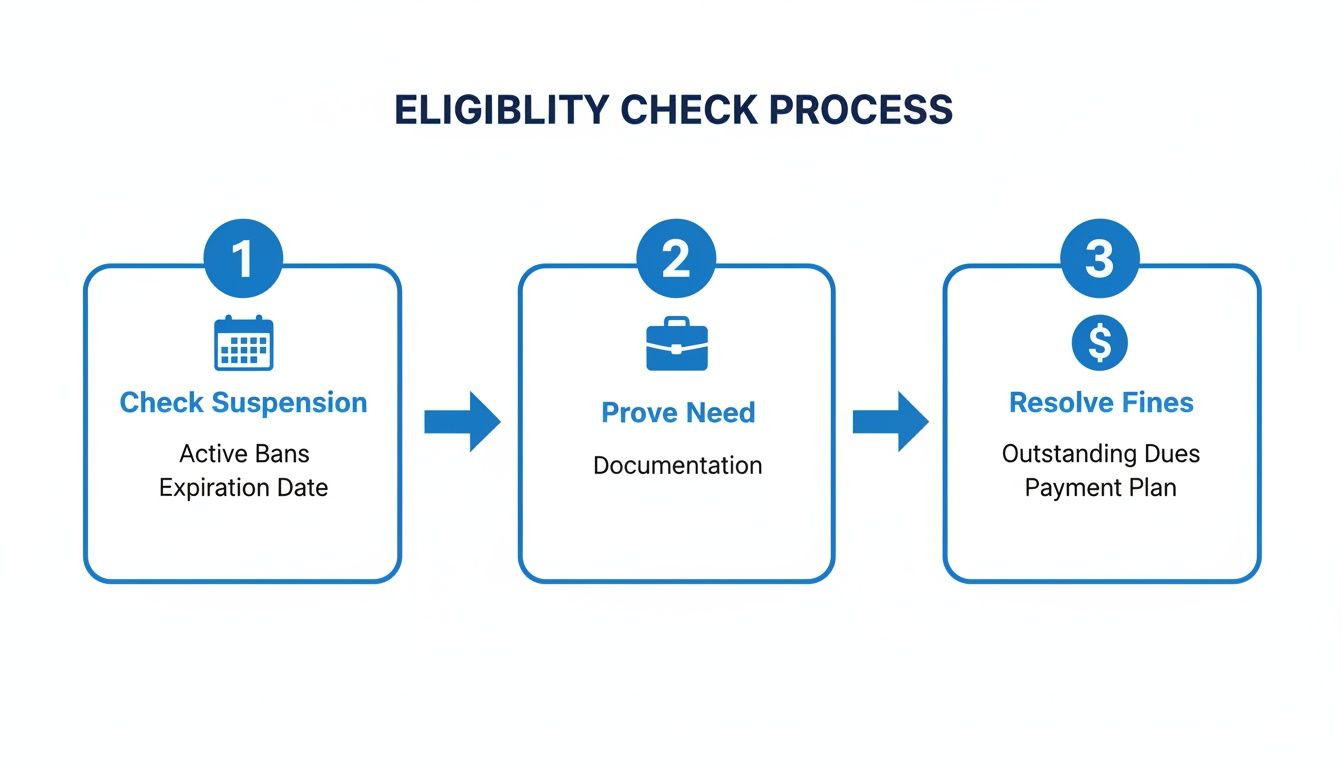
As you can see, confirming your suspension details, proving your need, and clearing up any outstanding fines are the absolute first steps.
Gathering Your Supporting Documents
The application form by itself isn't enough. You need to back up your claim of hardship with strong, verifiable evidence. Think of these documents as the proof that validates the story you’re telling on your application.
Your supporting documents should paint a clear, undeniable picture of how not being able to drive creates a genuine hardship. A vague letter from your boss just won't cut it.
For instance, if you need to drive for your job, get a letter from your employer on official company letterhead. A proper letter will include:
Your job title and a quick rundown of your responsibilities.
A direct statement confirming that driving is essential for your job or your commute.
Your typical work schedule, including days and hours.
The employer’s contact info so the FLHSMV can verify everything.
If you’re a student, a copy of your class schedule combined with a letter from the school registrar can be powerful proof. You can find more tips on building a strong case in our guide on applying for a hardship license in Florida.
Scheduling and Preparing for Your Hearing
After you've put together your application and all your supporting documents, you'll need to schedule a hearing at a local Administrative Reviews Office. Be ready to pay all the required fees at this time, which usually includes the application fee plus any license reinstatement fees.
This hearing is your chance to present your case in person to a hearing officer. They’re going to review all your paperwork, ask you questions, and decide if you meet the state's very strict criteria. Our firm focuses on Florida traffic and DUI defense, and our goal is to make sure your application is complete, compelling, and correctly presented. Remember, past results do not guarantee future outcomes.
Common Application Mistakes and How to Avoid Them
When you're trying to get a hardship license in Florida, the process can feel unforgiving. With so few applications actually getting approved, even a tiny mistake can shut the whole thing down. Knowing where people usually trip up is the best way to build a solid application right from the start.
The single biggest reason applications get denied? Incomplete or incorrect paperwork. It sounds simple, but a small error on Form HSMV 78306, like a mistyped driver's license number or a vague explanation for your hardship, will stop your application dead in its tracks.
For example, a letter from your boss that just says "John needs to drive for work" is useless. It’s too vague and will absolutely get rejected. A strong employer letter needs to be on company letterhead and get specific, detailing your job duties, work schedule, and explaining exactly why driving is essential for you to keep your job.
Unresolved Underlying Issues
Another frequent—and completely avoidable—reason for denial is failing to clean up your record before you apply. The Florida Highway Safety and Motor Vehicles (FLHSMV) will not grant a restricted license to someone with unpaid court fees or outstanding tickets, even if they're from other counties. Before you submit a single page, you have to be certain your record is completely clear.
Check for old fines: Call the clerk of court in any county where you've ever gotten a ticket and confirm you have a zero balance.
Handle court obligations: Make sure every court-ordered class or payment plan is officially marked as complete.
Know your exact license status: Don't just assume you know why it's suspended. Get the facts. Check out our guide on how to check if your license is suspended for a clear picture of what the state has on file.
Tying up these loose ends isn't just a suggestion; it's a non-negotiable prerequisite. A hearing officer won't even look at your application otherwise.
Ineligibility Due to the Offense
Finally, it's crucial to understand that not every offense is eligible for a hardship license, at least not right away. Certain convictions come with mandatory "hard suspension" periods where absolutely no driving is permitted. No exceptions. This is especially true where the hardship license system bumps up against Florida's strict DUI laws.
While license suspensions for impaired driving account for just 3% of total suspensions in the state, they come with harsh rules. For example, those charged with a DUI must prove enrollment in DUI school, then serve a 30-day hard suspension for a BAC of .08 or higher, or 90 days for refusing a breathalyzer. You can explore more about Florida's license suspension policies and their economic impact in this detailed report.
A second DUI conviction or certain drug-related offenses can disqualify you from getting a hardship license altogether. Misunderstanding these strict waiting periods and eligibility rules is a common and costly mistake. Because our firm focuses on Florida traffic law, we can help clarify your eligibility based on the specifics of your case. Our goal is always to protect your license and your record.
How an Experienced Traffic Attorney Can Assist You

You can try to apply for a Florida hardship license on your own. But it's a notoriously difficult road to travel. The approval rates are low for a reason—the Florida Highway Safety and Motor Vehicles (FLHSMV) scrutinizes every single detail, and one small mistake on a form can get your application tossed out immediately.
This is where having a legal professional in your corner can be beneficial.
Working with an attorney who handles traffic law provides strategic support that goes far beyond just filling out paperwork. The first thing we do is a top-to-bottom review of your case to confirm you’re even eligible. We make sure you’ve served your mandatory "hard suspension" time and that every last outstanding fine has been paid off.
The sheer number of license suspensions in Florida is staggering. As of late 2022, over 700,000 Floridians had their licenses suspended just because they couldn't afford to pay fines and fees from traffic tickets. An analysis by the Fines and Fees Justice Center found that’s one out of every 24 driving-age adults in the state. This highlights a massive crisis rooted in debt-based suspensions that you can read more about in their report on the economic impact.
Building a Strong Case for the Hearing Officer
An experienced attorney knows how to build a rock-solid case file designed to prove your hardship to the hearing officer. It’s about more than just checking boxes. We make sure your letters from work are specific and verifiable, your ADI or DUI school enrollment is perfectly documented, and every piece of information on Form HSMV 78306 is accurate and compelling.
An attorney can represent you at the administrative hearing. This is a huge advantage. They can present your case clearly, field any tough questions from the hearing officer, and ensure the entire process is fair. Our firm handles criminal traffic matters across all 67 Florida counties, so we’re familiar with the specific procedures of different administrative review offices.
An investment in a consultation is an investment in protecting your ability to drive. Our goal is to protect your license and record. Past results do not guarantee future outcomes.
Ultimately, the goal is often to tackle the underlying traffic issue that caused the suspension in the first place. By handling the original violation, we work to protect your driving record from the start. That is a way to avoid needing a hardship license altogether. You can learn more about how a suspended license lawyer can assist with every step of this complicated process.
Common Questions About Florida Hardship Licenses
When you're trying to get a hardship license in Florida, a lot of specific questions pop up. The rules can feel confusing, so let's clear up some of the most common issues we see drivers run into.
Can I Get a Hardship License If I Have Unpaid Tickets?
No, you absolutely cannot. This is a non-negotiable starting point and one of the fastest ways to get your application denied.
Before the Florida Highway Safety and Motor Vehicles (FLHSMV) will even look at your case, you have to settle up on all outstanding traffic tickets, court costs, and any other fees you owe. Your record has to be completely clear of these financial obligations. Think of it as a clean slate requirement—you can't ask for a special privilege to drive while you still owe for past mistakes.
What's the Difference Between a "Business" and an "Employment" License?
Understanding the difference here is critical because it determines exactly where and when you're allowed to drive. The freedom you have with each license is very different.
Employment Purposes Only: This is the most restrictive type. It only allows you to drive to work, from work, and for tasks you have to do as part of your job. That’s it. No other driving is permitted.
Business Purposes Only: This license gives you a bit more breathing room. It covers driving that's necessary to "maintain livelihood." This includes your commute, but it can also cover essential trips for school, church, or medical appointments.
The type you qualify for usually depends on why your license was suspended in the first place.
Be warned: you have to follow the rules of your specific hardship license to the letter. If you have an "Employment Purposes Only" license and get caught running a personal errand, you could face a new charge for driving with a suspended license. That would mean losing your hardship privilege immediately.
How Long Does the Hardship License Application Process Take?
Getting a decision on your hardship license isn't an overnight thing. The timeline to apply for a hardship license in Florida can vary.
After you've submitted your application, proof of ADI or DUI school enrollment, and all your other documents, the final step is an administrative hearing with the FLHSMV. The hearing officer usually makes a decision right there at the end of your hearing.
But the whole process—from enrolling in the class to gathering paperwork, scheduling the hearing, and getting the official green light—can easily take several weeks. If you want to minimize the time you're stuck without a license, it's smart to start the process the moment you become eligible. Past results do not guarantee future outcomes, and our goal is to protect your license and record.
Navigating the complexities of a hardship license application can be daunting. The team at Ticket Shield, PLLC focuses on Florida traffic law and is ready to help guide you through the process. For a free consultation to discuss your case, visit us at https://www.ticketshield.com.