Navigating the Maze: A Guide to Applying for a Hardship License in Florida
A practical guide to applying for hardship license in florida, including Form HSMV 78306, online steps, eligibility limits, and hearings.
Losing your driver's license in Florida can throw your entire life into chaos. Suddenly, getting to work, taking your kids to school, or making it to a doctor's appointment feels impossible. The good news is, there's a formal process for applying for a hardship license in Florida that can get you back on the road for essential needs. It’s a restricted license designed to help you keep your life moving while your full driving privileges are on hold.
How We Evaluated the Florida Hardship License Process
This article is built around the actual state process, not generic driver-advice copy. We reviewed the Florida Bureau of Administrative Reviews hardship materials, the current Application for Administrative Hearing, Form HSMV 78306, and FLHSMV resources on administrative reviews and hardship hearings and license suspensions and revocations. We also compared how the rules change depending on the reason for the suspension—DUI, points, refusal, or habitual traffic offender status—because the answer is rarely one-size-fits-all.
Our aim here is practical: identify the documents people most often miss, the timing mistakes that cause automatic denials, and the hearing issues that decide whether someone gets broader Business Purposes Only relief or something narrower. In my experience, the biggest problems are not dramatic legal disputes; they are preventable process failures like applying before the hard-suspension period ends, bringing the wrong course proof, or showing up without receipts proving all required fees were paid.
Understanding Florida Hardship Licenses
A license suspension, whether you're in a busy area like Broward County or a quieter part of the state, brings your daily routine to a screeching halt. The Florida Highway Safety and Motor Vehicles (FLHSMV) understands this, which is why they offer a path forward with a hardship license. This isn't a free pass; it's a critical, restricted permit that lets you drive for very specific, approved reasons.

The state offers two main types of hardship licenses, and they are not created equal. Knowing the difference between them is the first and most important step in preparing your application for approval.
Business Purposes Only vs. Employment Purposes Only
The most common option is the Business Purposes Only (BPO) license. Don't let the name fool you—its scope is much broader than just driving for your job. A BPO license lets you drive for any activity that's necessary to maintain your livelihood.
This typically includes:
Driving to and from work.
Performing job duties that require you to be behind the wheel.
Getting to and from school if you're a student.
Traveling to essential medical appointments for yourself or a family member.
Attending religious services.
On the other hand, an Employment Purposes Only license is exactly what it sounds like: restrictive. It only allows you to drive directly to, from, and for work-related tasks. A trip to the doctor or the grocery store is strictly off-limits. This type is far less common and is usually reserved for very specific circumstances.
Key Takeaway: The BPO license offers much more practical flexibility for real-world needs. When you go before the hearing officer, you'll need to clearly explain and justify why you need these specific driving privileges.
For a quick reference, here's a breakdown of the key elements of a Florida hardship license.
Florida Hardship License At a Glance
This table provides a snapshot of the types of licenses available and the common reasons a driver might need one.
Category | Key Details |
|---|---|
License Types | Business Purposes Only (BPO): For work, school, medical, and religious needs. Employment Purposes Only: Strictly for work-related driving. |
Common Suspensions | DUI, accumulation of too many points, Habitual Traffic Offender (HTO) status, drug-related convictions. |
Primary Goal | To allow limited, essential driving to maintain livelihood while full driving privileges are suspended. |
Understanding these basics will help you prepare a stronger application and set realistic expectations for the process ahead.
For drivers who know SR-22 may become part of the reinstatement process, this plain-English explainer offers more from Florida All Risk Insurance on how the filing works.
The Importance of a Flawless Application
The application process is administrative, which means details matter more than emotion. A strong hardship request usually rises or falls on timing, complete paperwork, school enrollment or completion proof, and whether your driving record still shows unresolved problems. Instead of relying on rumor or old county handouts, it is smarter to work from the current state form and the FLHSMV's published hardship-hearing process.
This is why careful preparation is everything. You can get familiar with the specific regulations by reviewing the complete hardship license in Florida rules and requirements. As you pull everything together, remember that your goal is to present a clear, honest, and well-documented case for why you absolutely need this license.
Before you even think about filling out forms or tracking down documents for a hardship license, you have to nail down one critical detail: are you eligible? This is the first hurdle where so many drivers stumble. Your eligibility isn't a simple yes-or-no question; it's tied directly to the specific reason your license was suspended in the first place. The rules for a DUI are a world apart from the rules for someone who just racked up too many points.
Getting this right from the start is the key to setting realistic expectations. Many suspensions come with a mandatory "hard suspension" period. Think of it as a required waiting time during which you cannot legally drive. If you try to apply before that clock runs out, you're guaranteed an automatic denial. You'll just be wasting your time and money.
Understanding Hard Suspension Periods
The hard suspension is the toughest part because you can't fight it. You just have to wait it out. How long you have to wait depends entirely on what got you suspended.
Point-Based Suspensions: If you piled up too many points on your record (12 points in 12 months, 18 in 18 months, or 24 in 36 months), you're in one of the more straightforward situations. Generally, there's no hard suspension period, so you can apply for a hardship license right away.
DUI Convictions: For a first-time DUI conviction, you're looking at a 30-day hard suspension. Once those 30 days are up, you can start the application process. But, and this is a big one, if that DUI involved a refusal to take a breath test, the waiting period jumps to a painful 90 days.
Habitual Traffic Offender (HTO): If you've been labeled a Habitual Traffic Offender, you're facing a five-year revocation. Before you can even be considered for a hardship license, you have to serve a mandatory one-year hard suspension.
Important Note: Getting caught driving during your hard suspension period will instantly make you ineligible for a hardship license. It could also lead to much more severe penalties, including potential criminal charges. It is absolutely critical that you respect this waiting period.
Prerequisites You Must Meet Before Applying
Beyond waiting out any required hard suspension, you have to complete a few prerequisites. The FLHSMV won't even glance at your application until you show proof that these are done. Think of them as your ticket to get in the door for an administrative hearing.
The most common requirements involve enrolling in and completing specific driver education courses. The right course for you depends entirely on why your license was suspended.
Common Required Courses:
DUI School (DUI Level I or Level II): Required for any driver whose suspension is tied to a DUI, whether it was a conviction or a refusal to submit to testing. You'll need to show proof of enrollment when you apply.
Advanced Driver Improvement (ADI) Course: This 12-hour course is required for drivers with point-based suspensions or those designated as a Habitual Traffic Offender. It's designed to address the driving behaviors that led to the suspension.
These courses aren't just about checking a box. They show the hearing officer that you're taking this seriously and are committed to being a safer driver on the road.
Don't Guess About Your Suspension Status
Before you spend a dime on courses or application fees, you need to be absolutely certain about the details of your suspension. You have to know the exact start date, the specific reason for it, and every single requirement tied to it. It’s common for drivers to be caught off guard by old, unpaid tickets or other issues that throw a wrench in their eligibility.
The only way to get the facts straight is to go directly to the source. Use the FLHSMV's online portal to check your license status and get a clear picture of your entire record. For more detailed guidance, you can learn how to check if your license is suspended to make sure you have all your ducks in a row. This one simple check can save you from major headaches and set you up for a much smoother application process.
Can You Apply for a Hardship License Online in Florida?
Not from start to finish. Florida does let many drivers check status information online and, in some cases, pay certain reinstatement fees electronically, but the hardship request itself still turns on formal documents, course proof, and a Bureau of Administrative Reviews process. In practice, that means online tools can help you prepare, but they do not replace the application and hearing requirements.
The cleanest way to think about it is this:
Usually possible online: checking your license status, reviewing reinstatement requirements, and sometimes paying eligible fees through FLHSMV services.
Still required for the hardship request: the current Form HSMV 78306, proof of DUI school or ADI compliance when applicable, and any required Bureau of Administrative Reviews scheduling or hearing step through the state's administrative review process.
If your case requires a hearing, online payment alone does not put you back on the road. The state still has to determine eligibility, confirm the correct suspension category, and decide what restricted driving privilege—if any—should be granted.
Preparing a Flawless Application Package
Once eligibility is confirmed, the paperwork stage becomes the center of the process. For most drivers, the operational core is Form HSMV 78306, not a generic hardship request letter and not a verbal explanation at the counter. The state form, your supporting records, and proof that you completed the right prerequisites are what move the case forward.
This quick visual breaks down the key milestones you have to hit before you can even start on the paperwork.
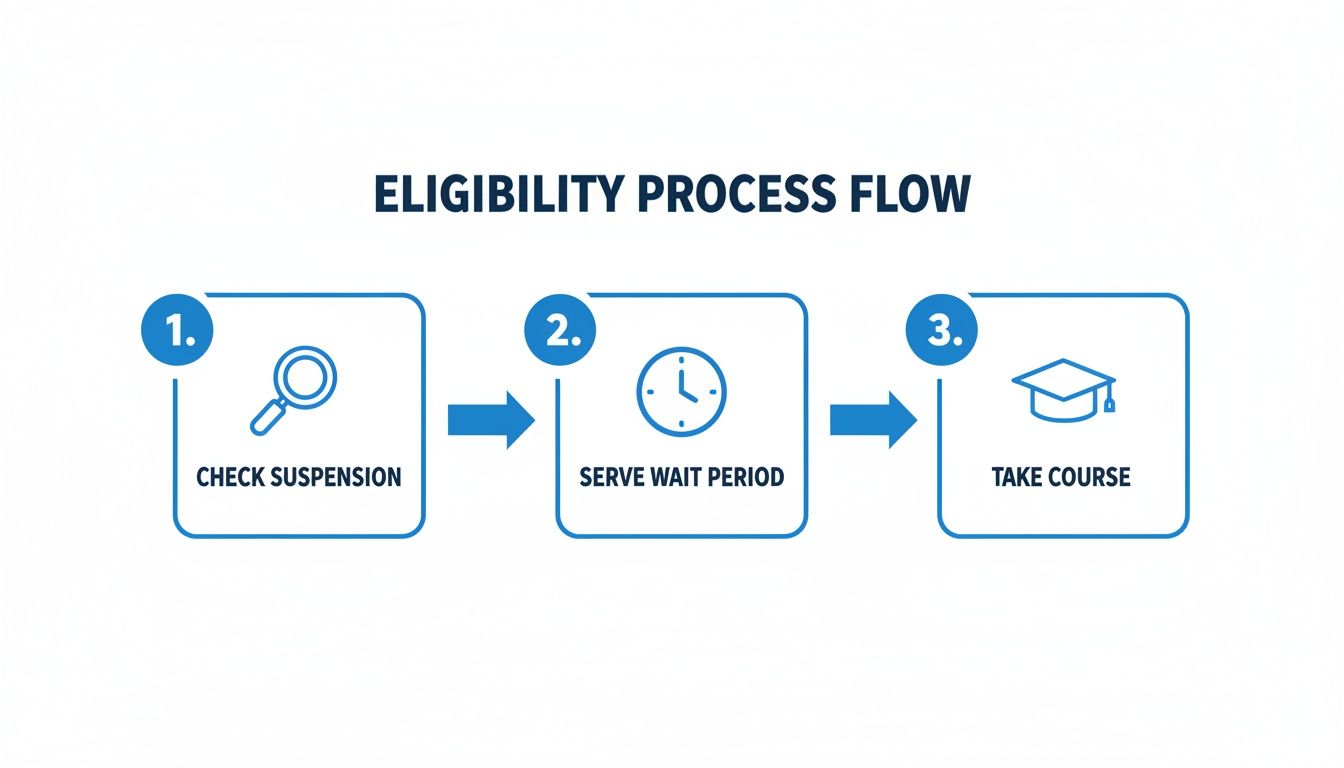
Think of it as a checklist. You have to clear each one of these steps in order before you can move on to the next.
What Form HSMV 78306 Is and Where to Get It
The official document is the Application for Administrative Hearing, Form HSMV 78306. FLHSMV's published form shows Rev. 3/2024, and that date matters because older saved copies and third-party versions may not match the state's current fields or instructions.
You should get the form directly from FLHSMV's forms library or from the Bureau of Administrative Reviews process pages, not from a random document site. Third-party fillable copies can be convenient for typing, but the official FLHSMV version controls if there is any difference in wording, revision date, or required fields.
What the form generally asks for includes:
your identifying information and contact details
driver license information
the action you are asking the state to review
the basis for the hearing request
the office or county information tied to the filing
signature and submission details
I see the same delay points repeatedly: drivers leave sections blank, use an old address that does not match state records, misstate the suspension date, or fail to clearly identify why limited driving is needed. A vague hardship explanation rarely helps. A specific one tied to work schedule, school attendance, or recurring medical treatment is much easier for a hearing officer to evaluate.
What to Bring With the Form
Your application package should be organized around the form and the proof needed to support it. Bring copies you can leave behind and originals if you may need to verify authenticity.
Checklist:
completed Form HSMV 78306
proof of DUI school or ADI enrollment/completion, depending on the case
reinstatement fee receipts and any filing-fee receipt you have
employer proof, school records, or medical documentation showing the need to drive
valid photo ID
any Bureau of Administrative Reviews notices, prior denial letters, or related hearing paperwork
For fee handling, drivers should expect the process to be structured and fee-based rather than informal. One commonly cited procedure note explains that the hardship filing includes a $12.00 fee payable to the Division of Motorist Services and that the request is not complete until payment is received, as described in this procedural summary of expedited hardship review. Even when local practice differs on intake logistics, the larger point holds: assume the state will require the proper form, proof, and payment before it treats the request as ready for review.
Common Filing Mistakes That Slow or Sink a Case
Some problems are easy to fix before filing and expensive to fix after a denial:
applying before the hard-suspension period ends
failing to resolve other open suspensions, unpaid obligations, or holds on the record
attaching course proof for the wrong program
bringing an employer note that does not explain why driving is part of the job
forgetting receipts that show reinstatement steps have already been paid
submitting a packet built from third-party forms without confirming the current FLHSMV version
Before filing, it is worth confirming your record one more time through the state's suspensions and revocations resources. The most frustrating denials are often the ones that had nothing to do with hardship at all—they came from an unresolved issue still sitting on the driving history.
What to Expect at Your Administrative Review Hearing
This hearing is where a Florida driver moves from paperwork to proof. It is not a criminal trial, and it is not just a casual interview. The Bureau of Administrative Reviews hearing officer reviews your category of suspension, your compliance with prerequisites, your stated need to drive, and whether Florida law even allows hardship relief in your situation.
Who Is Not Eligible Right Now
Before you focus on persuasion, make sure you are not walking into an avoidable denial. Drivers are commonly ineligible at the time of filing when any of the following is true:
The hard-suspension period is still running. If the mandatory waiting period for your suspension category has not expired, the request is premature.
There are unresolved suspensions, revocations, or unpaid obligations on the record. FLHSMV hardship review does not erase separate holds or open compliance problems.
You drove during the suspension, which can create new exposure and damage eligibility for hardship relief.
Required DUI school or ADI enrollment is missing. For many categories, school compliance is a gatekeeping requirement, not an afterthought.
You want hardship driving for a CDL. Florida does not issue hardship privileges for operation of a commercial motor vehicle during a CDL disqualification.
Your suspension category carries its own bar or waiting rule. DUI refusals, HTO revocations, and some repeat-alcohol scenarios often involve stricter timing and narrower relief under FLHSMV hardship procedures.
The state's administrative hearing guidance and suspension and revocation rules are the best starting point for category-specific limits. If your timeline is even slightly unclear, do not assume the earliest possible date is the right one.
What the Hearing Officer Can Approve, Deny, or Restrict
A hearing officer does not answer yes or no. Depending on the record and the law, the officer may:
approve hardship driving
deny the request entirely
approve a narrower restriction than the driver wanted
require additional compliance before issuance
That matters because many drivers ask for the broadest practical relief and receive something tighter. For example, a person who proves a direct work need but offers weak medical or school documentation may end up with a more limited privilege than expected. A case with inconsistent testimony, shaky proof of necessity, or unresolved record issues may be denied even if the hardship itself seems real.
In my view, the two most persuasive themes are consistency and credibility. If the form says one thing, the employer letter says another, and your oral explanation says a third, the hearing usually goes badly.
How to Prepare for the Questions That Actually Matter
The hearing officer's core concerns are straightforward: are you legally eligible, do you need limited driving, and can you be trusted to follow restrictions? Expect direct questions about your work duties, schedule, transportation alternatives, school attendance, medical travel, and what steps you have already completed.
Good preparation means being ready to answer with facts, not speeches. Bring the route, the schedule, the employer statement, the class paperwork, and the payment receipts. If you live with another licensed driver, be ready to explain why that does not fully solve the problem. If public transit is unrealistic, explain exactly why—distance, job-site changes, overnight shifts, patient visits, or medical timing.
For more complex hearings, it can be helpful to know that legal court transcription services exist to create an official record of the proceedings, which could be important if you need to reference the details later.
Our practice handles these meetings across Florida, and we know exactly what to expect. You can learn more about the structure of an administrative license suspension hearing to be even better prepared. A respectful attitude and solid preparation can make all the difference.
Taking Care of Post-Hearing Rules: SR-22 Insurance and IIDs
Getting that approval at your administrative review hearing feels like a huge win, but hold on—you're not quite at the finish line for getting that hardship license. Before you can legally drive again, you have to check off any other requirements the state has mandated. These aren't optional suggestions; failing to comply will keep that hardship license just out of reach.
For a lot of drivers, particularly those with DUI-related suspensions, you’ll be introduced to SR-22 insurance and Ignition Interlock Devices (IIDs). These are legal requirements you must meet to keep your restricted driving privileges.

What Is the SR-22 Insurance Requirement?
Let's clear up a common misconception: an SR-22 is not a type of insurance. It's a certificate, a special form your insurance company files directly with the Florida DHSMV for you. Think of it as proof that you're carrying the state's minimum required liability coverage.
Essentially, the SR-22 is your insurance company telling the state, "We've got this driver covered, and we promise to let you know the second their policy is canceled or lapses." It’s how Florida keeps tabs on high-risk drivers and makes sure they stay insured.
You'll usually be required to maintain an SR-22 for three consecutive years if your license was suspended for reasons like:
A DUI conviction
Refusing a breath, blood, or urine test
Causing an accident while you were uninsured
Being labeled a Habitual Traffic Offender (HTO)
Maintaining continuous coverage is essential. If your policy lapses for any reason, your insurer is legally required to file an SR-26 form, which cancels the SR-22 and immediately triggers a re-suspension of your license.
Getting Familiar With the Ignition Interlock Device (IID)
For any driver convicted of a DUI in Florida, an Ignition Interlock Device is mandatory. No exceptions. This device is a small breathalyzer that gets professionally installed right into your car’s ignition system. To start your vehicle, you have to blow into it and provide a breath sample that’s free of alcohol.
The IID doesn't stop there. It will also prompt you for random "rolling re-tests" while you're on the road to make sure you haven’t had a drink since starting the car. If you fail a test or try to mess with the device, it gets reported straight to the DHSMV and can lead to serious consequences, including having your hardship license revoked.
Key Consideration: All costs tied to the IID are your responsibility. That means the initial installation fee, monthly monitoring and calibration fees, and the final removal fee. These expenses can easily run into several hundred dollars over the required period.
Florida’s hardship license rules are directly tied to the state's battle against impaired driving. Statewide data shows that DUI is a persistent problem, leading to thousands of arrests and suspensions every year. In 2018, for example, law enforcement in Florida made 32,177 DUI arrests, the vast majority involving adults. The strict IID and SR-22 rules are a direct response to these ongoing safety concerns. You can explore more about Florida's DUI statistics to see the data behind these policies.
Ignoring these post-hearing requirements is a huge mistake. It not only puts your hardship license at risk but can also bring on new charges and make your suspension period even longer. For a closer look at the consequences, check out our guide on the penalties for driving with a suspended license. Handling these responsibilities shows the state you're serious about following the law.
How a Traffic Law Attorney Can Guide You
While you can technically try to get a Florida hardship license on your own, some cases are much riskier than others. A straightforward point suspension with clean records and complete course proof may be manageable without counsel. A layered case with alcohol issues, prior denials, or multiple open suspensions is different. That is especially true in a state where debt-based license suspensions have drawn criticism for hurting drivers without improving public safety, as discussed in this coverage of Florida's debt-based suspension policy.
When Legal Help Is Most Useful
An attorney usually adds the most value when the issue is not just filling out a form but identifying what the state will treat as a legal or procedural barrier. That often includes:
DUI refusal cases, where timing, school requirements, and category-specific rules are easy to misread
HTO revocations, because the waiting periods and reinstatement path are stricter
prior denials, especially when the denial notice is not obvious to a nonlawyer
multiple concurrent suspensions, where one cleared issue may still leave another block in place
disputed eligibility dates, such as uncertainty about when a hard suspension began or ended
hearings where the driver may incriminate themselves, including admissions about driving while suspended or inconsistent facts tied to the underlying case
A lawyer can help identify the cleanest theory for hardship relief, organize the documents around that theory, and keep the client from making unnecessary statements that create new problems.
What a Lawyer Can and Cannot Do in This Process
A lawyer can verify suspension categories, review the driving record, prepare the filing package, explain likely hearing questions, and present the strongest lawful case for restricted driving. A lawyer cannot erase mandatory waiting periods, invent eligibility where the statute does not allow it, or guarantee that a hearing officer will approve the request.
That distinction matters. The best legal help in this setting is not magic; it is accurate diagnosis, disciplined preparation, and preventing avoidable mistakes.
Attorney Advertisement: Dealing with the Bureau of Administrative Reviews is all about precision. Our firm's practice focuses on traffic law matters, which means we know exactly what hearing officers look for and how to present your case in the most effective way possible. Office in Broward.
Making a Complex Process Manageable
An attorney’s main job here is to bring a sense of order to what feels like a chaotic and overwhelming process. Instead of you losing hours trying to translate legal jargon or hunting down the right forms, we take care of the details.
This includes things like:
Confirming Your Eligibility: First, we verify your specific suspension type and confirm you meet all prerequisites, such as completing any required suspension term.
Getting the Application Right: Our team reviews every line of Form HSMV 78306 to catch and correct the common errors that often cause rejections.
Building Your Case: We help assemble the strongest available proof of hardship, such as properly formatted letters from your employer or medical documentation that presents a clear record.
Our firm is built to help drivers facing these specific challenges. If you're struggling with a suspended license, we offer a free consultation to discuss your case. Submitting information through our contact form does not create an attorney-client relationship. Please be aware that past results do not guarantee future outcomes, but our objective is always to fight for the best possible resolution for you.
Got Questions? We’ve Got Answers.
Can I do the hardship license application online?
Usually only parts of the process. You can often check your status and handle some fee-related steps through FLHSMV services, but hardship relief itself still depends on the current Form HSMV 78306, the right school proof, and any required Bureau of Administrative Reviews hearing or scheduling step. In other words, online tools help you prepare; they do not replace the state review that decides whether restricted driving will be granted.
How do I know if I’m eligible?
Start with the reason for the suspension, then confirm three things: whether a hard-suspension waiting period applies, whether your DUI school or ADI requirement has been satisfied, and whether your record still shows other open suspensions, unpaid obligations, or holds. The safest first move is to verify your status through FLHSMV and compare it with the hardship rules tied to your suspension category.
Do I need an appointment, or can I just walk in?
Do not assume a walk-in will work. Hardship matters are handled through the Bureau of Administrative Reviews, and many drivers need a scheduled administrative step rather than a standard counter visit. Check the applicable FLHSMV or BAR office instructions before going, especially if your case requires a hearing and not just fee payment or status review.
Who is not eligible for a hardship license in Florida?
Common disqualifiers include applying before the hard-suspension period ends, having unresolved suspensions or unpaid obligations, driving while suspended, missing required DUI school or ADI proof, seeking hardship privileges for CDL operation, or falling into a category with stricter statutory bars or waiting periods. Eligibility depends on the exact suspension type, not just on whether driving is inconvenient.
Navigating the complexities of a license suspension can be overwhelming, but you don't have to do it alone. The team at Ticket Shield, PLLC is dedicated to helping Florida drivers protect their driving privileges. For a free, confidential consultation to discuss your case, visit us at https://www.ticketshield.com.