
A Guide to Hardship License in Florida Rules
Understand the hardship license in Florida rules. This guide explains eligibility, the application process, and how to navigate restrictions successfully.
Losing your driver's license can feel like your world has shrunk. Suddenly, simple tasks like getting to work, picking up groceries, or making a doctor's appointment become massive logistical hurdles. But if your license has been suspended, the hardship license in Florida rules might offer a path back to some level of independence.
A hardship license isn't a get-out-of-jail-free card. Think of it as a restricted permit that allows you to drive only for the essential trips you absolutely need to make to keep your life on track. It’s a privilege, not a right, and it comes with some very strict limitations.
Understanding Your Options Under Florida Hardship License Rules
When a license suspension throws a wrench in your life, Florida law recognizes that people still need to earn a living and manage basic responsibilities. The hardship license is the state's answer to this problem, but getting one is far from a sure thing.
It’s best to think of a hardship license not as a replacement for your regular license, but as a special key that only opens a few specific doors—the door to your job, your school, or your doctor's office. All the other doors, like driving to a friend's house or the beach, remain firmly locked.
The Two Types of Hardship Licenses
Florida offers a couple of different hardship licenses, and the one you might qualify for depends on your specific situation and the judgment of the FLHSMV hearing officer reviewing your case. Each has its own rules about where you can and can't go.
Here's a quick look at the two types of hardship licenses and what they generally allow you to do.
Types of Florida Hardship Licenses and Allowed Activities
License Type | Permitted Driving Activities ('Driving necessary to maintain livelihood') |
|---|---|
Business Purposes Only | This is the more common type. It generally covers driving to and from work, any on-the-job driving your employer requires, and essential travel for medical care or educational purposes. |
Employment Purposes Only | This license is much more restrictive. It typically only allows you to drive directly to your workplace and straight back home. It does not cover other necessary trips, like going to the grocery store. |
As you can see, even the more flexible "Business Purposes Only" license comes with serious limitations. It’s crucial to understand and respect these boundaries.
Eligibility Is Not Automatic
Just because you need to drive doesn't mean the state will automatically grant you a hardship license. Your eligibility is tied directly to the reason your license was suspended in the first place, whether it was for a DUI, racking up too many points, or another violation.
Before you can even apply, you’ll have to jump through several hoops. This often involves completing mandatory courses like DUI school, getting special SR-22 insurance, and serving what's known as a "hard suspension." That’s a non-negotiable waiting period where you can't drive at all. For some first-time suspensions, this period might be 30 days, but it gets much longer for repeat offenses.
You can learn more by reading about the detailed requirements for a Florida hardship license. Understanding these foundational rules is the first step in figuring out if a hardship license is even a possibility for you.
Figuring Out if You Qualify for a Hardship License
Before you even think about filling out an application for a Florida hardship license, the very first—and most critical—step is figuring out if you're even eligible. This isn't a guarantee. It's a privilege the Florida Highway Safety and Motor Vehicles (FLHSMV) only grants to people who meet a strict set of rules. The requirements are incredibly specific and hinge almost entirely on why your license was suspended in the first place.
Think of it like trying to get through a series of locked gates. The reason for your suspension is the first gate. Some violations slam that gate shut immediately, while others might leave it open—but only if you can get through all the other gates behind it.
Suspensions That Often Qualify
While every single case is looked at on its own, there are some common types of license suspensions that might let you apply for a hardship license after you've served a mandatory waiting period.
These often include:
First-Time DUI Offenses: If this is your first DUI conviction or your first administrative suspension for refusing a breathalyzer, you can often apply.
Too Many Points: Racking up excessive points on your driving record will get your license suspended, but it usually doesn't prevent you from seeking restricted driving privileges.
Certain Drug Offenses: Some drug-related convictions that lead to a license suspension may still leave the door open for a hardship license.
But here’s a critical point: even with a qualifying suspension, you can't escape the "hard suspension" period. This is a non-negotiable, mandatory blackout period where you are completely barred from driving. For a first DUI, this hard suspension is typically 30 days.
Mandatory Prerequisites You Cannot Skip
Just having the right kind of suspension isn't enough. The FLHSMV demands that you complete several crucial steps before they will even glance at your application. These aren't suggestions; they are firm, non-negotiable requirements.
The most common prerequisite is enrolling in (and often completing) a state-approved educational course. Depending on your violation, this could be:
Advanced Driver Improvement (ADI): This is the typical course required for point-related suspensions.
DUI School: This is absolutely mandatory for anyone trying to get a hardship license after a DUI-related suspension.
You have to show proof of enrollment or completion with your application. If you don't, it’s an automatic denial. This step is designed to show the state you're taking this seriously and are making an effort to be a safer driver.
Automatic Disqualifiers for a Hardship License
Just like some suspensions open the door to eligibility, others slam it shut and lock it. Certain serious offenses will make you automatically ineligible for a hardship license in Florida, usually in cases where public safety is considered to be at major risk.
Common deal-breakers include:
Multiple DUI Convictions: A second DUI conviction within five years comes with a mandatory one-year hard suspension before you can even be considered. A third DUI could lead to a five-year revocation, with no chance of a hardship license for a huge chunk of that time.
DUI Causing Serious Bodily Injury or Death: These extremely serious offenses almost always result in long revocations with no possibility of a hardship license.
Habitual Traffic Offender (HTO) Revocations: If you've been officially designated as an HTO, you're facing a five-year revocation and will typically have to wait at least one full year before you can even petition for a hardship license.
To get a clearer picture of how your past tickets might affect your eligibility, an advanced tool like an AI Legal Traffic Ticket Analyzer can offer some valuable insights into your violation history. The specific details of your driving record play a huge role in the hearing officer's final decision. If your suspension is tied to a different kind of issue, our guide on what qualifies as no valid driver's license in Florida has more information that might help.
How to Apply for a Florida Hardship License
Trying to figure out the application process for a Florida hardship license can feel like you're staring at a mountain of paperwork and confusing rules. But if you break it down, step by step, it becomes much more manageable. The whole journey kicks off with a formal request for an administrative review hearing with the Florida Highway Safety and Motor Vehicles (FLHSMV). This hearing is your chance to make your case.
Getting a "yes" from the hearing officer requires some serious prep work. You'll need to round up specific documents, know the costs involved, and hit every deadline perfectly. Think of it as building a case for yourself—you’re not just proving you need to drive, but also that you’re taking the right steps to be a responsible driver again.
The Administrative Review Hearing
Your first official move is to get that administrative review hearing on the calendar. This isn't a criminal court trial with a judge and jury; it’s an administrative meeting with an FLHSMV hearing officer. Their job is to look at your file, listen to your story, and decide if you should get restricted driving privileges based on the official hardship license in Florida rules.
At the hearing, you have to give a compelling, specific reason why you need to drive. Vague statements like "I just need to get around" are going to fall flat. You must show that not having a license will cause a real, verifiable hardship—like losing your job, being unable to get to mandatory classes, or missing critical medical treatments.
Gathering Your Essential Documents
Preparation is everything. Walking into that hearing unprepared is the fastest way to get your request denied. You have to bring a very specific set of documents to prove both your eligibility and the hardship you’re facing.
Your application packet should always include these items:
Proof of Course Enrollment: This one is non-negotiable. You need a certificate showing you’ve enrolled in or already finished the required course, like a DUI School or an Advanced Driver Improvement (ADI) course.
Application Form: The official application for a hardship license, filled out completely and correctly.
Identification: Your state-issued ID or another valid proof of identity.
Evidence of Hardship: This is your proof. It could be a formal letter from your employer on company letterhead, a copy of your school schedule, or paperwork showing recurring medical appointments.
The diagram below gives you a clear picture of the core steps you have to complete just to get to the point where you can even apply.
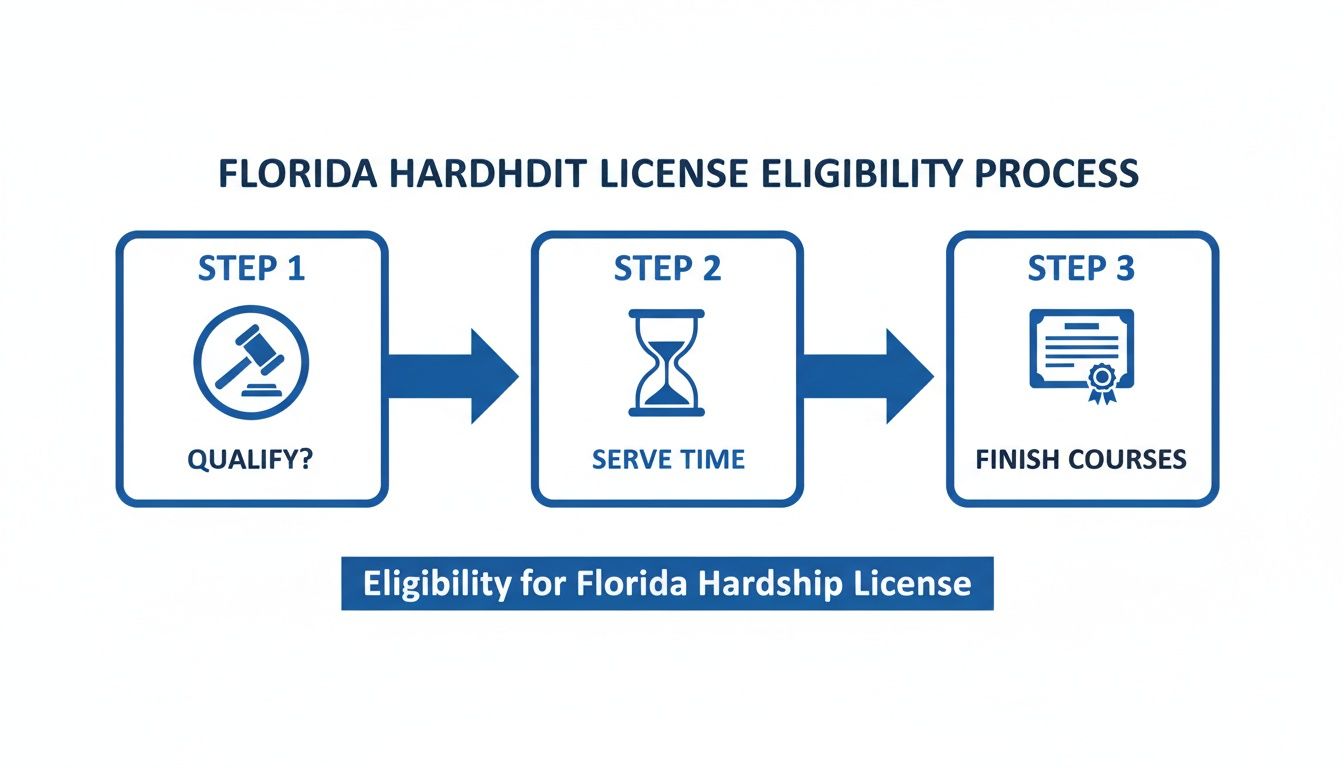
As this visual shows, qualifying isn't just one step. It's a sequence of mandatory actions: first, confirming your suspension type even allows for a hardship license, then waiting out the required "hard time," and finally, completing the state-mandated driver courses.
Understanding the Costs and Fees
Getting a hardship license isn’t free. There are several costs you need to be ready to pay to get your application processed and have your driving privileges reinstated on a restricted basis.
Be prepared for multiple payments. The process involves an application fee, a hearing fee, and potentially a license issuance fee. These can add up, so it's smart to call your local administrative review office beforehand to confirm the exact amounts.
The costs usually break down like this:
Application and Hearing Fees: These are the administrative fees for filing your application and for the hearing itself.
Reinstatement Fee: If your license was suspended, you'll have to pay a fee to get it officially reinstated, even for restricted driving.
Course Costs: The ADI or DUI school programs aren't free. You're responsible for the full enrollment cost.
SR-22 Insurance Costs: This is often the biggest and most ongoing expense of the entire process.
It's a tough reality that many license suspensions aren't for dangerous driving but for unpaid fines and fees, trapping many Floridians in a difficult cycle. In fact, debt-based suspensions make up about 75% of all suspensions in the state. These policies have a massive economic impact, with some studies estimating that Florida loses around $491 million in consumer spending each year because of the employment and mobility problems they create.
For those working to get back on the road, our guide on how to reinstate your suspended drivers license offers more helpful steps.
The SR-22 Insurance Requirement
For a lot of applicants, especially those with DUI-related suspensions, getting SR-22 insurance is an absolute must. It's crucial to understand that an SR-22 isn't actually a type of insurance. It’s a certificate of financial responsibility that your insurance company files with the state for you.
This certificate is your proof that you carry Florida's minimum required liability insurance. It also officially labels you as a high-risk driver, which, unfortunately, means your insurance premiums are going to go up—likely by a lot. You have to keep this SR-22 coverage for the entire time the state requires, often for several years, without a single gap. If your coverage lapses for even a day, it will trigger an immediate re-suspension of your license.
Living with Driving Restrictions and Avoiding Violations
Getting your Florida hardship license is a huge relief, but it’s also the start of a period that demands serious discipline. The challenge now shifts from getting the license to keeping it. You have to follow the rules to the letter, because the Florida Highway Safety and Motor Vehicles (FLHSMV) doesn’t play around with violations. This isn't just about avoiding another ticket; it's about proving you can be trusted behind the wheel again.
Think of your hardship license as driving under a microscope. Any tiny step outside its narrow terms can bring down severe and immediate consequences. Let this section be your guide to staying compliant and understanding the fine line you have to walk, so you don't put your driving future in even more jeopardy.
Understanding "Business Purposes Only"
The most common restriction you’ll see is "Business Purposes Only." That phrase sounds simple enough, but how the state interprets it can be tricky. It's strictly defined as any driving necessary to "maintain livelihood."
What does that actually cover?
Driving straight to your job and straight back home.
Driving as part of your on-the-job duties.
Traveling to and from school if you're a student.
Getting to a doctor's office for necessary medical care.
Driving to and from your place of worship for services.
Here's what it absolutely does not cover: personal errands or social trips. Stopping at a friend's house, going to the movies, or making a quick run to the grocery store for a non-essential item are all violations.
Real-World Example: Let's say you have a "Business Purposes Only" license. Driving to your construction job in the morning is perfectly fine. But deciding to stop at a coffee shop that's two miles off your direct route to chat with a friend? That's a violation. Even a small detour for a personal reason can get you in big trouble.
The Serious Consequences of Violations
The state gives you a hardship license as a privilege, not a right. Break the rules, and they see it as a breach of trust. The penalties are harsh. Any traffic stop—even for something minor like a broken taillight—that reveals you’re driving outside your restrictions can unleash a world of hurt.
The fallout for breaking the rules is swift and severe:
Immediate Revocation: Your hardship license can be taken away on the spot, leaving you with absolutely no legal way to drive.
Extended Suspension: The original suspension period for your license will probably get longer, pushing back the date you can get your full license back.
New Criminal Charges: You could be slapped with a new criminal charge for Driving While License Suspended or Revoked (DWLSR). That’s a serious offense with its own set of penalties.
Significant Fines and Fees: A new violation means new court costs, fines, and administrative fees, digging you into an even deeper financial hole.
A single mistake can put you in a much worse legal and financial spot than you were in before. To get a clearer picture of the risks, it's worth understanding the penalties for driving with a suspended license in Florida, because that's the charge you'll likely face.
Practical Tips for Strict Compliance
Living with hardship restrictions means changing your entire mindset about driving. Every single trip has to be planned and justified based on the limits of your license.
Keep Your Documents Handy: Always have your hardship license, proof of SR-22 insurance, and any other helpful papers (like your work schedule) with you in the car.
Plan Your Routes: Stick to the most direct routes for any permitted travel. Don't take "scenic" detours that an officer could interpret as personal driving.
Talk to Your Employer: If your job requires you to drive, make sure your boss knows your exact restrictions. You don't want them asking you to run an errand that's outside your legal limits.
Be a Perfect Driver: Obey every single traffic law. No speeding, no rolling stops, nothing. When you have a hardship license, you simply can't afford any new violations, period.
Following these rules isn't just a suggestion; it’s a requirement. You have to treat this privilege with the seriousness it deserves. It’s the only way to get through your suspension period and finally earn your full driving rights back.
Common Reasons Your Hardship Application May Be Denied
Getting a denial letter after applying for a hardship license can be a gut punch, especially when your job and daily life hang in the balance. But here’s the thing: understanding why the Florida Highway Safety and Motor Vehicles (FLHSMV) denies applications is the best way to avoid making the same critical mistakes.
Hearing officers don't have much wiggle room. They follow the hardship license in Florida rules to the letter, and even a small slip-up can get your case tossed out. The whole process is designed to be strict, and denials almost always boil down to two things: simple administrative errors or failing to actually prove your case.
Administrative and Procedural Errors
A surprising number of applications never even get a fair shake because of basic paperwork mistakes. These aren't about whether you deserve the license; they're about following the rules. One small error, and you’re back to square one.
Here are the most common administrative tripwires:
Incomplete or Inaccurate Paperwork: Every single line on that application matters. Missing a signature, getting a date wrong, or leaving a section blank is an easy reason for the hearing officer to stamp "denied."
Missed Deadlines: The timelines for requesting a hearing and getting your application in are non-negotiable. If you wait too long to file, you might be out of luck before you even start.
Failure to Complete Prerequisites: You must show proof that you’ve enrolled in required courses like DUI School or an Advanced Driver Improvement (ADI) program. Without that certificate of enrollment, your application is dead on arrival.
It's crucial to remember that the hearing officer has the final say and can deny an application for any failure to follow the process perfectly. There’s almost no room for error, so double-checking every single document isn’t just a good idea—it’s essential.
Failing to Demonstrate Genuine Hardship
Beyond the paperwork, the real heart of your application is proving that being unable to drive is a genuine, significant hardship. A vague or weak claim is probably the number one reason applications get rejected. The burden is entirely on you to show the hearing officer that your need fits the state's narrow definition of "maintaining livelihood."
To build a strong case, you have to back it up with clear, solid evidence.
For Employment: Just saying "I need my car for work" won't cut it. You need an official letter from your boss on company letterhead. It should spell out your job duties, your work schedule, and state clearly that driving is required for you to keep your job.
For Medical Needs: Get documentation from your doctor that explains why you need to attend frequent medical appointments and provides a schedule.
For Education: Provide a copy of your official class schedule from the school, along with proof of your enrollment.
Hearing officers are trained to spot the difference between genuine necessity and simple convenience. Your evidence needs to paint a crystal-clear picture of how your life will be fundamentally crippled without limited driving privileges.
Negative Driving History and Other Factors
Finally, the hearing officer is going to pull up your entire driving record and scrutinize it. They’re trying to figure out if you’re a risk to public safety. Even if you nail the paperwork and prove your hardship, a history of repeated tickets, multiple suspensions, or a pattern of irresponsible driving can sink your application. The officer might simply decide that granting you even limited privileges is a risk they aren't willing to take.
This is a huge issue in Florida, where millions of suspension notices get sent out. Between 2017 and 2021, the state issued over 5.1 million suspension notices for unpaid court debt alone. That’s a staggering number. Research has also found that these debt-based suspensions hit certain communities harder than others, adding another layer of complexity. You can read more about the impact of debt-based license suspensions in Florida in this recent report.
How a Traffic Attorney Can Help with Your Application
Trying to navigate the maze of hardship license in Florida rules by yourself is a recipe for stress and confusion. Between the strict deadlines, the mountain of precise paperwork, and a formal hearing you have to prepare for, it’s all too easy to make a mistake. One wrong move can get your application denied on the spot, pushing you even further away from getting back on the road.
This is exactly where having professional guidance makes all the difference. Our firm's practice focuses on traffic and DUI defense, so we know every administrative hurdle in the hardship application process inside and out. While past results do not guarantee future outcomes, our goal is to protect your license and your record by making sure every single detail is handled correctly and on time.
Building Your Strongest Case
A traffic attorney does a lot more than just fill out some forms. We are here to help you pull together the evidence needed to build a strong, persuasive case that clearly shows why you need restricted driving privileges.
This involves a few key steps:
Document Review: We'll comb through all your paperwork—from the application itself to your proof of course enrollment—to make sure it's 100% accurate and complete.
Evidence Gathering: We help you get the strongest proof of your hardship, like a detailed letter from your boss explaining your work schedule or official documentation of your medical appointments.
Hearing Preparation: We’ll walk you through what to expect at the administrative review hearing. You'll go in knowing how to present your case to the hearing officer clearly and with confidence.
An attorney knows what the hearing officer needs to hear and can help you frame your situation in the most effective way possible.
Attorney Advertisement: Please be aware that this is an attorney advertisement. The information on this website is for general informational purposes only and does not constitute legal advice. Past results do not guarantee future outcomes.
Navigating the Legal System
The legal system has its own language, and for someone who isn't familiar with it, the whole process can feel overwhelming. A traffic attorney can be your guide, handling communications with the FLHSMV and ensuring every procedural rule is followed to the letter.
We handle criminal traffic matters across Florida. Office in Broward. Keep in mind that submitting information through our website form does not create an attorney-client relationship. For a free, confidential consultation to talk about your specific situation, contact Ticket Shield today. We're here to help you understand your rights and options.
Got Questions About Hardship Licenses? We've Got Answers.
When your license gets suspended, a flood of questions usually follows. It's a confusing and stressful situation, and everyone's case is a little different. Here, we'll tackle some of the most common things people ask about getting a hardship license in Florida. Think of this as a starting point, not a substitute for advice from a qualified attorney about your specific case.
How Long Does It Take to Get a Hardship License in Florida?
The timeline really depends on why you were suspended and how busy your local FLHSMV office is. First, you have to get through any mandatory "hard suspension" period. This is a blackout period where you absolutely cannot drive, no exceptions. For many first-time offenses, this is 30 days.
Once that's over, you can request an administrative hearing, but getting a date on the calendar can take several weeks. If you get the green light at the hearing, you could walk out with your hardship license that same day—but only if you've already paid all your fees and have your SR-22 insurance locked in. It is advisable to start the process the very first day you're eligible.
Can I Get a Hardship License for a Five-Year Suspension?
This all comes down to the violation that caused the suspension in the first place. A five-year revocation often happens when someone is labeled a Habitual Traffic Offender (HTO).
In a lot of these HTO cases, you're looking at a mandatory one-year "hard suspension"—that's a full year with zero driving privileges. After you successfully get through that year, you might be eligible to apply for a hardship license for the next four years. But it's far from a sure thing; approval is never automatic and comes with a very strict set of requirements.
What Is the Difference Between a Hardship License and a Reinstated License?
It's crucial to know that these are two completely different things. People mix them up all the time.
A Hardship License is a temporary, restricted permit. It lets you make essential trips, like getting to work or school, while your license is still actively suspended. It’s a bridge to get you through a tough time, not the final destination.
A Reinstated License means your full suspension period is over, you've jumped through all the hoops the state requires (like paying fines and finishing courses), and you've gotten your full, unrestricted driving privileges back.
The end goal is always to get fully reinstated. The hardship license is just a tool to help you function legally until you get there.
Do I Need a Lawyer for My Hardship License Hearing?
You aren't legally required to bring an attorney, but you're walking into a formal hearing where the hearing officer has the power to say no. The rules are strict, and one mistake can sink your application. Having an attorney whose practice focuses on traffic cases can be a significant advantage.
Our goal is to protect your license and record by ensuring your application is accurate, helping you meet all prerequisites, and building a persuasive case for your need to drive. This professional guidance does not guarantee a specific outcome but aims to present your case in the strongest possible light.
Navigating the complexities of a hardship license application can be daunting. The team at Ticket Shield, PLLC focuses its practice on Florida traffic and DUI defense and is ready to help you understand your options. For a free, confidential consultation, contact us today at https://www.ticketshield.com.

