What Qualifies as "No Valid Driver's License" in Florida? | Key Facts
What qualifies as no valid drivers license in florida? Usually never licensed, 6+ months expired, or missed new-resident deadlines.
Attorney Advertisement. Office in Broward. Past results do not guarantee future outcomes. Submitting information does not create an attorney-client relationship.
In Florida, getting pulled over and charged with “No Valid Driver’s License” (NVDL) is a different matter than a simple speeding ticket. This isn't just about forgetting your wallet at home; it means the officer believes you were driving without the legal authority to be on the road at all.
This charge usually comes up in a few specific situations: you’ve never been issued a license, your old one has been expired for more than six months, or you’re a new resident who missed the deadline to get a Florida license. Understanding this is critical because an NVDL is a criminal offense, not just an expensive fine.
How We Reviewed What Qualifies as No Valid Driver's License in Florida
We reviewed this article against the text of Fla. Stat. 322.03, the separate expired-license rule in Fla. Stat. 322.065, and the suspended-or-revoked framework in Fla. Stat. 322.34. We also checked FLHSMV guidance for new Florida residents and general Florida driver license requirements. The point was to separate four issues that get blurred together on the internet: never licensed, expired less than six months, expired more than six months, and driving while suspended or revoked.
In our review of Florida's statutes and DHSMV guidance, the biggest source of confusion was not the rule itself but the threshold facts that change the charge. Residency status, prior convictions, whether a Florida license was ever issued, and whether the state had already suspended or revoked driving privileges can all move a case out of NVDL and into a different category. That is why this guide focuses on what officers typically cite, what court records often say, and which documents usually matter most.
Unpacking The No Valid Driver's License Law
Florida’s starting rule is section 322.03(1): a person may not drive a motor vehicle on a Florida highway unless that person has a valid driver license issued under chapter 322, subject to recognized exceptions for certain nonresidents. In plain English, the state is alleging you did not have valid driving privileges for that trip at all—not merely that you left the card at home or had a paperwork issue.
That distinction matters because Florida breaks similar-looking situations into separate buckets. In practice, we see confusion most often around the six-month expiration line and around cases where a person once had a license but later lost it. Those are not the same case legally, even if the ticket language sounds similar.
How Florida Usually Sorts These Cases
Never licensed: This is the clearest NVDL scenario. If FLHSMV records show no license was ever issued and no lawful exception applies, the officer may cite section 322.03.
Expired less than 6 months: This is usually not treated as NVDL. Under section 322.065, driving with a license expired for six months or less is a noncriminal traffic infraction.
Expired more than 6 months: Once the expiration goes beyond six months, the case is often charged under the same no-valid-license framework rather than the minor expired-license infraction.
Suspended, revoked, or canceled: This is generally not NVDL. It usually falls under section 322.34, because the issue is not that you never had authority to drive, but that the state later took it away.
If the allegation is that you never had one, readers may see shorthand such as “NVDL,” “No Valid DL,” or a docket description that tracks section 322.03. Officers and clerks sometimes use plain-language labels that are less precise than the statute, so the better question is not what the ticket title says, but what legal status the state is claiming: never issued, expired too long, or suspended/revoked.
This is also why it helps to understand Florida's driver's license regulations in general. The statute creates the baseline rule; FLHSMV records and residency facts usually decide which side of the line your case falls on. For anyone facing criminal traffic charges, that threshold issue often shapes the entire defense.
Key Scenarios Leading To An NVDL Charge
So, when does an officer write up an NVDL ticket? It typically boils down to a few common situations. While the details might vary, each scenario comes from the same root problem: the driver lacks a state-issued credential that gives them permission to drive.
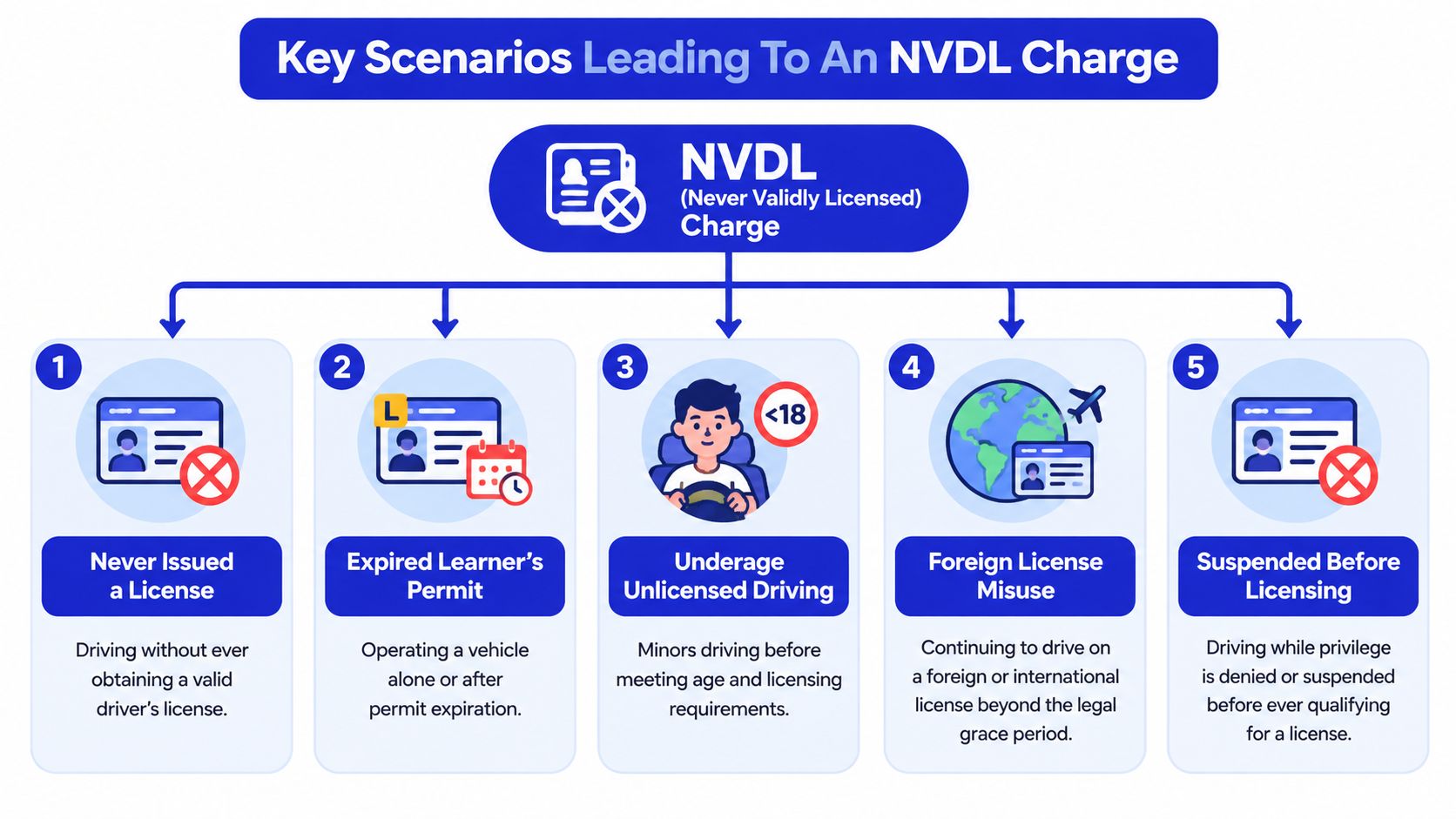
The infographic below breaks down the three main ways people find themselves facing this charge.
As you can see, it’s not just for teenagers who never took a driving test. People who let their license expire for a long time or new residents who fail to get a Florida license are just as vulnerable. This is what sets it apart from a charge like Driving While License Suspended (DWLS), which is about driving after your privileges were taken away. An NVDL charge, on the other hand, focuses on those who either never got their driving credentials or failed to maintain them as required by law.
To help clear up any confusion, it’s useful to see how these common driving offenses stack up against each other. Each one has its own specific definition and penalty under Florida law.
Florida Driving Offenses at a Glance
This table breaks down the differences between NVDL and other license-related charges in Florida. Knowing which one applies to your situation is the first step toward building a defense.
Violation Type | Common Scenario | Governing Statute | Typical Classification |
|---|---|---|---|
No Valid Driver's License (NVDL) | Never obtained a license or it's expired for 6+ months. | 322.03 | Misdemeanor |
Driving While License Suspended (DWLS) without Knowledge | Driving on a suspended license but unaware of the suspension. | 322.34(1) | Civil Infraction |
Driving While License Suspended (DWLS) with Knowledge | Knowingly driving on a suspended, revoked, or canceled license. | 322.34(2) | Misdemeanor or Felony |
Expired License (Less than 6 months) | Driving with a license that expired less than six months ago. | 322.065 | Civil Infraction |
Understanding these distinctions is key. An officer has discretion, but the facts of your case—like how long your license has been expired or whether you knew about a suspension—determine the severity of the charge you'll face.
How Common Scenarios Lead to an NVDL Citation
The useful way to read this issue is scenario by scenario. Florida does not treat every “no license” stop the same, and a lot of bad advice comes from collapsing different fact patterns into one label.

Scenario 1: You Were Never Issued a License
What this is: A classic NVDL case under section 322.03. If a driver has never been licensed by Florida or another jurisdiction that Florida recognizes for that situation, the officer may treat the stop as driving without valid legal authority.
What this is not: This is not the same as forgetting to carry the plastic card. If you had valid driving privileges and can prove it, the issue may be documentation, not a true no-valid-license case.
Scenario 2: Your License Expired More Than 6 Months Ago
What this is: Florida separates short-term expiration from long-term expiration. Once a license has been expired for more than six months, the case can be treated much more like an NVDL charge than a simple traffic ticket.
What this is not: If the expiration is six months or less, section 322.065 makes that a noncriminal infraction. In our view, this is one of the most important cutoffs in the entire article because people often assume any expired license automatically means a criminal charge, and that is wrong.
Scenario 3: You Moved to Florida but Kept Using an Out-of-State License Past the Deadline
What this is: Florida requires many new residents to obtain a Florida license within 30 days of establishing residency under FLHSMV's new-resident guidance. Once residency begins, an otherwise valid out-of-state license may stop protecting you from an NVDL allegation if you miss that deadline.
What this is not: Merely visiting Florida, working temporarily, or passing through does not automatically make you a Florida resident. Facts such as employment, school enrollment for children, a homestead step, or other residency indicators can become central.
Scenario 4: You Have a Foreign License but Became a Florida Resident
What this is: A valid foreign license can be enough for a visitor in many situations, but residency changes the analysis. After you become a Florida resident, the state generally expects you to qualify for a Florida license rather than continue driving indefinitely on foreign credentials.
What this is not: This is not a blanket rule that every foreign-license holder is driving illegally. The key issue is whether you were still a visitor or had crossed into Florida residency. For a practical overview of how visitors and residents are treated, World Driving Permit’s guide is a useful companion resource.
When an Expired License Is Not Treated as NVDL
If your license expired recently, timing matters. A license expired for six months or less is generally handled as the separate expired-license infraction in section 322.065, not as a criminal no-valid-license charge. That is why one of the first documents to check is the actual expiration date, not just the offense title typed onto the citation.
Forgotten License Card vs. No Driving Privileges
A missing card and missing legal authority are different things. If you were validly licensed but did not have the physical license with you, the state may be dealing with proof-of-possession issues rather than a true NVDL charge. I would not treat those as interchangeable, and neither should a court reviewing the underlying records.
Residency and status mistakes are common, which is why timing and paperwork matter so much. In fact, issues with out-of-state licenses can sometimes lead to headaches, much like the ones seen in cases of a dismissed suspended license ticket in Orange County, FL, where paperwork and timing mean everything.
A broader reason courts take license-status issues seriously is safety data. The National Highway Traffic Safety Administration reported that 19% of motor vehicle fatalities involved drivers with invalid licenses, and 13% of all drivers involved in fatal crashes had invalid licenses in the federal analysis it published in its invalid-license report. That statistic does not decide any individual Florida case, but it helps explain why license-status offenses are treated as more than technicalities.
Understanding the Penalties for an NVDL Conviction
Getting a citation for “No Valid Driver’s License” (NVDL) isn’t like a simple speeding ticket. This is a criminal charge, and a conviction can create a ripple effect that follows you for years. In Florida, an NVDL is classified as a misdemeanor, not a minor infraction, and the penalties get much tougher with each offense.
The legal system takes this very seriously. From a public safety standpoint, driving without ever having been licensed is a major red flag. That’s why the consequences go far beyond a fine, potentially impacting your freedom, finances, and future.

The Escalating Nature of NVDL Charges
Florida law uses a tiered system for NVDL penalties. A first-time offense is already serious, but getting caught again may be viewed as a pattern of ignoring the law, and the consequences get much steeper.
Even for a first-timer, driving without a valid license can lead to fines from $100 to $500, having your vehicle impounded, and a misdemeanor on your record.
Here’s a quick look at how the charges stack up:
First Offense: This is charged as a second-degree misdemeanor. The maximum penalties are up to 60 days in jail and a $500 fine.
Second Offense: The stakes get higher. It’s now a first-degree misdemeanor, with penalties of up to one year in jail and a fine of up to $1,000.
Third or Subsequent Offense: A third NVDL conviction can mean mandatory jail time. At this point, it’s an extremely serious charge with significant legal repercussions.
To get a clearer picture of this escalation, let's break down the penalties in a table.
Florida NVDL Penalties by Offense
The table below summarizes the escalating criminal penalties for driving without a valid license in Florida, as defined by state law.
Offense Number | Criminal Classification | Maximum Jail Time | Maximum Fine |
|---|---|---|---|
First | Second-Degree Misdemeanor | 60 Days | $500 |
Second | First-Degree Misdemeanor | 1 Year | $1,000 |
Third+ | First-Degree Misdemeanor | Mandatory Jail Time, Up to 1 Year | $1,000+ |
As you can see, the state doesn't take repeat offenses lightly. The consequences are designed to be a strong deterrent.
A conviction for NVDL is not just a one-time penalty. It creates a permanent criminal record that can appear on background checks for employment, housing, and even loan applications.
Long-Term Consequences Beyond Fines and Jail
The immediate legal problems are just the beginning. A significant challenge of an NVDL conviction is the long-term hurdles it creates, popping up long after you’ve paid the court costs.
Think about your car insurance. Insurers see an NVDL conviction as a high risk, which almost always leads to a significant, long-lasting spike in your premiums. Some companies might even drop your policy completely, making it very difficult and expensive to get insured and back on the road legally.
On top of that, having a criminal record can close doors on job opportunities, especially roles that require a clean driving history or driving a company vehicle. It’s a blemish that can impact professional licenses and derail career paths. That's why it's so important to handle the charge correctly from the get-go, as it's often tied to other license issues. You can get a better sense of related procedures by learning about the administrative license suspension hearing process.
NVDL vs. Driving While License Suspended
On the surface, "No Valid Driver's License" (NVDL) and "Driving While License Suspended" (DWLS) sound like they could be the same thing. It’s an easy mistake to make, but in the eyes of Florida law, they are worlds apart.
The distinction is absolutely critical because the penalties, the evidence needed to prove the case, and the strategies for addressing each charge are completely different. Getting a handle on which one you’re facing is the first step to figuring out what comes next.
Think of it like this: An NVDL charge is the state alleging you never had permission to drive in the first place. A DWLS charge, on the other hand, means you once had that permission, but the state revoked it.
The Foundation of the Charge
An NVDL citation, which falls under Florida Statute 322.03, is typically given to someone who has never been licensed, let their license expire for over six months, or moved to Florida and failed to get a new license. The prosecutor's case hinges on proving one simple thing: you didn't have the basic, initial credential to be behind the wheel.
A DWLS charge is a different beast entirely. Governed by Florida Statute 322.34, it applies to drivers who did have a valid license, but their driving privileges were taken away. This could be for anything from racking up too many points and DUI convictions to failing to pay child support.
With a DWLS charge, the state has to prove two key things:
Your license was, in fact, officially suspended or revoked.
You knew about the suspension.
That second point—the element of "knowledge"—is a massive dividing line between the two offenses and often becomes the central point in a DWLS defense.
The core legal question for NVDL is: "Did this person ever have a valid license to drive at this time?" For DWLS, the question is: "Did this person drive after being officially told they could not?"
Why the Distinction Matters for Your Case
This isn't just a matter of legal jargon; it has a direct and serious impact on the consequences you could be facing. A DWLS with knowledge is almost always treated more seriously than a first-offense NVDL. Why? Because it suggests you knowingly defied a court or administrative order, and judges take that very seriously.
For example, a first-time NVDL is a second-degree misdemeanor. But a DWLS with knowledge conviction can escalate quickly. Subsequent offenses can even become felonies, carrying the potential for significant prison time.
Because the state has to prove different things for each crime, your defense strategy must be adapted accordingly. For an NVDL charge, your defense might focus on showing you had a valid out-of-state license or that there was a simple clerical error. For a DWLS charge, the defense often revolves around proving you were never properly notified that your license was suspended in the first place.
Knowing exactly which charge you're up against is the key to building an effective response.
Potential Defenses and What to Do Next
An NVDL citation is the start of a county-court case, not the finish line. In most Florida cases, the driver is either arrested or more commonly given a Notice to Appear or misdemeanor traffic citation with a mandatory court date. That means you need to treat it like a criminal matter right away: read the charge, calendar the appearance date, and stop driving unless and until your status is lawful.
I would begin with documents before arguments. Gather the citation, any current or expired license cards, proof of identity, proof of residency history, any out-of-state or foreign license records, FLHSMV printouts, renewal receipts, immigration or travel documents if relevant, and any letters showing a suspension was lifted or an error was corrected. A lot of Florida license cases turn on records, dates, and status snapshots rather than on witness credibility alone.

What Usually Happens After the Citation
In county court, the first practical issue is usually appearance and status. Some courts expect a plea or waiver decision early; others focus first on setting the case, confirming counsel, and addressing documents. Local procedure can vary by county, and a Tallahassee-area case in Leon County may not move exactly like one in Broward or Orange, so readers should always check the court information listed on the citation and any clerk notice that follows.
If you were cited in Leon County, the Leon County Clerk of the Circuit Court and Comptroller and the Second Judicial Circuit are the places to verify court dates, division information, and local procedures. In our experience, that local-process step gets overlooked far too often by people who focus only on the statute and miss a required appearance.
Defenses That Match the Most Common Fact Patterns
You had valid privileges. If you were validly licensed in another state, or held a Florida license that records failed to show correctly, certified driving records and license copies can matter more than the officer’s roadside impression.
You had not yet become a Florida resident. For new arrivals, the legal fight may center on whether residency had started. Lease dates, job start dates, school enrollment, utility setup, and similar records can help.
The case is really a clerical or FLHSMV database problem. We have seen cases where mismatched names, old addresses, or timing gaps in agency records made the charge look worse than it was.
The wrong offense was charged. If the license was expired for six months or less, the facts may support the separate infraction under section 322.065 rather than a criminal NVDL case.
The state is confusing NVDL with DWLS. If there was once a valid license and the matter involved suspension, revocation, or cancellation, the charge analysis changes and the prosecution may need to prove notice or knowledge under section 322.34.
A Practical Action Plan
Do not keep driving. Another stop can turn a manageable case into a much worse one.
Pull your driving record fast. A current FLHSMV record can show whether the issue is no prior license, expiration, cancellation, or suspension.
Build a timeline. Write down when you moved, when the license expired, when you renewed, and what documents prove each date.
Bring status documents to court or counsel. Valid out-of-state records, passport/entry records, proof of nonresidency, or corrected FLHSMV paperwork can change the case.
Confirm local court procedure. County courts differ on scheduling, document submission, and whether an early resolution is realistic.
There is also a policy reason these cases can snowball so quickly. Research summarized in a peer-reviewed analysis found state estimates suggesting 5% to 17% of licensed drivers may have suspended licenses at a given time, often for non-driving-related reasons, as discussed in this license-suspension research summary. That does not excuse an NVDL charge, but it does explain why sorting out the exact legal category matters so much before you decide how to respond.
Got Questions About Florida NVDL Charges? We've Got Answers
Can you drive in Florida without a license?
No. Florida generally requires a valid driver license to operate a motor vehicle on public roads under section 322.03. Limited nonresident exceptions exist, but they depend on your actual status and whether Florida still recognizes the license you have.
Can I actually be arrested for no valid driver's license in Florida?
Yes. Because NVDL is generally charged as a criminal misdemeanor rather than a simple civil ticket, an officer can arrest or issue a Notice to Appear requiring you to come to court. Whether that happens in a specific stop can depend on the officer, your record, and whether there are other charges involved.
Is an expired license the same thing as no valid driver's license?
Not always. If the license expired six months or less ago, section 322.065 usually treats it as a noncriminal infraction. After that six-month point, the case can be handled much more like an NVDL charge.
What if I had a valid license from another state?
That may be a defense, but it depends on residency. If you were still a nonresident and your out-of-state license was valid, that can be strong evidence against an NVDL allegation. If you had already become a Florida resident and missed the deadline to obtain a Florida license, the same card may no longer solve the problem.
What if I'm from another country and driving on a foreign license?
Visitors are often allowed to drive with valid foreign credentials, but residency changes the rule. Once you become a Florida resident, FLHSMV expects you to obtain a Florida license within the required timeframe for new residents. The key issue is not nationality; it is whether your legal and factual status was still that of a visitor.
Will an NVDL conviction add points to my license?
Usually, the larger danger is not points but the criminal record. A conviction can create a misdemeanor record that affects jobs, housing, and insurance. That is why even a first offense should be reviewed carefully rather than treated like an ordinary traffic fine.
Frequently Asked Questions
Can I fix the case by getting a license after the ticket?
Sometimes getting properly licensed helps the outcome, but it does not automatically erase the original charge. Courts and prosecutors may still look at whether you were legally allowed to drive on the day of the stop.
What documents help most in an NVDL case?
The most useful records are usually driving histories, license copies, renewal receipts, residency documents, and any FLHSMV correspondence. If the dispute is about whether you were a Florida resident yet, timeline documents can be especially important.
Is “never had a license” treated differently from suspension?
Yes. “Never had a license” usually points toward NVDL under section 322.03. A prior valid license that was later suspended, revoked, or canceled usually points toward DWLS under section 322.34.
If I just forgot my wallet, is that still NVDL?
Not necessarily. If you had valid driving privileges at the time, forgetting the card is different from never being licensed or having invalid status. The case may still require proof, but the legal category should be different.
Does Tallahassee handle these cases differently?
The governing statutes are statewide, but court administration and scheduling details can differ by county. In a Tallahassee or Leon County case, confirm your court date, division, and filing instructions through the local clerk or court website rather than assuming another county’s process applies.
Facing a criminal traffic charge is stressful and confusing. At Ticket Shield, PLLC, our practice focuses on traffic and DUI defense across Florida. Our goal is to protect your license and your record. For a free consultation to talk about your case, visit us at https://www.ticketshield.com.