Driver License Restoration Attorney: A Florida Guide
Lost your license? A Florida driver license restoration attorney can help. This guide covers eligibility, the DMV process, and how to get back on the road.
Your Florida license is suspended, but this isn't the end of the road. A driver license restoration attorney challenges the suspension, handles the DHSMV process, and protects your right to drive. Act fast. Florida gives you very little room for mistakes.
You open a letter from the Florida Department of Highway Safety and Motor Vehicles. Your stomach drops. Your license is suspended. Now every practical problem hits at once. Work. School drop-offs. Medical appointments. Rent. Insurance. Your entire week just changed.
That panic is real. So is the risk of making it worse.
Most drivers lose time because they freeze, guess, or trust the wrong kind of help. They call a generic office. They use an app. They upload documents into a portal and hope someone important sees them. That is not a defense strategy. That is paperwork drifting through a system that does not care how badly you need to drive.
A Florida suspension case has to be handled with precision. The state uses different rules depending on why your license was pulled, which office is reviewing it, and whether you're dealing with an administrative action, a court issue, or both. If you've already checked a notice and still aren't sure what your status is, review how to check if your license is suspended in Florida and then take the next step immediately.
You don't need another vague guide. You need a roadmap that treats this like what it is. A threat to your mobility, your income, and in some cases your career. A driver license restoration attorney exists for exactly this reason. To stop small mistakes from turning into long suspensions and long suspensions from turning into revocations.
Table of Contents
Introduction Your License Is Suspended Now What?
A suspended license changes your life faster than most criminal charges. You feel it the next morning. You can't legally drive to work. You can't promise the judge you'll be careful. You can't talk your way out of a traffic stop if you're caught driving while suspended.
The first thing I tell drivers is simple. Stop guessing. Read the notice carefully. Then move.
Some suspensions are tied to a DUI arrest. Some come from points, missed hearings, unpaid tickets, or a hold you didn't know existed. Florida traffic law under Chapter 316 creates the underlying violations that often trigger the license problem, whether that was speeding, careless driving, or a more serious offense that put you on the state's radar. The suspension itself is usually handled through the licensing system, not by wishful thinking in court.
Why this feels so confusing
Florida doesn't present one clean path back to legal driving. You may be dealing with the court, the clerk, the DHSMV, and proof requirements at the same time. Each office cares about its own box being checked. If one item is missing, your reinstatement stalls.
That is why drivers often think they fixed the issue when they haven't. They pay a fine. They complete a class. They assume the license should reactivate. Then they find out there's still a hold.
Practical rule: Never assume payment alone restores your license. A paid ticket and a cleared suspension are not always the same thing.
What you should do first
Start with the paper trail. Find the suspension notice, any court paperwork, proof of payment, and anything related to classes, insurance, or prior traffic cases. Dates matter. Codes matter. Small errors matter.
Then look at your situation through one question. Is this a simple administrative fix, or does it require a real defense? If alcohol, refusal, repeat driving history, or a revocation is involved, you're no longer in simple-fix territory.
A driver license restoration attorney steps in at that point to control the process before the process controls you.
Why Was Your Florida Driver License Suspended?
Florida does not suspend licenses by accident. There is always a trigger. Your job is to identify it correctly. If you misidentify the trigger, you follow the wrong reinstatement path and lose more time.

Points and repeat violations
Florida tracks your driving record closely. Too many violations in too short a period can trigger suspension action. That often starts with offenses under Chapter 316, such as speeding, reckless driving, or other moving violations that stack up over time.
For some drivers, the pattern is the underlying problem. One ticket feels manageable. Several tickets turn into a points issue. Repeated serious violations can also lead to Habitual Traffic Offender treatment, which is far more dangerous than an ordinary suspension.
DUI and administrative action
DUI-related suspensions are different. They move fast and they hit hard. Florida Statute 322.28 governs DUI-related license consequences, and the underlying driving offense sits inside Florida's traffic code framework. If you were arrested for DUI, refused testing, or allegedly blew over the legal limit, the state may move against your license separate from the criminal case.
Drivers often make a costly mistake. They focus only on court and ignore the licensing side. That can leave them with a criminal defense in motion and a license still gone.
If alcohol use is part of your case, recovery documentation can matter later. For some drivers, especially after repeat alcohol-related issues, support records from a legitimate treatment provider help show stability and compliance. A practical starting point is alcohol addiction treatment if the underlying problem is bigger than the traffic stop.
Unpaid obligations and missed court dates
A license can also be suspended because you didn't pay a ticket, failed to comply with a court order, missed a required appearance, or left an old case unresolved. These suspensions often surprise people because the original violation may have happened months ago.
Here's the danger. Drivers treat these as clerical problems. Sometimes they are. Sometimes they're not. If the failure triggered additional consequences, multiple case numbers, or a hold across agencies, you need to clear every layer.
A suspension notice tells you the state has already acted. Your response has to be specific, not hopeful.
A good diagnosis comes before any restoration plan. If you don't know whether you're dealing with points, DUI consequences, unpaid obligations, or repeat-driver status, you are not ready to file anything.
Can You Get Your License Back?
You wake up, check your phone, and realize you still have to get to work, pick up your kids, or make deliveries. Florida does not care. If your license is suspended or revoked, the state blocks your ability to drive until you satisfy the exact condition tied to your record.
Yes, many drivers can get their license back. The issue is whether you qualify for full reinstatement now, a hardship license first, or nothing yet because a hold, waiting period, or revocation barrier is still active.
That answer turns on the specific reason for the suspension and the driver behind the file. A gig worker with nonstop delivery app income on the line needs a faster, work-focused plan. A service member may be dealing with deployment, out-of-county paperwork, or timing problems a generic checklist never addresses. Those details change strategy.
Eligibility depends on the reason for the suspension
Some cases are fixable once the underlying problem is cleared. That usually means unpaid tickets, missed compliance requirements, or a failure to appear that can be resolved and properly reported.
Other cases are much harder. DUI-related suspensions, habitual traffic offender status, and revocations can require hearings, classes, proof of treatment, FR-44 insurance, waiting periods, or a petition for restricted driving instead of full reinstatement.
Do not treat these categories as interchangeable. Florida does not.
A generic guide usually tells you to pay a fee, complete a class, and wait. That advice overlooks the core issue. Many drivers have layered holds from different courts, agencies, or old cases, and one cleared item does not automatically release the license. You need a file-specific plan.
County process matters, but your record matters more
Procedure can vary from office to office, and local practice affects how quickly paperwork moves and what problems surface first. That is real. Still, the bigger issue is accuracy. If the reinstatement request does not match your status, Florida will reject it or leave you chasing the wrong fix.
That is where direct lawyer access matters. Impersonal systems and generic call-center answers tend to treat every suspension the same. They do not look at a gig driver and ask whether a hardship route protects income fastest. They do not look at a military driver and account for service-related scheduling problems, command obligations, or an old Florida hold that followed the driver across state lines.
You need someone who can read the record, identify the actual barrier, and tell you what to do next.
Here is the practical breakdown:
Situation | What usually decides whether you can get back on the road |
|---|---|
Unpaid ticket or failure to comply | Whether every court or agency hold is cleared and reported correctly |
DUI-related suspension | Whether you still have hearing rights, class requirements, or hardship-license eligibility |
Repeat traffic history | Whether your current status allows reinstatement now or places you in a longer penalty category |
Revocation | Whether the waiting period has run and whether you qualify to apply for limited driving privileges |
If you want a plain-English overview before you act, review how to reinstate a suspended license in Florida. Then stop relying on one-size-fits-all advice. Your restoration strategy should match your Florida driver profile, your county process, and the exact reason the state took your license.
Your Roadmap to Driver License Restoration in Florida
Speed matters. If your suspension is tied to a DUI arrest, Florida gives you a narrow opening to protect yourself. According to this Florida DUI hearing guide, you have a 10-day window from the date of the suspension notice to request an administrative hearing with the DHSMV. Miss it, and the suspension can become automatic without review. The same source states that drivers who engage counsel within 5 days see 40 to 60 percent higher success rates.
That isn't a detail. That's the clock.
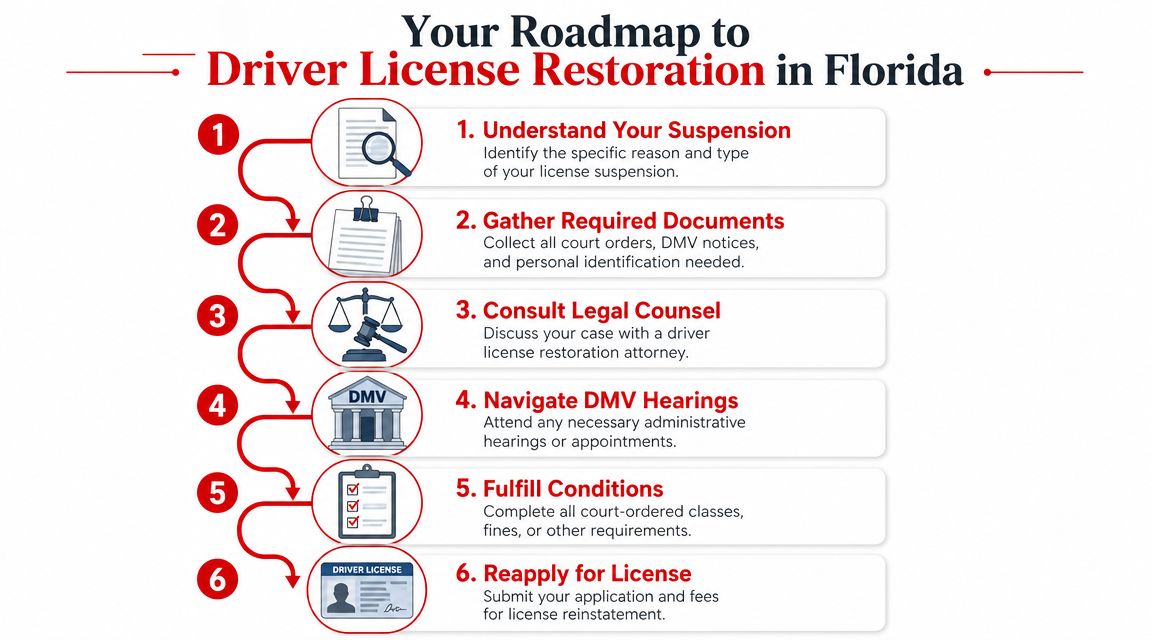
Immediate steps to take
Read the notice line by line: Confirm the effective date, the listed reason, and whether your case is tied to a DUI, refusal, points issue, or failure to comply.
Protect the 10-day deadline if DUI is involved: Administrative hearing rights disappear fast. Waiting to "see what happens" is how drivers lose options.
Stop driving unless you are clearly authorized: A new charge for driving while suspended can create a much worse file than the one you started with.
Pull together every related document: Include your citation, arrest paperwork, court notices, proof of class completion, insurance documents, and prior correspondence.
Request guidance before filing anything blind: Use Florida administrative license suspension hearing information to understand what the DHSMV process involves.
What to prepare before the hearing or filing
Not every restoration case requires the same package. That is exactly why checklists copied from the internet fail.
You may need:
Proof of compliance: This can include court receipts, class certificates, or evidence that a prior case is closed.
Insurance documentation: If the state requires proof of financial responsibility, submit exactly what is required and make sure it is current.
Identity records: Mismatched names, outdated addresses, or missing identifiers create avoidable delays.
Rehabilitation evidence when relevant: In alcohol-related cases, hearing officers often want to see that the problem behind the suspension has been addressed in a real way.
File early. Review twice. Confirm receipt. Bureaucratic silence is not approval.
Some drivers can resolve the issue through clean compliance and payment. Others need hearing preparation, witness management, or evidence challenges. If your suspension touches DUI allegations, implied consent issues, or repeat history, this is not a self-help project. It's a defense problem wearing administrative clothing.
What Does a Driver License Restoration Attorney Do?
A real driver license restoration attorney does more than fill out forms. The lawyer protects deadlines, finds defects, frames the facts correctly, and keeps you from saying or filing something that damages your own case.
That distinction matters because plenty of Florida drivers end up in systems that feel convenient but aren't legal strategy. Automated apps collect data. Ticket mills push volume. Middlemen answer messages. A restoration case requires lawyer judgment.

A lawyer protects deadlines and evidence
In a serious suspension case, counsel starts by identifying exactly what is happening at the DHSMV level and at the court level. Those aren't always the same fight.
A lawyer can:
Request the right hearing quickly: That preserves rights that disappear if you wait.
Review reports and records: Police narratives, notice forms, and testing records all matter.
Spot procedural weaknesses: Officers and agencies make mistakes. Those mistakes only matter if someone knows how to use them.
Prepare you for the hearing: Your words need to be consistent with the documents already in the file.
This is especially important in high-volume venues such as Miami, where cases may move through administrative channels tied to areas near the Richard E. Gerstein Justice Building. Speed and precision matter in those environments.
Direct lawyer access matters
The quality of communication changes outcomes. If you're forced to talk through layers of intake staff, bots, or rotating case managers, the person making legal decisions may not know the facts that matter most.
You should be able to speak directly with the attorney handling your case by phone or text. That isn't a luxury. It's how deadlines get met, documents get corrected, and strategy shifts quickly when new information appears.
A generic service often treats your suspension like a data-entry problem. A lawyer-led defense treats it like what it is. A legal threat to your license record.
If you want a clearer sense of what this kind of representation looks like in practice, review what a suspended license lawyer does in Florida.
Representation changes the odds
The reason I push drivers to get counsel is simple. The system rewards experience.
According to this analysis of reinstatement appeals, specialized attorneys in highly regulated states achieve success rates over 97%, while self-represented applicants are denied up to 90% of the time. The same source says legal representation can improve approval odds by up to 10-fold compared with pro se attempts.
That doesn't mean every Florida case will produce the same result. It means the pattern is clear. Administrative license work punishes amateurs.
Here is the practical difference:
DIY or impersonal system | Direct attorney strategy |
|---|---|
You react after notices arrive | Counsel acts before deadlines expire |
Forms are submitted without case framing | Evidence is organized around a legal theory |
Communication goes through staff or bots | You speak with the lawyer handling the case |
Errors are discovered late | Problems are caught early and corrected fast |
A short explanation can help if you're weighing whether legal representation is worth it:
When your right to drive depends on procedure, precision beats convenience every time.
What Are the Costs and Timelines for License Restoration?
You find out your license is suspended on a Tuesday morning. By lunch, you have missed a shift, lost a delivery block, or put your base commute at risk. That is when cost and timing stop being abstract. They become immediate damage.
Start with the hard truth. License restoration in Florida is rarely a single payment and almost never a same-day fix. The total bill usually comes from two places. The state charges its own fees and compliance costs. Your legal cost covers the work required to identify every hold, choose the right restoration path, and keep you from making mistakes that stretch the suspension.
Florida does publish certain reinstatement fees. The Florida Highway Safety and Motor Vehicles department lists a $45 suspension termination fee and, for many revocations, a $75 revocation termination fee on its reinstatement fees page. See the official Florida reinstatement fees and payment information. Those numbers are only part of the expense. You may also have to pay for court compliance, traffic school, treatment, insurance filings, or old citations that triggered the suspension in the first place.
Legal fees are a separate decision. Make that decision based on risk, not wishful thinking. If you want a practical benchmark for representation, review how much a traffic lawyer costs in Florida. The cheap option often gets expensive fast when a driver files the wrong paperwork, misses a hearing deadline, or clears one hold while another one stays buried in the record.
Ticket Shield's difference shows up here. You need direct lawyer access, not a call center reciting generic steps. A gig worker may need a plan built around restoring income fast and documenting work necessity. A service member may need a strategy that accounts for duty status, command issues, and related disciplinary exposure. If your suspension overlaps with military legal concerns, the UCMJ Lawyer Directory on military justice is a useful starting point for that part of the problem.
Timelines depend on the reason for the suspension. A straightforward compliance suspension can clear relatively quickly once every requirement is satisfied and the state processes the reinstatement. A DUI-based revocation, habitual traffic offender case, or matter involving multiple holds takes longer because the process may require hearings, waiting periods, proof of treatment, or insurance filings.
The delays I see most often are preventable:
Missing supporting documents
Wrong forms filed with the wrong office
Outstanding holds from another county or agency
Confusion between the criminal case and the separate license case
Waiting too long to act after notice
Here is my recommendation. Get the driving record first. Confirm the exact suspension basis, every hold, and every agency involved. Then build the response around your life, not around a generic checklist. That approach matters even more for gig workers and military drivers, because the timeline is not just about getting legal driving privileges back. It is about protecting income, job status, and stability before the backlog gets worse.
We Defend Florida Gig Workers and Military Personnel
Your license gets suspended on Monday morning. By Monday afternoon, the delivery apps stop sending orders or your base access starts raising questions. For gig workers and service members, that gap is where people make expensive mistakes. Generic checklists do not protect you here. You need a plan built around how you work and what your record puts at risk.
Gig drivers need proof that matches how they earn
If you drive for Uber, Lyft, DoorDash, Instacart, or similar platforms, a suspension can cut off income immediately. The legal problem is only part of it. The platform may deactivate you, your insurance position may change, and a delayed fix can wreck the week financially.
A generic guide usually tells you to pay the fee, complete the class, and wait. That is not enough for a Florida gig driver. Your case should be framed around fast, accurate proof of current work and the specific harm caused by lost driving privileges. Direct lawyer access matters here. An impersonal intake system will miss the details that separate a weak hardship presentation from one that shows real earning loss and real urgency.
Useful records often include:
Driver platform account screenshots and recent earnings statements
Trip history or delivery logs showing active work
Bank deposits tied to app-based driving income
Proof you are the primary earner for rent, child support, or household bills
Insurance and vehicle documents tied to platform use
Military drivers face two files, not one
Military personnel and veterans often have more at stake than a civilian driver with the same suspension code. A license problem can affect reporting, duty reliability, on-base driving, security concerns, and command attention. If the underlying incident also touches disciplinary issues, you may be dealing with a traffic case, an administrative license problem, and military consequences at the same time.
That requires a tighter strategy and cleaner documentation. You need to know what belongs in the DHSMV file, what belongs with command, and what should never be handled casually. Service records, duty schedules, deployment timing, and command letters can matter. So can the difference between an active-duty driver who must report across county lines and a veteran trying to keep a CDL or civilian driving job after separation.
If your case overlaps with military disciplinary exposure, the UCMJ Lawyer Directory on military justice is a useful resource for the military side of the problem.
Ticket Shield's difference is simple. You get direct lawyer access and a strategy built for your driver profile. A gig worker needs a record that proves present income disruption. A service member needs a record that protects both driving privileges and professional standing. Those are different cases, and they should be handled that way.
Frequently Asked Questions About Florida License Restoration
What is the difference between a suspension and a revocation
You get pulled over on the way to work, hand over your license, and learn the state says you should not be driving at all. Your next step depends on one word in your record.
A suspension usually means Florida took away your driving privilege for a set period or until you finish specific requirements. A revocation is more serious. It means the state ended that privilege and may require you to wait, reapply, and prove you qualify before you drive again.
That label controls the case. It affects eligibility, paperwork, hearing strategy, and how quickly you can get back on the road.
Can you get a hardship license in Florida
Sometimes. The answer depends on the reason for the suspension, whether you completed the required classes or filings, and whether Florida allows restricted driving in your situation.
Do not guess here. A hardship license can let you drive for work, school, business, church, or medical needs, but the category matters and the proof matters. A weak application gets denied. A targeted one has a real chance.
This issue hits working drivers hardest. Generic guides treat every suspended driver the same. That is a mistake. A rideshare driver, delivery driver, field tech, or home health worker needs a record that shows income loss, work routes, platform requirements, and why limited driving is necessary now. Ticket Shield's difference is direct lawyer access and a strategy built for the way you work, not a canned checklist from a call center.
Why is Florida blocking my license because of another state
Because state records follow you.
If another state reported a suspension, revocation, failure to appear, unpaid citation, or hold, Florida can refuse to issue or restore your license until that state clears it. Moving to Florida does not wipe out the problem. Waiting does not fix it either.
You need to identify the exact state, the exact hold, and the exact condition for clearance. Then you need to confirm Florida updated its system after the other state released the block. That last step gets missed all the time.
If my criminal case is dismissed does my license come back automatically
No.
This is one of the costliest mistakes Florida drivers make. A dismissal in criminal court does not automatically remove an administrative suspension, a DHSMV hold, or a reinstatement requirement. Criminal court and licensing consequences often run on separate tracks.
You need to check your actual driver record, confirm what DHSMV still requires, and deal with each item directly. That is especially true if you depend on your license to earn income or report for duty. Gig workers and military drivers usually need a more precise plan than the standard advice you find online.
If your license is on the line, do not rely on a chatbot, a call center, or a volume firm that routes you through staff. You need direct attorney access and a strategy built for your driver profile. Visit Ticket Shield, PLLC for a free consultation.