Probable Cause Traffic Stop: Your Legal Guide
Learn what probable cause traffic stop means in Florida, how it differs from reasonable suspicion, and steps to challenge an unlawful stop.

You're in the driver's seat, then the lights hit. Maybe it was a quick lane change, a cracked taillight, or an officer who says you were speeding. In that instant, the fine is not the main problem. The core issue is whether the officer had a lawful basis for the stop, because that decision can follow you into court, onto your record, and straight into your insurance.
Florida drivers get too much bad advice on this topic. People hear “probable cause” and “reasonable suspicion” used like they mean the same thing, and that confusion costs them. They do not mean the same thing. If you were pulled over in Florida, the standard that justified the stop, and the standard that justified any search or arrest after it, matters a lot.
Table of Contents
The Moment the Lights Come On
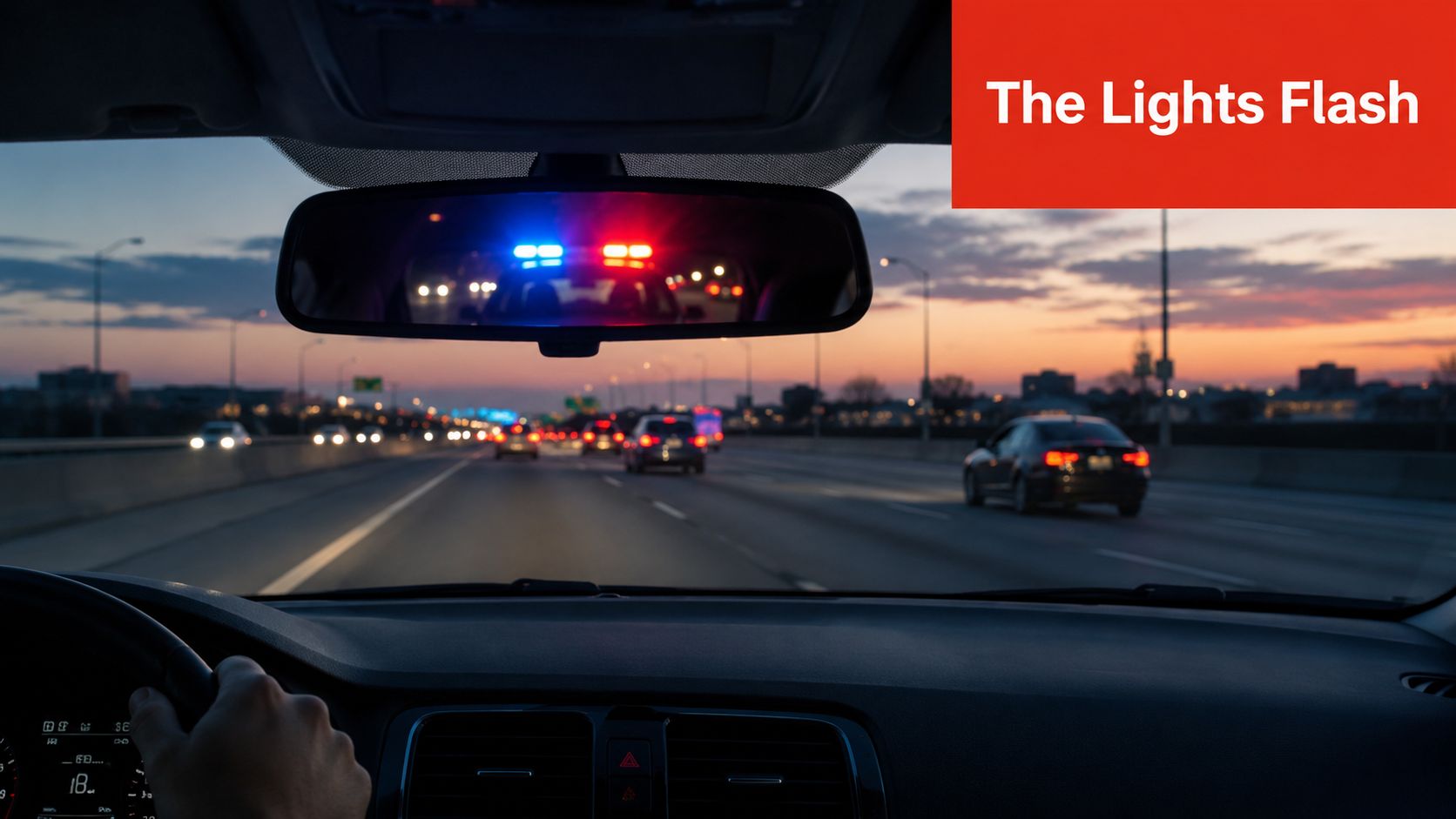
The stop usually starts small. You're driving home on a Florida road, traffic is moving, and then the patrol lights flash behind you. Your pulse jumps. You start replaying everything, speed, lane position, the tail light you meant to fix, the turn you took a little wide.
That moment is more than an inconvenience. It is a legal seizure, and the officer's reason matters from the first second. A lawful stop can begin with something as ordinary as a visible equipment issue or a driving error that fits Chapter 316. A weak or made-up reason can make the whole stop vulnerable later.
A minor citation can still create major fallout. Florida traffic cases often turn on details that drivers forget within minutes, while the officer writes them down immediately. That is why a broken light, a lane deviation, or a speed allegation can become a bigger fight than the original ticket. If you want a simple example of how a minor defect can become roadside trouble, the plain-language explanation in broken tail light help from T1A Auto shows why equipment issues get attention fast.
The citation itself is not the whole story. The larger risk is what comes next, the record, the insurance consequences, and whether the stop gives the state a reason to dig deeper. For a broad overview of what a stop means in practice, the internal guide on what is a traffic stop is useful background, but the sharper question is whether the officer had enough legal footing to start the encounter at all.
Practical rule: treat the stop as evidence gathering from the first word. Your goal is not to argue on the shoulder. Your goal is to preserve the facts that may later show the officer overreached.
What Probable Cause Actually Means
Probable cause means concrete, articulable facts that would lead a reasonable person to believe a violation occurred. In plain English, it is not a hunch. It is not a vibe. It is a reason that can be explained, tested, and challenged.
Florida traffic law gives officers real anchors. Florida Statute 316.187 ties speed to the posted lawful limit and to conditions that are reasonable and prudent, so an officer who observes a driver violating that rule may have a legitimate basis for action. Florida Statute 316.192 addresses careless and reckless driving, which gives officers another route when the driving conduct itself creates danger. A stop based on a specific statutory violation is very different from a stop based on vague suspicion.
How the officer thinks about it
The officer is supposed to connect observed facts to a traffic law. A tail light that is visibly broken. A car moving at a speed that appears unsafe for conditions. A driver cutting across lanes in a way that matches a statute. Those are the kinds of details that move the encounter from speculation to legal action.
A useful way to think about probable cause is this. If the officer had to explain the reason out loud in court, would the explanation rest on facts or on guesswork? If the answer is guesswork, the stop is weaker than most drivers realize.
The technical standard is the totality of the circumstances, meaning the officer's knowledge, observations, and any corroborating facts are considered together. That is why one small fact can matter less than the combination of several. But the core idea does not change. The officer needs something stronger than a bare suspicion before the law treats the stop as justified.
The officer's story has to be concrete enough that another reasonable person could follow it. If the narrative sounds thin when written down, it will usually sound thin in court.
Probable Cause vs Reasonable Suspicion Explained
Most online explanations blur these standards. That is a mistake. Reasonable suspicion is the lower threshold that often justifies the initial stop. Probable cause is the stronger standard that usually comes into play for arrest or a search after the stop has already started.
The difference matters because a stop can begin lawfully and still become unlawful later. An officer may have enough to pull you over, but not enough to search your car. If the facts don't justify the next step, the defense should attack the escalation.
Standard | What It Means | When It Applies | Required Officer Belief |
|---|---|---|---|
Reasonable Suspicion | Specific facts that suggest a traffic or equipment violation may be happening | Initial stop in many Florida traffic encounters | More than a guess, less than probable cause |
Probable Cause | Facts and circumstances that would lead a reasonable person to believe a violation or crime occurred | Search, arrest, or stronger enforcement action | Concrete facts, not a hunch |
Florida drivers need to understand the timeline. The first question is whether the officer had enough to stop the car. The second question is whether the officer had enough to search, detain longer, or arrest. Mixing those questions up is how people lose winnable cases.
The legal references on traffic law stop show why the distinction is not academic. Courts look at what the officer knew at each stage, not just what the report says after the fact. That is why a stop can start on a legitimate observation and still collapse if the officer's later claims don't line up with the facts.
What to remember at roadside
Stop level: the officer needs a lawful reason to initiate the pull over.
Search level: the officer needs stronger facts before looking through the vehicle.
Arrest level: the officer needs enough evidence to move from suspicion to a formal custodial action.
Court level: the judge will care about what was observed, not what was assumed.
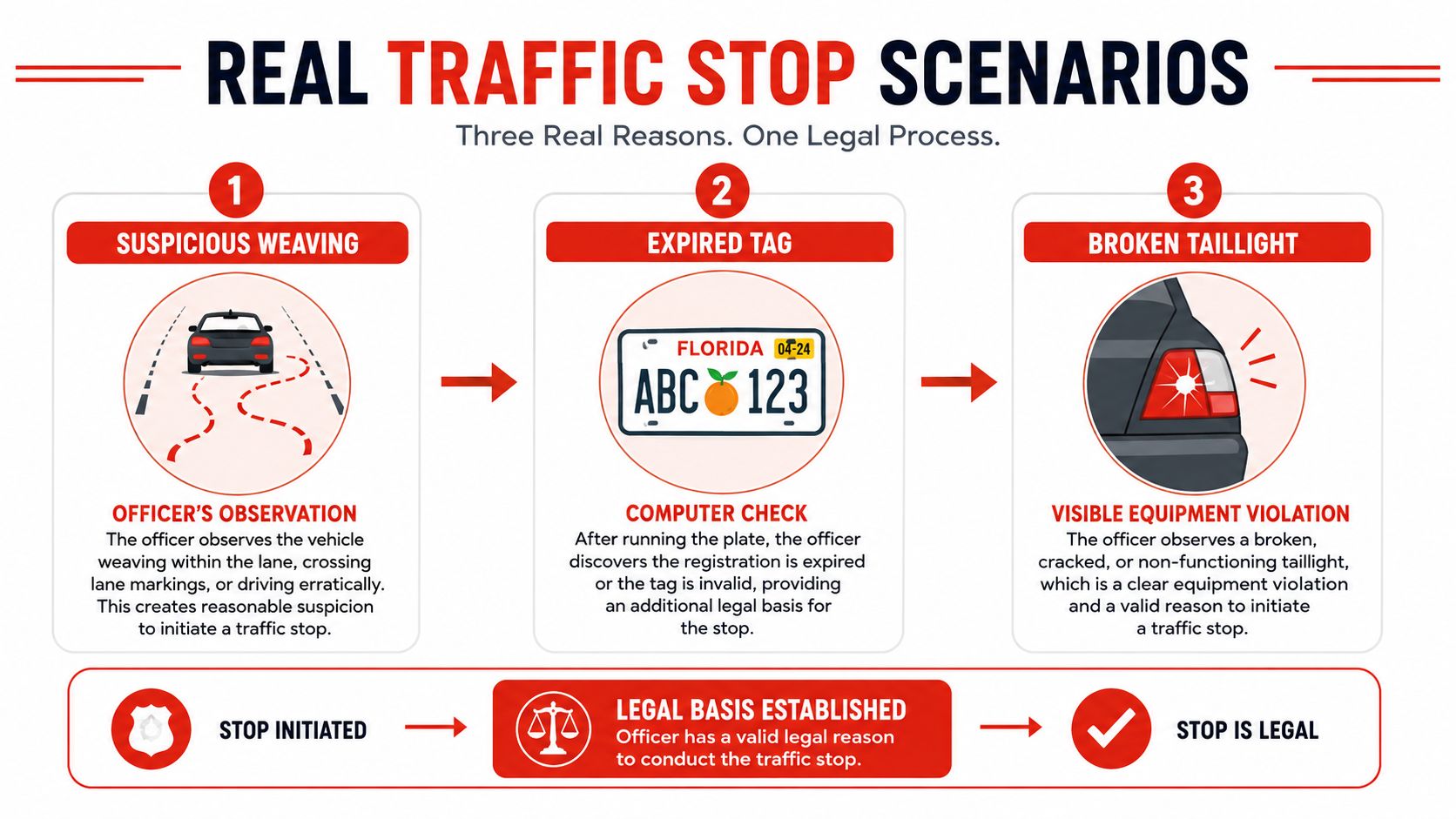
Real Traffic Stop Scenarios and Their Legal Outcome
A visual estimate of speeding is one of the most disputed stop reasons. An officer says you were going too fast, but the dashboard camera, body camera, or follow-up video may show a different story. If the officer had only a rough estimate and no reliable corroboration, the defense should press hard on whether the stop really rested on facts or on a loose impression.
Another common pattern is the slow follow. The officer trails a vehicle for several blocks, watches it drift, then lights it up. That may be enough if the driving conduct is specific and legally meaningful. It may also be nothing more than an officer looking for a reason to justify a stop after the fact.
Three scenarios, one question
A cracked taillight creates a visible equipment issue. That can justify a stop if the defect violates the vehicle code or reflects unsafe operation. But if the officer claims the taillight was the reason and then escalates based on a supposed odor, the defense should test whether the second claim is independent and reliable, or whether it was added later to pad a weak stop.
A hard number matters here. In large-scale traffic-stop research cited in law review literature, arrests occurred in 3.7 per 1,000 traffic stops, and misdemeanor citations were issued in 47.1 per 1,000 stops. That means most stops end without arrest, which is exactly why drivers should stay calm, avoid volunteering extra information, and document everything they can remember once the stop ends.
The public often assumes every stop ends in arrest or some dramatic search. It usually does not. But the fact that most stops end short of arrest does not make them harmless. The roadside record can still shape the case, and a weak stop reason can be the opening a defense lawyer needs.
Your Rights and Duties During a Florida Stop
When the lights come on, stay controlled. Pull over safely. Turn off the engine. Keep both hands where the officer can see them. If the officer asks for your license, registration, and insurance, produce them without drama.
That is the duty side. The rights side is just as important. You do not have to help build the state's case by talking too much. You do not have to consent to a search. You do not have to explain your whole day.
Short rules that save people from making things worse
Move safely: pull over without sudden braking or wild steering.
Stay visible: keep your hands on the wheel unless the officer asks otherwise.
Keep it tight: answer identity questions, then stop talking.
Protect your rights: decline consent to search if you do not want a search.
Do not volunteer where you were going, where you came from, or who you were with unless that information is required for identification. Officers listen for admissions, inconsistencies, and nervous overexplaining. The cleaner your roadside conduct, the less you give them to work with.
If the officer pushes for a search, stay calm and clear. Say no if you are declining. You can ask whether you are free to go, and you can do that without being rude. The practical guide on whether you have to sign a traffic ticket is helpful if the officer tries to turn a simple stop into a pressure test.
Memorize this: be polite, be brief, do not consent, do not volunteer. That line protects you more than arguing ever will.
Suppression and Challenge Strategies That Work
A weak stop reason is not just a courtroom argument, it is a suppression issue. The defense starts by testing whether the initial stop was lawful. If it was not, the next question is whether the officer's later observations were independent or were the product of that illegal detention.
That is where the motion matters. A motion to suppress asks the court to exclude evidence that came from an unlawful stop or from an unlawful expansion of that stop. The judge looks at the first reason for the pull over, then at any escalation, then at whether the later evidence was tainted by the original problem. That sequence matters because a clean stop can still become infected if the officer overreaches.
Where the cracks usually appear
Video mismatch: the officer says one thing, but dashcam or bodycam footage tells another story.
Thin observations: the report uses broad language like weaving or speed without concrete detail.
Late-added facts: the officer's later explanation feels more polished than the roadside story.
Missing preservation: footage or data that should exist is gone or incomplete.
That is why preserving recordings matters so much. If a device or file is damaged, recovery can be critical. A resource like reliable hard drive recovery can matter when video evidence sits on storage that has to be retrieved before it disappears for good.
The internal explanation of what is a motion to suppress evidence fits right here, because suppression is not a slogan. It is a technical tool that attacks the stop, the expansion of the stop, and the evidence that followed. If the officer's version is shaky, that is where the advantage is found.
Take Action and Protect Your License Today
If you think the stop was weak, move fast. Save the citation. Photograph the scene if you can safely do it. Write down the time, location, reason given, weather, lighting, lane position, and anything the officer said before the conversation drifted. Those details fade quickly, and they matter more than most drivers realize.
Do not assume the ticket is too small to fight. A traffic stop can affect your record, and in Florida, points are the problem most drivers feel later, not the fine. Use the practical checklist in what to do when you get a ticket so you don't miss something important while the details are still fresh.
Ticket Shield, PLLC is a lawyer-led Florida traffic defense firm. That means you speak directly with an attorney by phone or text, not a middleman, not a corporate answering service, and not a chatbot. That matters when the issue is probable cause, because the facts need legal review from the start, not a scripted intake.
You have two paths. One path is fast, automated, and detached. The other is direct legal representation built to challenge the stop, the report, and the fallout. If you want a real defense aimed at No Points on your license, don't wait for the deadline to box you in.
Visit Ticket Shield, PLLC today for a free consultation and get direct attorney help on your probable cause traffic stop. If your goal is No Points on your license, make the call now.