Do You Have to Sign a Traffic Ticket in Florida?
Do you have to sign a traffic ticket? Learn what your signature means in Florida, the consequences of refusing, and your legal options after a traffic stop.

That moment an officer hands you a ticket, your mind is probably racing. Amid all the stress, you hear one simple instruction: "Sign here."
Let’s clear this up right now: signing a traffic ticket in Florida is not an admission of guilt. Think of it like signing for a package delivery; you’re just acknowledging that you’ve received the document. Nothing more.
What Signing a Florida Traffic Ticket Really Means
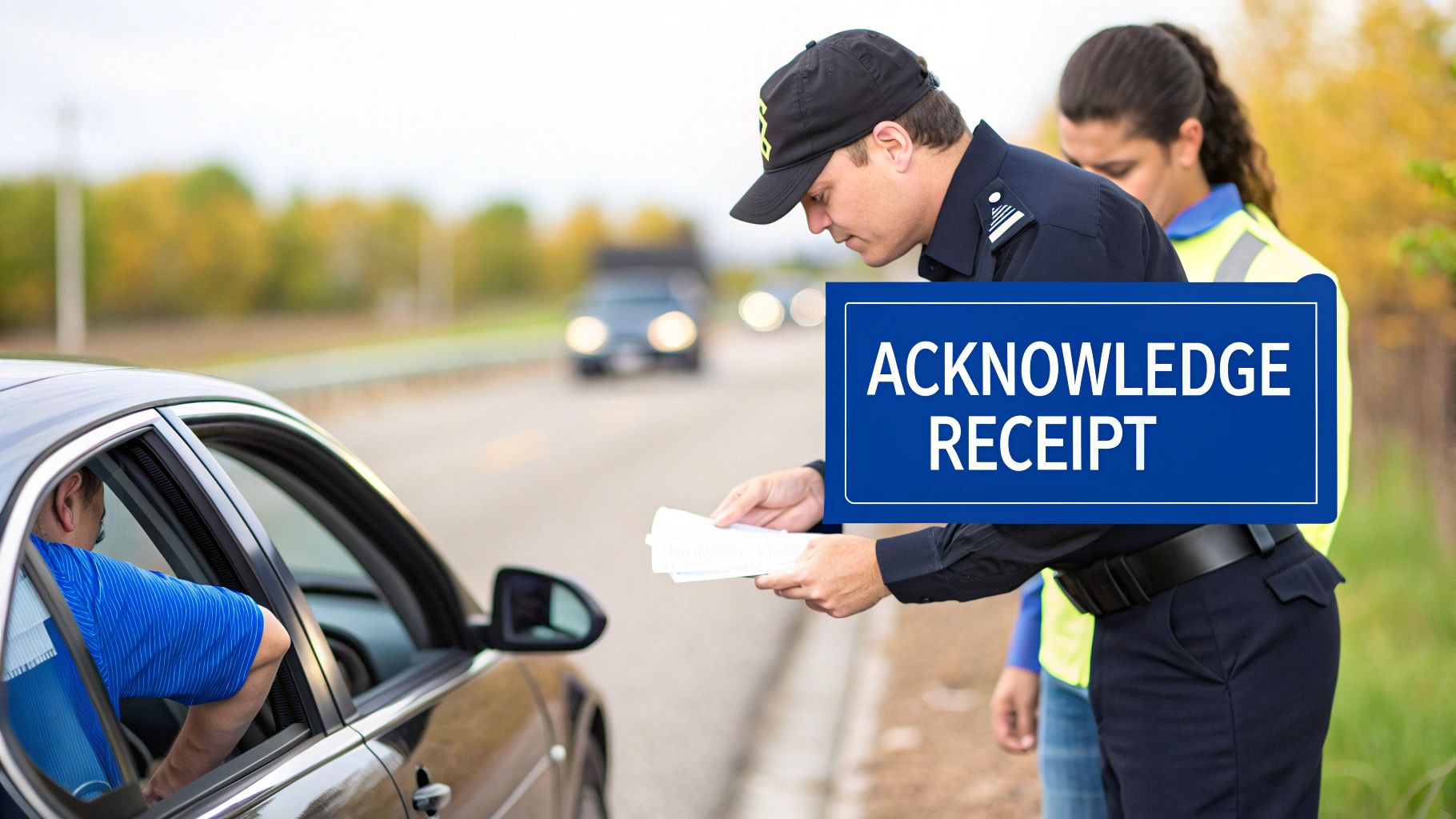
The request to sign a traffic ticket causes a ton of confusion and anxiety. A lot of people mistakenly believe their signature seals their fate, legally confessing to whatever the ticket says. This myth can make an already tense situation a whole lot worse.
The reality, though, is much simpler and purely procedural. Whether you're on a busy highway in Miami-Dade County or a quiet rural road, your signature serves one primary purpose: it’s your written promise to deal with the ticket.
A Promise to Respond, Not an Admission of Guilt
Your signature is a legally binding agreement that you will address the citation by the deadline printed on it. It’s a formal way of saying you’ve received the notice and you understand you have to take action. This whole process is designed to be way more efficient than the alternative, which could involve being taken into custody for even a minor infraction.
By signing, you’re essentially telling the state you will choose one of these options:
Pay the fine associated with the ticket.
Elect to attend a driver improvement course (if you are eligible).
Formally contest the ticket in court.
To make this crystal clear, let's break down exactly what that signature on the dotted line means—and what it absolutely doesn't.
Your Signature on a Ticket: What It Means vs. What It Doesn't
What Signing Means | What Signing Does NOT Mean |
|---|---|
You acknowledge receipt of the ticket. It’s proof you were given the citation. | You admit guilt. Signing is not a confession to the violation. |
You promise to appear in court or resolve it. You agree to handle it by the deadline. | You waive your right to fight the ticket. You can fully contest it later. |
You can leave the traffic stop. It's the step that concludes the roadside interaction. | You agree with the officer's claims. It has zero impact on your legal defense. |
Seeing it laid out like this really helps demystify the process. It's all about procedure, not guilt.
Your signature is your pledge to appear or resolve the matter, preventing the need for a more serious immediate intervention from law enforcement. It preserves your right to fight the ticket later.
Understanding this distinction is the first step in taking control of the situation. The side of the road is not the place to argue your case. The time for that comes after you’ve calmly finished the traffic stop, and your signature is the key that lets you move on to that next, more important phase.
By signing, you aren't weakening your position; you are simply following the required legal procedure to address the issue on your own terms later.
Understanding the Law Behind the Signature Requirement
So, why does the law even care about your signature on a traffic ticket? It all comes down to a system designed to be efficient. It keeps the courts from getting completely bogged down and prevents a minor roadside stop from turning into a full-blown legal drama.
The whole process is built around Florida Statute 316.650. This law is important because it defines most common traffic violations—like speeding or rolling through a stop sign—as civil infractions, not criminal offenses. Think of it this way: a civil infraction is treated more like a disagreement over a bill than a crime against the state. That distinction changes everything.
A Civil Process, Not a Criminal Arrest
Because your ticket is for a civil infraction, the officer doesn't need to arrest you and haul you off to jail. The system is streamlined to avoid that. Your signature on the ticket is simply your formal promise to the court that you'll deal with the citation later. It's the simple act that keeps the wheels of justice turning without resorting to arrests for minor issues.
This procedure is the same everywhere in the state, from Broward County all the way to the Panhandle. It’s a standard process that balances the need for enforcement with a driver’s right to handle the matter at a more convenient time. Knowing it's a civil process should help take some of the intimidation out of a traffic stop.
The legal framework in Florida treats most traffic tickets as civil matters. Your signature is simply the procedural key that allows you to drive away and address the citation later, rather than face an immediate arrest.
Interestingly, this isn't just a Florida thing. In most states, signing a ticket is not an admission of guilt but an agreement to either show up in court or pay the fine. Florida's law is just very clear that signing is part of a civil process. The important thing to remember is that just paying the fine is the same as pleading guilty. To see what that really means for your record and insurance, check out our guide on what happens if you plead guilty to a traffic ticket.
What Happens If You Refuse to Sign Your Ticket?
It’s a classic scene we’ve all imagined. An officer hands you a ticket you know is unfair, and that defiant voice in your head tells you, "Don't sign it!" Refusing feels like the only way to protest right there on the spot. But while that urge is understandable, it’s one you need to ignore.
In Florida, refusing to sign a traffic ticket can take a simple traffic stop and blow it up into a much bigger legal mess.
Your signature isn't an admission of guilt. It's just a promise—your word that you'll either show up in court or handle the ticket by the deadline. When you refuse to give that promise, the officer can interpret it as a refusal to comply with a lawful order. And that gives them grounds to arrest you.
From a Civil Infraction to a Misdemeanor
Just like that, a simple civil ticket can turn into a criminal charge. Under Florida law, refusing to sign a civil traffic infraction is a second-degree misdemeanor. The side of the road isn't a courtroom, and trying to argue your case by withholding your signature is a strategy that is likely to backfire.
The time to challenge the ticket comes later, in a proper legal setting. Signing the ticket lets you end the traffic stop peacefully, drive away safely, and keep all your rights to fight the citation later.
Think about it in the real world. You get pulled over in Palm Beach County for what you believe was a perfectly legal stop. If you sign, you're back on the road in minutes, ready to plan your defense. If you refuse, you risk ending your day in handcuffs, which complicates everything.
Refusing to sign does not make the ticket go away. It only makes your situation worse by piling a potential criminal charge on top of the original traffic violation. The best move is almost always to sign.
Remember, signing is just a procedural step. It’s your promise to appear, much like getting a summons for a court date. Failing to show up after you've made that promise has its own set of serious penalties. To see just how bad that can get, learn more about what happens if you have a missed court date for a traffic ticket and the risk it poses to your license.
The key takeaway is simple: stay calm, comply with the officer's instructions, and sign the ticket. This one small action ends the stop and puts you in the best position to effectively challenge the citation, protecting both your freedom and your driving record.
Navigating Your Options After You Receive a Ticket
The traffic stop is over, the officer has driven away, and you're left holding that little piece of paper. Now what? This is the moment you shift from reacting to the stop to making a strategic plan. The choice you make next can have a real impact on your driving record and your insurance rates for years to come.
Once you have the ticket in hand, you have three main paths you can go down. Each one has its own set of pros and cons, and the right decision really depends on your specific situation. Let's break them down.
Your Three Choices Explained
This isn’t a decision to take lightly, as it directly affects both your wallet and your driving privileges.
Pay the Ticket: This is the fastest way to make the problem "go away," but it's also a direct admission of guilt. Paying the fine means you're accepting the conviction and any points that come with it, which is exactly what leads to higher insurance premiums.
Elect Traffic School: If you're eligible, you can choose to attend a driver improvement course. You still have to pay the fine, but finishing the school successfully will keep the points off your license. The violation itself, however, may still show up on your record.
Contest the Ticket: This means pleading not guilty and challenging the citation in court. It's your right to make the state prove its case against you, and it offers the potential to get the ticket dismissed entirely, avoiding all the penalties.
This decision-making process is pretty straightforward, as you can see below.
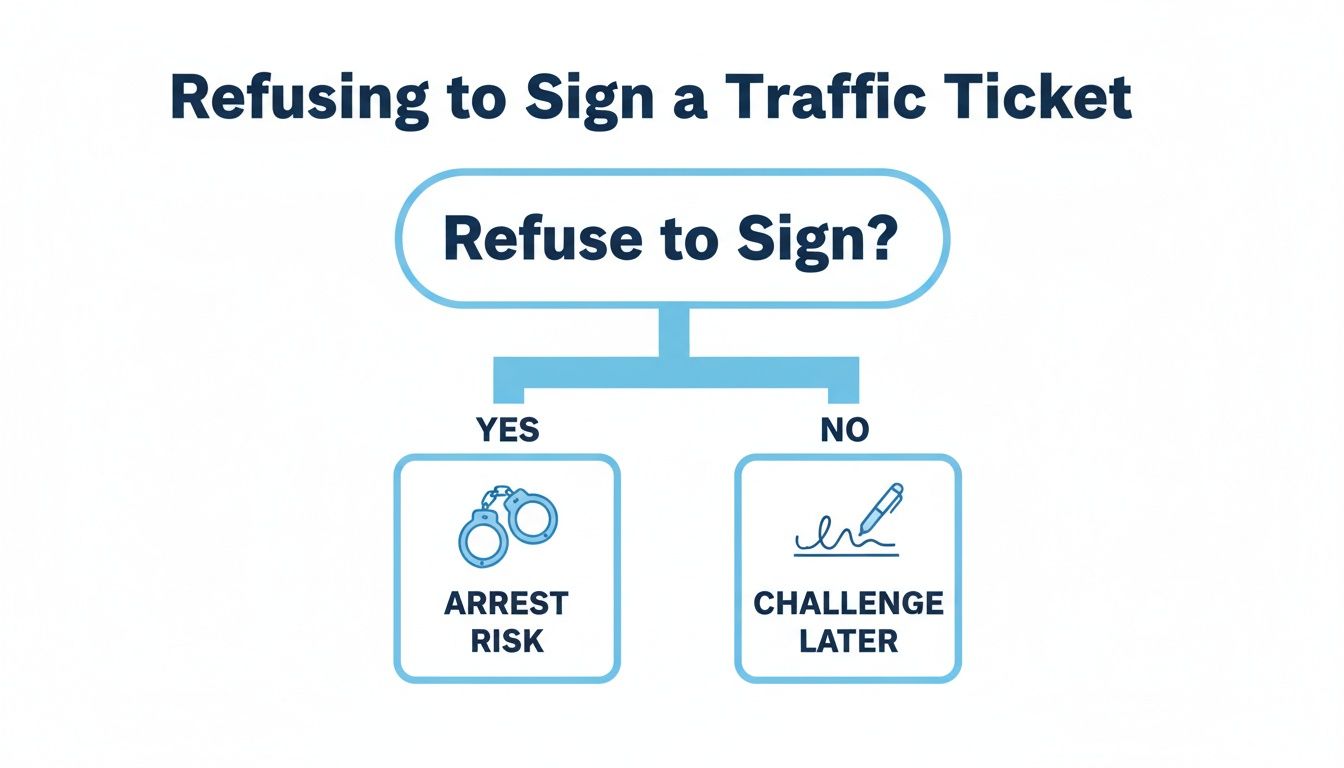
As the visual shows, signing the ticket is just the procedural step that unlocks your ability to make one of these strategic choices later.
To help clarify your decision, here’s a quick comparison of what each path looks like in the real world.
Your Three Main Choices After a Florida Traffic Ticket
Action | Potential Outcome on Points | Impact on Insurance | Best For |
|---|---|---|---|
Pay the Fine | Guaranteed points are added to your license. | Likely to increase for 3-5 years. | Someone who doesn't mind a conviction on their record or a potential insurance hike. |
Attend Traffic School | No points added if you're eligible and complete the course. | Usually avoids an increase, but the violation is still on your record. | Drivers with a clean record who are eligible and want a surefire way to avoid points. |
Fight the Ticket | Potential for zero points if the ticket is dismissed or amended. | No impact if the case is won. The conviction is avoided. | Anyone who wants to keep their record completely clean and avoid all long-term costs. |
Ultimately, fighting the ticket is the only option that gives you a chance at a complete dismissal, protecting both your license and your insurance rates from any negative impact.
The Strategic Advantage of Legal Counsel
Sure, you can handle the ticket yourself, but bringing in a traffic ticket attorney gives you a huge advantage. An experienced lawyer knows how to analyze the details of your stop, spot procedural mistakes or weaknesses in the officer's case, and can manage the entire court process for you. In most cases, you won't even have to show up to court yourself.
Their entire goal is to protect your license and your record by working toward a dismissal or getting the charge reduced. For some cases, there are other potential outcomes to explore, like a traffic ticket deferral program if one is available. An attorney can tell you if that's a viable path for your specific situation.
Why Contesting Your Ticket Can Be a Smart Move
When an officer hands you a ticket, the first instinct for many Florida drivers is to just pay the fine and get it over with. It feels like the path of least resistance. But that's a common misconception, and it's one that can cost you far more than the price of the citation.
Fighting a ticket isn't just a hassle—it's your legal right. More than that, it's often a smart, proactive move to protect your driving record from points and keep your insurance premiums from spiking.
Traffic citations aren't always cut and dry. Police officers are human, and mistakes happen. The radar gun used to clock your speed might not have been properly calibrated. Or maybe there was a procedural error in how the ticket was written and filed. These aren't just minor technicalities; they can be legitimate grounds for a strong defense.
Protecting Your Rights and Your Record
Challenging a ticket isn't about looking for a loophole. It's about exercising your right to due process and holding the state to its burden of proof. Can they truly prove their case against you? An experienced attorney will dig into every detail of your stop, from the initial reason you were pulled over to the evidence presented on the citation itself.
Think about some of the common defense angles we see:
Challenging the Officer's Observations: Did the officer really have a clear, unobstructed view? Were the weather conditions poor enough to affect their judgment?
Questioning the Equipment: Was the radar or lidar gun recently calibrated according to the strict standards set by Florida law?
Identifying Procedural Errors: Did the officer follow every single legal requirement when they wrote and filed the citation? A misstep here can invalidate the whole thing.
Sadly, traffic enforcement isn't always applied equally. A revealing study using Lyft driver data in Florida found that minority drivers are 24-33% more likely to get a speeding ticket than their white counterparts, even when driving at the same speeds. This kind of data underscores why it's so important for every case to get a fair review.
Past results do not guarantee future outcomes. Our goal is to protect your license and record by ensuring your rights are upheld throughout the legal process.
Remember, fighting your ticket is the only option that gives you a shot at a complete dismissal. When you start to understand the different strategies available, it becomes clear why so many drivers choose to contest their citation. For a deeper dive, check out our guide on how to beat a traffic ticket in Florida. It’s your first step toward building a more informed defense.
How a Traffic Defense Firm Can Help

Trying to figure out the Florida court system on your own can be an intimidating and confusing mess. Once you've decided what to do with your ticket, bringing in a traffic defense firm takes the weight off your shoulders. We handle the paperwork, deal with the court, and put together a defense strategy built to protect your driving record.
Our focus is always on seeking the best possible result for your specific situation. We work to protect your license and your record by aiming for a dismissal, reduced charges, or avoiding points altogether. Our office is in Broward, and we handle traffic matters across Florida. For many drivers, having a legal team is a powerful advantage. You can read more about it in our article about whether you need a lawyer for a traffic ticket.
For Florida drivers facing tickets, an experienced firm can make a significant difference. Our practice focuses on traffic and DUI defense.
Attorney Advertisement. Office in Broward. Submitting your information for a free consultation does not create an attorney-client relationship. Past results do not guarantee future outcomes.
Common Questions About Florida Traffic Tickets
Drivers across Florida often have the same questions when they get a ticket. Here are some of the most common ones we hear. This is for general information and is not a substitute for legal advice about your specific case.
Does Signing a Ticket Affect My Right to Fight It Later?
Not at all. Your signature is just a promise to show up in court or handle the ticket by the deadline—it's nothing more than an acknowledgment that you received the citation.
Signing that piece of paper doesn't waive any of your constitutional rights. You are still completely free to contest the ticket, explore your legal options, and fight for your record once the traffic stop is over.
How Long Do I Have to Respond to a Traffic Ticket in Florida?
In Florida, the clock starts ticking the moment you get that ticket. You generally have 30 calendar days from the date of the citation to take action.
Within that 30-day window, you have to make a choice: pay the fine (which is pleading guilty), elect to take traffic school, or plead not guilty and prepare to fight it. Missing that deadline is a bad idea, as it can lead to bigger problems like a suspended driver's license.
Can an Officer Actually Arrest Me for Refusing to Sign a Ticket?
Yes, they absolutely can. While it might seem like a small act of defiance, refusing to sign a civil traffic ticket in Florida is actually a second-degree misdemeanor.
An arrest isn't guaranteed, but the officer has the legal discretion to take you into custody to make sure you'll eventually answer for the ticket in court. It’s almost always smarter to just sign the ticket and then deal with the legal battle later on your own terms.
Deciding how to handle a traffic ticket is a critical first step in protecting your driving record. For a free, no-obligation consultation to understand your options, contact Ticket Shield, PLLC today.
Learn more at https://www.ticketshield.com