Florida Traffic Law Stop: A Driver's Rights Guide
Pulled over in Florida? Understand your rights during a traffic law stop. Our guide covers what to say, search rules, and how to protect your record.

You're driving home in Florida. You glance up, see flashing lights in the mirror, and your stomach drops. That reaction is normal. A traffic law stop is not casual. It's a legal event, and what you do in the next few minutes can shape whether this ends with a warning, a citation, a suspended license, or something much worse.
If you've already been stopped, or you're worried about the next one, you need a plan before you need luck. You also need to understand one hard truth. The system moves fast, and drivers who talk too much, consent too quickly, or trust an automated app to “handle it” usually make their position worse.
Table of Contents
What Should You Do When You See Flashing Lights
TL;DR: Signal, pull over safely, keep your hands visible, stay polite, say as little as possible, and don't consent to searches. A Florida traffic stop can escalate fast. Treat it like a legal event, not a roadside conversation.
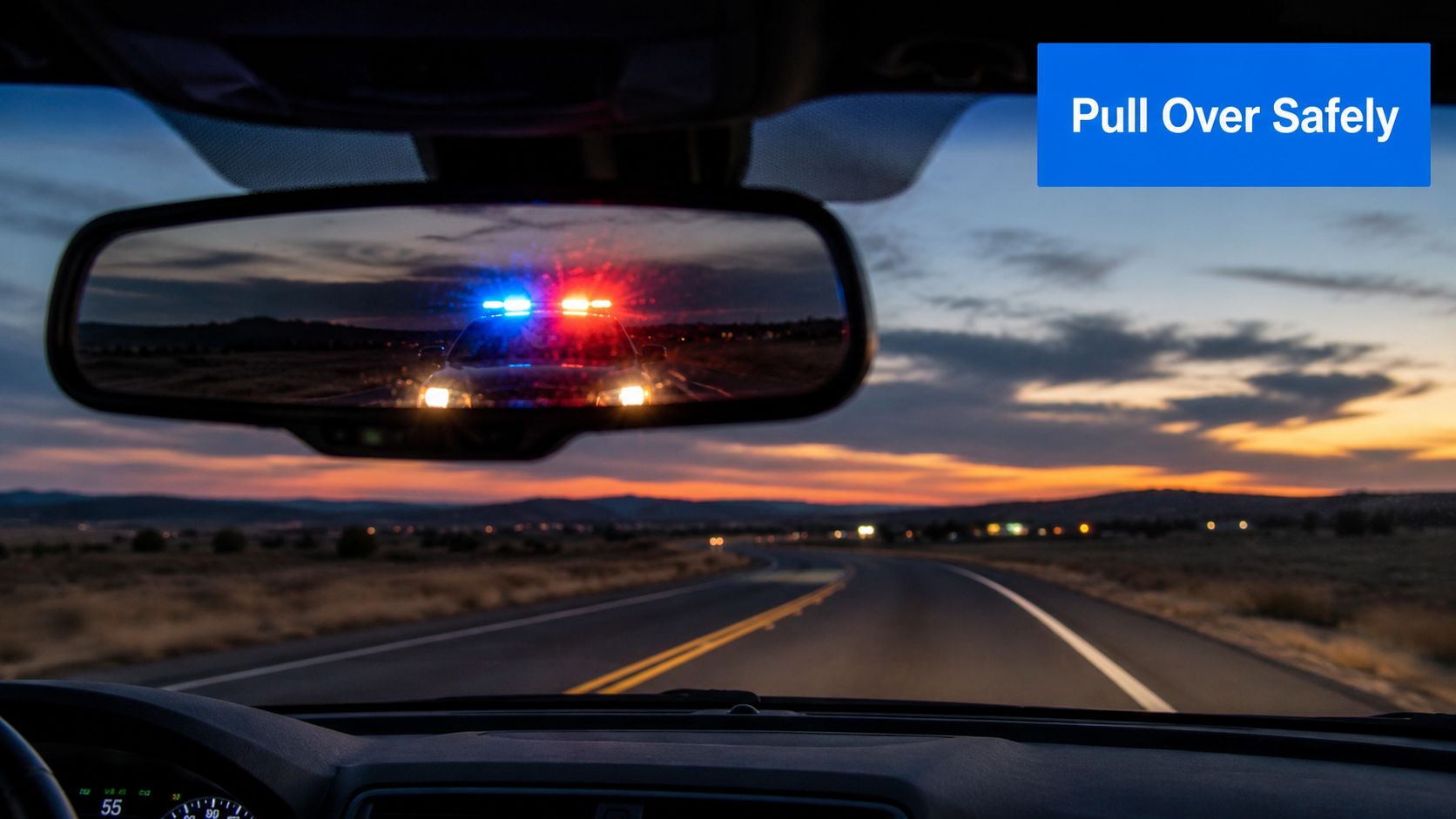
You're in the right lane on I-95, the Turnpike, or a neighborhood street near the Orange County Courthouse. You see red and blue lights behind you. Your first instinct might be panic, anger, or the urge to explain yourself before the officer even reaches your window. Don't.
A stop is one of the most common ways people enter the legal system. In the United States, police conduct around 32 million traffic stops each year, more than 1 million drivers are arrested during those stops, and roughly 60% end in a citation, according to this traffic stop analysis. That's why you should treat every stop as high stakes from the first second.
How should you pull over safely
Don't slam on the brakes. Don't make sudden movements. Signal, slow down, and move to a safe location as soon as it's practical.
If it's dark, pick a well-lit shoulder, parking lot entrance, or side street if one is immediately available. That usually helps both you and the officer. Then stop the car, put it in park, lower the window, and keep your hands where they can be seen.
Use this order:
Signal promptly: Show that you're complying, not evading.
Choose a safe place: A short, calm pull-over is better than a jerky stop in a dangerous lane.
Turn off distractions: Lower music. Put the phone down.
Make your hands visible: Put them on the wheel until the officer gives instructions.
For a broader overview of how a stop works, read this guide on what a traffic stop is.
Why do the first moments matter so much
Drivers often hurt themselves before the first question. They reach into the glove box too early. They jump out of the car. They start volunteering excuses. They try to “talk their way out of it.”
That's a mistake.
Practical rule: Your job at the roadside is to stay safe, comply with lawful commands, and protect your record. It is not to win the case through casual conversation.
If the officer thinks you're nervous, evasive, angry, or impaired, the stop can widen quickly. A simple ticket can turn into questioning, a vehicle search request, field sobriety exercises, or an arrest decision. Calm conduct protects you. Loose talk does not.
Why Were You Pulled Over
An officer in Florida can't pull you over just because they feel like it. They need a legally supportable reason tied to a suspected violation. In plain English, they need something they can point to and defend later.
That reason can be small. Very small.
What gives an officer a legal reason to stop you
A lawful stop often starts with a minor moving violation. Courts regularly uphold stops when an officer can articulate a specific traffic basis for the detention. That includes things like signaling failures, as reflected in this legal discussion of vehicle stop standards. In real life, that means the stop may be legal even if the underlying driving behavior felt insignificant to you.
That matters because many Florida drivers think, “It was only a lane drift,” or, “I slowed down enough.” But roadside law doesn't run on what felt close enough. It runs on what the officer says they observed and whether a court accepts that explanation.
Common reasons drivers get stopped include:
Turn signal issues: Not signaling early enough, or not signaling at all.
Tag or equipment issues: A light out, an unreadable plate, or something dangling into view.
Lane behavior: Weaving, drifting, or movements the officer describes as unsafe.
Stop sign problems: Slowing instead of fully stopping.
Speed-related conduct: Not only speeding, but accelerating oddly or braking late.
What Florida law requires once the stop begins
Florida Statute 316.072(3) requires drivers to comply with lawful orders and directions from law enforcement officers who are enforcing traffic laws. That is the point where many drivers make the problem worse. They confuse compliance with surrender.
They're not the same.
You must comply with lawful directions. You do not have to volunteer damaging statements. You do not have to turn the stop into an interview.
A useful way to think about it is this:
Issue | What it means for you |
|---|---|
Officer claims a traffic violation | The stop may be lawful even if the violation seems minor |
Officer asks for license, registration, insurance | You should provide them calmly |
Officer starts asking broad questions | You should stay polite and measured |
Officer tries to expand the stop | Your words can help them or hurt you |
The most dangerous phrase at a traffic stop is often, “I only had two drinks,” or, “I know why you stopped me.”
Minor violations often become the doorway to bigger investigations. That's why you should never underestimate a traffic law stop in Florida.
What Are Your Rights During a Traffic Stop
In such situations, drivers need a script. Not confidence. Not improvisation. A script.
You have rights during a Florida traffic stop, but rights don't protect you if you waive them by talking too much. Stay respectful. Stay controlled. Give the required documents. Then stop feeding the stop.
What should you say and what should you refuse
Start simple. If the officer asks for your license, registration, and proof of insurance, provide them. If the officer asks where you're coming from, whether you were speeding, whether you've been drinking, or whether there's anything illegal in the car, slow down before you answer.
You do not help yourself by filling silence.
Use short, clean statements:
If asked accusatory questions: “I'm choosing to remain silent.”
If pressed for admissions: “I don't want to answer questions.”
If the stop seems to continue without explanation: “Am I being detained, or am I free to go?”
If asked to sign a citation: Signing is usually not an admission of guilt. If you're unsure, review this explanation on whether you have to sign traffic tickets.
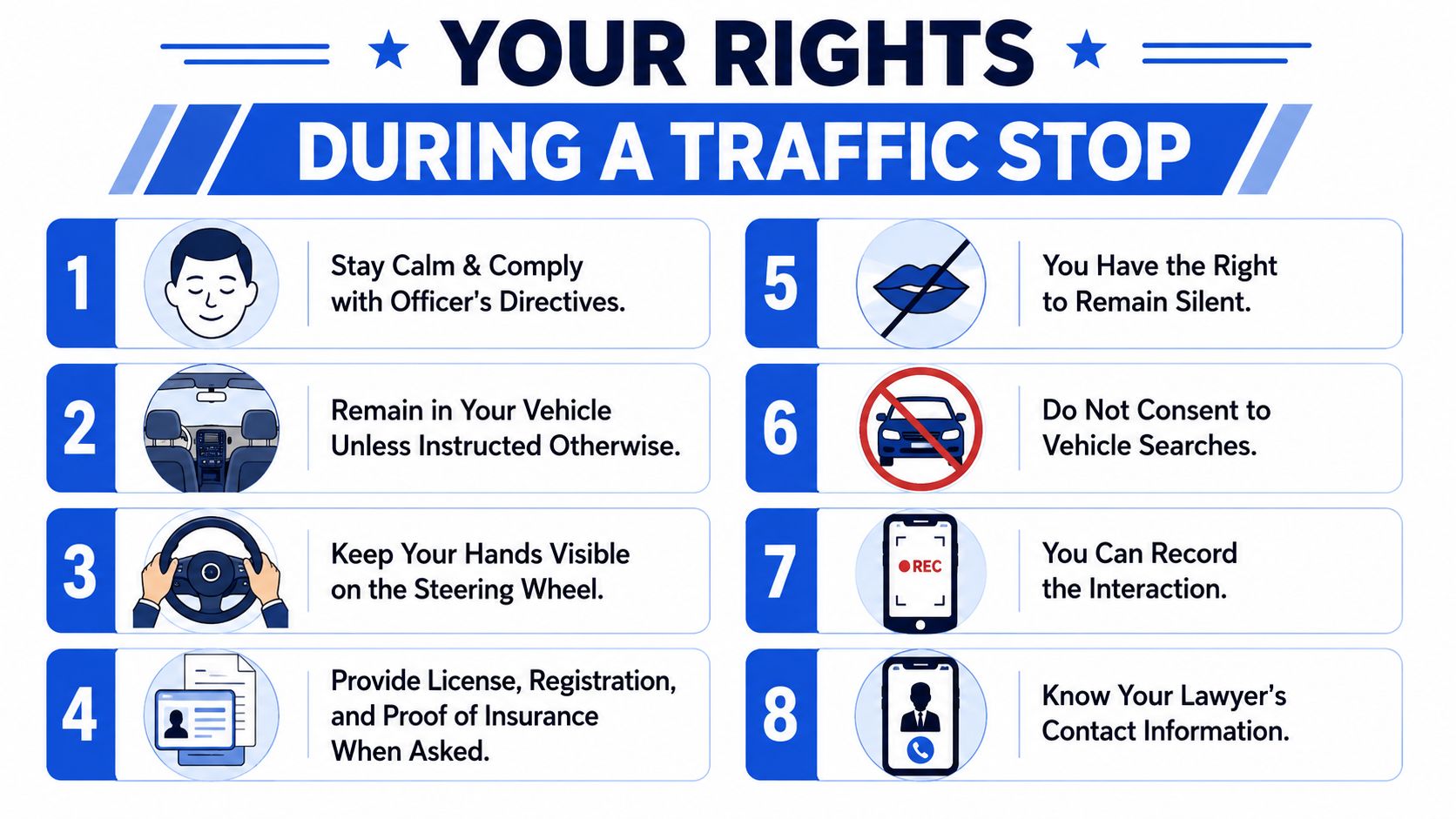
Here's the checklist I'd want a driver to follow.
Immediate Steps to Take
Keep your hands visible: Put them on the steering wheel. If it's nighttime, turn on the interior light.
Wait before reaching: Don't dig through a bag or glove box until the officer asks.
Stay in the vehicle: Unless the officer tells you to get out, remain seated and still.
Be polite, not chatty: Courtesy helps. Explanations usually don't.
Provide required documents: License, registration, and insurance. Nothing extra.
Don't volunteer consent: If the officer asks to search, refuse clearly and calmly.
Don't debate roadside facts: Court is where legal arguments belong.
Remember details: Badge name, patrol car number, time, location, and what was said.
A visual version can help if you're trying to remember this under stress.
When should you ask if you are free to go
Not in the first five seconds. Not in a hostile tone. Ask once the officer has your documents or after a round of questioning that seems to be stretching beyond the reason for the stop.
If the officer says you're free to go, leave calmly. If the officer says you're being detained, stop talking.
“Officer, I want to comply, but I'm not answering questions.”
That sentence protects a lot of drivers.
One more thing. You can be calm and still be firm. Too many people think they must choose between politeness and self-protection. You don't. The right approach is both.
Can the Officer Search Your Vehicle
Drivers often give away the case. Not because the officer had clear legal authority. Because the driver said yes.
If an officer asks, “You don't mind if I take a quick look, right?” the answer should be short and respectful: “Officer, I do not consent to any searches.”
What is the difference between suspicion and probable cause
Drivers mix these up all the time. They matter.
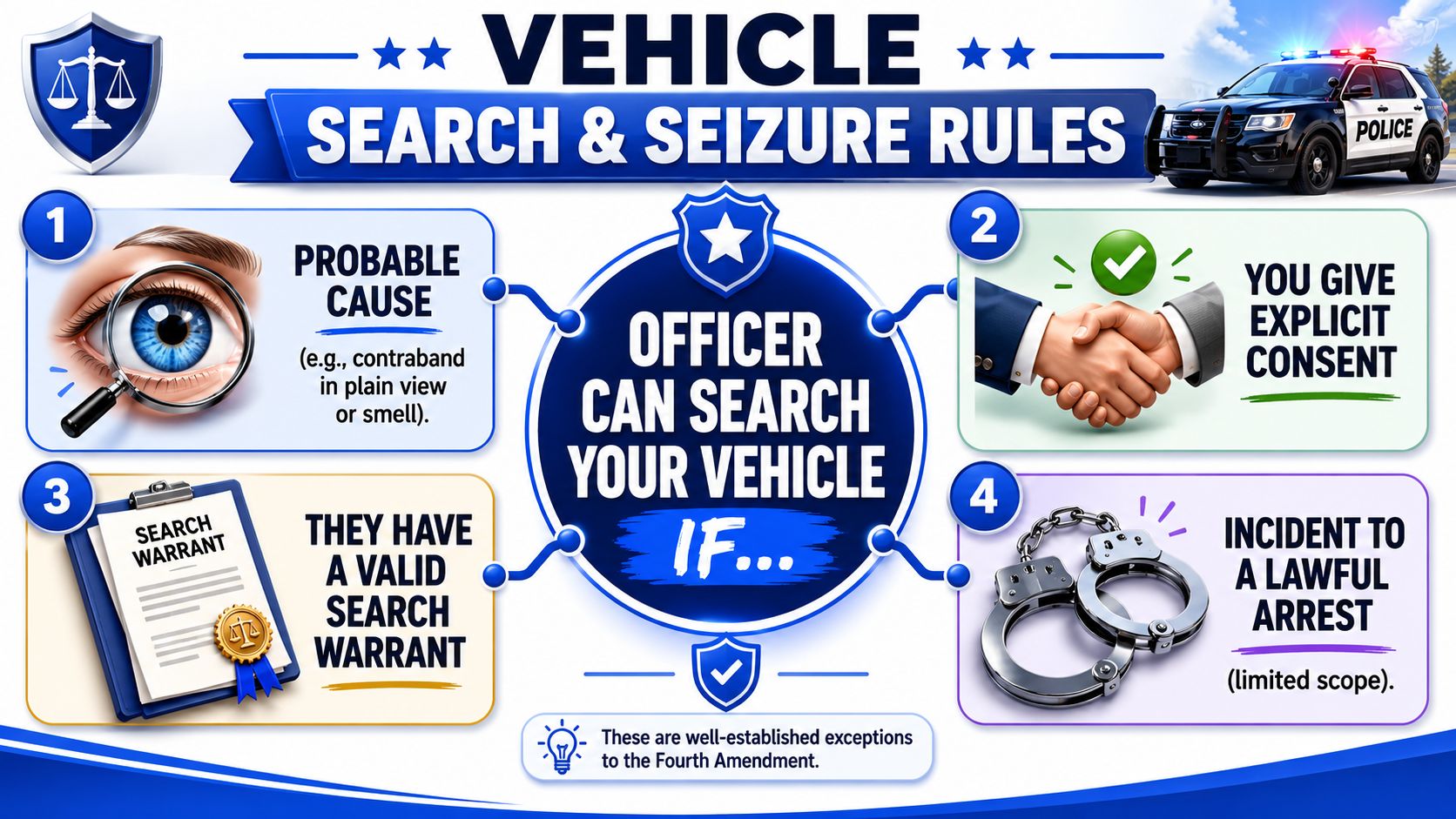
Reasonable suspicion is the lower standard that may justify a stop or temporary detention. Probable cause is a stronger legal basis and often becomes the issue when police search a vehicle or make an arrest. You don't need to argue those standards on the roadside. You need to avoid making the officer's job easier.
A vehicle search may be claimed under several theories, including:
Claimed basis | What it usually means |
|---|---|
Consent | You said yes, even casually |
Plain view | Officer says contraband or evidence was visible |
Lawful arrest | Search may follow arrest in certain circumstances |
Warrant or another exception | Officer claims a recognized legal basis |
If you consent, you hand the state an argument it otherwise might not have. If you refuse, the state has to justify the search without your help. That difference can matter later at the Richard E. Gerstein Justice Building or any Florida courtroom handling suppression issues.
For a related overview of search rules, review these warrant requirements.
What should you say if an officer asks to search
Say it clearly. Say it once. Repeat it if necessary.
Your line: “Officer, I do not consent to any searches.”
Then stop. Don't explain. Don't joke. Don't try to sound clever.
Officers often phrase the request in a way that feels informal. “Mind if I look?” “You've got nothing to hide, right?” “It'll only take a minute.” That's not small talk. It's a request that can damage your defense.
Use this comparison:
Bad response: “I guess that's fine.”
Bad response: “Only the trunk.”
Bad response: “Sure, but there's nothing in there.”
Protected response: “I do not consent to any searches.”
If the officer searches anyway, do not physically interfere. Don't argue. Don't reach. Don't resist. Let the legal fight happen later, where it belongs.
If police act without your consent, your lawyer may be able to challenge the search. If you gave consent, that challenge gets harder.
That is why refusal matters, even when the officer proceeds anyway.
How Do DUI Stops and Checkpoints Work
A DUI stop is different from an ordinary citation stop because the consequences move fast. Your statements matter more. Your decisions matter more. And Florida's DUI laws carry immediate license consequences that many drivers don't see coming.
What does implied consent mean in Florida
Florida Statute 316.1932 is the state's implied consent law. By driving in Florida, you've already agreed to submit to a lawful breath, blood, or urine test after a lawful DUI arrest under the circumstances covered by the statute.
That does not mean you lose every right. It does mean the refusal decision carries its own penalty structure.
A refusal can trigger an administrative license suspension. For many drivers, that surprise is worse than the roadside encounter itself. If you're under investigation for DUI, you should speak carefully, avoid volunteering facts, and understand that the testing issue is separate from whether the state can ultimately prove guilt in court.
What rights do you still have at a checkpoint
DUI checkpoints are not a free-for-all. Police still have to operate within constitutional limits, and you still have the right to remain silent beyond identifying yourself and handling required documents.
What you should do at a checkpoint:
Stay calm: Anxiety alone doesn't help you.
Provide documents when asked: Keep it routine.
Avoid admissions: Don't answer “How much have you had to drink?” with a number.
Don't consent to extra searches: A checkpoint is not automatic permission.
Ask for counsel quickly after arrest: The earlier you protect the record, the better.
If you want a plain-language overview, review this page on DUI checkpoint legality.
A checkpoint stop can feel scripted. That's exactly why drivers become careless. They assume everyone gets waved through, so they start chatting. Then an officer notices odor, speech, movement, confusion, or an admission the driver never needed to make.
At that point, the stop changes.
If you're asked to perform roadside exercises, the decision becomes tactical and fact-specific. If you're arrested, timing matters. The paperwork, the suspension issue, the officer's observations, and any recorded statements all start forming the state's case right away. At the Edgecomb Courthouse and courts across Florida, the defense often turns on details the driver barely remembers. That's why preserving those details early matters.
What Is the Best Way to Protect Your Record Now
If you've been through a traffic law stop, don't wait for the insurance notice, the license problem, or the court date to get serious. Get serious now.
A citation can put points on your record. A criminal traffic charge can threaten your license, your job, and your background checks. If you drive for work, even one case can affect your income. If you hold a clearance or professional license, the consequences can spread beyond traffic court.
Why a real lawyer matters after a traffic law stop
Many drivers make the second big mistake at this point. The first was talking too much at the roadside. The second is handing the case to an automated app or a volume-based ticket mill that keeps you away from the actual attorney.
That model is built for processing. Your case needs judgment.
You won't be texting with a chatbot or a paralegal. You will speak directly with your attorney. That matters when the issue is not just paying a ticket, but protecting your license, spotting a search problem, evaluating a suppression issue, or deciding whether traffic school or another strategy serves your interests. In some situations, learning the benefits of a defensive driving course can help drivers understand how safety education fits into a broader record-protection strategy, even though your Florida legal options should be reviewed under Florida law.
One available option for Florida drivers is traffic ticket defense through Ticket Shield, PLLC, a lawyer-led service that handles traffic defense matters statewide and allows direct attorney communication by phone or text.
What should you do after the citation or arrest
Act quickly and keep it organized.
Save every document: Citation, bond paperwork, tow sheet, and court notice.
Write down the stop details: Time, location, officer statements, and what you said.
Preserve video: Dashcam, phone video, rideshare app logs, and passenger messages.
Don't post about it: Social media turns private mistakes into public evidence.
Get legal advice early: Fast review creates more options.
The goal is simple. No Points if possible. No careless plea. No blind trust in a system that moves faster than you think.
If you were stopped, cited, or arrested in Florida, protect yourself now. Visit Ticket Shield, PLLC for a free consultation and a direct review with a real attorney focused on the No Points goal.