
Florida Warrant Requirements: Know Your Rights 2026
Navigate Florida's warrant requirements for searches & arrests. Protect your rights from invalid warrants. Get expert legal help in 2026 from Ticket Shield.

If police want to search your car or home, stay calm, don't consent, ask to see the warrant, and say as little as possible. Florida drivers make their biggest mistakes in the first minutes. Protect yourself fast. Then call a lawyer who answers.
Flashing lights in your mirror. A knock at the door. An officer telling you they “can get a warrant” or already have one. That's when people panic and start talking.
That's also when they give away rights they can't get back.
As a Florida driver, you need to understand one thing immediately. Warrant requirements exist to limit police power, not to make your life easier in the moment. If you don't know how to respond under pressure, those protections can collapse fast.
The Fourth Amendment, ratified in 1791, created the core U.S. warrant requirement by stating that no warrants shall issue except on probable cause and that warrants must particularly describe the place to be searched and the persons or things to be seized, as explained by Cornell Law School's Fourth Amendment overview. That rule matters in Florida traffic cases because searches often become the turning point in DUI, drug, reckless driving, and license-related prosecutions under Chapter 316.
If you're dealing with a stop, a home visit, a missed court date, or a search tied to your car, don't treat this like a paperwork problem. Treat it like a record-protection problem.
Table of Contents
What Should I Do If Police Want to Search My Car or Home?
If an officer asks, “Mind if I take a look?” the safest answer is simple. “I do not consent to any search.”
Say it calmly. Say it clearly. Then stop talking.
A lot of Florida drivers confuse politeness with consent. You can be respectful without helping the police build a case. If the encounter starts on the roadside, keep your hands visible, provide the documents Florida law requires, and don't argue. If the encounter starts at your home, step outside if safe to do so and ask whether they have a warrant.
Your first job is to avoid making it worse
The biggest mistake is trying to talk your way out of the moment. Drivers say things like “There's nothing in there” or “Go ahead, I've got nothing to hide.” That doesn't help. It usually makes the search easier to defend later.
Florida traffic enforcement under Chapter 316 can escalate quickly. A stop for speeding under section 316.187 or a DUI investigation under section 316.193 can turn into a search dispute in minutes. Once that happens, your words matter.
Practical rule: Never physically resist. Never consent. Never volunteer facts.
If an officer says you have to sign a citation, that issue is separate from consent to search. If you're unsure about that difference, read whether you have to sign a Florida traffic ticket.
What you should actually say
Use short lines. Don't improvise.
If asked for consent: “I do not consent to any search.”
If they claim authority: “Am I free to leave?”
If they say no: “I want to remain silent and speak with a lawyer.”
If they say they have a warrant: “Please show me the warrant.”
Don't explain. Don't justify. Don't fill silence.
Your goal isn't to win a debate on the street or in your driveway. Your goal is to preserve the record for a legal challenge later. That takes discipline.
What Are Florida's Basic Warrant Requirements?
Florida drivers hear the word “warrant” and assume it means the search is automatically legal. It doesn't. A warrant still has to meet basic constitutional requirements.
A valid U.S. search warrant must be supported by probable cause through oath or affirmation, and it must particularly describe the place to be searched and the persons or things to be seized, as explained in FindLaw's Fourth Amendment annotation.
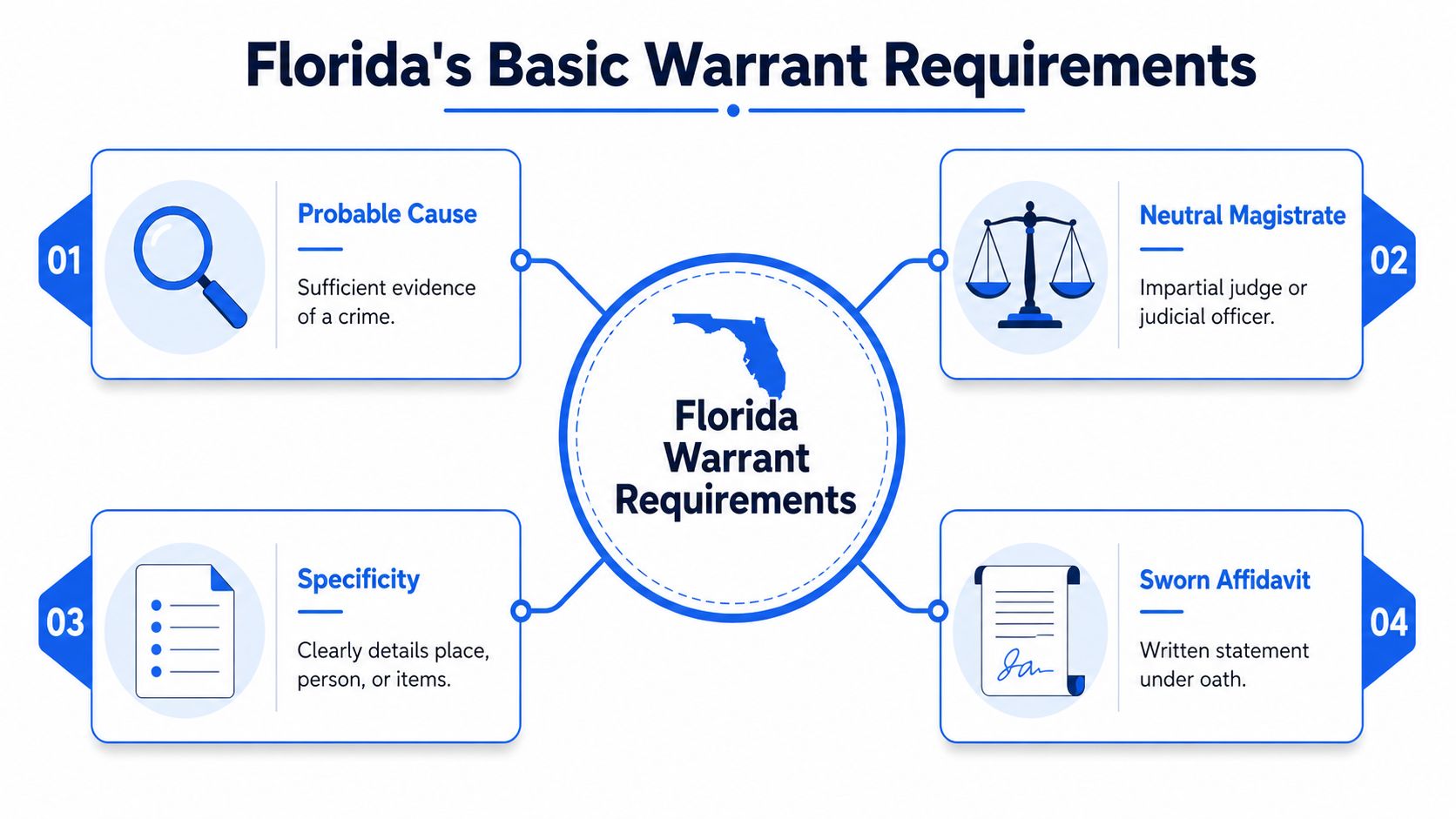
What makes a warrant legally valid
Think of a warrant like a precise shopping list for a specific store. It can't just say “look around and take what seems important.” It has to identify what officers are looking for and where they're allowed to look.
These are the practical pillars:
Probable cause: An officer has to present facts. Not a hunch. Not a guess.
Sworn affidavit: Those facts are usually placed in a written statement under oath.
Neutral magistrate: A judge or magistrate must review the request.
Specificity: The warrant must identify the place and the items with enough detail to limit officer discretion.
That last part is where many drivers get blindsided. A vague warrant gives officers room to push boundaries. A narrow warrant creates cleaner lines for your defense lawyer to enforce.
Why specificity matters more than drivers think
If police want to search your house, the warrant should tell them where and what. If they want a phone, laptop, or records, the warrant should reflect that with care. If they exceed the listed scope, that's a problem.
This matters in Florida because traffic cases often connect to broader allegations. A stop can lead to a phone seizure. A crash investigation can lead to record demands. An unpaid ticket issue can turn into a warrant-related court problem. If that's your situation, review whether you can get a warrant for unpaid tickets in Florida.
A warrant is not a hunting license. It's supposed to be a limited authorization.
Drivers who understand warrant requirements make better decisions. They don't volunteer consent. They don't assume “judge signed it” ends the analysis. They preserve details, then challenge what should be challenged.
How Do Police Get a Warrant in Florida?
Officers usually start with a sworn affidavit. That document lays out the facts they claim establish probable cause. Then they present it to a judge or magistrate for approval.
In a busy courthouse like the Richard E. Gerstein Justice Building in Miami, that process can move fast. Much faster than generally thought.
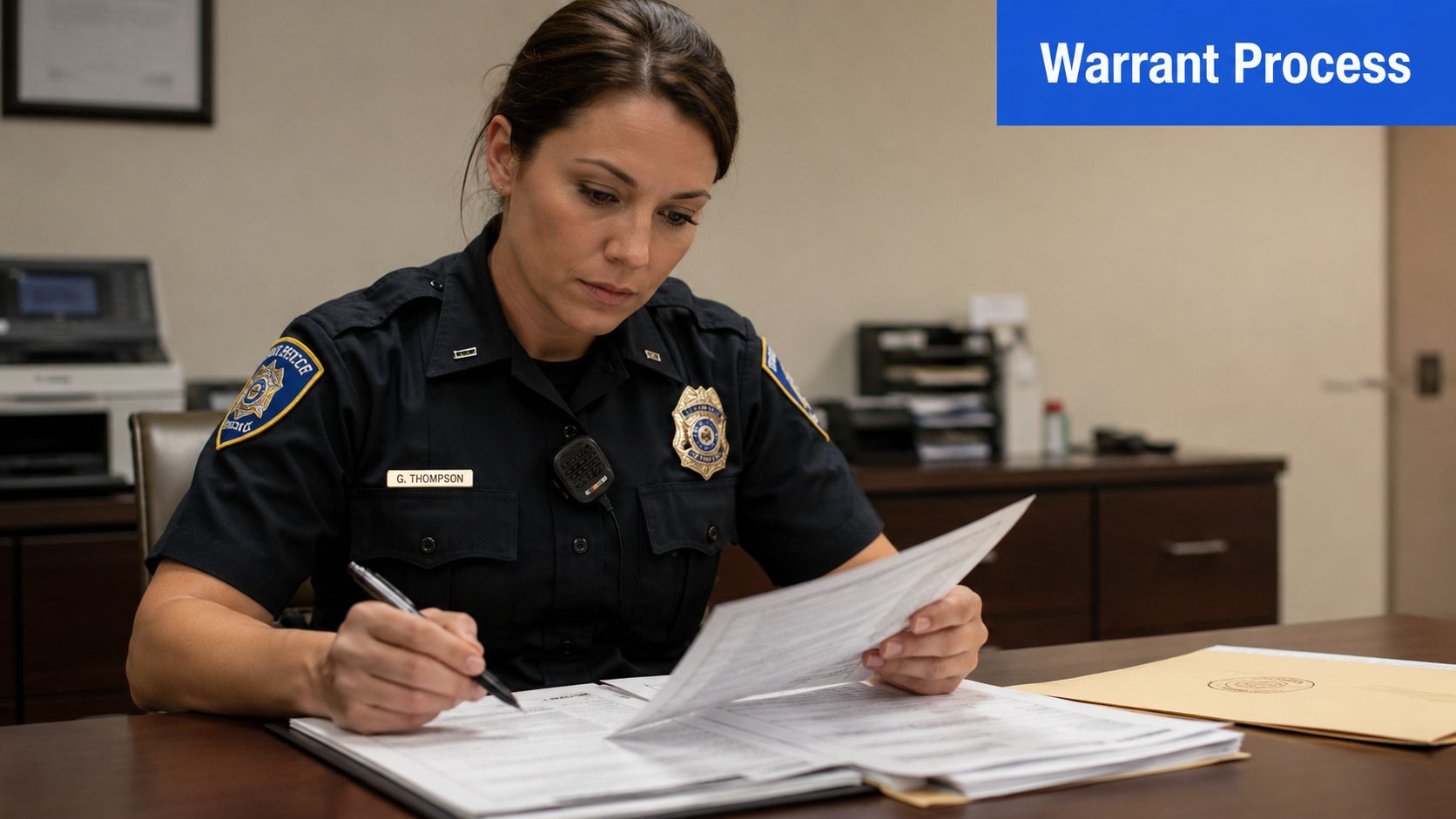
What officers submit to a judge
The affidavit is the engine of the whole process. If the facts in it are weak, misleading, stale, or too vague, the warrant can be vulnerable later.
That's why the details matter:
Part of the process | What it means for you |
|---|---|
Officer writes affidavit | Your case may turn on what was included or omitted |
Judge reviews request | Approval doesn't guarantee the affidavit was strong |
Warrant gets issued | Police gain authority only within the warrant's scope |
A lot of drivers assume a judge spent serious time digging through every claim. That assumption is dangerous.
Why you should never assume judicial review caught every problem
A major empirical study found that over 93% of warrant applications were approved on first submission, and the median time for a judge to open, read, analyze, and return a warrant affidavit was only three minutes, according to the Harvard Law Review analysis of warrant review.
That should change how you think about warrant requirements.
Judicial approval is important. It is not magical. Judges work fast. Officers write affidavits. Mistakes happen. Overstatements happen. Missing context happens.
If you missed a hearing and now you're worried a warrant may be active, handle that immediately. Start with what happens if you miss a Florida court date.
Don't assume the paper is flawless because it carries a signature. Get it reviewed.
When Can Police Search Without a Warrant?
The default rule is that police generally need a warrant before searching private property, subject to limited exceptions. For drivers, those exceptions are where most roadside damage happens.
That's because officers rarely announce, “I'm using an exception to the warrant requirement.” They just ask questions, make a request sound routine, or claim urgency.
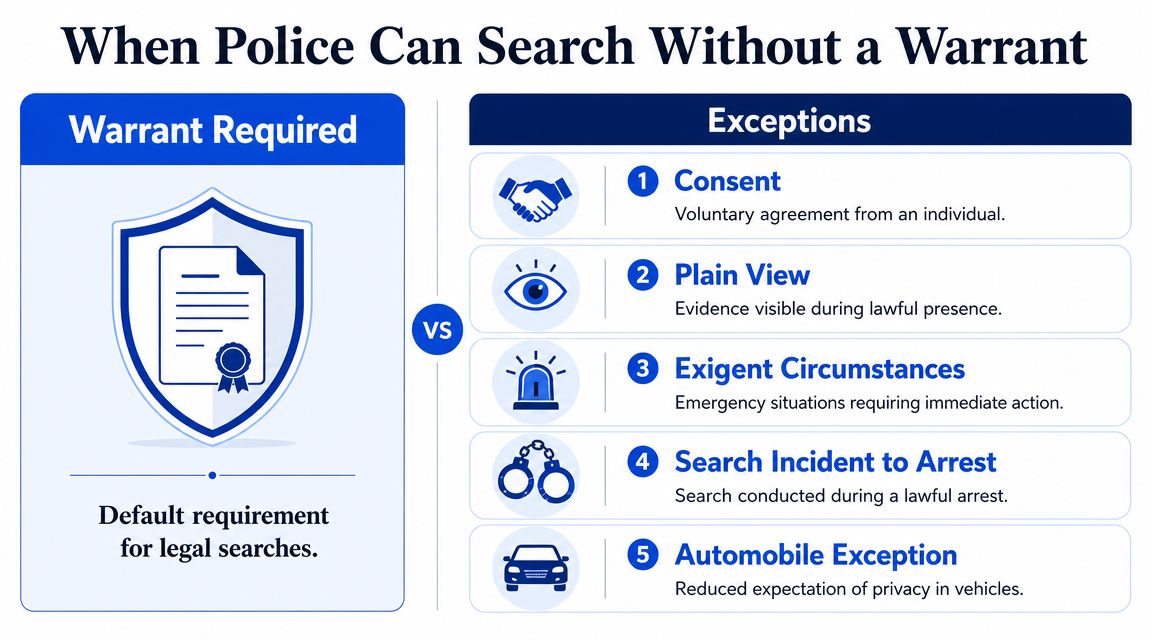
Consent is the easiest way to lose control
Consent is simple. If you agree, officers usually don't need a warrant.
That's why your answer matters so much.
Don't say “go ahead.” That can shut down a strong later challenge.
Don't open containers for them. That looks like cooperation.
Don't think silence helps. Use clear words. “I do not consent to any search.”
If you want a clear picture of how a roadside encounter unfolds before search issues start, review what a Florida traffic stop actually involves.
Emergency claims have limits
Police can sometimes enter without a warrant if they claim emergency aid. But that exception is narrower than officers often make it sound.
For emergency aid entries without a warrant, police do not need probable cause. They need an objectively reasonable basis to believe someone is seriously injured or imminently threatened, and the entry cannot expand beyond what is needed to address that emergency, as discussed in this explanation of the Supreme Court's emergency-entry standard.
That means “emergency” doesn't automatically authorize a full evidence-gathering search.
If officers say they entered to protect someone, the legal question becomes what they reasonably needed to do, and whether they stayed inside those limits.
Here's a practical distinction:
Situation | What the exception allows |
|---|---|
Serious injury or immediate threat | Entry to address the emergency |
Once emergency is resolved | Not a free pass to keep searching everywhere |
Other exceptions drivers need to understand
Some exceptions show up often in Florida traffic cases.
Search incident to arrest: If police lawfully arrest you, they may search within the limits tied to that arrest.
Plain view: If an officer is lawfully present and sees evidence in plain view, they may seize it.
Vehicle-related searches: Cars carry less privacy than homes, but that doesn't mean officers can do anything they want. Scope still matters.
Watch this short video for a plain-English breakdown of warrant exceptions in vehicle-related situations.
Your job during any of these encounters is consistent. Don't resist. Don't consent. Don't narrate. Let your lawyer deal with the legality.
What Are My Rights if Police Arrive With a Warrant?
If police arrive with a warrant, the moment is tense but the rules are still the rules. You do not have to help them build a bigger case.
You also should not interfere physically. That will only create new charges and make your defense harder.
Immediate Steps to Take
Stay calm: Keep your hands visible. Don't make sudden movements. Don't turn a lawful entry into an avoidable confrontation.
Ask to see the warrant: You want the actual document, not a summary. Look for the address, your name if relevant, and what property or items it covers.
Read the scope: A warrant for one area is not permission to search every room, every device, and every person on scene.
State non-consent clearly: Say, “I do not consent to any search beyond the warrant.” That preserves your position.
Stay silent after that: Don't answer investigative questions. Don't explain who owns what. Don't identify passwords or account access unless your lawyer advises otherwise.
Document what you can: Note the time, number of officers, what they searched, what they seized, and what they said.
Call a lawyer immediately: Fast legal review matters. Delay helps the prosecution.
What to remember under pressure: You can comply without cooperating.
If officers exceed the warrant's stated limits, your lawyer may be able to challenge the search later. But that challenge gets stronger when you kept your cool and didn't muddy the facts.
How Can an Invalid Warrant Be Challenged?
A warrant isn't the end of the case. It's often the beginning of the actual fight.
When police search under a weak, vague, or overbroad warrant, your lawyer can attack the search directly. In Florida court, one of the main tools is a motion to suppress evidence. That asks the judge to exclude evidence obtained through an unlawful search.
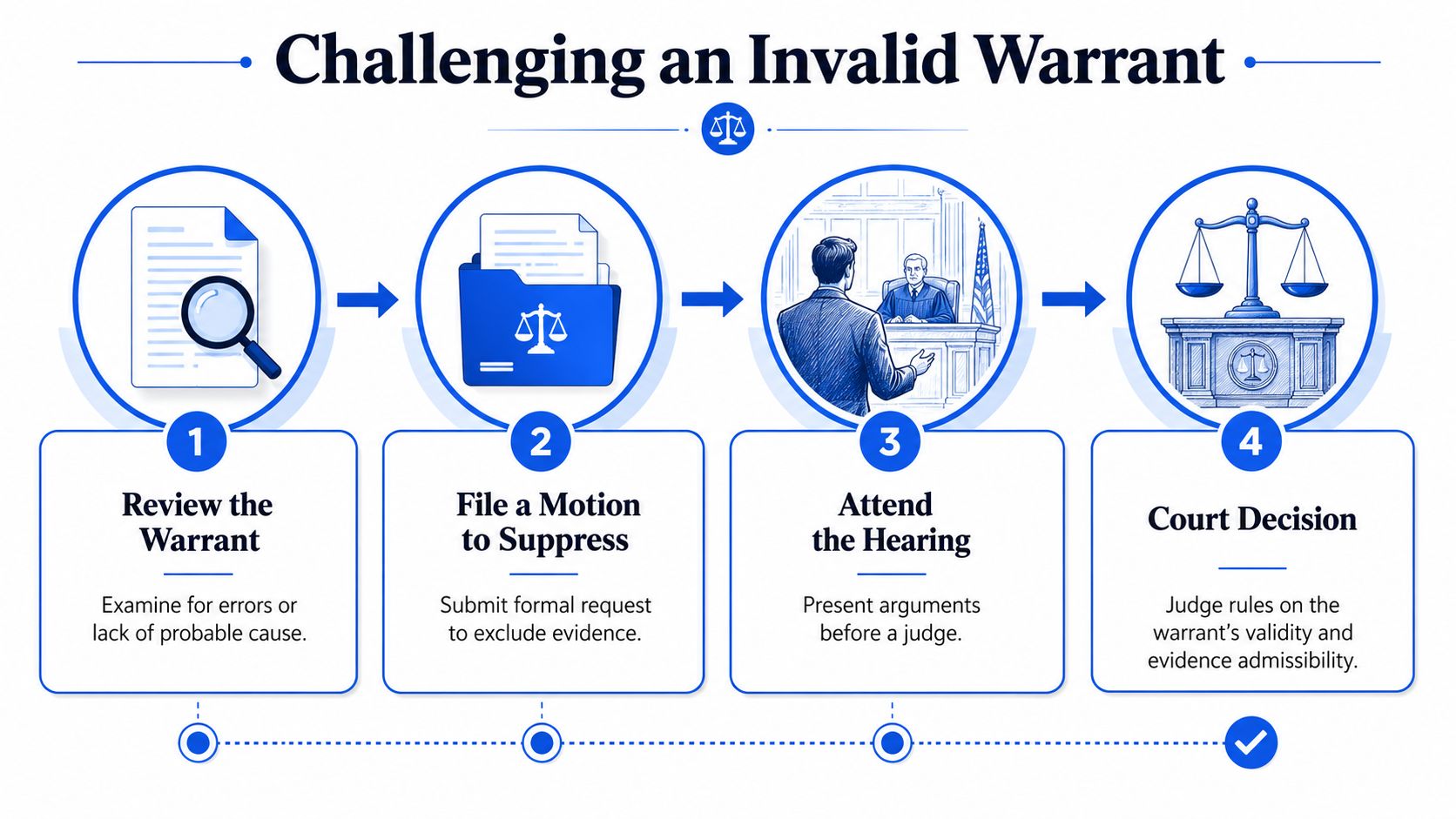
The fight usually starts with a motion to suppress
In this context, legal theory becomes courtroom pressure.
A defense lawyer may challenge a warrant by arguing:
The affidavit lacked real facts: Conclusions and suspicion aren't enough.
The warrant was too broad: It didn't clearly limit what officers could search or seize.
The officers went beyond scope: They searched places or took items not covered by the warrant.
The affidavit contained false or misleading statements: If key facts were distorted, the warrant's foundation can collapse.
If you want the procedural basics, read what a motion to suppress evidence does in Florida cases.
A challenge like this is technical. It depends on the affidavit, the warrant language, the return, body camera footage, dispatch timing, and officer testimony. This isn't something you want handled by an automated app or a ticket mill with layers of staff between you and the lawyer.
Digital searches are a major pressure point
Phones create special problems because they hold so much personal information. Courts and training guidance treat particularity as especially important in digital-device warrants. Warrants should describe the files or information sought as specifically as reasonably possible to prevent overbroad searches, according to the UNC School of Government handout on digital-device search warrants.
That matters in traffic-related prosecutions more than people realize. A crash case, racing allegation, DUI investigation, or reckless driving arrest can quickly lead to demands for phone evidence.
A phone search can reveal far more than the police needed for the original stop. That's exactly why overbreadth arguments matter.
One practical option for Florida drivers dealing with warrant fallout, missed court issues, or suppression questions is Ticket Shield, PLLC. The firm handles traffic and traffic-related criminal matters statewide, and clients communicate directly with their attorney by phone or text rather than through middlemen.
Protecting Your Rights During a Florida Traffic Stop
Few individuals won't face a home warrant. They will face a roadside stop.
That's where these warrant requirements become real. A deputy stops you. The questions start. Then the request comes. “Mind if I search the car?” If there's a DUI investigation under Florida Statute 316.193, the pressure rises fast. If it's a speeding or reckless driving stop under Chapter 316, officers may still try to expand the encounter.
What matters on the roadside
You need a short script and the discipline to stick to it.
Provide required documents: Don't turn basic compliance into a separate issue.
Don't volunteer explanations: Short answers only.
Refuse consent politely: “I do not consent to any search.”
Don't debate roadside law: Save the legal argument for court.
Ask if you're free to leave: If not, stop talking and request counsel.
If an officer claims to smell something, sees something, or says your behavior gave them concern, don't try to out-argue them from the driver's seat. Your protection comes later through review of body cam, reports, the stop timeline, and the actual legal basis they relied on.
Why direct attorney access matters
Florida drivers often make another mistake. They assume every traffic-defense service works the same way. It doesn't.
If your case involves a search, a warrant issue, a missed court date, a capias concern, a suspended license risk, or a DUI investigation, you need direct legal advice from an actual attorney. Not a chatbot. Not a call-center layer. Not a case mill that treats your stop like bulk paperwork.
A lawyer-led defense matters because search issues are fact-sensitive. The exact words used. The order of events. The claimed exception. The scope of the search. Those details decide whether evidence comes in or gets attacked.
If your goal is no points, a protected license, and a cleaner record, act early. Waiting usually hands control to the prosecution.
If police searched your car, threatened a warrant, served one, or charged you after a Florida traffic stop, get legal help now. Ticket Shield, PLLC gives Florida drivers direct access to their attorney by phone or text, not middlemen or automated apps. Visit TicketShield.com for a free consultation and fight for the No Points outcome.

