Your 2026 Guide to the Pretrial Intervention Program Florida
Facing charges in Florida? Discover the pretrial intervention program florida, eligibility, and how to protect your record in 2026. Ticket Shield can assist.
Florida's Pretrial Intervention Program can stop a criminal case before conviction, but only if you act fast, qualify under local rules, and apply correctly. Miss the deadline or file the wrong package, and that opportunity can disappear before your case really starts.
You just got charged. You're staring at paperwork, bond conditions, a court date, and a thousand worst-case scenarios. If your case is headed into a Florida courthouse like the Richard E. Gerstein Justice Building in Miami, the pressure hits hard and fast. That's normal. What matters now is that you don't freeze.
A lot of people hear “pretrial intervention program Florida” and assume it's simple. It isn't. The idea is simple. The execution is not. One county may move quickly. Another may require a tight document package, a signed waiver, and an application filed almost immediately after arraignment. If you wait around for the next court date, you may already be late.
This is also where people get burned by automated apps, ticket mills, and intake systems run by middlemen. Criminal diversion is not a chatbot problem. It's a strategy problem. If immigration concerns overlap with your criminal case, even understanding the hearing process matters. A plain-English guide on pretrial hearings during ICE detention can help you understand that overlap before one bad assumption creates a second legal crisis.
Table of Contents
You Were Charged with a Crime What Now
First, stop making this worse.
Don't call the prosecutor yourself and try to “explain.” Don't post about the arrest. Don't assume your charge is too minor to matter. A misdemeanor can still damage your job, your license, your insurance, and your future applications. A traffic-related criminal charge can do all of that at once.
If your case involves a vehicle, you also need to understand that Florida traffic crimes don't live in a vacuum. Chapter 316 of the Florida Statutes controls many of the offenses drivers face, including reckless driving under section 316.192. That matters because some drivers think they only have a “ticket problem” when they have a criminal case.
Your first goal is simple
You need to find out, immediately, whether diversion is on the table before the window closes.
That means identifying:
The county handling your case
The exact charge filed or likely to be filed
Your arraignment date
Any local application deadline
Your prior record, if any
Whether a local PTI office requires a lawyer-submitted package
Practical rule: If you're asking about PTI after the deadline passed, you may already be negotiating from a weaker position.
What you should do today
Get your paperwork together: Keep the notice to appear, bond paperwork, charging document, and court date in one place.
Confirm the court location: County practice can change the entire strategy.
Write down the facts once: Date, time, officer contact, statements made, and any witnesses.
Check for license risk: Criminal driving charges can trigger separate consequences from the court case.
Move before arraignment if possible: Waiting usually doesn't create an advantage. It burns time.
A pretrial intervention program can be a lifeline. But lifelines have conditions. You don't get credit for meaning well after the deadline expires.
What Exactly Is a Pretrial Intervention Program
You get arrested, panic, and assume the case will either end in a plea or a trial. That is not always true. In the right case, a pretrial intervention program can stop the prosecution track and give you a path to a dismissal.
The concept is simple. The process is not.
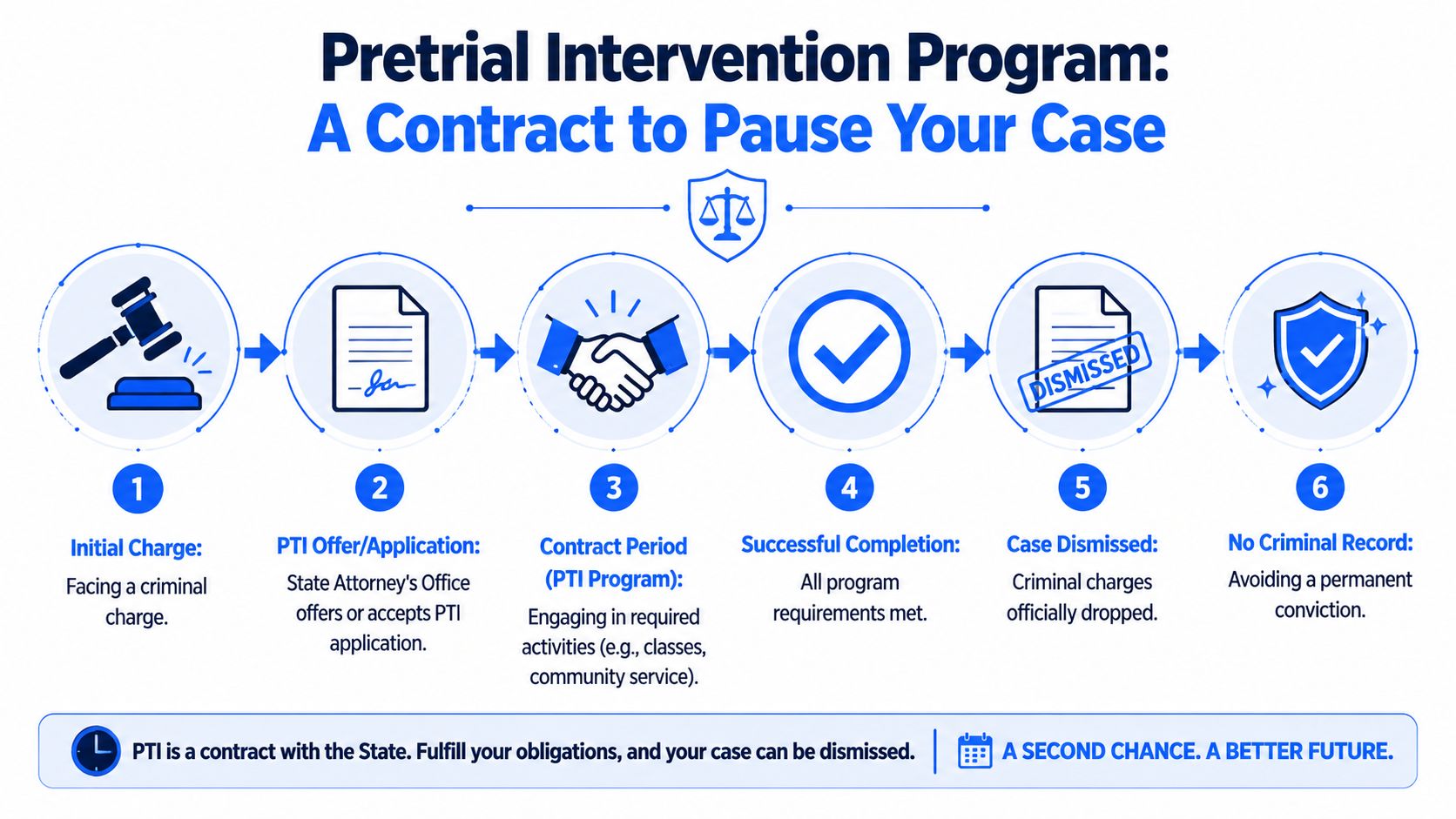
A pretrial intervention program is an agreement that puts your criminal case on hold while you complete a set of conditions ordered or approved through the program. Those conditions often include supervision, classes, counseling, treatment, community service, restitution, or other case-specific requirements. Finish successfully, and the State will often dismiss the charge. Fail, and the prosecution usually picks up right where it left off.
Why PTI is different from probation
PTI happens before a conviction. That is the point.
Probation usually comes after a plea or guilty finding. PTI is a pre-conviction resolution. You complete the program first, and if you do it correctly, you may avoid a conviction entirely. For many people, that difference affects employment, professional licensing, housing, immigration exposure, and plain old peace of mind.
If you want a broader foundation before deciding whether diversion fits your case, this breakdown of what a pretrial diversion program is is worth reading alongside your case paperwork.
PTI is a contract. You accept strict conditions now to get a dismissal later.
Why clients misunderstand PTI
People hear "diversion" and assume it is informal, automatic, or easy to get. That is the mistake. PTI sounds simple because the end goal is simple. Do the work, get the dismissal. But getting approved is often the hard part, and every county has its own habits, deadlines, paperwork, and gatekeepers.
That is why smart defense strategy starts early. You do not wait to "see what happens." You identify the right program, present the case in the strongest light, and avoid stupid errors that make the prosecutor or PTI office think you are a bad risk. A missed deadline, a bad statement, unpaid restitution, a dirty drug test, or an incomplete application can shut the door fast.
PTI can be one of the best outcomes in a Florida criminal case. It is also one of the easiest options to lose through delay, confusion, or bad advice.
Are You Eligible for a Florida PTI Program
You get arrested, you hear the words "first offense," and you assume PTI should be available. That assumption gets people denied.
Eligibility for PTI in Florida looks simple from the outside. In real life, it is a county-by-county screening process with hard exclusions, local preferences, and fast-moving deadlines. Your charge matters. Your record matters. The facts matter. The county matters. How quickly your lawyer acts matters just as much.
Who usually fits the PTI profile
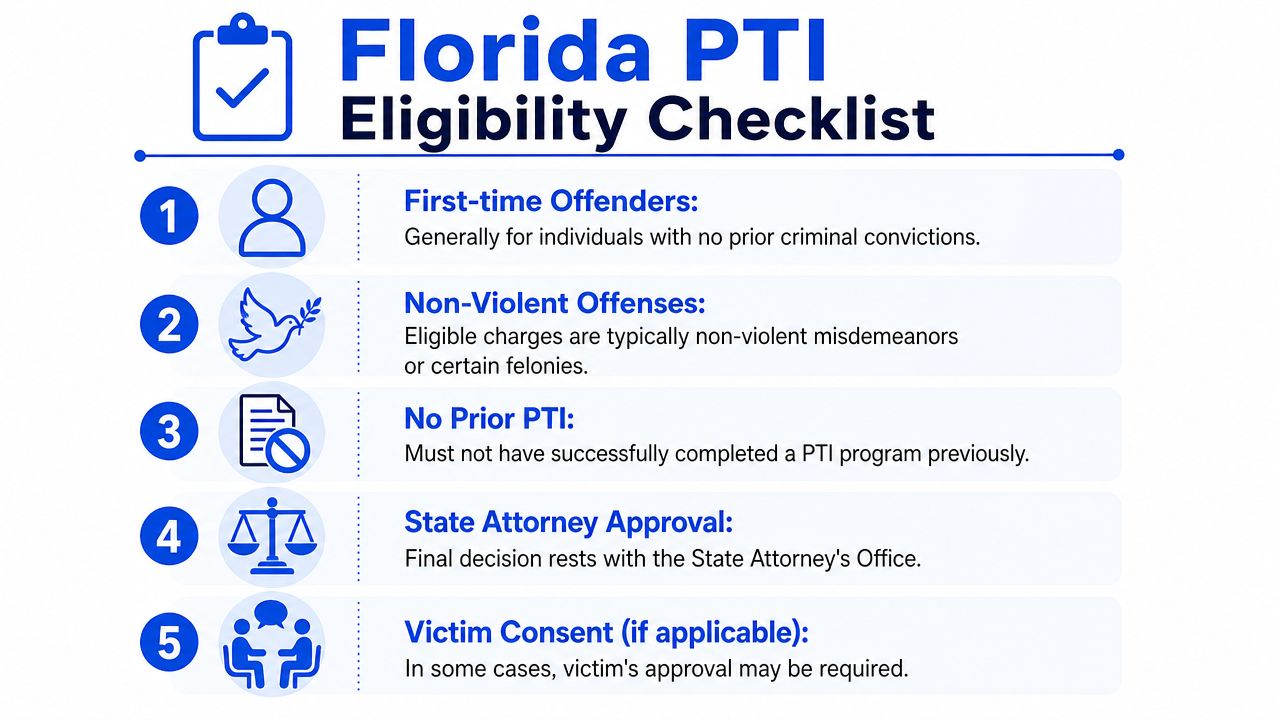
PTI is typically aimed at people the prosecutor considers low risk and suitable for early diversion. In many Florida felony PTI programs, that often means no prior adult felony conviction, no prior felony PTI participation, and a non-violent third-degree felony. Some counties also expect the application to be submitted quickly after arraignment and may reject late or incomplete packages without much sympathy.
That gives you the true test.
Ask these questions immediately:
Factor | Usually helps | Usually hurts |
|---|---|---|
Criminal history | Little or no record | Prior felony record |
Charge type | Non-violent offense | Violence-related allegations |
Timing | Fast action after arrest or arraignment | Waiting to see what happens |
Prior diversion | No prior PTI or similar history | Prior PTI participation |
Case presentation | Restitution ready, documents organized, stable background | Missing paperwork, unresolved issues, bad facts |
A clean record helps. It does not guarantee anything.
A messy application hurts. It can kill a strong case before anyone looks at the good parts.
Why traffic-related criminal charges get misread
A lot of drivers make the same mistake. They treat the case like a ticket when the state is treating it like a crime.
That matters because criminal driving charges may or may not fit local diversion rules. Reckless driving, for example, is a criminal offense under Florida law. Some traffic-related criminal cases can be positioned for diversion. Some cannot. Bad facts, alleged injuries, aggressive driving, a poor prior record, or a county policy against certain charges can shut the door fast.
If your case involves alcohol, read this guide on the Florida DUI diversion program. DUI screening is often tougher than ordinary misdemeanor screening, and many people waste time assuming all diversion programs work the same way.
A short video can also help if you're trying to understand why “am I eligible?” is never a one-word answer.
What blocks PTI even when the charge looks minor
People often get blindsided. The charge may look minor to you and still fail PTI screening for reasons that have nothing to do with the police report alone.
Local programs often care about details such as filing deadlines, signed waivers, attorney-submitted applications, restitution, victim input, residency issues, treatment needs, and offense-specific exclusions. The overview of Florida pre-trial intervention program administration reflects how much program administration and local practice affect who gets in.
Mental health can matter too. If a county wants proof that treatment or evaluation is appropriate, your lawyer may need to address that early and carefully. This overview of the psychiatric assessment process gives a plain-English explanation of what that evaluation can involve.
PTI eligibility is not just about your charge. It is about whether your case is packaged the right way before the window closes.
Do not ask only whether you qualify in theory. Ask what this county requires, what documents are missing, whether restitution or treatment must be lined up now, and whether something in your background is going to be used against you before you even get through the door.
How Does the PTI Application and Program Work
You miss the first deadline, say the wrong thing to the wrong person, or wait for the next court date to “see what happens.” That is how people lose PTI before anyone even reviews the good facts in their case.
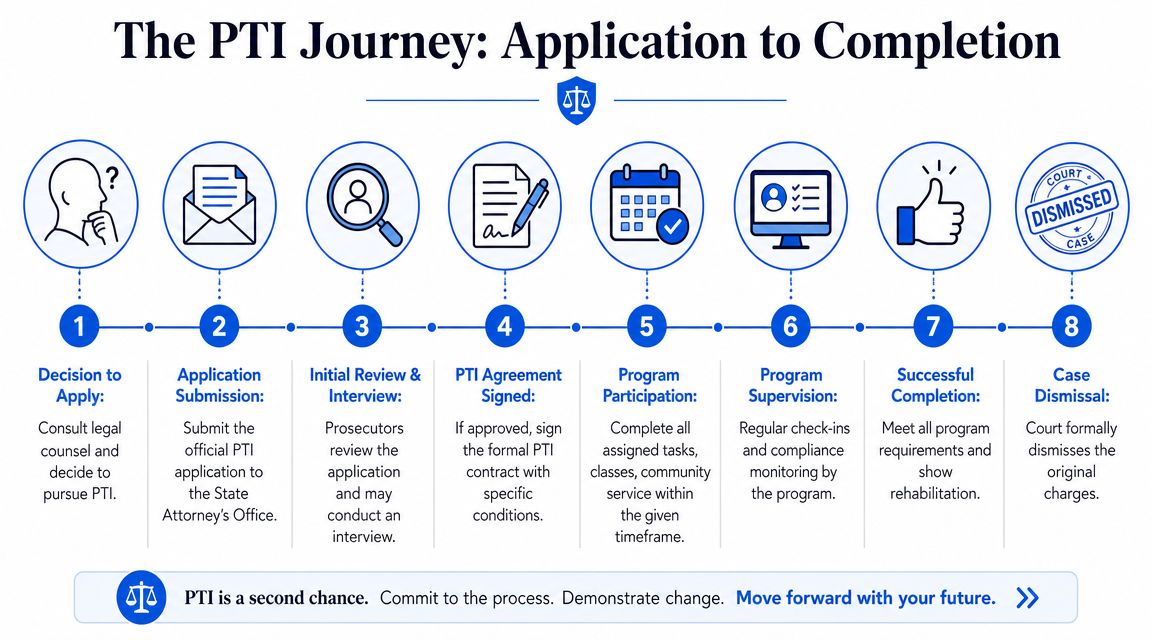
PTI sounds simple. Apply, complete conditions, get the charge dismissed. The actual process is harder because the pressure falls at the front end. You need the right timing, the right paperwork, and the right presentation of your case before the prosecutor decides you are worth the risk.
Start with the county's actual process, not a generic Florida summary. Some offices want an application fast after arraignment. Some expect defense counsel to submit the package. Some want treatment, restitution, or other supporting material lined up before they take the request seriously. If you do not know the deadline, who submits the application, and what documents the local office expects, you are already behind.
Handle these steps immediately:
Confirm your arraignment date and PTI deadline: Do not guess. Get the date, get the deadline, and calendar both.
Find out who controls the application: In many counties, your lawyer has to package and submit the request properly.
Collect the documents early: Character letters, proof of employment or school, treatment records, restitution information, and anything else that shows stability and accountability.
Stop talking about the facts of the case: Casual admissions can damage both PTI and your defense.
Address treatment issues now: If mental health, substance use, or counseling will be part of the pitch, prepare for it before the State asks. This plain-English guide to the psychiatric assessment process explains what that evaluation can involve.
If you are also weighing other deferred-resolution options, read this explanation of what a plea in abeyance is. PTI is different. The strategy, timing, and long-term effect are different too.
After acceptance, the case is paused and your contract starts. That contract usually requires reporting, classes, counseling or treatment, community service, restitution if there is a victim loss, and payment of program fees. The exact terms depend on the county and the facts of your case. The point is simple. PTI is not a formality. It is supervised performance.
Treat every condition like a court order.
Miss a meeting, skip a class, fail a test, or fall behind on payments, and the State can remove you from the program. Then the prosecution picks up where it left off, usually with less patience than before. Judges and prosecutors tend to give one clean shot at diversion, not repeated chances after careless mistakes.
Successful completion usually ends with the charge being dismissed. Failed completion puts you back in the normal criminal process, with lost time and fewer advantages. That is why the smartest move is to build the application carefully at the start, then complete every condition exactly as written.
How Do PTI Programs Differ Across Florida Counties
The phrase pretrial intervention program Florida sounds statewide and uniform. It isn't. The authority is statewide. The practice is local.
That difference matters more than most defendants realize.
A county comparison that proves the point
Broward County's felony PTI packet says the program is for qualifying third-degree felonies, lasts a full year, and requires a completed application within 45 days of arraignment. It also limits eligibility to people with no prior adult felony convictions and no more than three prior non-violent misdemeanor convictions or arrests, according to Broward County felony PTI information.
Manatee County looks very different. Its program is shorter, uses different supervision fees, and imposes a different community-service requirement. Other State Attorney materials also show a 90-day Pretrial Intervention Level 1 track in some jurisdictions. That is the point. Florida has a statewide diversion concept with local rules layered on top.
Why local practice changes your options
If your case is in Fort Lauderdale at the Broward County Judicial Complex, a one-year felony diversion track may shape the negotiation. If your case is somewhere else, the timeline and required package may look nothing like Broward's.
Here's the practical takeaway:
Don't borrow advice from another county
Don't trust a statewide summary without local confirmation
Don't assume a misdemeanor PTI process matches a felony PTI process
Don't wait for court to “sort it out”
County-by-county variation is why two people with similar charges can face very different diversion paths. One gets a real chance at dismissal. The other misses the filing window and never gets reviewed.
What Are the True Benefits and Risks of Entering PTI
PTI can be a strong move. It can also be the wrong move if you enter blindly, agree to conditions you can't realistically complete, or treat the program casually.
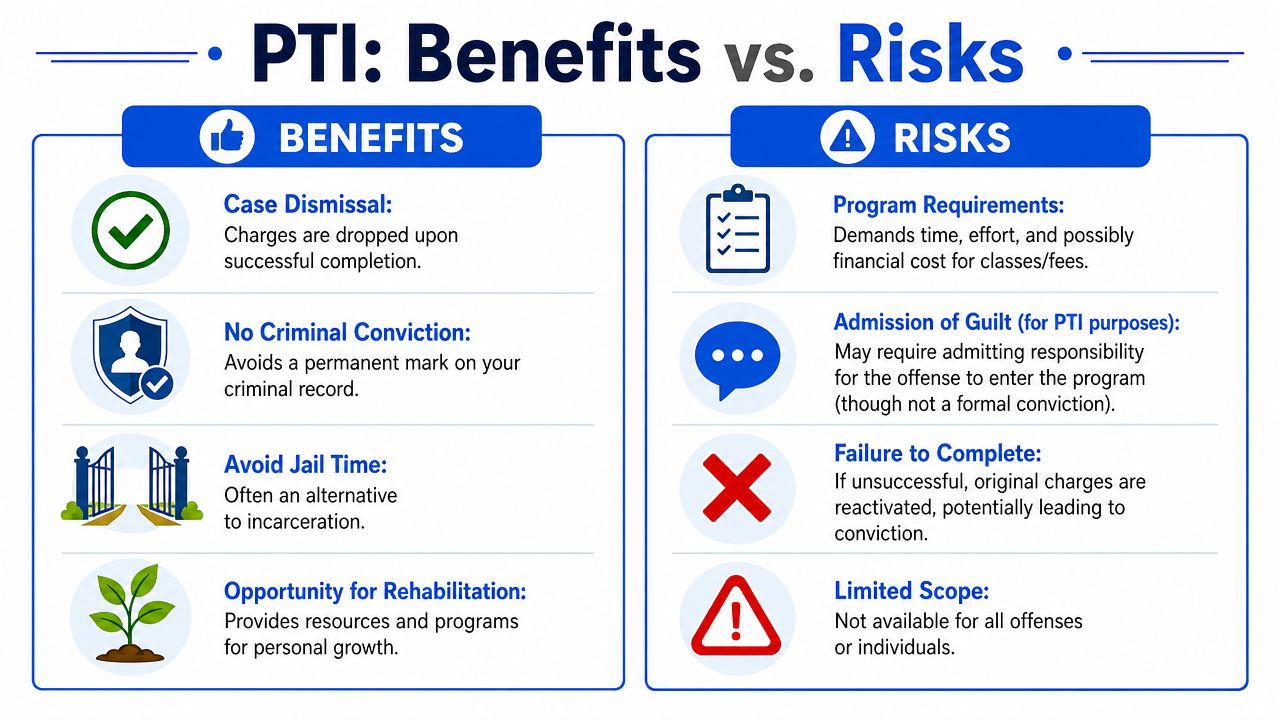
The upside is powerful
The biggest benefit is straightforward. Successful completion generally leads to dismissal of the charge rather than a conviction, which is built into Florida's PTI framework under section 948.08.
That protects more than your court file.
A dismissal can help protect:
Employment prospects
Professional licensing concerns
Housing applications
Background checks
Your ability to explain the case without a conviction attached
If you're weighing PTI against a plea that ends in withheld adjudication, this guide on withhold adjudication in Florida is useful because those outcomes are not the same thing.
For drivers who are trying to understand related record language, this BDISchool guide for drivers on adjudication withheld gives a practical comparison point.
The downside is real if you enter blindly
PTI usually requires compliance, patience, and sacrifice. You may need to waive certain rights, including speedy-trial protections. You may have to complete treatment, classes, supervision, restitution, or community service while the case stays open in the background.
If you fail, the prosecution resumes.
That's the hard truth. The case doesn't magically disappear because you tried. It comes back, often after time has passed, deadlines have shifted, and your bargaining power may be weaker than it was on day one.
Enter PTI only if you can finish it. Hope is not a compliance plan.
A dismissed charge is valuable. A failed diversion attempt can leave you exposed, delayed, and frustrated.
Frequently Asked Questions About Florida PTI
Can you get PTI for a DUI in Florida
Sometimes, but never assume it applies automatically. DUI-related diversion is often treated more cautiously than other misdemeanor cases. The exact answer depends on the county, the facts, and the prosecutor's policy.
Does PTI erase the arrest record
No. PTI and dismissal are not the same as automatically wiping out the record. Dismissal is still a major win, but record-clearing is a separate legal question.
What happens if you fail the program
Your case can return to active prosecution. The State doesn't have to pretend the PTI attempt never happened. That's why missed requirements, failed tests, unpaid costs, or silence from the defendant can create serious damage quickly.
Do you really need a lawyer to apply
If local rules are strict, yes, legal help matters. A lawyer doesn't just send in forms. A lawyer checks timing, identifies disqualifiers, frames your eligibility, manages the package, and helps prevent avoidable violations after acceptance.
What if the prosecutor dismisses the case another way
That can happen too. In Florida, you may hear the phrase nolle prosse, which means the State drops the prosecution. If you want that term explained clearly, read this guide on what nolle pros means in court.
If you've been charged, don't sit back and hope PTI gets offered automatically. In Florida, speed and local knowledge change outcomes.
If your goal is no points, no conviction, and the strongest dismissal strategy available, speak with a lawyer-led Florida defense team, not an automated app or a middleman. Visit Ticket Shield, PLLC for a free consultation.