Withhold Adjudication Florida: Impact on Your Record
Learn how a withhold adjudication florida affects your record and license. Discover the benefits and requirements for Florida drivers in 2026.
A withhold of adjudication in Florida means you are not formally convicted, even if you plead guilty. It can protect your record and often help avoid points, but it is not a dismissal. You fight for it. You do not automatically receive it.
A lot of bad advice floats around online about withhold adjudication florida. The worst version is this: “Just ask for a withhold and the case goes away.”
That advice can damage you.
If a judge, clerk, or someone online mentioned a withhold, you're at a turning point. Your next move affects your license, your insurance, your job, and in some cases your professional future. In Florida traffic and criminal courts, including places like Miami's Richard E. Gerstein Justice Building, a withhold can be powerful. It can also be misunderstood so badly that you walk into a plea thinking you're safe when you're not.
A withhold is not luck. It's not a form. It's not an app feature. It's a legal outcome that has to be earned through eligibility, negotiation, and strategy.
Table of Contents
What Does a Withhold of Adjudication Mean for You?
A withhold of adjudication means you are fighting to avoid the word that does the significant damage: convicted.
The court can accept a plea or resolve the case without formally adjudicating you guilty. Your case still exists. You may still have fines, classes, probation, or court costs. But the result is different in the place that matters most, your record and the fallout that follows it.
That is why clients get in trouble when they treat a withhold like a routine checkbox. It is not automatic. It is not something a website hands you. It is a negotiated outcome, built from the charge, your driving history or criminal history, the court, and the pressure your lawyer puts on the prosecutor before you give up your bargaining position.
Florida law allows judges to withhold adjudication in qualifying cases under §948.01. For you, that legal phrase translates into a simple question. Are you going to walk out of this case with a result you can live with, or with a conviction that keeps costing you after court is over?
A withhold often matters most for people who cannot afford a careless plea. Commercial drivers. Rideshare drivers. Nurses. Teachers. Service members. Anyone applying for housing, professional licensing, or better work. If that is you, the right strategy starts before the plea is entered, not after the damage is done. If you are comparing outcomes in different states, do not assume they work the same way. Florida handles these cases differently from dispositions like a plea in abeyance in other states.
Practical rule: If your goal is to protect your future, a withhold can be the target worth fighting for. If you plead first and ask questions later, you usually lose the chance to fight for it.
Here is what hits you first if your case is handled the wrong way:
Your immediate plea decision: Once you accept the wrong deal, your options shrink fast.
Your record exposure: The wording of the outcome can affect jobs, licensing, and screening.
Your real-life pressure points: Driving for income, holding a clearance, or keeping a professional license changes what a smart resolution looks like.
That is why direct attorney access matters. A real Florida traffic defense lawyer can spot the risk that applies to your life, push for the right terms, and tell you when a withhold is worth pursuing and when a different defense is stronger. An app cannot do that.
Is a Withhold of Adjudication the Same as a Conviction?
No. A withhold of adjudication is not the same as a conviction under Florida law.
That difference can protect your job, your license, and your options later. It can also disappear if your case is handled lazily.
A conviction means the court formally adjudicates you guilty. A withhold means the court stops short of that final finding. You can still face probation, fines, classes, court costs, and other conditions. The case is still real. The risk is still real. But the legal label is different, and that label matters.
Florida judges have authority to withhold adjudication under §948.01. In traffic cases, that can be a major advantage because the right outcome may protect you from consequences that hit hard after a standard conviction. If you drive for work, apply for professional licenses, or live under employer screening policies, that distinction is not technical. It is personal.
Here is the mistake people make. They talk about a withhold like it is a coupon the court hands out. It is not. A withhold is an outcome you fight for. You build for it before the plea. You negotiate for it with the facts, your history, and the weak points in the State's case. That does not happen through an app or a volume plea service.
Why the difference matters
A conviction can create problems with hiring, licensing, insurance, and future sentencing exposure. A withhold often reduces that fallout because you were not formally convicted. For a rideshare driver, delivery driver, or anyone whose income depends on staying active on a platform, that difference can decide whether one case becomes a temporary setback or a financial crisis.
Florida is also its own system. If you are comparing outcomes from another state, use caution. A plea in abeyance in another state may sound similar, but it is not the same legal tool and does not carry the same consequences.
What a withhold does not do
A withhold does not erase the arrest.
A withhold does not mean nobody will ever see the case.
A withhold does not guarantee every employer, insurer, agency, or prosecutor will treat the case lightly.
And a withhold can come with strings that hurt you if you ignore them. The court may place you on probation and impose conditions you must complete. If you violate those terms, the judge can adjudicate you guilty and the protection you fought for can collapse.
That is why smart defense starts with consequences, not slogans. “No conviction” sounds good, but the key question is whether the full deal protects your record, your income, and your future. An experienced Florida traffic defense lawyer looks at that whole picture and fights for the version of a withhold that genuinely helps you.
Who Is Eligible for a Withhold of Adjudication in Florida?
Eligibility is not a sympathy test. It is a legal gate, and if your case does not fit through that gate, the judge cannot save you with good intentions.
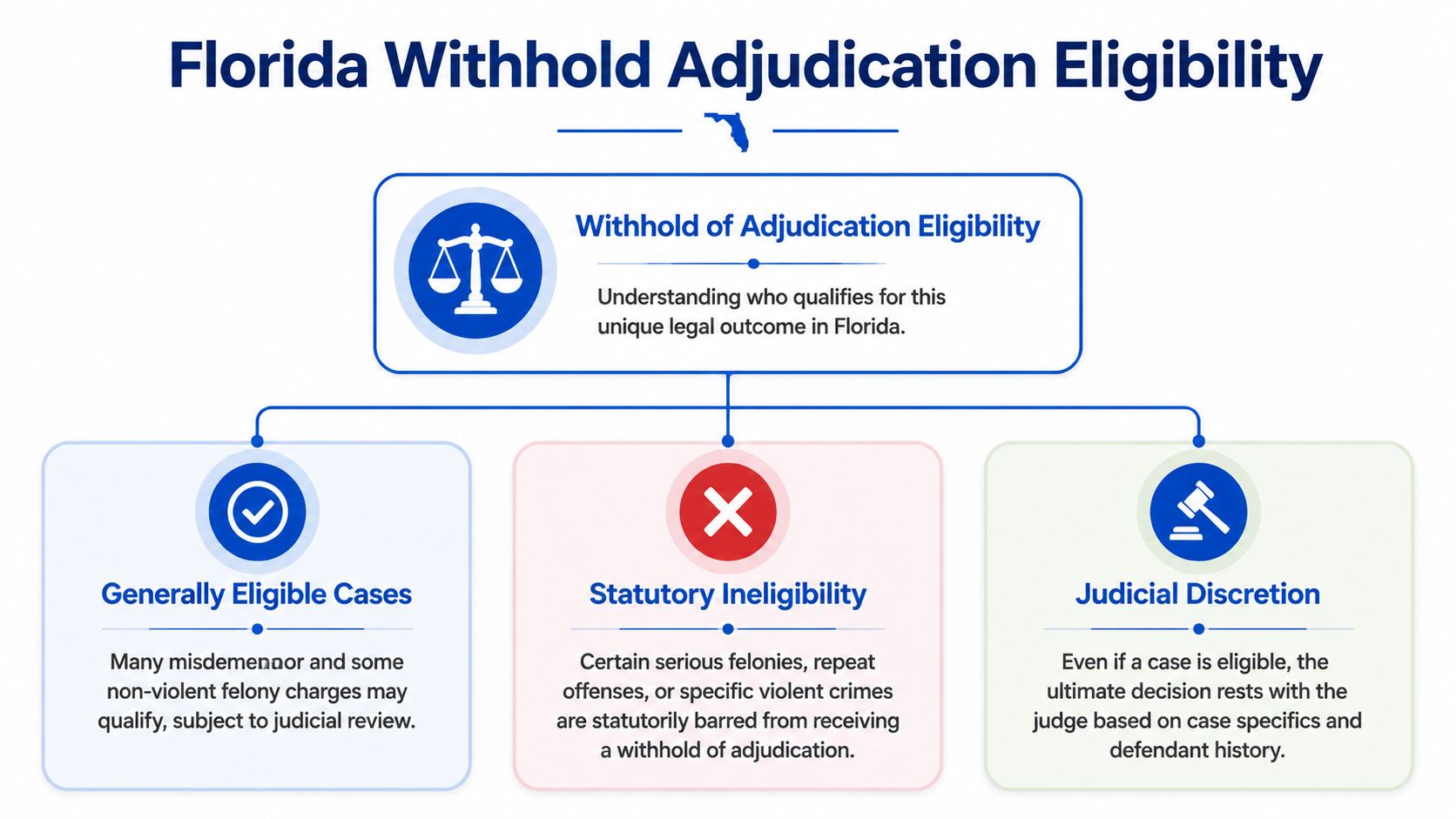
Florida Statute §948.01 gives judges power to withhold adjudication, but that power stops where the statute stops. Capital felonies, life felonies, and first-degree felonies are off the table. If you are charged in one of those categories, asking for a withhold as your main plan is wasted motion.
For third-degree felonies, your history matters fast. If you already have two or more prior felony withholds, Florida law blocks another one in many situations. That is why online form services fail people. They treat "eligible" like a checkbox. A defense lawyer treats it like a record-by-record legal analysis before you walk into a plea that can damage you permanently.
Who is flatly disqualified
Some cases are barred by law, period:
Capital felonies
Life felonies
First-degree felonies
Second-degree felonies sit in a tighter lane than many people realize. Under §775.08435, a withhold usually requires either a written prosecutor request or specific court findings under §921.0026. That means you do not drift into a withhold. You build a basis for it, or you do not get it.
Factors Influencing the Judge's Decision
In the cases where a withhold is legally available, the fight shifts to strategy. The court will look at your prior record, the charge itself, the facts the prosecutor plans to emphasize, and whether your lawyer gives the judge a reason to use discretion in your favor instead of against you.
That last part decides cases.
A person charged with a misdemeanor or qualifying traffic offense may be technically eligible and still walk out with an adjudication because nobody framed the case correctly. Judges see rushed pleas every day. Prosecutors hear empty promises every day. If your lawyer cannot present mitigation that fits your judge, your county, and your charge, eligibility means very little.
Sometimes the right move is not chasing a withhold first. Sometimes it is pursuing a different off-ramp, such as a pretrial diversion program in Florida traffic and criminal cases, if that path protects your record better.
Your driving history can also shape how the court and insurers view your case. QuoteFii's insights on driving records help show why prior entries matter long before anyone talks about "mercy."
Reality check: Legal eligibility only gives you a chance to fight. It does not hand you the result.
Here is the advice I give clients. Do not guess. Do not rely on a clerk, a forum thread, or an app that spits out generic answers. Get a lawyer who reads the charging document, checks every prior disposition, measures the statutory limits, and negotiates from the start for a withhold that effectively protects your record. That is how you pursue this outcome in Florida.
How Do Withholds Affect DUIs and Your Driver's License?
Start with the rule that gets people hurt. A withhold does not automatically protect your license.
For an ordinary traffic case, a withhold can keep points off your record and limit the fallout. DUI works differently. If you walk into court assuming the word "withhold" solves a DUI license problem, you are already behind.
Florida Statute §316.650(1) sits inside a system where the court case and your driving privilege can collide fast. You have to evaluate three separate fights at once: what happens in criminal court, what DHSMV does to your license, and how this case can be used against you later.
Why DUI is the trap people misunderstand
DUI is where bad legal advice causes real damage.
In Florida, a withheld adjudication does not give DUI defendants the protection they expect on the licensing side, and Florida law blocks withholds on second and later DUI offenses. That means a person can hear a court term that sounds favorable and still get hit with serious driver's license consequences. The court result and the DHSMV result are related, but they are not the same problem.
That is why strategy matters. You do not "get" a withhold in a DUI case by asking nicely or clicking through an automated service. You fight for every inch of ground, and sometimes the right fight is reducing the charge, attacking the stop, challenging the breath case, or protecting the license first. For broader context on how suspension issues develop after an arrest, review this Florida DUI license suspension guide.
How points, priors, and future exposure actually work
Now separate DUI from other traffic offenses.
A withhold on a speeding ticket can stop points from being assessed. That can save a commercial driver, a rideshare driver, or anyone one ticket away from an insurance spike. But do not confuse "no points" with "no consequences."
Florida Statute §322.34 treats a prior withhold for Driving While License Suspended (DWLS) as a conviction for future DWLS charges, which means a withhold can still come back to hurt you later, as explained in this Florida FAQ on withheld adjudication and traffic offenses.
Here is the practical breakdown:
Speeding and many moving violations: a withhold may prevent points.
DWLS cases: a prior withhold can count against you in a later DWLS prosecution.
DUI cases: license penalties can still apply even if someone tells you a withhold sounds like a win.
Insurance companies create a separate problem after court is over. They often price risk based on the full driving history, not just the label attached to the final disposition. If you want the underwriting side explained in plain English, QuoteFii's insights on driving records give useful context.
The right move is to treat the license issue like an emergency from day one. A real Florida traffic defense lawyer checks the citation, the prior record, the timing of the suspension, and the pressure points in the prosecutor's case before recommending any plea. That is how you fight for a result that protects more than the paperwork in court.
This short video also helps frame how quickly a license issue can become the bigger emergency:
Will a Withhold Show Up on a Background Check?
Yes. In many cases, it will.
A withhold can stop a formal conviction from appearing on your record, but it does not make the case disappear. Employers, licensing boards, landlords, and government screeners may still see that you were arrested, charged, or prosecuted, along with a final disposition that says adjudication withheld.

That distinction matters. A withhold puts you in a better position than a conviction, but background screening companies are not in the business of giving you the benefit of the doubt. They report what is there. If the case is visible, it can still cost you a job interview, a professional license, housing, or a clearance review.
What employers and screeners may actually find
Many background checks pick up the existence of the case unless the record is later sealed. This is the core issue. You can win the first fight in court and still lose the second fight in the hiring process.
This hits hardest in healthcare, finance, education, childcare, transportation, and any role with state licensing or federal screening. A recruiter may not care about the legal nuance between a conviction and a withhold. They may just see a criminal case and move on to the next applicant.
If your concern is a drinking-and-driving allegation, this guide on whether a DUI appears on a background check explains the screening problem in plain English.
A withhold helps. Sealing changes the picture.
A withhold is often the first objective. Sealing is often the next one.
If the charge is eligible and your record allows it, sealing can block public access to the case. That changes what many private employers and routine background search companies can see. It does not erase history for every government agency or every high-level screening process, but it is often the difference between a visible case and one that stops showing up in ordinary searches.
That is why I do not treat a withhold as the finish line. I treat it as part of a larger defense plan. The strategy should start at the beginning of the case, with one question in mind: are we building toward a result that protects your record later, or are we just closing the file fast?
The practical question to ask right now
Do not ask only, “Can I avoid a conviction?”
Ask, “Will this still show up six months from now when I apply for work?”
That is the question that matters in real life.
You should leave court knowing the answers to these two points:
Is this offense legally sealable?
Does your prior record block you from sealing it?
If your lawyer is not planning for both, the defense is incomplete. An app will not spot those long-term record consequences, and it will not fight for a case outcome that keeps the sealing door open.
That same point carries across legal problems generally. Haddad & Associates P.A. makes it well in the accident context. Serious consequences require an actual lawyer, not a shortcut.
Why You Need a Lawyer and Not an App to Get a Withhold
A withhold is negotiated. It is argued. It is positioned.
It is not downloaded from a dashboard.
At the Broward County Judicial Complex, no judge is waiting to be persuaded by a chatbot. No prosecutor cares that an automated platform sent you a reminder. If your case is close, the result turns on facts, mitigation, timing, and advocacy.
A withhold is negotiated not downloaded
This matters most in cases with statutory hurdles. For a second-degree felony, Florida Statute §775.08435 requires either a written request from the prosecutor or specific court findings. The verified guidance here also states that experienced firms report success rates over 70% in Broward and Palm Beach when using mitigation-based strategy in that setting, as summarized from the cited statute discussion.
That kind of result doesn't come from automation. It comes from a lawyer building a record that gives the prosecutor or judge a reason to say yes.
As a general reminder of why legal representation matters when the consequences spill beyond the citation itself, Haddad & Associates P.A. discusses why hiring a lawyer after a car accident matters. Different area of law, same core truth. Serious consequences require an actual advocate.
Why direct attorney access changes the outcome
If you use a middleman system, you often don't know who is reviewing your case, who is making strategic decisions, or whether anyone has evaluated the court, the prosecutor, and your driving or criminal history together.
A lawyer-led model is different. Services such as Ticket Shield's explanation of why a local lawyer beats app-based handling focus on direct attorney involvement because that's what this work requires. The legal issue is not just filing paperwork. The issue is deciding whether to push for dismissal, reduction, diversion, or a withhold, then presenting the one that protects you most.
If your future depends on avoiding points, avoiding a conviction, or preserving a professional path, you need a person who can make judgment calls in real time. An app cannot do that.
Is a Withhold of Adjudication Your Best Defense?
Sometimes yes. Sometimes no.
That's the answer clients need, even if it's not the answer they hoped for.
A withhold can be the right outcome when the evidence is strong, dismissal is unlikely, and your biggest goal is avoiding a formal conviction or keeping points off your license. It may be the wrong target when a better defense exists, when the charge carries hidden licensing consequences, or when accepting any plea would create future damage that outweighs the short-term relief.
At the Edgecomb Courthouse in Tampa and across Florida, smart defense means choosing the result that protects your life outside the courtroom, not just the result that ends the case fastest.
Immediate Steps to Take
Stop guessing about your eligibility: Prior withholds, charge level, and traffic history can change everything.
Do not plead just because the offer sounds lenient: “Withhold” can still carry major consequences in DUI and DWLS situations.
Get your citation and case documents together: The exact statute charged matters. In traffic cases, Chapter 316 offenses can have very different downstream effects.
Ask about sealing early: A withhold may solve only half the problem if the record remains public.
Focus on the end goal: If your priority is no points, license protection, or avoiding a conviction, your strategy should be built around that from day one.
The clearest way to understand it is:
Benefit (Pro) | Risk (Con) |
|---|---|
You may avoid a formal conviction under Florida law | It is not a dismissal |
It can help protect civil rights in ways a conviction may not | The case may still appear on background checks unless sealing is available |
In many traffic matters, it can help avoid points | It does not provide full protection in every driving-related case |
It can preserve future opportunities better than an adjudication of guilt | DUI and DWLS issues can carry separate consequences that people often misunderstand |
It may support later sealing eligibility in qualifying cases | You do not automatically get it. You have to be eligible, and someone has to fight for it |
If you're asking whether withhold adjudication florida is your best move, don't ask that question in the abstract. Ask it against your charge, your record, your job, your license, and your real exposure. That's how good decisions are made.
If your goal is No Points, protect your license, and avoid a conviction if the law allows it, get legal advice before you plead. Visit Ticket Shield, PLLC for a free consultation.