Pretrial Diversion Program Florida: Get Your Case Dismissed
Facing charges? Learn how a pretrial diversion program florida can get your case dismissed. Our 2026 guide details eligibility, risks, and attorney assistance.

Yes. A Florida pretrial diversion program can end in dismissal, but it is not automatic. It's a negotiated deferred-prosecution deal with strict rules, deadlines, costs, and risks if you fail. Act fast and get a real lawyer involved before you give up rights or miss your chance.
You've just been charged. Your stomach drops. You're checking your phone, reading half-answers online, and trying to figure out whether this can be fixed before you walk into the Orange County Courthouse in Orlando.
Someone may have told you, “Ask for diversion.” That advice is incomplete. A pretrial diversion program in Florida can be a real path to dismissal, but it can also become a trap if you enter the wrong program, sign the wrong agreement, or assume the prosecutor is doing you a favor. They aren't. They are offering terms.
That's why this decision shouldn't be made through an automated app, a call center, or a ticket mill that routes you through middlemen. This is a legal negotiation with lasting consequences. If your case can be dismissed outright, diversion may be the wrong move. If diversion is your best play, the terms need to be reviewed before you sign anything. If you're trying to understand dismissal outcomes, start with this explanation of what nolle pros means in court.
Table of Contents
Your One Chance at a Dismissal
If the prosecutor offers diversion, treat it like a closing window. It may be your best chance to avoid a conviction. It may also be your only realistic shot at getting the case dropped without trial.
But don't confuse opportunity with safety. Diversion isn't a gift. It's a controlled deal. You accept conditions, follow rules, spend time and money, and stay out of trouble long enough to earn a dismissal. If you misread the terms, miss a deadline, or violate the program, the case comes right back to life.
At the courthouse, people around you may act like this is routine. It isn't routine to you. Your license, job, security clearance, immigration situation, professional reputation, and future background checks may all be on the line.
Practical rule: Never accept diversion because it “sounds easier.” Accept it only after someone has reviewed whether the State can actually prove the charge and whether the terms are survivable for your life, schedule, and budget.
This is especially important in driving-related criminal cases. Florida traffic charges often sit inside a broader criminal framework tied to Chapter 316, including offenses under statutes such as section 316.193 for DUI. A bad decision early can follow you long after the court date is gone.
What Is a Pretrial Diversion Program in Florida
A pretrial diversion program in Florida is a deferred-prosecution arrangement. That means the State hits pause on the criminal case while you complete conditions. It is not an acquittal. It is not the court declaring you innocent.
Under Florida Statute 948.08, Florida's PTI framework is built around that basic idea. It generally applies to first offenders or people with very limited prior history, and the prosecution is held in abeyance while the program runs.
Why deferred prosecution matters
The simplest way to understand it is this. Your criminal case is placed on pause, not erased.
If you complete the program, the prosecutor can dismiss the case. If you fail, the pause ends and the prosecution resumes. The file doesn't vanish. It waits.
That distinction matters because many people walk into diversion thinking they already “beat the case.” They haven't. They've entered a structured opportunity to avoid a conviction.
Here's the practical difference:
Situation | What it means |
|---|---|
Case paused | You are still under conditions and scrutiny |
Case dismissed after completion | You avoided a conviction on that charge |
Case resumed after failure | The State picks the prosecution back up |
What you give up to get in
Florida law also makes clear that diversion comes with tradeoffs. Participants usually waive speedy-trial rights while they are in the program under section 948.08. That gives prosecutors time to hold the case open while watching whether you finish.
That waiver is not a technical footnote. It is a serious legal concession.
You may also need approvals from multiple people depending on the program. In some cases that can include the program administrator, the assigned prosecutor, the judge, and the victim. That means eligibility on paper doesn't guarantee admission in real life.
Diversion works best when the terms match your life. If you travel for work, work nights, support children, or depend on your license to earn income, the wrong conditions can set you up to fail.
So yes, diversion can be powerful. But it only helps if you understand that you're signing a legal contract while the government keeps your case on standby.
Are You Eligible for a Florida Diversion Program
Individuals often ask the wrong question. They ask, “Do I qualify?” The better question is, “Do I qualify in this county, with this prosecutor, on this charge, under this program?”
That's because Florida diversion is not one uniform statewide system. It's a patchwork.
Who usually qualifies
At the broadest level, diversion usually targets first-time or low-risk defendants. That often means nonviolent charges and limited prior record. But that broad description only gets you so far.
If your case involves alcohol, drugs, or mental health concerns, prosecutors may also look for supporting evaluations or treatment plans. In some cases, getting a professional assessment early can help your lawyer present you as a safer candidate for supervision. If that applies to you, this overview of substance abuse evaluations gives a useful baseline of what those assessments can cover.
Charges tied to driving can be more sensitive. For example, cases touching Florida traffic law under Chapter 316 may require extra care because prosecutors know a driving-related conviction can affect insurance, employment, and a person's ability to stay on the road.
If your charge is DUI-related, you should also read this breakdown of a Florida DUI diversion program because those cases are treated differently from many standard misdemeanor files.
Why county rules change everything
The local State Attorney's Office often dictates the specifics. Florida programs vary by county in timeline, structure, and cost. The U.S. Department of Justice's discussion of pretrial diversion notes that Miami-Dade allows charges to be dropped after successful completion, Broward's felony PTI is a one-year track for qualifying third-degree felonies with an application deadline of 45 days after arraignment, and Central Florida's Level 1 program defers prosecution for 90 days with a $100 fee plus a $25 donation to Central Florida Crimeline under this reference.
That is the point. The rules do not travel well from county to county.
Here's how that affects you:
Deadline pressure: A short filing window can kill a good case for diversion before negotiations even begin.
Charge-specific screening: One county may be open to a resolution another county rejects.
Local practice: Some programs are formal and published. Others depend heavily on prosecutor discretion and courthouse custom.
If your case is sitting in Orlando, what matters is what the local office and court will accept there. If it's in Broward, the practice at the Broward County Judicial Complex matters more than any generic article online.
What Is Daily Life Like in a Diversion Program
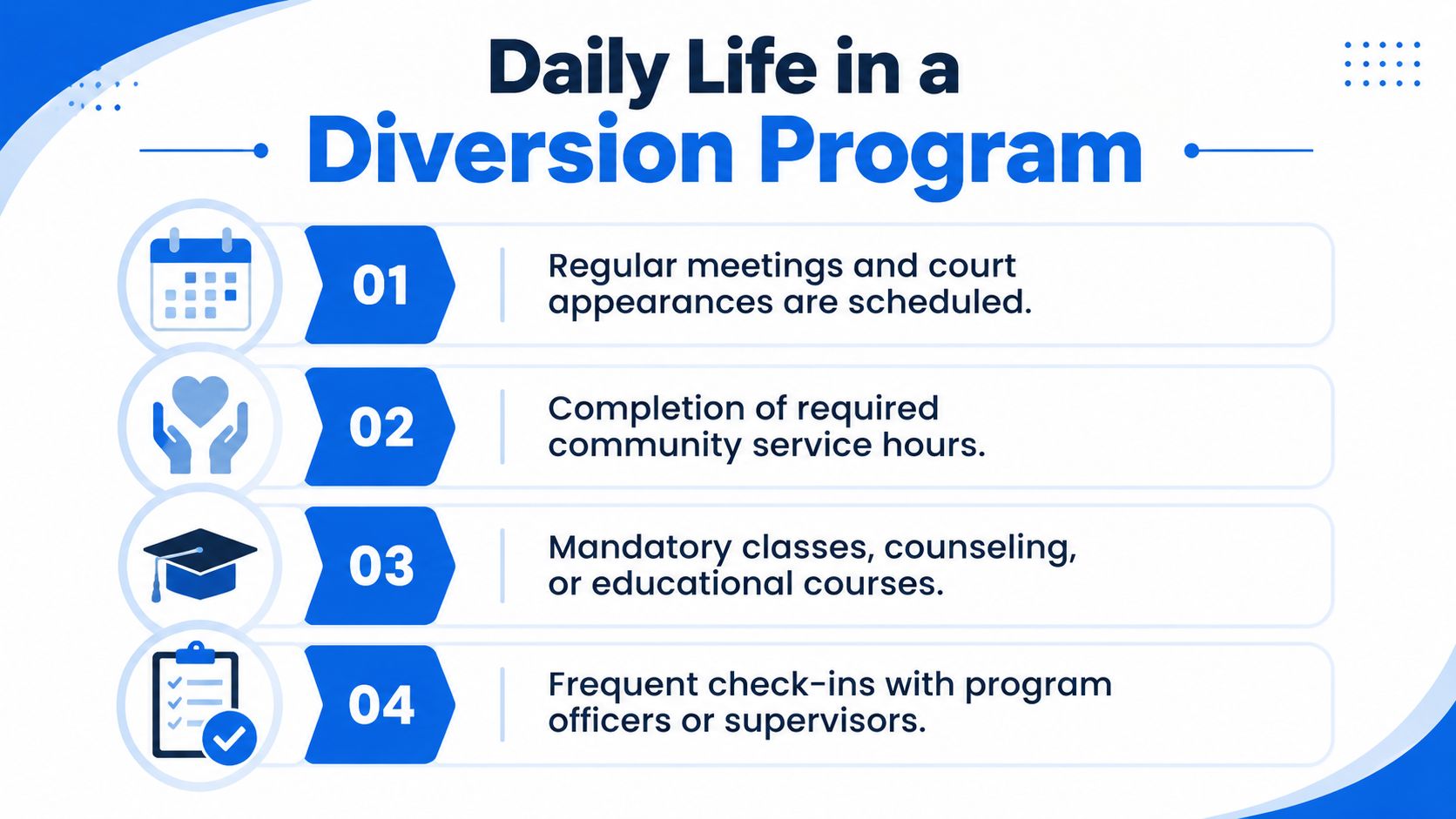
Some individuals think diversion means waiting passively until the charge disappears. That's wrong. Diversion feels more like low-level supervision with constant obligations hanging over your week.
Florida programs can require reporting, restitution, community service, classes, counseling, and monitoring such as random drug testing. Broward County describes felony PTI as a 12-month program that can extend to 18 months in some cases, and successful completion can lead to dismissal according to Broward's diversion program page.
Right at the start, understand the rhythm of the program.
What compliance actually feels like
Your calendar stops being fully yours. Meetings get scheduled. Classes have deadlines. Community service hours have to be documented. If treatment is part of the deal, missing sessions can trigger problems quickly.
A typical week may involve:
Check-ins: Regular contact with a supervision officer or program staff.
Tasks after work: Classes, counseling, or educational sessions outside your normal schedule.
Proof requirements: Receipts, certificates, logs, and written confirmation that you completed what you were told to do.
Zero-slack living: Any new arrest, missed appointment, or positive test can put dismissal at risk.
For people who need treatment support, judges and prosecutors often respond better when the work is real and sustainable. If recovery is part of your case, this article on effective holistic addiction methods can help you think beyond just checking a box.
Later in the process, many clients realize the hardest part wasn't getting accepted. It was staying organized long enough to finish.
Why people fail even when they mean well
Failure often comes from life, not bad intent. Work shifts change. Childcare falls through. Transportation becomes a problem. Money gets tight. One missed requirement becomes two, and suddenly the program administrator is reporting noncompliance.
Don't enter diversion assuming you'll “figure it out.” Build a compliance plan before day one. Calendar everything. Save every document. Ask questions early.
That is why I tell clients to be brutally honest before enrolling. If the conditions don't fit your life, that issue needs to be addressed before the agreement is signed, not after you're already in violation.
What Is the Step-by-Step Process to Get into Diversion
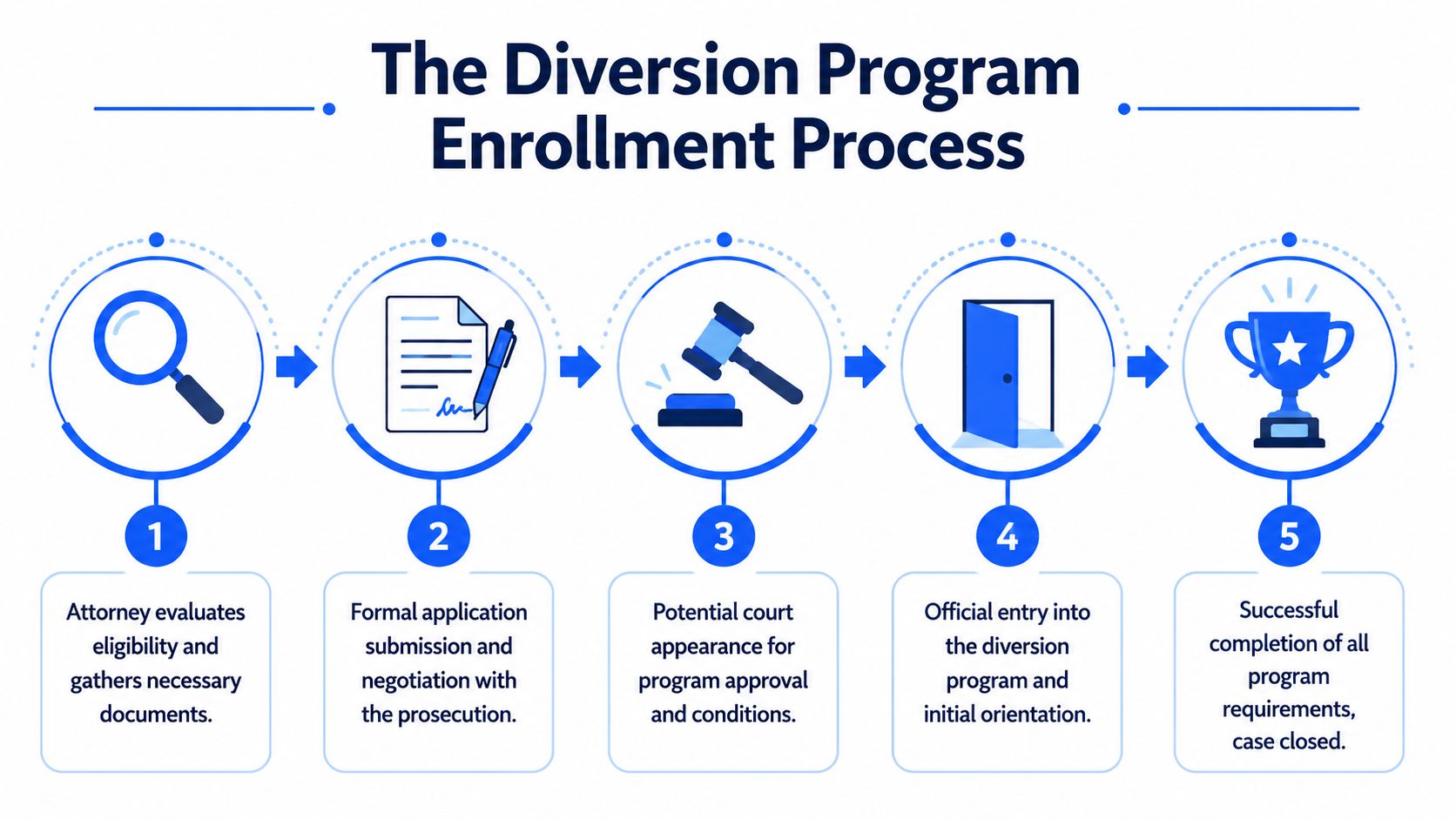
Diversion has paperwork, approvals, and decision points. It is not a handshake in the hallway. It is a formal legal process that should be managed carefully.
At a glance, the path usually looks like this.
The legal gates you must clear
Most cases move through a sequence like this:
Case review by defense counsel
Before anyone says yes, your lawyer should review the charge, the evidence, your history, and the local program rules.Application and negotiation
Entry often requires formal paperwork and contact with the prosecutor or program office. During this stage, facts about treatment, work stability, military service, or counseling can matter.Approval stage
Some cases need approval from more than one decision-maker. A clean record alone doesn't guarantee admission.Signing the agreement
This is the point where legal rights are waived and conditions become binding.Intake and orientation
Once you're accepted, the compliance clock starts. That means deadlines, reporting instructions, and proof requirements.
What your lawyer should review before you sign
Not every diversion offer is smart. Some are loaded with conditions that make failure likely. Others may be worse than litigating the case. That is why your lawyer needs to read the agreement line by line.
Ask these questions before signing:
What happens on a technical violation? Some programs move quickly toward termination.
What are the exact conditions? Vague promises are dangerous.
What are the dismissal terms? You need to know what successful completion triggers.
Does the program fit the case? A weak State case should not be surrendered without analysis.
If therapy is part of the resolution, selecting the right modality can matter. For clients dealing with trauma, substance use, or anxiety issues tied to the charge, this comparison on choosing trauma and addiction therapy is a useful starting point.
A more detailed Florida-specific walkthrough of this enrollment path is available in this guide to the pretrial intervention program in Florida.
Evaluating the Benefits and Risks of Diversion
Diversion can be a smart move. It can also be a bad bargain. You need to weigh it like a ledger, not a slogan.

When diversion is worth it
The obvious upside is dismissal. In Florida county programs, successful completion can result in charges being dropped. That matters because avoiding a conviction can protect your work, your housing applications, your professional licensing, and your future court exposure.
There is also emotional value. Some people need an exit ramp. If the evidence is strong and the offer is fair, diversion can reduce uncertainty and give you a defined path out of the system.
A few benefits stand out:
Benefit | Why it matters |
|---|---|
Dismissal potential | You may avoid a conviction on the charged offense |
Structured resolution | You know what must be done and by when |
Reduced litigation stress | You aren't preparing for trial while the case stays active |
If your case later ends without adjudication, you may also need to understand the record consequences. This explanation of what adjudication withheld means helps clarify how Florida case outcomes can differ.
When diversion can hurt you
Here is the harder truth. Diversion often functions like a pay-to-participate system. The Florida Safety Council's DUI diversion information reflects that participants may have to pay for classes and evaluations themselves, and public descriptions of Florida diversion conditions commonly include fees, classes, community service, and monitoring obligations through this Florida DUI diversion reference.
For hourly workers, rideshare drivers, delivery drivers, and people already under financial pressure, those obligations can hit hard. The legal risk may go down while the daily life burden goes way up.
The main risks are plain:
Cost burden: Program fees are only the start. Classes, evaluations, monitoring, and lost work time can pile up.
Strict compliance: One violation can destroy the deal.
Resumed prosecution: If you fail, you are back in the criminal case with the original charge still waiting.
There is also a fairness problem that clients need to understand. Diversion access is not always evenhanded. A 2024 analysis reported in Route Fifty found that in Florida only 16% of Black felony defendants were eligible for diversion, compared with 23% of white defendants and 28% of Hispanic defendants in that reporting as summarized here.
That should tell you something important. Eligibility is not just about whether you “deserve” it. It can be shaped by policy choices, local practice, and discretionary decisions. If your case belongs in diversion, your lawyer needs to press that position forcefully.
A good diversion offer solves a problem. A bad one creates a longer, more expensive path to the same courthouse.
Why You Need a Lawyer for a Diversion Program
A lawyer's job is not to fill out a form and disappear. A lawyer decides whether diversion is the right move, pushes for better terms if it is, and steps in fast if something starts going wrong.

A lawyer decides whether diversion is even the right move
Many people fall into a common trap. They assume dismissal through diversion is always better than fighting. That isn't true.
If the stop was bad, the witness is weak, the paperwork is flawed, or the State can't prove an element, diversion may be unnecessary. In a driving-related criminal case, that analysis can include the underlying traffic statute in Chapter 316, the officer's basis for the stop, and the admissibility of the evidence. A real defense starts there.
If you want a clearer sense of the attorney's role beyond paperwork, read this overview of what a criminal defense lawyer does.
Direct attorney access matters when something goes wrong
Problems rarely happen on schedule. A client misses a class. A drug screen is disputed. A work conflict causes a missed check-in. A new allegation appears. That is when middlemen fail you.
A lawyer-led firm matters because you need fast decisions and direct communication. Ticket Shield, PLLC handles Florida defense matters with direct attorney communication by phone or text, which is materially different from automated apps or ticket mills that filter clients through non-lawyer systems.
That difference matters most when the prosecutor is about to revoke your opportunity.
Here's what counsel should be doing for you:
Screening the offer: Is this a fair path or a bad deal?
Negotiating conditions: Can reporting, treatment, or class terms be made more realistic?
Protecting compliance: If you hit a snag, your lawyer should intervene before a violation becomes a termination.
Planning for the endgame: If you complete the program, the dismissal and record-cleanup strategy should be handled promptly.
You don't need software when your future is on the line. You need judgment.
Frequently Asked Questions About Florida Diversion
What happens if you get a new charge while in diversion
Expect immediate trouble. A new arrest or criminal allegation can trigger termination from the program. Then you may face prosecution on both the new case and the original case that had been paused.
If you are in diversion, live carefully. Don't assume the court will give you a second chance.
Will diversion still show up on a background check
The case can be dismissed after successful completion, but that does not automatically erase the arrest record. Dismissal and record clearing are different things.
That is why clients often need a second step after the case ends. If your goal is a clean record, ask about sealing or expungement as part of the same strategy, not as an afterthought.
Can you get diversion for a DUI charge
Sometimes, but not everywhere, and not under every fact pattern. DUI cases are harder because prosecutors scrutinize them more closely, especially when public safety concerns are involved.
That is one reason Florida drivers charged under section 316.193 need immediate legal analysis. A DUI diversion discussion is never just about the criminal file. It can affect your license, work, insurance, and any job that depends on driving.
Is diversion fair and equally available to everyone
No. It isn't always applied evenly.
The Route Fifty reporting discussed earlier cited a 2024 analysis showing that in Florida only 16% of Black felony defendants were eligible for diversion, compared with 23% of white defendants and 28% of Hispanic defendants. That disparity is exactly why passive lawyering is dangerous. If eligibility is discretionary, advocacy matters.
Can you apply on your own
You can try. I don't recommend it.
You may not know the local deadlines, what the prosecutor wants to see, whether your facts should be framed differently, or whether the offer is worse than litigating the case. Self-advocacy is risky when your rights are already under pressure.
Is diversion always better than pleading guilty
No. Sometimes it is. Sometimes it isn't.
If the cost, time, supervision demands, and waiver of rights are too severe, a different resolution may make more sense. If the State's evidence is weak, fighting may make more sense. The right answer depends on your facts, your county, your record, and your risk tolerance.
What should you do right now if diversion might be on the table
Move fast and stay quiet.
Immediate steps to take:
Do not discuss the case publicly: Don't post, text, or explain your version online.
Gather your documents: Bring the notice to appear, bond papers, charging paperwork, and any court date information together.
List your obligations: Work schedule, travel, childcare, treatment history, and financial limits all matter in negotiations.
Avoid new trouble: Even minor misconduct can eliminate your advantage.
Talk to counsel early: Timing matters with diversion. Delay can cost you options.
If you've been charged in Florida and you're trying to protect your record, your license, and your future, get legal advice before you agree to any diversion terms. Visit Ticket Shield, PLLC for a free consultation and ask about the No Points goal.