
What Does a Criminal Defense Lawyer Do: Your 2026 Guide
What does a criminal defense lawyer do? Charged in Florida? Learn how we protect your record, license, and future in 2026. Fight for your best outcome.
The stop is over. The charge isn't. You're staring at paperwork, court dates, license risk, and a system that already started building a case against you. If the allegation involves driving, Florida Statutes Chapter 316 can control everything from the underlying offense to the consequences that follow, including section 316.193 in DUI cases.
A criminal defense lawyer is your shield. They investigate your case, challenge the prosecution's evidence, negotiate to reduce or dismiss charges, and defend your rights in court to protect your license, record, and freedom. Your defense starts immediately.
If you've been arrested, cited for a criminal traffic offense, or told to appear in court, don't guess your way through it. Read this, then act. If you want a clearer picture of what happens when you first speak with counsel, start with a criminal defense attorney consultation guide.
Table of Contents
How Does a Lawyer Protect Your License from DUI or Traffic Crimes
When Should You Hire a Lawyer and What Can You Expect to Pay
Introduction
You don't feel protected after an arrest or criminal citation. You feel exposed. That's normal. The court, the prosecutor, the officer, the paperwork, the deadlines. None of it was built for your comfort.
A criminal defense lawyer changes that. Not by making promises. By taking control of what can still be controlled.
That means stopping bad statements, preserving favorable evidence, finding defects in the stop or investigation, challenging weak proof, and protecting your practical life. Your car. Your job. Your record. Your license. In Florida traffic-related criminal cases, those things can unravel fast if you wait.
What Is a Criminal Defense Lawyer's Primary Mission
A criminal defense lawyer's primary mission is simple. Stand between you and the power of the state. If your case lands in a major courthouse like Miami's Richard E. Gerstein Justice Building, that mission doesn't become theoretical. It becomes urgent.
Under the Sixth Amendment, defendants are entitled to assistance of counsel, and professional performance standards say defense counsel's paramount obligation is to provide zealous, quality representation at all stages of the criminal process while staying current on criminal law and procedure, as described in this discussion of the role of a criminal defense attorney.
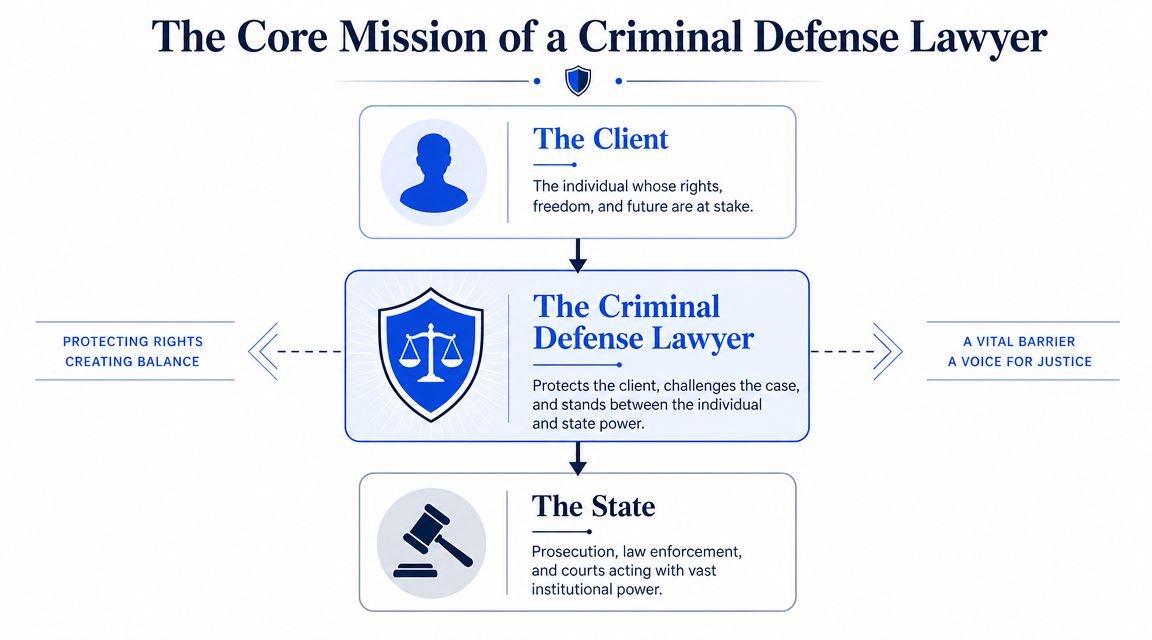
Why your lawyer stands between you and the state
The officer wrote the report. The prosecutor reads that report from the government's side. The judge manages the case. None of those people are your advocate.
Your lawyer is.
That matters because criminal cases are full of pressure points. Police questioning. consent issues. search issues. witness mistakes. missing video. sloppy paperwork. overcharging. A good defense lawyer doesn't just react to those problems. They look for them on purpose.
Practical rule: If the state has one version of events and you have no lawyer, the state's version usually gets a head start.
Some criminal accusations also grow out of private disputes, false assumptions, or digital communications taken out of context. If your issue overlaps with online impersonation or deception in a relationship, this catfishing guide for suspicious partners is a useful companion read on how certain conduct can cross into criminal territory.
What that mission looks like in real life
The mission isn't limited to trial. In fact, trial may never be the most important part of your case.
A criminal defense lawyer protects you by doing work that starts immediately:
Blocking self-inflicted damage after arrest, citation, or contact from investigators.
Testing the legality of the stop or search if police found evidence through questionable conduct.
Checking whether the state can prove the charge under the correct statute.
Pushing back on weak assumptions dressed up as certainty.
Making sure your side is built with evidence, not panic.
For drivers in Florida, that mission often intersects with Chapter 316. A reckless driving allegation, DUI charge, suspended license accusation, or serious moving violation can carry criminal consequences and collateral damage at the same time. Your lawyer's job is to fight both.
How Does Your Lawyer Fight For You Before Trial
The defense is often assumed to start in court. Wrong. It starts in the office, on the phone, in discovery, in witness interviews, and in the first hard look at the state's evidence.
A criminal defense lawyer's core technical function is case engineering. They interview the client and witnesses, perform legal research to build a defense theory, gather and test evidence, draft and argue motions, and negotiate plea bargains. Suppression motions can exclude unlawfully obtained evidence and materially change the prosecution's bargaining power, as explained by Cornell Law School's overview of criminal attorneys.
What case engineering actually means
Crucial work is performed. Your lawyer takes raw material and turns it into strategy.
That raw material includes police reports, body camera footage, dashcam video, witness statements, dispatch records, chemical test records, crash reports, scene photos, phone data, and your own timeline. Some of it helps the state. Some of it helps you. Some of it contradicts itself.
Your lawyer's job is to sort that out fast.
Here's what that often looks like in practice:
Interviewing you early: not just to hear your story, but to identify timelines, witnesses, medical issues, work needs, and facts that may disappear if nobody preserves them.
Examining the stop: in a Florida driving case, the legal basis for the stop can be the opening fault line.
Reviewing reports against video: officers sometimes omit details, compress timelines, or describe behavior more confidently than the footage supports.
Testing the proof element by element: the state doesn't win because it charged you. It wins only if it can prove the charge.
If you're trying to understand one of the most important pretrial tools, read this guide on what a motion to suppress evidence does.
Why motions matter before any jury is picked
Motions can change a case before the courtroom drama ever starts. If police obtained evidence unlawfully, your lawyer may ask the court to keep that evidence out. If the charging document is defective or the facts don't support the offense, your lawyer may attack the case from the front.
That pressure matters. Prosecutors negotiate differently when key evidence is vulnerable.
A strong defense doesn't wait for the state's next move. It creates consequences for weak police work and weak charging decisions.
This video gives a helpful overview of how defense lawyers approach that pretrial fight.
Immediate steps to take
If you're in crisis right now, do these things today:
Stop talking about the case: don't explain it to friends, coworkers, or online followers.
Save everything: screenshots, texts, towing documents, bond papers, crash photos, citations, and voicemail messages.
Write your timeline now: memory fades quickly after a stop or arrest.
List witnesses immediately: names first, contact details second, what they saw third.
Don't miss deadlines: court dates and administrative deadlines don't wait for you to calm down.
What Happens with Plea Bargains and Trials
People ask what does a criminal defense lawyer do, and they usually picture trial. That's incomplete. A lot of valuable defense work happens in negotiation, and negotiation isn't surrender.
The American Bar Association describes criminal defense counsel as responsible for investigating facts and negotiating pleas, and the U.S. Department of Justice notes that plea bargaining resolves the vast majority of criminal cases in the U.S., which is why pretrial negotiation often matters as much as trial strategy in this overview of what a defense lawyer does.
When a plea bargain is the smart move
A plea bargain is a tool. Sometimes it's the right one.
If your lawyer found weaknesses in the state's proof, mitigation in your background, or practical reasons the prosecutor should reduce the charge, negotiation can protect you from harsher consequences. In a driving-related criminal case, that can mean fighting for an outcome that better protects your record, your employment, or your ability to stay on the road.
A smart plea decision depends on questions like these:
Issue | Why it matters |
|---|---|
Strength of the evidence | Weak proof gives the defense leverage |
Your goals | License protection may matter more than principle alone |
Risk of trial | Some cases carry severe downside if a jury convicts |
Available alternatives | A reduced charge can sometimes limit long-term fallout |
If you're weighing plea options in Florida, this explanation of what a plea of no contest means is worth reading before you decide anything.
When trial is worth the risk
Sometimes the state's offer is bad. Sometimes the allegation is wrong. Sometimes the evidence is too shaky to accept a conviction just to end the stress.
That's when a lawyer prepares for trial with intent.
Trial means challenging witnesses in open court, forcing the state to prove every element, exposing contradictions, and showing the judge or jury that the accusation doesn't hold up. It's not about theatrics. It's about burden of proof.
The right question isn't “Do I want a trial?” The right question is “Does this offer protect my future better than making the state prove its case?”
How Does a Lawyer Protect Your License from DUI or Traffic Crimes
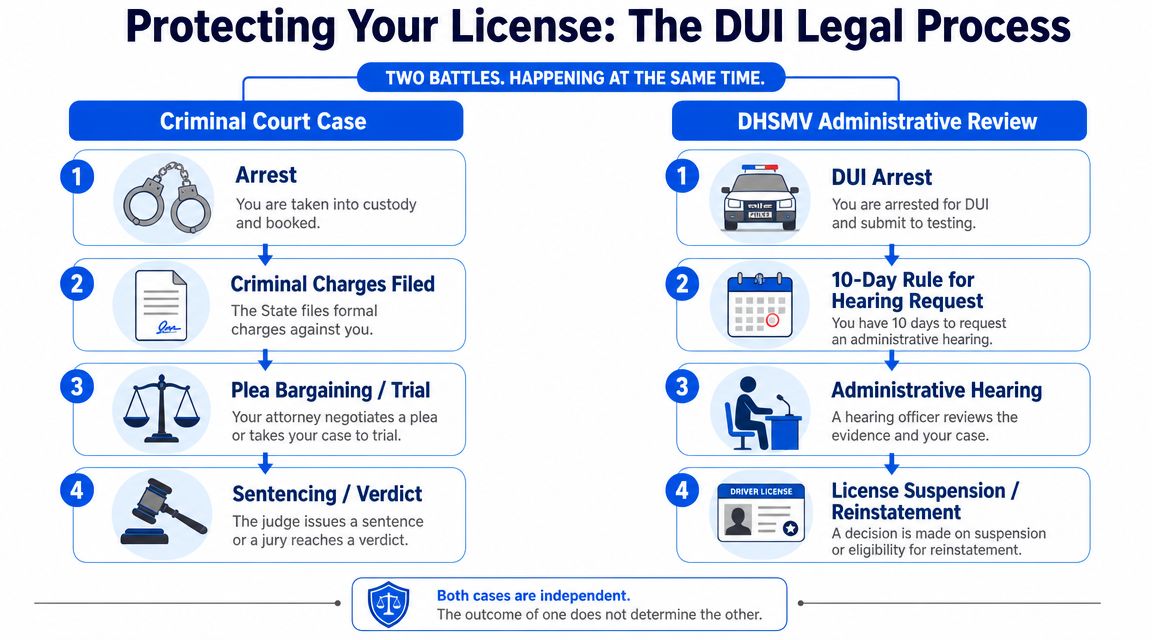
For Florida drivers, the stakes quickly become personal. A DUI case under Florida Statute 316.193 isn't just about criminal court. It can threaten your ability to drive to work, pick up your kids, keep a delivery account active, or hold onto your professional routine. In Orlando, cases like this can move through the Orange County Courthouse while a separate license problem is already unfolding outside the courtroom.
In major legal markets, criminal defense is a high-volume public function that includes investigation, motion practice, and plea negotiation. The U.S. Bureau of Justice Statistics reported that total representations by panel attorneys and federal defender organizations rose 26% in a four-year period in the late 1990s, with criminal representations growing 25%, according to the BJS report on defense counsel in criminal cases.
Why DUI defense is really two fights at once
A DUI arrest can trigger a criminal case and a license problem at the same time. That's why drivers get blindsided. They think only about court, while the damage to their driving privilege is already moving on a separate track.
A lawyer handles both pressure points together:
The criminal side involves the charge, the evidence, negotiations, motions, and court appearances.
The license side involves protecting your driving privilege and attacking the basis for suspension where possible.
The practical side involves keeping you mobile enough to work and function while the case is pending.
If you need a Florida-specific overview, start with these Florida DUI law basics.
How a lawyer attacks the driving-related consequences
The defense isn't limited to whether you were ultimately guilty or not guilty. A careful lawyer also asks harder questions. Was the stop lawful. Were field exercises handled properly. Did the officer overstate impairment. Are the reports consistent. Is there video support. Did the state preserve what matters.
That work is especially important in traffic-related criminal cases under Chapter 316, including DUI, reckless driving, racing, leaving the scene, and other offenses that can put your license and record at risk.
For drivers comparing how other states treat record consequences, this piece offers insights for Georgia DUI drivers. Florida is different, but looking at how other states handle long-term consequences helps drivers understand why early, state-specific defense matters.
Here's the blunt advice. If your charge involves driving, hire counsel who understands both the courtroom file and the license consequences. If your lawyer only talks about the court date, that's not enough.
When Should You Hire a Lawyer and What Can You Expect to Pay
You should hire a lawyer immediately. Not after arraignment. Not after you “see what happens.” Immediately.
Time helps the state if you do nothing. Time helps you only if someone is using it to protect you.
Why waiting hurts you
Evidence disappears. Video gets overwritten. Witnesses stop answering. Your own memory gets softer around the edges. Meanwhile, the state keeps moving.
The earlier a lawyer gets involved, the more options you keep alive. That can include preserving evidence, controlling communication, identifying defenses, and avoiding statements that make a bad situation worse.
Waiting is a decision. It usually benefits the prosecution, not you.
What you're actually paying for
You're not paying for a person to stand next to you for a few minutes in court. You're paying for judgment, preparation, strategy, legal research, communication, document review, motion practice, negotiation, and courtroom advocacy if the case demands it.
That's why price-shopping a criminal defense matter as if you're buying a basic app subscription is a mistake. The fee is about protection from larger losses. A conviction or bad plea can trigger fines, record damage, insurance problems, job issues, professional headaches, and license trouble that cost more than the legal fee ever would.
If you want a broader look at how legal fees are discussed in a different DUI-related context, this article on understanding DUI accident lawyer costs is useful as a general consumer read. But for your Florida criminal or traffic matter, the right question isn't “What's the lowest fee?” It's “Who's going to protect me?”
One factual example of a lawyer-led Florida option is Ticket Shield, PLLC, which states that it handles Florida traffic, DUI, and serious traffic-related criminal matters statewide and gives clients direct attorney access by phone or text.
Why Is Direct Attorney Access Non-Negotiable
If you're facing a criminal charge, you need your lawyer. Not a call center. Not a chatbot. Not a “case manager” who relays messages and never stands up in court for you.
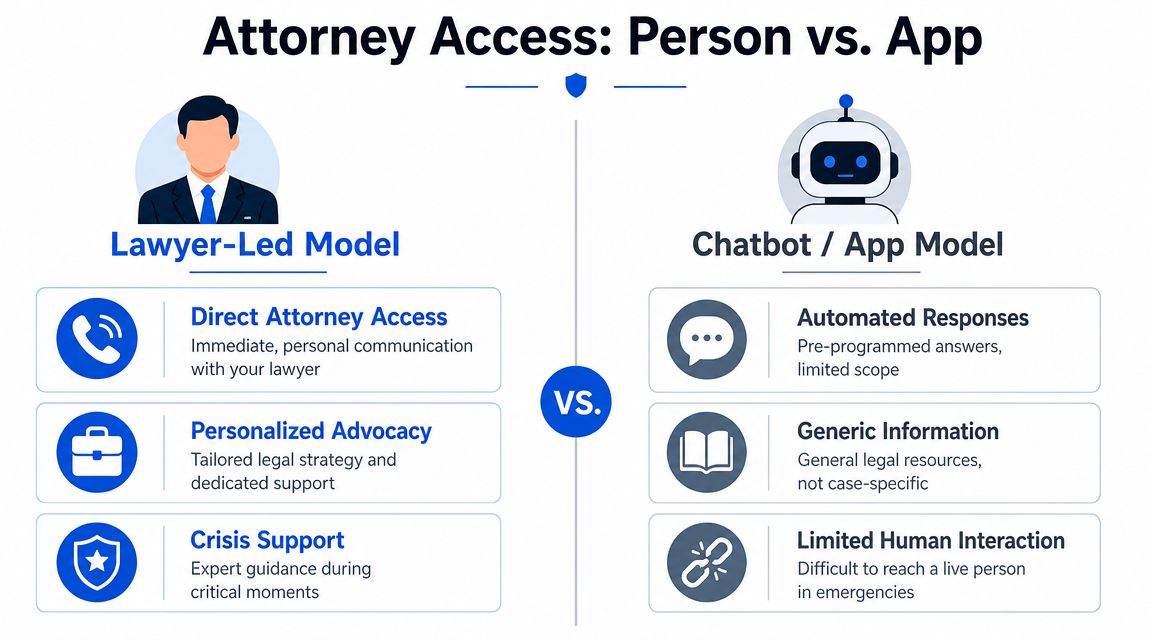
The professional model for a criminal defense lawyer includes interviewing clients, researching precedent, analyzing evidence, drafting motions, and negotiating pleas. In the U.S., there were more than 252,000 criminal defense lawyers by 2025, indicating a large and specialized legal workforce dedicated to this hands-on process, as noted in Indeed's career overview of what criminal lawyers do.
Why middlemen weaken a defense
Your case is fact-sensitive. One detail can change the strategy. One missed answer can create panic. One misunderstood goal can produce the wrong outcome.
That's the danger of automated legal services and ticket mills. They standardize communication because that's easier for them. It's worse for you.
A real defense requires direct conversation about things like:
What happened during the stop
What you said and what police claim you said
Whether preserving your license is the priority
How a plea could affect work, immigration, or background checks
Whether the state's evidence matches the charge
If you're comparing models, this breakdown of why a local lawyer can be better than apps lays out the practical difference.
What direct access changes
Direct attorney access changes speed, clarity, and trust. You can ask the question when it matters. Your lawyer can adjust strategy when facts shift. You don't waste time filtering your crisis through people who aren't licensed to defend you.
That matters in places like the Broward County Judicial Complex, the Edgecomb Courthouse in Tampa, and courthouses across Florida where traffic crimes and DUI cases move fast. If you can text or call your actual attorney, your defense becomes more precise because your communication is more precise.
You don't need a faceless system when the state already is one.
If you want to protect your record, license, and insurance from a Florida criminal traffic charge or DUI, get a lawyer involved now. Visit Ticket Shield, PLLC for a free consultation and ask about the No Points goal.
