
Florida DUI Laws: Protect Your Future
Charged with DUI in Florida? Understand Florida DUI laws, penalties & defense strategies. An experienced attorney protects your license & record.
A Florida DUI arrest creates two urgent fights at once: your criminal case and your license suspension. Under Florida Statute 316.193, waiting is a mistake. Move fast, protect your license, and get a real defense strategy in place immediately.
You were likely released a few hours ago. Your car may still be impounded. Your phone is full of messages. You're searching florida dui laws because you need a straight answer, not a lecture.
Here it is. A DUI arrest in Florida is not a routine traffic problem. It is a criminal accusation with immediate fallout. Your license can be hit right away. Your job can be affected. Your insurance situation can get worse. And if you handle it casually, you can lose ground before your first court date even arrives.
Florida treats DUI cases seriously because the state sees them constantly. In 2021, Florida recorded 5,111 alcohol-confirmed crashes, and one Florida DUI statistics summary reported more than 55,000 DUI citations in a single year, with over 33,000 DUI convictions reported from those citations, according to Florida DUI statistics reporting. That tells you two things. Enforcement is active, and prosecutors handle these cases every day.
You need to think about your case as a two-front fight.
First, there's the administrative case against your license. That starts immediately after arrest. It moves fast. If you miss the deadline to challenge it, you can lose your chance to fight that suspension.
Second, there's the criminal case. That's where the state tries to prove you were driving, or in actual physical control, while impaired or over the legal limit under Florida Statute 316.193.
Those are separate problems. They require one strategy from day one.
Urgent reality: If you wait to “see what happens in court,” you may already lose the first battle before the criminal case begins.
If you want a step-by-step overview of the immediate aftermath, review what happens after a DUI arrest. Then keep reading, because the legal details matter.
Table of Contents
How Does Florida Legally Define a DUI
You can leave jail thinking the case is about one bad night. It isn't. From day one, you are dealing with two fights at once. The criminal case in court, and the license suspension that starts almost immediately. Both fights turn on how Florida defines DUI, because that definition gives the state more than one way to come after you.
Florida's definition is broader than many drivers expect. Prosecutors usually have two paths. They can claim you were impaired, or they can rely on an unlawful alcohol level. Your defense strategy has to identify which path they are using right away, because the pressure points are different.

What must the state prove
Florida uses a dual-proof structure. The state can try to convict you by arguing that your normal faculties were impaired, even without a breath result over the legal limit. Or it can rely on a BAC of 0.08 or higher. Those are very different cases, and they should be defended differently.
That is why drivers get trapped by bad assumptions. “I blew under the limit” is not a complete defense. “I was polite” is not a complete defense. If the officer claims your speech, balance, coordination, judgment, or reactions were affected, the prosecution may still push an impairment case.
If your arrest involved alcohol plus stimulants or prescription medication, the case gets more dangerous. Mixed-substance allegations often create symptoms that officers label as impairment, even when the medical picture is far less clear. If that applies to you, understanding the health risks of Adderall and alcohol helps explain why these cases become both medically messy and legally aggressive.
For a focused explanation of the legal threshold, review Florida's legal blood alcohol level rules.
A short visual can help if you're trying to make sense of the law while everything still feels chaotic.
Why actual physical control matters
Florida does not need to catch you driving down the road. A DUI arrest can also be based on actual physical control of the vehicle. That issue shows up in parked-car cases, roadside sleep cases, and situations where the officer believes you had the present ability to operate the car.
Being parked does not end the case. Key questions are where you were, where the keys were, whether the engine was running, and whether the officer can prove you had control of the vehicle.
In this context, early strategy matters. The same facts that shape the criminal charge can also affect the license fight. If the state has a weak driving narrative, a weak timeline, or weak proof of control, your lawyer should attack those points immediately instead of letting the officer's version harden into the official story.
What Are the Criminal Penalties for a Florida DUI
You are already in two fights. One starts at the DMV and threatens your ability to drive in the next few days. The other runs through criminal court and can leave you with a conviction, probation, fines, jail exposure, and a record that keeps showing up long after this arrest stops feeling new.
On the criminal side, Florida can punish even a first DUI harder than drivers expect. A first conviction can mean a $500 to $1,000 fine and up to 6 months in jail under Florida Statute 316.193. A second conviction brings a $1,000 to $2,000 fine and greater jail exposure. If this is not your first case, do not make assumptions. Dates, prior dispositions, and the exact allegation matter immediately.
A lot of people fixate on whether they are going to jail. That is too small a frame. The criminal case can also bring probation, required classes, treatment demands, vehicle restrictions, higher insurance costs, and a record that creates problems with work, housing, and professional licensing.
Your mistake would be treating the criminal case as something you deal with later, after the license problem settles down. That approach loses ground in both places. The facts the officer wrote on day one will shape plea talks, motions, sentencing risk, and the separate license suspension fight. Early defense work gives your lawyer a chance to attack the stop, the arrest, the testing, and the officer's timeline before the state's version hardens.
For a tighter summary of the exposure tied to this charge, read Florida DUI penalties explained.
Florida DUI criminal penalties by offense standard
Penalty | First Conviction | Second Conviction | Third Conviction (within 10 years) |
|---|---|---|---|
Fine range | $500 to $1,000 | $1,000 to $2,000 | Penalties increase sharply under Florida law |
Jail exposure | Up to 6 months | Higher than a first offense | A third DUI within 10 years brings much more serious exposure |
Case severity | Criminal conviction with lasting record consequences | Harsher treatment and fewer easy options | Repeat-offense prosecution carries major long-term risk |
The table only gives you the broad outline. Real exposure depends on whether the state is alleging prior convictions, when those priors happened, and whether any added facts make the case worse. If there is any repeat-offense issue in your case, get a lawyer reviewing the paperwork now, not after arraignment.
How Do Aggravating Factors Increase DUI Penalties
You get arrested expecting one standard DUI case. Then the paperwork says your breath result was high, your child was in the back seat, or the officer claims your prescription medication affected your driving. The case got harder before you even left jail.

Which facts make a DUI case more dangerous
Certain facts give prosecutors more room to push for harsher penalties and make judges less receptive to leniency. A claimed BAC of 0.15 or higher can raise the penalty range. So can having a passenger under 18 in the vehicle. Those allegations also make your license fight more sensitive, because the officer's version of events starts affecting both tracks of the case immediately.
That is the point many drivers miss. You are not only defending a criminal charge. You are protecting your ability to drive while the state builds the criminal case against you. If your arrest involves facts that make the DUI look worse on paper, your strategy has to address the court case and the administrative suspension from day one. For a closer look at that separate deadline problem, review this guide to Florida DUI license suspension rules and deadlines.
Drug impairment allegations create a different problem. The state does not need alcohol to file a DUI. If the officer claims a controlled substance, marijuana, or even lawful prescription medication impaired your normal faculties, you can still face the same type of criminal charge. These cases often turn on officer observations, body camera footage, field exercises, statements you made, and whether there is any reliable proof tying the substance to actual impairment.
Who faces extra risk under florida dui laws
Some arrests carry professional and practical fallout long before the criminal case is resolved.
Commercial drivers: A DUI allegation can put your CDL and your income in danger fast.
Under-21 drivers: Younger drivers often face immediate school, insurance, and family consequences even before court.
Drivers using prescription medication: Having a valid prescription does not block a DUI prosecution if the officer claims impairment.
Gig and delivery drivers: App-based work can disappear based on the arrest alone.
Parents driving with children: A minor passenger changes how the case is viewed from the start.
If one of those facts applies to you, do not treat the arrest like a routine first offense. Your lawyer needs to examine the traffic stop, the officer's observations, the testing history, and every statement tied to impairment before the state uses those allegations to its advantage. Delay helps the prosecution, not you.
A DUI involving a high alleged BAC, a minor passenger, drug impairment, or a work-related license risk needs immediate defense planning on both fronts: the criminal case and the license suspension.
What Happens to Your License After a DUI Arrest
This is the part many people miss. Your DUI case in court is only one problem. Your license is the other.
After arrest, Florida's implied-consent process can trigger an immediate administrative license suspension. According to this Florida DUI administrative overview, you often have just 10 days to request a hearing to challenge the suspension. That administrative process is separate from the criminal case.
Why the license fight starts immediately
If the officer says you tested over the legal limit, a suspension can begin. If the officer says you refused a lawful test, a different suspension framework can apply. The consequences are not identical.
The same Florida DUI administrative source notes that a first refusal can mean a one-year suspension, while a test over 0.08% can mean a six-month suspension, with longer terms in repeat situations. That difference matters because the facts of your stop affect both your defense strategy and your ability to keep driving.
If your job depends on getting to clients, work sites, a hospital, a base, or a courthouse, this may be the most urgent issue in your case.
What you should do before the deadline expires
You need to move as if the clock is already running, because it is.
Confirm the date of arrest: The administrative deadline is tied to time, not to when you finally feel ready to deal with it.
Preserve paperwork: The citation, notice of suspension, and any temporary driving paperwork matter.
Separate the problems in your mind: Winning or improving the criminal case doesn't automatically fix the administrative suspension.
Get legal action started quickly: A DUI lawyer can assess the license issue while also reviewing the stop, arrest, and testing sequence.
For a focused guide on this process, review Florida DUI license suspension rules.
Missing the hearing deadline can hand the state an easy win on your license, even while the criminal case is still being fought.
What Are the First Steps You Must Take
If you've just been arrested, don't drift. Don't over-explain. Don't start calling friends for legal advice. Take control of the next few hours.
The right first moves protect your defense. The wrong ones create evidence.
Immediate steps to take
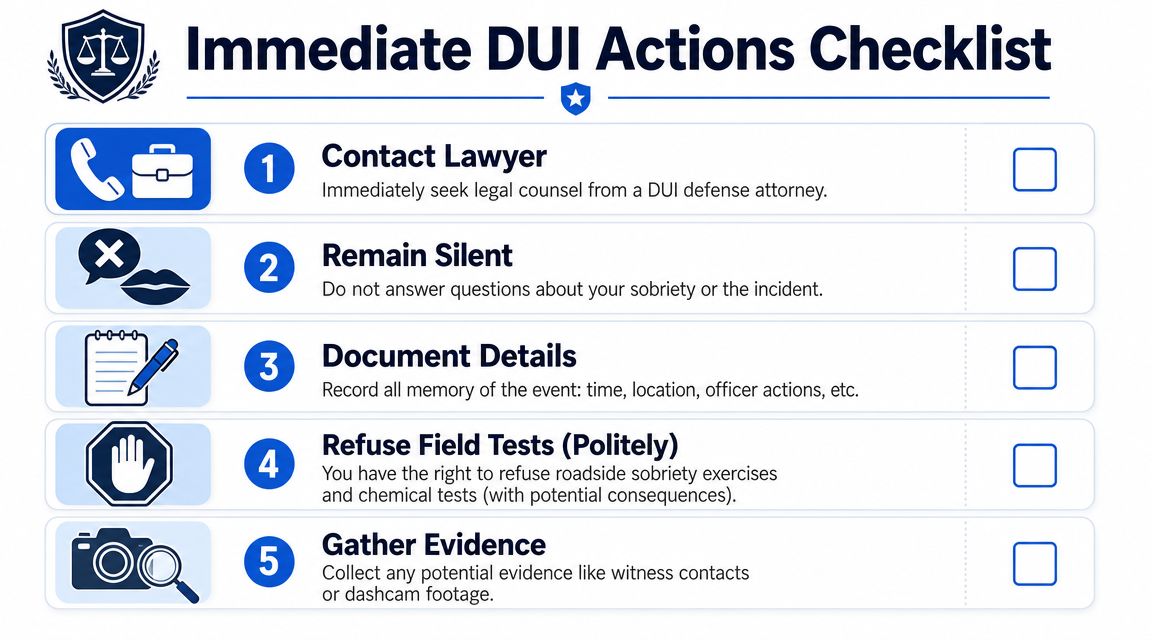
Stop talking about the facts: Don't explain how much you drank. Don't text your version of events to a group chat. Don't post anything.
Write down everything you remember: Time of stop. Location. Officer statements. Whether field exercises were requested. Whether a breath, blood, or urine test was requested. Whether passengers or witnesses were present.
Save every document: Bond papers, tow information, receipt records, citation paperwork, and any temporary driving permit.
Make a list of evidence sources: Dashcam footage, rideshare records, bar receipts, surveillance cameras, witness names, and phone location data can matter.
Get legal counsel immediately: The administrative deadline doesn't wait for your first court date.
One more point. Be careful with field sobriety issues. People often misunderstand what they were required to do and what they weren't. Your lawyer needs the exact sequence of events, not a simplified version.
A lawyer-led defense service such as Ticket Shield, PLLC can help with Florida DUI representation statewide and coordinate the immediate review of both the criminal charge and the license issue. What matters most is that you act quickly and get actual legal guidance, not generic app prompts.
How Can You Defend Against a Florida DUI Charge
An arrest is not proof. It is the start of the state's case. Your defense starts by testing every assumption the officer made and every procedure the state expects the court to trust.
Where strong DUI defenses usually begin
A real DUI defense is not magic. It is methodical. It asks whether the state can legally use what it collected and whether the evidence is reliable.
Common pressure points include:
The stop itself: Did the officer have a valid legal basis to stop your vehicle?
The arrest decision: Did the officer have probable cause, or just a suspicion dressed up as certainty?
Field sobriety exercises: Were they given in a fair setting, with clear instructions, or in conditions that made failure likely?
Breath or blood testing: Was the machine functioning properly? Was the procedure followed correctly? Was the chain from stop to test clean?
Officer observations: Do the bodycam, report, and timeline match, or do they conflict?
If you want a practical breakdown of defense angles, review how to beat a DUI in Florida.
A DUI defense isn't about “getting off on a technicality.” It's about forcing the state to prove every required element with lawful, reliable evidence.
Why courthouse experience still matters
DUI cases are local in practice. Judges differ. prosecutors differ. Hearing habits differ. Filing culture differs. A lawyer who regularly handles these cases knows how they tend to move in specific courtrooms and where prosecutors often overstate weak evidence.
That matters in major venues like the Richard E. Gerstein Justice Building in Miami. It matters just as much in Fort Lauderdale, Tampa, and Orlando. Procedure is statewide. Pressure points are often local.
A strategic defense doesn't wait for trial to begin fighting. It starts with records, video, notices, deadlines, suppression issues, negotiation posture, and license protection. Every day you delay makes that harder.
Why Is Speaking Directly to an Attorney Your Most Important Move
A DUI charge is too serious for middlemen. You need answers tied to your facts, your paperwork, your deadline, and your courthouse. Not canned replies. Not chatbot summaries. Not a case manager relaying messages three days later.
Direct access matters because DUI cases move fast. If your license issue is time-sensitive, if your paperwork is confusing, or if the officer's version of events is already wrong, you need legal judgment now. That means speaking with the attorney handling the strategy.
That's the difference between a lawyer-led defense and the automated-app model. At Ticket Shield, clients speak directly with their attorney by phone or text. That structure matters in a DUI case because decisions about hearings, evidence preservation, statements, and next steps shouldn't be filtered through layers of non-lawyers.
If you're gathering recordings, bodycam references, or voicemail evidence, even support work like accurate legal content transcription can help organize information for attorney review. But tools don't replace legal analysis. They support it.
If you've been arrested, your goal is simple. Protect your license. Protect your record. Build a defense before the state gets comfortable with your case.
If you want to protect your license, fight the DUI, and pursue the strongest possible No Points outcome where applicable, visit Ticket Shield, PLLC now for a free consultation.
