
How to Beat a DUI in Florida: Legal Guide 2026
Arrested for a DUI in Florida? Learn how to beat a DUI in Florida. Get our 2026 legal guide on fighting charges, protecting your license, & navigating courts.
You were arrested. Your car may have been towed. Your license feels at risk. You’re replaying every word the officer said and wondering if the case is already over.
It isn’t.
A DUI arrest in Florida is serious, but it’s still a case that can be challenged. The outcome often turns on what happens next, how fast evidence is preserved, and whether your lawyer digs into the stop, the testing, and the paperwork instead of pushing you through a system.
Table of Contents
What Should You Do After a DUI Arrest in Florida
TL;DR: Yes, you can beat a DUI in Florida. Many cases are dismissed, but only if you act fast, protect your license, and attack the stop, the testing, and the officer’s procedure before the state locks in its version of events.
Right now, you need to stop thinking like someone who has already been convicted. You’ve been accused. That’s different.
Florida DUI law is found in Florida Statute 316.193, and that statute gives the state a path to prosecute. It does not guarantee them a win. In fact, approximately 30 to 40 percent of DUI cases filed in Florida are dismissed, which shows these cases are highly defensible when someone challenges them with strategy and speed, as noted in Florida DUI dismissal data.

If your case lands in Miami-Dade, that fight may move through the Richard E. Gerstein Justice Building. If it’s filed elsewhere, the pressure is the same. The prosecutor will rely on the officer’s report, roadside observations, and any test results they think they can get admitted.
Your job is to stop helping them.
Why you should fight the charge immediately
Too many drivers make the same mistake. They assume the arrest, the breath number, or the officer’s confidence means the case is finished. It doesn’t.
A DUI case is built piece by piece. The stop has to be lawful. The officer’s observations have to hold up. The testing has to comply with Florida rules. The paperwork has to match the video. If one major part fails, the advantage shifts.
Practical rule: Treat the first conversation with a lawyer as evidence preservation, not damage control.
That’s why the first move isn’t explaining yourself to friends, posting online, or waiting for your court date. The first move is locking down your defense. A focused explanation of the immediate process is in what happens after a DUI arrest in Florida.
What not to do after the arrest
Don’t call the arrest “open and shut.”
Don’t assume refusing or taking a test automatically decides the outcome.
Don’t hire an impersonal service that routes you through staff, scripts, or chatbots. DUI defense isn’t clerical work. It’s litigation. The lawyer needs to know your timeline, your medical history, what the officer said, where the stop happened, and what conditions existed at the scene.
Here’s the blunt truth. If you want to know how to beat a DUI in Florida, you start by acting like details matter. Because they do.
What Are Your First Steps After Being Released
The clock starts the moment you’re out. Not when you calm down. Not when you get the court notice organized. Immediately.

What needs to happen in the first day
Florida has a separate license process that moves fast. If your license was suspended after the arrest, the deadline to challenge that suspension is short. Missing it can cost you options you can’t easily get back.
Take these steps first:
Call a DUI defense lawyer immediately: This is not optional. The lawyer needs time to protect your driving privilege, request records, and identify what evidence may disappear.
Find your paperwork: Put the citation, notice of suspension, bond papers, and any property receipt in one folder. Don’t leave anything in the glove box or a jacket pocket.
Write your timeline from memory: Include where you were, what you ate, what you drank if anything, when you drove, when you were stopped, what the officer asked, and whether you took roadside or chemical tests.
List every witness: Passengers, bartenders, servers, valet staff, friends, or anyone who saw your condition before driving may matter later.
Protect your phone data: Save rideshare records, maps history, texts, call logs, and receipts. Those details can support timing arguments and impeachment.
What evidence should you preserve immediately
Memories get weaker fast. Video gets overwritten. Businesses erase footage. Officers write reports that may sound clean and certain even when the stop was messy in real life.
Preserve anything that helps reconstruct the scene:
Photos of your clothing and shoes: Footwear matters if the officer claimed you performed poorly on roadside exercises.
Medical information: If you have GERD, diabetes, an inner ear issue, anxiety, a mobility problem, or take prescription medication, gather records and a medication list.
Work records or schedules: These can help explain fatigue, shift work, or why you were driving at that hour.
Location details: If the stop happened in a dim lot, on a sloped shoulder, near flashing lights, or in heavy traffic, write that down while it’s fresh.
Don’t “clean up” your story. Preserve it exactly as you remember it.
You should also get clear on the license issue early. A practical overview is in Florida DUI license suspension information.
Later in the case, this kind of evidence can become the difference between a weak defense and a targeted one.
This short video helps explain why early action matters.
How Can a Lawyer Challenge the State's Evidence
A solid DUI defense doesn’t start with excuses. It starts with attacking proof.
The state has to build a chain. A lawyer’s job is to break it. That means testing the legality of the stop, the reliability of field exercises, the integrity of the chemical evidence, and the officer’s compliance with constitutional rules.
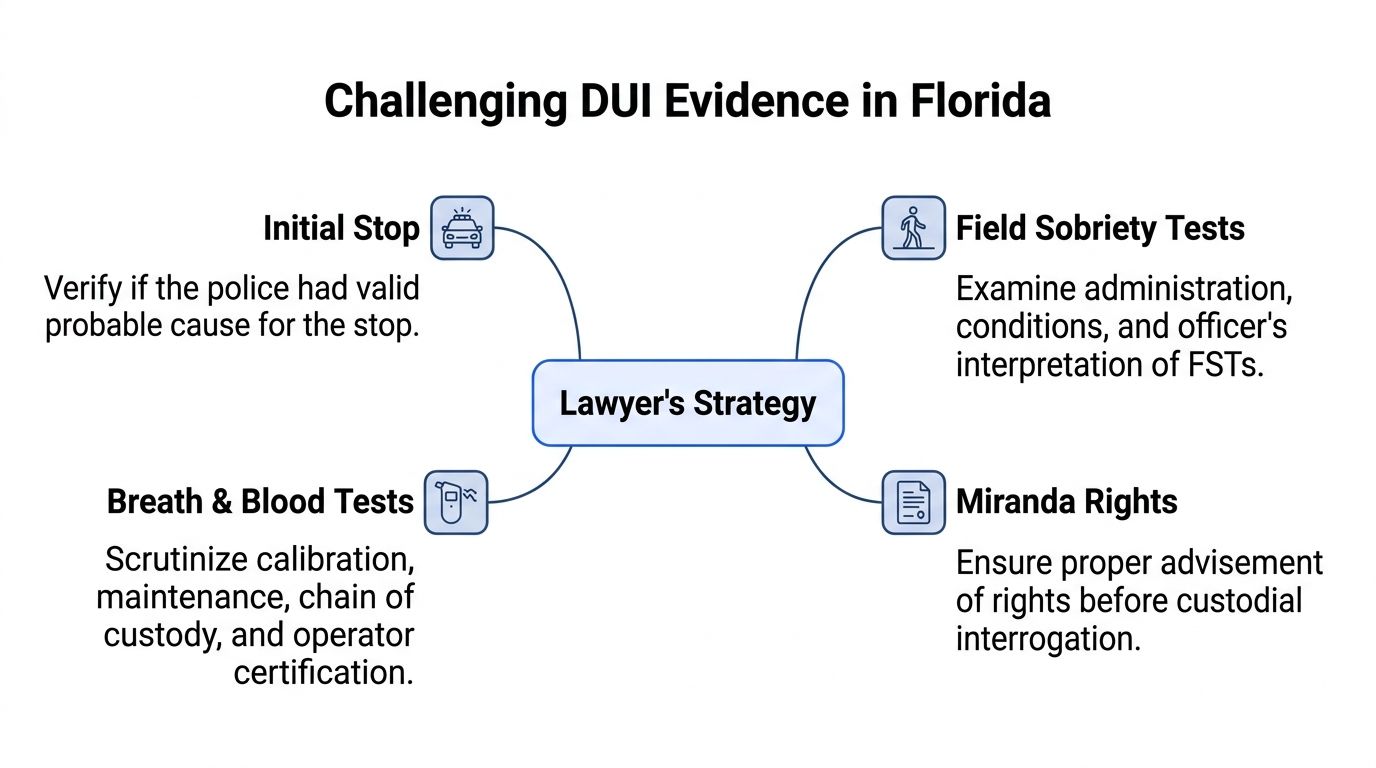
Was the initial stop legal
If the officer didn’t have a lawful basis to stop your vehicle, the case may be vulnerable from the beginning. That issue matters because illegal stops can lead to suppression of the evidence gathered afterward.
A lawyer will compare the report to body camera, dash camera, dispatch logs, and any other available record. If the officer claimed lane violations, erratic driving, or some traffic infraction, the video should support it. If it doesn’t, that becomes a pressure point.
The role of litigation is paramount. A targeted suppression challenge can undercut the prosecution before trial. If you want a practical look at that process, read how a motion to suppress evidence works in Florida.
Can field sobriety tests be attacked
Yes. Often.
Field sobriety tests are not clean science. They’re roadside exercises interpreted by an officer under conditions that are frequently poor for accuracy. In Florida, those conditions can be especially problematic. Heat, humidity, bright police lighting, uneven pavement, and outdoor roadside settings can distort what the officer thinks they saw.
A lawyer should examine:
Issue | Why it matters |
|---|---|
Surface conditions | Uneven ground can affect balance and walking tasks |
Lighting and traffic | Flashing lights and passing cars create distraction |
Instructions | Unclear or rushed directions make performance less meaningful |
Physical condition | Injury, age, weight, footwear, and fatigue can affect movement |
Language barriers | Misunderstood instructions can look like noncompliance |
A bad roadside test is often a bad stage, not proof of impairment.
Can breath or blood evidence be excluded
This is one of the most technical and important parts of how to beat a DUI in Florida.
Under Florida Statute 316.1932, breath testing must follow strict protocol. Florida uses the Intoxilyzer 8000, and defense lawyers frequently challenge the machine’s maintenance records, the operator’s certification, and the required 20-minute observation period before testing. According to Florida Intoxilyzer challenge grounds, improper calibration alone accounts for up to 20 percent of successful DUI charge dismissals in Florida.
That gives you a clear lesson. Chemical evidence is not self-proving.
A lawyer should request and inspect:
Maintenance and calibration logs: If the machine wasn’t maintained properly, reliability becomes a major issue.
Operator certification records: The officer administering the test must be properly certified.
Observation period documentation: If the required pre-test observation wasn’t done correctly, mouth alcohol contamination becomes a real defense issue.
Error logs and machine history: These records can expose reliability problems.
Blood and urine evidence can also be challenged through chain-of-custody review, storage questions, contamination issues, and gaps in documentation.
What about Miranda and other procedural failures
Not every strong defense comes from a machine. Some come from the officer’s conduct.
If the state wants to use statements made during custodial interrogation, the lawyer will review whether Miranda applies and whether the warning was properly given. The timeline matters. The setting matters. The exact questions matter.
Other procedural failures may include inconsistent report writing, missing video, sloppy evidence handling, or officer testimony that doesn’t match the objective record.
This is why a DUI case should never be handed to a volume operation that treats files like forms. One option some Florida drivers consider is Ticket Shield, PLLC, because it’s a lawyer-led firm where clients communicate directly with their attorney by phone or text rather than through middlemen.
What Happens with Your License and in Court
You’re fighting two battles. If you don’t understand that early, you can lose one while focusing on the other.
One fight is administrative. The other is criminal. They overlap, but they aren’t the same.
How is the DMV case different from the criminal case
The DMV side is about your driving privilege. It moves quickly and focuses on whether the suspension stands.
The criminal case is about whether the state can prove a DUI under Florida Statute 316.193 in court. If your case is in Hillsborough County, that process may unfold at the Edgecomb Courthouse in Tampa.
Here’s the difference in plain terms:
Process | Main issue | Main goal |
|---|---|---|
DMV administrative case | License suspension | Keep or restore driving privileges |
Criminal court case | DUI prosecution | Dismiss, suppress, reduce, or defeat the charge |
A driver can do well in one and still have to fight the other. That’s why strategy has to be coordinated from the start.
What can pretrial motions do for you
Pretrial motions are where many DUI cases get stronger for the defense. A motion can force the judge to decide whether key evidence should stay in the case at all.
If the stop was illegal, if the chemical testing was flawed, or if the officer violated procedure, your lawyer may seek to suppress evidence before trial. That can change everything. Prosecutors negotiate differently when their strongest evidence is under attack.
Florida-specific facts can also matter more than people realize. As noted in discussion of Florida medical and environmental DUI defenses, conditions like high humidity, GERD, diabetes, and PTSD in veterans can compromise sobriety test results, and a skilled lawyer can use those overlooked factors to challenge the state’s evidence.
That matters because Florida roadside DUI investigations often happen outdoors, at night, under distracting and physically awkward conditions. A person with reflux, balance issues, blood sugar problems, or service-related medical conditions can look impaired when they aren’t.
Some of the strongest DUI defenses come from facts the officer ignored, not facts the driver invented later.
A good defense doesn’t throw those points in casually. It documents them. It gets records. It connects them to the officer’s observations and testing procedures. That’s how you turn a vague “I have a condition” claim into a serious evidentiary challenge.
Should You Accept a Plea Deal or Go to Trial
This decision should never be emotional. It should be strategic.
Some DUI cases should settle. Some should be tried. The right answer depends on the evidence, the judge, the county, the officer, the testing issues, and your exposure if the state proves its case.
When does a plea deal make sense
A plea deal can be smart when it meaningfully reduces damage. In some Florida cases, the defense may pursue a reduction to reckless driving involving alcohol, often called a wet reckless in everyday practice.
That is not the same as giving up. It can be the right move when:
The stop looks lawful: Video and reports line up cleanly.
The testing issue is limited: There’s no strong suppression path.
Your personal priorities are practical: You want to reduce risk, move faster, and protect employment.
The offer avoids harsher DUI consequences: A negotiated result may limit some long-term fallout compared with a DUI conviction.
The key is advantage. Good plea deals usually come after the defense exposes weakness. They do not usually appear because someone asked politely at arraignment.
A careful lawyer will also explain what a plea means for your record and rights. If you’re weighing that issue, review what a plea of no contest means in Florida.
When should you seriously consider trial
Trial becomes the stronger path when the state’s case looks fragile and the plea offer doesn’t reflect that weakness.
That may happen when:
The officer’s credibility is shaky
Video undercuts the report
Field sobriety evidence looks subjective or unfair
Chemical testing has serious admissibility problems
There’s a strong legal issue for suppression
The prosecutor refuses to move despite obvious defects
Here’s the practical way to approach this:
Path | Potential upside | Main risk |
|---|---|---|
Plea deal | Controlled outcome, faster resolution, possible reduction | You accept a conviction or reduced offense without forcing full proof |
Trial | Acquittal, stronger pressure on the state, full challenge to evidence | Less predictability if the judge or jury accepts the state’s version |
You also need to understand what’s at stake. A DUI conviction under Florida Statute 316.193 can carry serious penalties, including court-imposed sanctions affecting your license, your record, and your future driving status. That’s exactly why the decision must come after real case review, not fear.
The right question isn’t “Do I want trial?” It’s “Has the state built a case that should survive one?”
Why Is Direct Attorney Access Critical for Your DUI Defense
A DUI case changes fast. New records appear. Court dates move. Officers amend reports. Witnesses remember new details. Medical issues become relevant. You need answers quickly, and not from a call center.
That’s why direct communication with your lawyer matters so much.
Why middlemen hurt DUI cases
Impersonal legal services create delay. Delay kills defense value.
If your message goes through intake staff, case managers, automated apps, or generic support channels, the lawyer may not get the critical fact until days later. In a DUI case, that lost time can mean missed evidence, missed deadlines, or missed opportunities to frame the case correctly.
Here’s where middlemen usually create problems:
Urgent facts get filtered badly: A staffer may not recognize that your GERD diagnosis or balance disorder is central to the defense.
Deadlines get treated like admin tasks: DUI timelines require legal judgment, not just calendar entries.
Your story gets flattened: A real defense depends on nuance. Forms don’t capture nuance well.
You don’t know who is making decisions: That’s dangerous in a case involving your license and criminal record.
Why direct communication changes strategy
When you can speak directly with your attorney by phone or text, the defense gets sharper.
Your lawyer can tell you what records to gather, whether a medical issue matters, whether a witness is useful, and whether a new fact helps the DMV fight, the criminal case, or both. That communication also helps you avoid damaging mistakes, including statements, online posts, or casual admissions that seem harmless but aren’t.
If you’re choosing counsel, treat the consultation as a test. Ask who you’ll speak with. Ask how quickly you can reach your lawyer. Ask who handles strategy. Ask who appears in court. If the answers are vague, keep looking.
A DUI isn’t a traffic ticket you hand off and forget. It’s a moving legal problem that requires judgment, pressure, and responsiveness. If you want informed guidance before hiring counsel, start with a criminal defense attorney consultation guide.
The short version is simple. If you want to know how to beat a DUI in Florida, don’t hand your case to a system built for volume. Put it in the hands of a lawyer you can reach.
If you’ve been charged with DUI in Florida, act now. Visit Ticket Shield, PLLC for a free consultation focused on protecting your license, your record, and the No Points goal.
