
Improper Lane Change FSS: Florida Defense Guide
Cited for an improper lane change fss in Florida? Learn the statute, point risks, and how Ticket Shield fights to keep your record clear.

You're driving home when an officer's lights flash behind you. The lane change felt ordinary, but the officer says you moved without confirming it was safe. Now you're holding an improper lane change FSS citation and wondering whether paying it online will make the problem disappear.
It won't necessarily. A guilty disposition can affect your license status, insurance, and future driving options. The risk grows if you already have points, depend on a Florida license for work, or live outside Florida and assume the ticket will stay isolated here.
Table of Contents
The Hidden Danger of a Simple Lane Change Ticket
Most drivers treat a lane-change citation as a nuisance rather than a defense problem. That's exactly why paying without advice can be costly. Florida classifies improper lane-change conduct as a noncriminal moving violation, but “noncriminal” doesn't mean consequence-free.
A national safety analysis cited in NHTSA research estimated that lane-change crashes represented about 4% to 10% of all crashes, while a landmark analysis identified approximately 539,000 two-vehicle lane-change crashes in 1999, about 9% of all police-reported motor vehicle crashes that year. The same analysis identified 207,000 typical lane-change collisions, where one vehicle intentionally changed lanes and struck another vehicle. These figures explain why officers focus on the maneuver, not only on whether metal was damaged. NHTSA lane-change research

The immediate temptation is to pay, move on, and avoid a court date. But payment generally functions as accepting responsibility. That can create a record entry even when the officer's view was limited, the lane markings were unclear, traffic forced your movement, or the citation doesn't accurately describe what happened.
Protective advice: Don't decide based only on the amount printed on the citation. Decide based on what a conviction could do to your license and insurance.
You should also examine the physical circumstances. A properly adjusted mirror and a clear understanding of blind-spot limitations can help prevent future problems. T1A Auto's guide from T1A Auto offers practical information about blind-spot mirror installation, but defensive equipment doesn't replace a legal response to a citation you've already received.
Decoding Florida Statutes 316.085 and 316.089
Florida's lane-change laws focus on safety, interference with traffic, lane discipline, and official roadway controls. The statute printed on your citation matters because the state must establish the elements of the charged violation, not merely show that you changed lanes.
Florida Statute 316.085
Florida Statute § 316.085 addresses limitations on changing lanes. In substance, a driver moving from a lane must first determine that the movement can be made safely and without interfering with other traffic. The issue is not just whether your vehicle crossed a stripe. The issue is whether the maneuver was safe under the conditions the officer observed.
That creates several factual questions:
What the officer saw: Was the officer positioned to observe both your vehicle and surrounding traffic?
Traffic proximity: Was another vehicle affected or forced to react?
Signal use: Did you signal before beginning the movement?
Timing: Did you check mirrors and surrounding traffic before crossing the lane line?
Road conditions: Were markings, congestion, construction, or roadway design relevant?
Florida law also incorporates improper lane-change conduct into the state's aggressive careless driving statute when two or more listed acts occur simultaneously or in succession. That doesn't mean every lane-change ticket becomes an aggressive-careless-driving case. It means the surrounding conduct can change the legal exposure when additional statutory acts are alleged. Florida Statute § 316.085
Florida Statute 316.089
Florida Statute § 316.089 imposes a separate lane-discipline requirement. Drivers must operate as nearly as practicable entirely within a single lane and may not move from that lane until they first ascertain that the movement can be made safely. The statute also recognizes that traffic-control devices can prohibit lane changes in particular roadway sections, and drivers must obey those devices.
The prosecution therefore needs more than a conclusion that your vehicle was “out of position.” It must present evidence supporting the claimed failure to remain within the lane or the claimed unsafe movement. The officer's testimony may be central, but its strength depends on vantage point, distance, traffic conditions, roadway markings, and the precision of the written citation.
For a broader review of Florida traffic rules, consult Florida traffic laws and driver obligations. Don't assume the statute number is a technical detail. It identifies the theory the state is using and helps counsel determine which facts need to be challenged.
The Cascading Cost of Points and Insurance Hikes
The base fine is only the first question. The more important question is whether accepting the citation puts your driving record closer to a suspension threshold or gives an insurer a reason to reassess your risk.
Florida's official points schedule states that 18 points within 18 months results in a three-month suspension, while 24 points within 36 months results in a one-year suspension. Those thresholds make a single moving violation far more serious for a driver who already has a crowded record. Florida points and suspension information
An out-of-state driver also shouldn't assume Florida points stop at the state line. Reporting and licensing consequences can involve the driver's home jurisdiction, and the driver may not understand how a Florida disposition will be treated by the issuing authority or insurer. That uncertainty is a reason to obtain advice before choosing payment.
Insurance companies don't need a dramatic crash to view a moving conviction negatively. A conviction can become part of underwriting and renewal decisions, turning a seemingly limited ticket into recurring financial pressure. The exact effect depends on the driver's policy and insurer, so no responsible lawyer should promise a particular premium change. The strategic objective is clearer: avoid an unnecessary moving conviction when a lawful defense may protect your record.
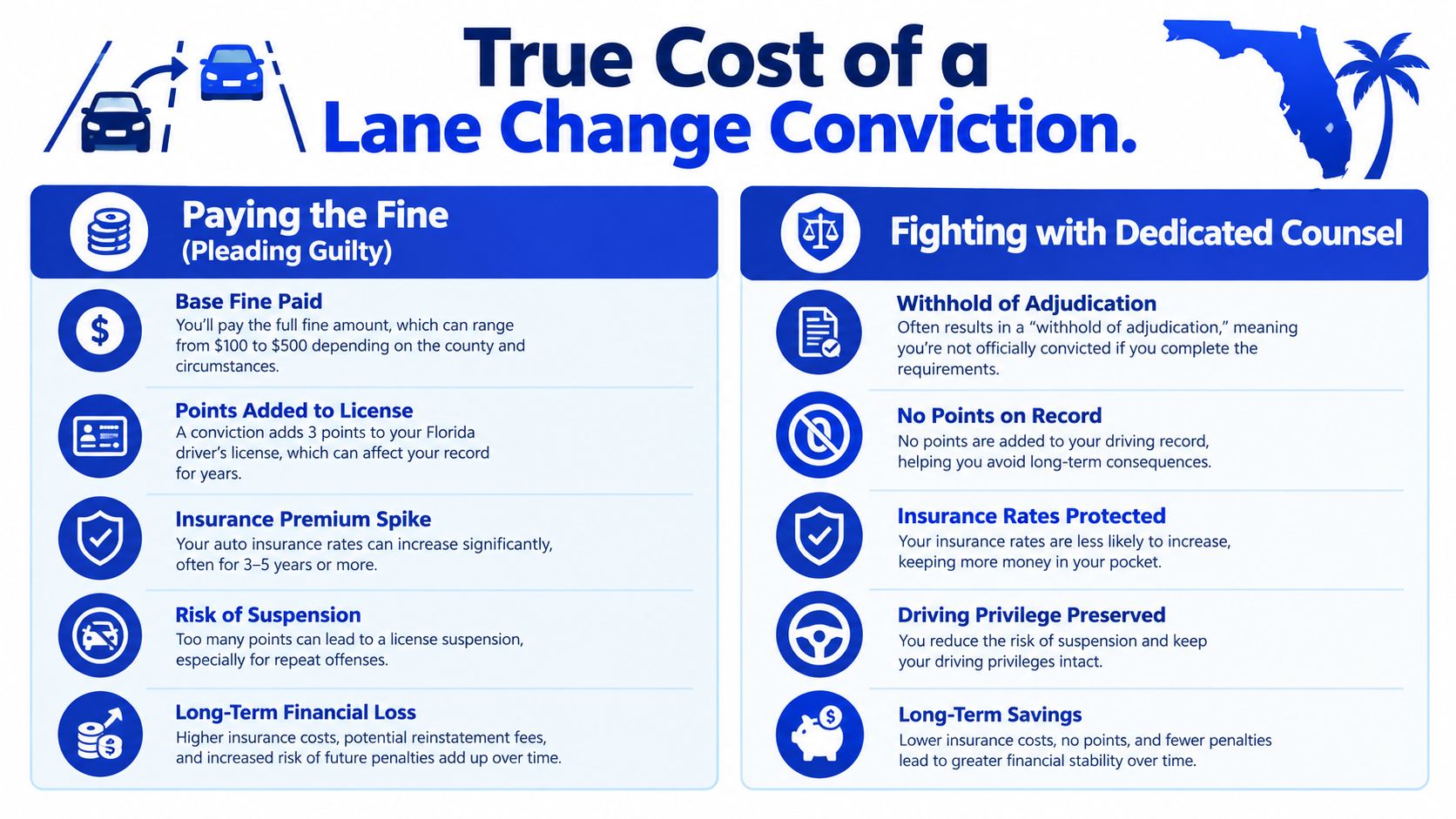
True Cost of a Lane Change Conviction
Impact Category | Paying the Fine (Pleading Guilty) | Fighting with Dedicated Counsel |
|---|---|---|
Immediate disposition | You accept the citation without testing the evidence. | Counsel reviews the facts and available legal options. |
License record | A moving disposition can affect your points history. | Counsel may pursue a result designed to avoid points where legally available. |
Insurance | The disposition may be considered during underwriting or renewal. | Protecting the record becomes a central defense objective. |
Suspension risk | Existing points can make threshold calculations more dangerous. | A strategic response can help prevent unnecessary accumulation. |
Long-term effect | You carry the consequences without challenging the officer's account. | You preserve defenses and negotiate from an informed position. |
The common online claim that every improper lane-change ticket automatically carries the same point result oversimplifies the issue. The disposition, statute, existing record, and collision allegations can all matter. Review the broader consequences in this Florida driver's license points guide before treating payment as a routine transaction.
How Officers Build Their Case Against You
An officer usually builds an improper lane-change case from observations made during a short, fast-moving event. The report may describe a failure to signal, a movement across a lane line, a vehicle being forced to brake, or a failure to check surrounding traffic. Those observations can support the citation, but they can also reveal weaknesses.
Driver behavior research helps explain the observations officers focus on. In one NHTSA study of lane changes, 17% of left-lane changes and 36% of right-lane changes involved drivers failing to scan their surroundings during the entire 8 seconds before the maneuver. The same study observed 8,667 lane changes, with 91% uneventful. NHTSA observational lane-change study

What the report should establish
A defensible review starts with the officer's exact account:
Observation point: Could the officer see your signal, mirrors, lane position, and surrounding vehicles?
Vehicle movement: Did your vehicle drift, cross deliberately, or move in response to traffic?
Traffic effect: Did another driver brake, swerve, or lose access to the lane?
Roadway evidence: Were lane lines visible and was signage relevant?
Sequence: Did the alleged conduct occur once, or did the report combine separate movements?
Research on unsafe urban lane-changing behavior identified failure to signal, failure to check mirrors or scan the roadway, and changing more than one lane at a time as observable behaviors. That matters because the state's case should rest on conduct tied to the statutory requirement, not merely on the fact that an officer disliked the maneuver.
Your own memory also matters. Write down the lane positions, traffic flow, weather, nearby vehicles, signals, signs, and what the officer said while the details are fresh. Don't argue about the facts on social media or give an insurer a speculative account before speaking with counsel. Guidance on the legal basis for a traffic stop is available in this discussion of probable cause in Florida traffic stops.
Strategic Defenses to Protect Your Driving Record
Automated ticket apps often reduce the process to intake forms, status messages, and communication through intermediaries. That model may be convenient, but convenience doesn't create a factual defense. Improper lane-change cases require someone to examine the officer's view, the roadway, the citation language, and the consequences of each possible disposition.
A lawyer-led defense can investigate whether the officer could reliably observe the complete maneuver. It can also test whether the report identifies the necessary safety failure or merely states a conclusion. If the citation alleges that you interfered with traffic, counsel should examine what vehicle was affected and whether the evidence supports that allegation.
Defense questions that matter
Was the movement unsafe? A lane change can be lawful when the driver first confirms it can be made safely.
Did the officer see the entire event? A partial view may not establish what happened before the vehicle crossed the line.
Were roadway markings clear? Faded, obscured, or confusing markings can affect the reliability of the observation.
Did traffic create an emergency response? A movement made to avoid an immediate hazard may require careful factual analysis.
Can the disposition avoid points? Where legally available, a withhold of adjudication or another negotiated result may protect the driving record.
Discovery, negotiation, and cross-examination should serve a specific objective, No Points on your license. That doesn't mean every case ends the same way, and no lawyer should guarantee a result. It means the defense should be built around your record, your facts, and the consequences you're trying to prevent.
Ticket Shield, PLLC provides a lawyer-led Florida traffic defense service with direct attorney communication by phone or text, rather than routing clients through corporate answering services, middlemen, or automated chatbots. The firm's published traffic-ticket dismissal guidance explains why case-specific legal work matters.
Evaluating Your Options After Receiving a Citation
You generally have three practical paths after receiving an improper lane-change citation. The right choice depends on your record, the facts, the deadline, and the consequences you can afford.
Pay the citation
Payment is simple, but it commonly means accepting the violation. You give up the opportunity to challenge the officer's observations, question the statutory basis, or pursue a disposition that protects your record. This option is particularly risky if your license is already near a suspension threshold or your employment depends on driving.
Consider traffic school carefully
Traffic school may be available in some circumstances, but it isn't automatically the safest choice. Eligibility restrictions, prior elections, court requirements, and the effect on your record can matter. You should confirm the consequences before selecting a course, especially if you're an out-of-state driver or have previously used a similar option.
Contest the citation with counsel
Representation gives you a structured review before you commit to a result. Counsel can examine the citation, assess the officer's position, identify factual defenses, handle court communication, and pursue a resolution aimed at avoiding points when the law and facts permit.
The decision shouldn't be based only on avoiding a personal appearance. It should account for license protection, insurance exposure, and the value of having an attorney responsible for the case. Ticket Shield reports that over 99% of its represented clients never appear in court, but you should treat that as the firm's published service information, not a promise about your individual case.
Use this Florida traffic-ticket response guide to organize your next steps, then obtain case-specific advice before paying or electing a course.
Secure Your Defense and Keep Your Record Clear
An improper lane change citation is small only if you look at the paper and ignore the record behind it. What matters is whether you can protect your driving privilege, avoid unnecessary points, and prevent a routine moving violation from creating problems with insurance or suspension thresholds.
Start with the citation. Identify the statute, response deadline, county, and alleged conduct. Preserve any dashcam footage, write down the traffic and roadway conditions, and avoid guessing about facts you don't remember. Your lawyer needs accurate details, not a polished story.
Choose direct legal communication when the stakes justify it. A lawyer-led firm should let you communicate with your attorney by phone or text, not force you through a chatbot or an anonymous call center. Ticket Shield, PLLC publishes Florida traffic defense pricing starting at $39.99 and serves all 67 Florida counties, but confirm current availability and pricing during your consultation.
The target should be clear: No Points on your license whenever that result is legally and factually achievable. Don't surrender that objective by paying first and asking questions later.
Visit Ticket Shield, PLLC for a free consultation about your improper lane change citation. You'll receive lawyer-led guidance focused on protecting your record and pursuing the ultimate goal of “No Points” on your Florida license.

