Florida Traffic Ticket Lawyer: How to Fight Your Citation
Hire a Florida traffic ticket lawyer to protect your license and avoid points. Learn defenses, county timelines, pricing, and how Ticket Shield fights for you.

You're staring at a Florida traffic ticket that looked minor until you realized what it can do to your license, your insurance, and your job. That's the trap. The paper in your hand feels like a nuisance, but in Florida it can become a record problem fast, especially if you drive for work, hold a CDL, or can't afford points showing up on your driving history.
A Florida traffic ticket lawyer is not there to “make it go away” with a quick shrug and a payment. The right lawyer forces the state to prove its case, protects your deadline, and pushes for the result you need, no points if that outcome is available. If you're in a hurry, the worst move is to pay first and think later.
Table of Contents
The Real Cost of a Florida Traffic Citation
You don't just pay a fine in Florida. You buy a problem that follows you into your insurance bill, your work record, and sometimes your license status. The citation in your hand is the smallest part of the damage.

A moving violation can create a long tail of expense. In Florida, the issue is not just the county fine, it's the conviction, the points, and the insurance fallout that can sit on your record for years. If you're trying to keep your job, especially if you drive for a living, that matters more than the number printed on the ticket.
Why paying feels easy and costs more
Paying a citation is fast, but it is also an admission of guilt. That means you're not solving the issue, you're accepting the record consequence and whatever insurance sees next. If your goal is to protect your driving history, paying first is usually the wrong move.
Practical rule: never treat a Florida moving violation like a parking ticket. If the charge can affect points, insurance, or work eligibility, handle it like a legal problem.
The state's outcome data makes the risk clear. In a separate statewide analysis of Florida traffic-offense cases across 2023 to 2025, there were 403,226 cases statewide, with a 45.4% guilty rate, a 34.7% adjudication-withheld rate, and only a 4.1% dismissal rate overall, plus an average fine of $300 and an average sentence of 2.9 months for convicted defendants, according to the source cited in the verified data. That's not a warning to panic. It's a reason to stop assuming the ticket will disappear.
For a closer look at what people pay after a citation, review the breakdown on Florida speeding fines and how local costs stack up. The number on the notice is rarely the cost.
Your 30-Day Window to Protect Your Record
Florida gives you a real deadline, and it's short. You generally have 30 days from the citation date to act, and if you sit on it, the state can start the suspension process. That deadline is where good cases are won and bad ones are lost.

There are only three sensible paths in most cases. You can pay, request a hearing, or elect traffic school if you're eligible. Each choice has a different consequence, and the wrong one can lock in points before you've had a real defense reviewed.
The three moves that matter
Paying the ticket closes the matter quickly, but it also acts like a plea. You're accepting the conviction path, not contesting it.
Requesting a hearing preserves your ability to challenge the stop, the officer's account, or the paperwork. That's the option that keeps an advantage in your hands.
Electing Basic Driver Improvement can help eligible drivers avoid points, but it does not erase the citation. It changes the licensing consequence, which is useful, but it's not the same thing as dismissal.
Florida's point-avoidance mechanic is specific. For certain violations, you may elect a Basic Driver Improvement course within 30 days of the ticket and complete a state-approved course to avoid points, even though the citation itself remains. That difference matters because a clean record is about the licensing outcome, not just the fine.
If you don't act inside the 30-day window, you're not negotiating anymore. You're cleaning up damage.
The courthouse logistics also matter, especially if you're juggling work or family. If you want more on how traffic-court handling works in a major county, see Jacksonville traffic court requirements. Timing is not a detail here. It's the case.
Why County Court Outcomes Vary Drastically
Florida traffic defense is local. The courthouse you're in changes the odds, the pace, and the practical strategy. That's why a Florida traffic ticket lawyer who knows your county is more valuable than someone working from a generic script.
Miami-Dade and Broward do not look the same
The county data in the verified record shows how much outcomes vary. In Miami-Dade County's 2024 non-criminal moving-violation cases, 55% were dismissed outright, 23% resulted in adjudication withheld, 21% were paid, and only 2% went to trial and were lost. In Broward County, the same dataset showed 31% dismissed, 46% adjudication withheld, 21% paid, and 2% found guilty in court.
Traffic Ticket Outcomes by Major Florida County | Dismissal Rate | Adjudication Withheld |
|---|---|---|
Miami-Dade | 55% | 23% |
Broward | 31% | 46% |
Those numbers tell you something simple. County practice matters. Judges, prosecutors, docket pressure, and local traffic patterns all shape the practical result.
Why adjudication withheld is worth fighting for
A dismissal is the cleanest result. Adjudication withheld is still valuable because it can avoid points and keep the outcome from becoming a straight conviction. That distinction is why experienced defense counsel doesn't stop at the fine amount.
The verified data also shows how concentrated enforcement is in Florida. Six counties, Miami-Dade, Broward, Palm Beach, Orange, Hillsborough, and Duval, accounted for 56% of all tickets issued in the state, with about 1.49 million citations combined. Miami-Dade alone accounted for about a quarter of all statewide tickets, while Orange County issued about 211,000, Broward about 210,000, Palm Beach about 192,000, Duval about 141,000, and Hillsborough about 115,000. That concentration is why local court knowledge pays off.
If you want the county-level side of the argument, the source discussing Miami dismissals is Miami traffic ticket dismissal data. The point isn't the headline. It's the pattern.
Lawyer-Led Defense vs Automated Ticket Mills
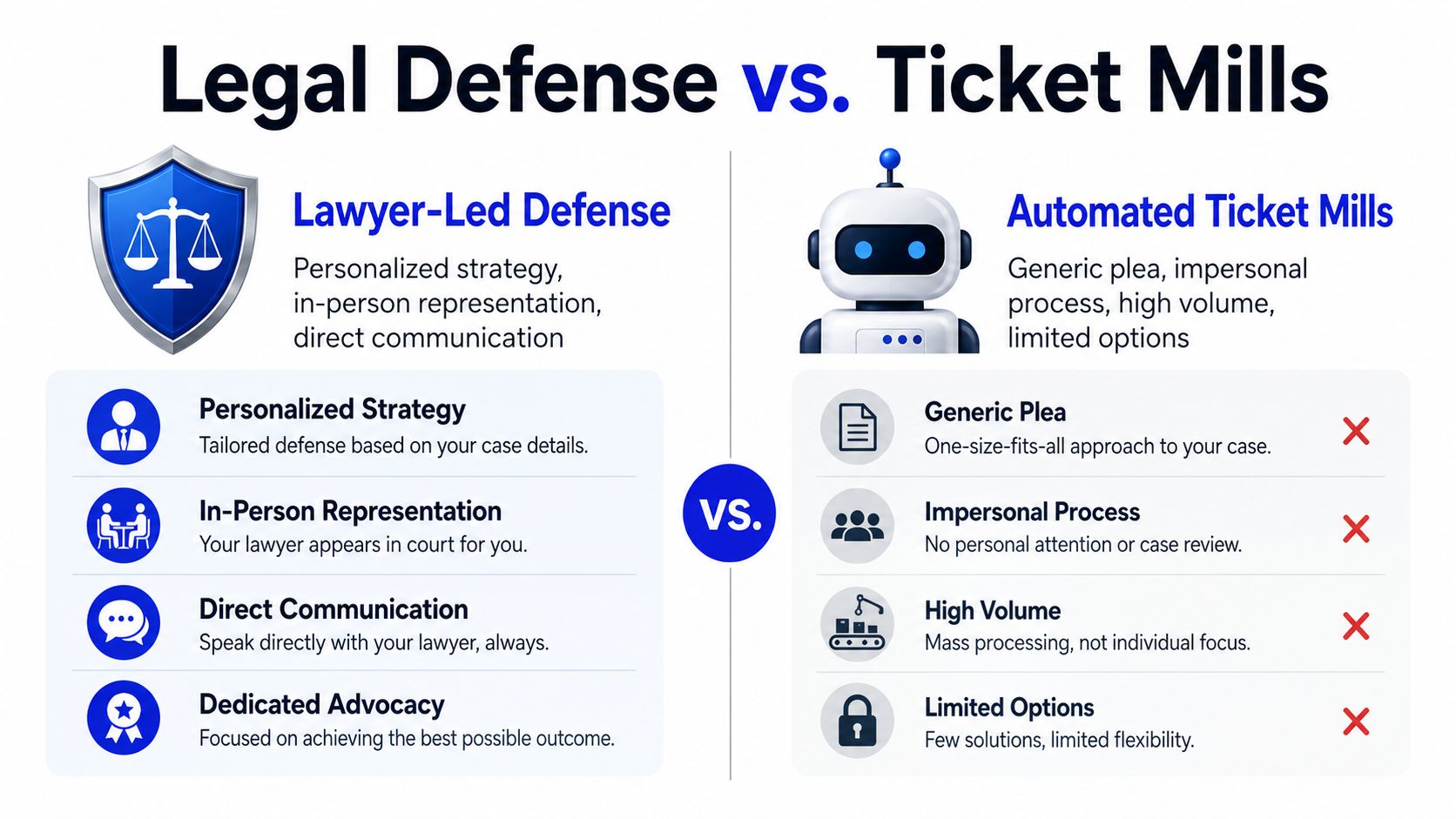
Automated apps and ticket mills sell convenience. They don't sell judgment. If your case is a simple office transaction, maybe that's enough. If you need someone to notice a weak stop, a bad citation, or a county-specific strategy, a factory model is the wrong tool.
What direct attorney access changes
With a lawyer-led firm, you talk to the attorney, not a chatbot, not a call-center script reader, and not a middleman who can't explain the strategy. That matters because traffic defense turns on small facts, the wording of the stop, the officer's testimony, the sequence of events, and the county's handling of your charge.
A better model is direct communication by phone or text with the lawyer handling the file. That gives you faster answers and fewer misunderstandings. It also means the person reviewing your case can spot issues that an automated intake form will never catch.
For a deeper look at why local, lawyer-led handling beats app-style processing, review why a local lawyer is different from apps.
Why non-lawyer handling creates risk
A non-lawyer process tends to flatten everything into a generic plea. That can leave defenses unused. It can also push you toward a result that looks efficient on paper but doesn't protect your record the way you need.
Ticket Shield, PLLC is one example of a lawyer-led Florida traffic defense firm, and the working model matters more than the marketing. Direct attorney communication means your case is reviewed as a legal problem, not a ticket number. That difference is exactly what automated platforms miss.
Bottom line: if your license, job, or clean record matters, don't let software make legal calls for you.
Hidden Consequences for Gig Workers and Professionals
A ticket hits different when you drive for money. If you're a rideshare driver, delivery driver, CDL holder, or someone whose employer watches your record closely, the citation is not just about points. It's about whether you can keep working.
Gig work breaks faster than people expect
Public traffic-ticket pages often talk about fines and court dates. They usually skip the issue of employment fallout. For delivery drivers and rideshare workers, a violation can create insurer reporting problems, platform deactivation, and scheduling trouble. That's the part generic advice misses.
If you rely on a car to earn money, a “small” citation can interrupt income immediately. That's why you should treat the ticket as a work-protection matter, not just a driving matter.
CDL holders and professionals have more to lose
Commercial drivers face a different kind of pressure. A bad outcome can threaten the credential that lets them work at all. The same is true for professionals whose employer expects a clean driving record, from sales reps to executives to field technicians.
Military personnel face their own risk profile. A driving issue can create complications far beyond the roadside stop, especially when a record review matters. The safe move is to handle the citation early and keep the paper trail as clean as possible.
The verified data points to this exact gap. Most public-facing traffic-ticket pages focus on points and fines, but they often fail to explain the downstream consequences for gig workers, CDL holders, and other working drivers. That omission is costly because it encourages people to think only about the ticket, not the job.
If driving is part of how you pay rent, defend the citation like it affects your income, because it does.
Statutory Defenses Under Florida Chapter 316
Florida traffic cases are not vibes. They're statutes, elements, proof, and procedure. That's why Chapter 316 matters, and why a Florida traffic ticket lawyer who knows the statute can make the state work for its case instead of for yours.
Start with the legal element the state must prove
One concrete example is Florida Statute 316.075, which governs obedience to traffic control devices and supports many red-light and signal-related citations. That matters because the prosecution has to prove more than “the driver looked unsafe.” It has to prove the device was lawfully placed, visible, and applicable to your movement.
That's where real defense work begins. The attorney does not ask for mercy. The attorney tests proof.
If the stop itself is shaky, that also matters. See probable cause in Florida traffic stops for the kind of threshold issue that can change a case before it gets to the merits.
Use procedure against the citation
Florida Statute 318.14 allows lawyers to appear in many non-criminal traffic cases on a client's behalf. That is practical, not cosmetic. It means you can protect your schedule while your lawyer handles the courtroom side when the charge and local rules allow it.
The defense sequence is straightforward.
Challenge the stop or citation basis. If the officer lacked a clean factual foundation, that weakens the case.
Force the state to prove every element. A traffic case still has to be supported by evidence, not assumptions.
Attack testimony and paperwork. Small defects can matter more than most drivers think.
Preserve your licensing options. That includes dismissal, adjudication withheld, or a no-points outcome where available.
Don't plead first and ask questions later. Once you pay, you've given up leverage you may not get back.
Florida traffic defense is strongest when it's specific, not generic. That means statute by statute, county by county, and fact by fact.
Transparent Pricing and Your Next Steps
You need a clean decision, not a mystery quote. Ticket Shield, PLLC offers cost-effective Florida traffic defense with pricing starting at $39.99, and the firm says clients can speak directly with their attorney by phone or text. That direct model is useful when you're trying to move fast and keep the record clean.
The firm also says it brings 25+ years of experience and former prosecutors to traffic defense, and that over 99% of clients never have to step foot in court. If you want a cost breakdown before you decide, review traffic lawyer cost details. What matters is whether the service is built to protect points, not just collect a fee.
You should move now if the deadline is still open. Once the 30-day window closes, your options narrow fast. The goal here is simple, No Points if that outcome is available in your case.
Visit Ticket Shield, PLLC today for a free consultation and get a lawyer-led plan focused on keeping points off your license. If you want the citation handled correctly, act now and protect your record before the 30-day window closes.