Ticket Lawyer Cost in Florida: What You'll Actually Pay
Learn what ticket lawyer cost really means in Florida. See flat-fee ranges, severity tiers, and the hidden downstream expenses most drivers miss.

In Florida, ticket lawyer cost for minor violations can start as low as $39.99 flat-fee, then rises fast with severity. The cost is what happens to your insurance, your points, and your license if you don't hire one.
You're probably staring at a citation right now, wondering whether it's smarter to pay it and move on or bring in a lawyer and fight for a clean record. Don't make the mistake of treating the printed fine as the whole bill. In traffic defense, the ticket is often the smallest number on the page.
Table of Contents
What a Florida Traffic Ticket Really Costs You
A driver gets pulled over on I-95, accepts the citation, and sees what looks like a manageable fine. That's the trap. The paper ticket is not the financial event, it's the starting point for the significant one, especially once points, insurance, and DMV consequences enter the picture. Florida drivers who want the full picture should also look at how court costs can change the price of a traffic ticket.
The number on the ticket is not the number that matters
Florida law treats speeding and other moving violations as more than a one-time payment. Under Florida Statute 316.187, speeding is not just a nuisance citation, it's a traffic offense that can trigger a chain reaction inside your driving record. If you pay first and ask questions later, you may be buying a conviction, not closing a matter.
Practical rule: Judge the ticket by its long-term cost, not the printed amount.
That's why the question is never just, “How much does a ticket lawyer cost?” The smarter question is, “What does it cost me if I don't fight this?” A lawyer's fee is one line item. A conviction can bring points, insurance pain, and license trouble that keep costing you long after the court date ends.
Why Florida drivers should think in terms of total damage
The cleanest way to think about a traffic ticket is as a budget decision with a license attached. If a lawyer can help you avoid points or reduce the charge, the lawyer's fee may be the smaller number. If you pay the ticket and the case follows you into insurance renewals and later license problems, the “cheaper” path stops looking cheap very quickly.
That is the part bargain-basement services ignore. They sell a low headline price, but they do not sit across from you and explain how one bad result can ripple through your record. In Florida traffic defense, the question is not what the citation says. It's what the citation does to everything after you pay it.
How Florida Traffic Lawyers Structure Their Fees
Florida traffic lawyers usually price routine citations around the work required, not around the sticker shock on the ticket. For ordinary speeding or red-light cases, flat fees are the norm. Hourly billing and retainers show up when the charge is messier, more contested, or serious enough to need more court time and more strategy. A real fee quote should spell out what you get, what costs extra, and whether the lawyer is handling a single appearance or a broader defense plan.
Flat fees fit routine traffic cases
Flat fees are the standard for everyday traffic tickets because the work is predictable. The lawyer already knows the county process, the likely prosecutor posture, and the usual result range. For routine violations, market guides place flat fees in a range that usually starts modestly and rises with the amount of work involved.
That structure is good for drivers because it gives you certainty. It also forces the lawyer to be clear about scope. If the quote is flat-fee, ask exactly what that fee covers, whether it includes court appearance, communications, and follow-up, and whether anything can trigger an added charge. If the answer keeps shifting, walk away.
For a clearer look at how flat-fee pricing is presented in local practice, see flat-fee traffic ticket lawyers in South Florida.
Retainers and hourly rates usually signal complexity
Hourly billing is usually a sign that the case is not simple. It shows up when the defense needs motion work, more court time, repeated calls with the prosecutor, or a fact pattern that will not stay in a standard box. Retainers serve the same purpose in a different form, they fund work in advance because the matter may expand.
That may make sense for a serious charge. It does not make sense as the default pitch for a basic ticket. If you hear hourly rates on a simple citation, ask why the case needs that structure. The answer should be concrete, not sales talk.
A transparent flat-fee quote is usually the cleanest protection against runaway costs.
If you want a lawyer-led setup with direct phone or text access to the attorney, Ticket Shield, PLLC is one example of a Florida shop that handles traffic matters that way. For firms that care about client communication and intake systems, the B2B newsletter for law practices gives useful context on how practices think about these systems.
Florida Price Tiers by Violation Severity
Florida traffic defense pricing tracks the seriousness of the charge, not just the citation type. Minor speeding usually sits at the low end because the file is simpler. Red-light, careless driving, and other contested moving violations move up a tier. Reckless driving and DUI are different matters entirely, because the defense can require heavier preparation, more court appearances, and sometimes trial-level strategy.
Florida Traffic Defense Price Tiers
Severity Tier | Example Violations | Typical Flat-Fee Range | Statutory Reference |
|---|---|---|---|
Minor moving violations | Speeding, stop-sign issues | $100 to $300 | Florida Statute 316.187 for speeding |
Moderate traffic matters | Red-light, careless driving | $300 to $700 | Florida traffic offenses under Chapter 316 |
Serious traffic and criminal traffic | Reckless driving, DUI, hit-and-run, suspended-license charges | $1,000+ | Chapter 316 and related Florida criminal traffic laws |
Why the price jumps with severity
Lower-cost defense work is usually built around standard, repeatable tasks. National pricing guides place simple violations in the low hundreds, while serious matters can climb much higher because they demand more preparation and more courtroom effort (Houlon Berman, CostHelper).
That pattern shows up in Florida too. A basic speeding ticket under Florida Statute 316.187 is a different file from a reckless-driving case or a DUI. One is often handled as a routine defense matter. The other can require a deeper review of the stop, the evidence, and the court calendar.
What Florida drivers should expect in practice
For simple matters, Florida traffic defense often stays in flat-fee territory. Broader benchmarks put the national average at about $758, with Thumbtack's typical range at $430 to $1,333 (Thumbtack). Another nationwide consumer dataset puts average traffic-lawyer cost near $250 per ticket, with a reported 2024 average of $250 versus $242 in 2023 (CostWhale).
That spread tells you what matters. Jurisdiction, attorney experience, and fee structure move the number. In Florida, serious cases cost more because they put more at risk. For the difference between a lawyer-led file and an app that pushes you through a script, see why local lawyer help beats automated ticket apps. Pay attention to the tier, not the marketing.
Lawyer-Led Defense Versus Ticket Mills and Legal Apps
A lawyer-led firm gives you a real person who knows the file. An automated app gives you a form. Those are not the same thing, and when your license is on the line, the difference matters. You need someone who can read the officer's notes, spot weak points, and tell you what to do before the hearing, not a chatbot that recycles the same script for every driver.

Direct access beats middlemen
When you can text or call your attorney directly, you get answers tied to your case. If the officer's notes have a defect, if the timing of the stop matters, or if a hearing notice creates a scheduling problem, you need quick advice from the person handling the defense. A corporate answering service cannot make judgment calls.
That matters in Florida traffic court because small details often control the result. A reduction negotiation is not just paperwork, it's case-specific strategy. If you're waiting on a canned response from a ticket mill, you've already given up the best part of the process, the human strategy.
Sticker price is not the same as value
Low-entry platforms advertise convenience. They make the front end look easy and the back end look invisible. The problem is that invisible often means unaccountable, and unaccountable often means you don't know who reviewed your file until it's too late.
Protective rule: If you can't speak to the lawyer handling your case, you don't really know what you bought.
The reason experienced drivers avoid bargain-basement systems is simple. The cheapest sticker price can become the most expensive outcome if the case is handled mechanically. That is especially true when you care about No Points, because a bad result costs more than the service fee ever did.
If you want a Florida example of the direct-service model, Ticket Shield, PLLC positions itself as lawyer-led, with clients communicating with the attorney by phone or text instead of through a chatbot or middleman. For more context on why that difference matters, review why a local lawyer can outperform an app.
Hidden Costs Most Drivers Forget to Add
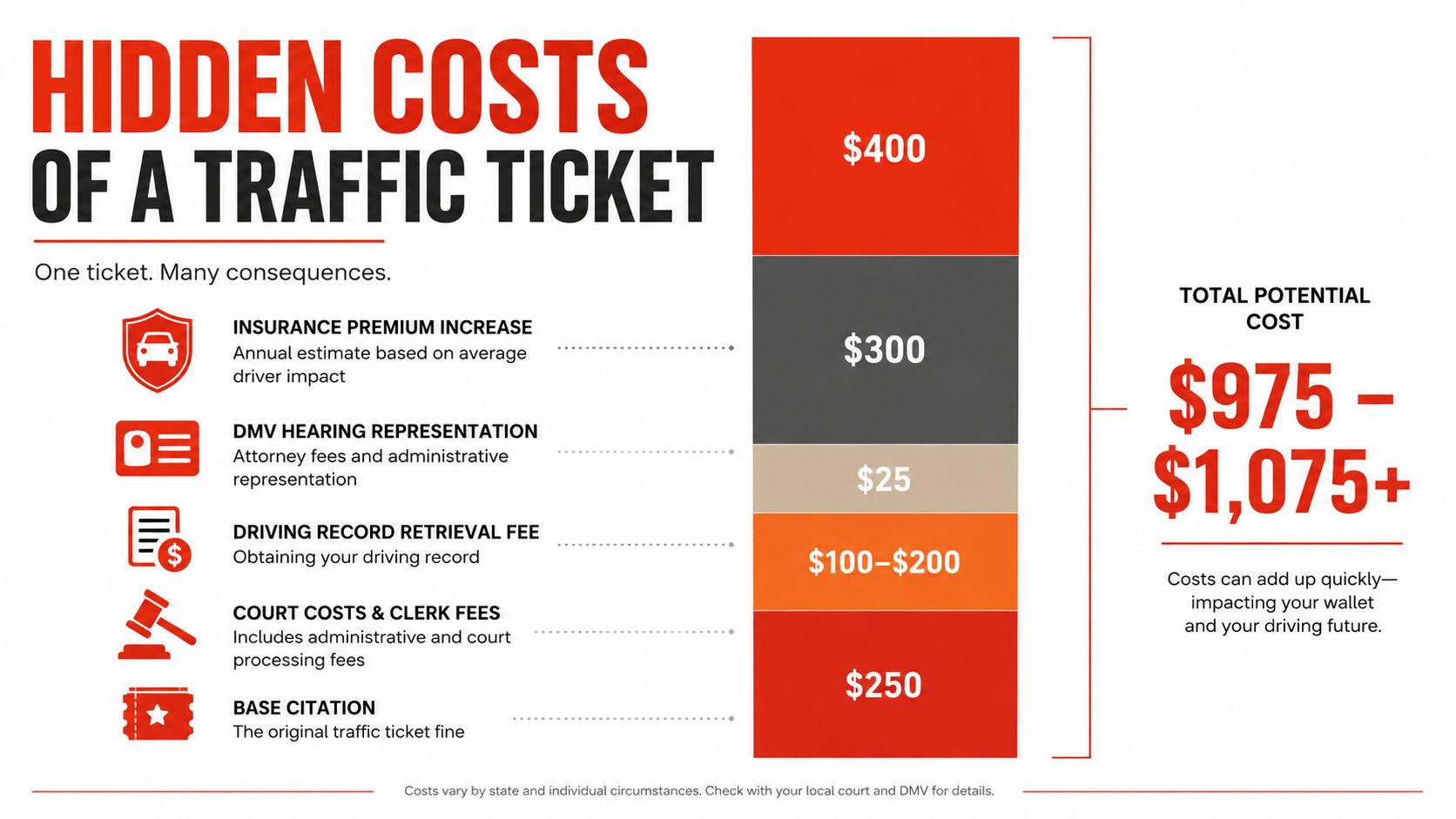
The legal fee is only one layer of the bill. If you're comparing “pay the ticket” against “hire a lawyer,” you have to include the fees and consequences that show up after the court date. That means court filing costs, record pulls, DMV-related issues, and the insurance hit that can follow a conviction.
The bill does not stop at the lawyer
A lot of content talks only about the lawyer's fee. That misses the question, which is what you'll pay end-to-end. Traffic defense can involve filing fees, driving-record fees, DMV hearing representation, and in more serious cases, expert-witness costs. Neutral cost guides note that those extras can add substantially to the bill, especially in trial-type matters (Houlon Berman).
The lowest quote is not always the lowest total cost.
That's the part most drivers miss. A guilty plea can create a chain of expenses you don't feel right away, but you absolutely pay for later. If you are trying to protect your budget, you have to compare the whole picture, not the upfront sticker.
Insurance is where the damage often shows up
The hidden cost that hurts most drivers is insurance. One Florida traffic-defense source says insurance premiums typically increase by 10 to 30 percent after violations, and that can add around $1,000 in cost for a single ticket (Law Offices of Scott B. Saul). That is why a small legal fee can be smart money if it helps you avoid a conviction.
The logic is straightforward. A lawyer's fee is finite. An insurance increase can keep coming back every renewal cycle. If you want to see how that plays out in a Florida speeding case, review the insurance increase after a Florida speeding ticket.
For traffic marketers and law firms trying to reach the right drivers, a local visibility strategy also matters. A Local SEO tool for Lawyers is useful only if it gets you in front of the people who need defense before they pay the wrong way.
Questions to Ask Before You Hire a Florida Traffic Attorney
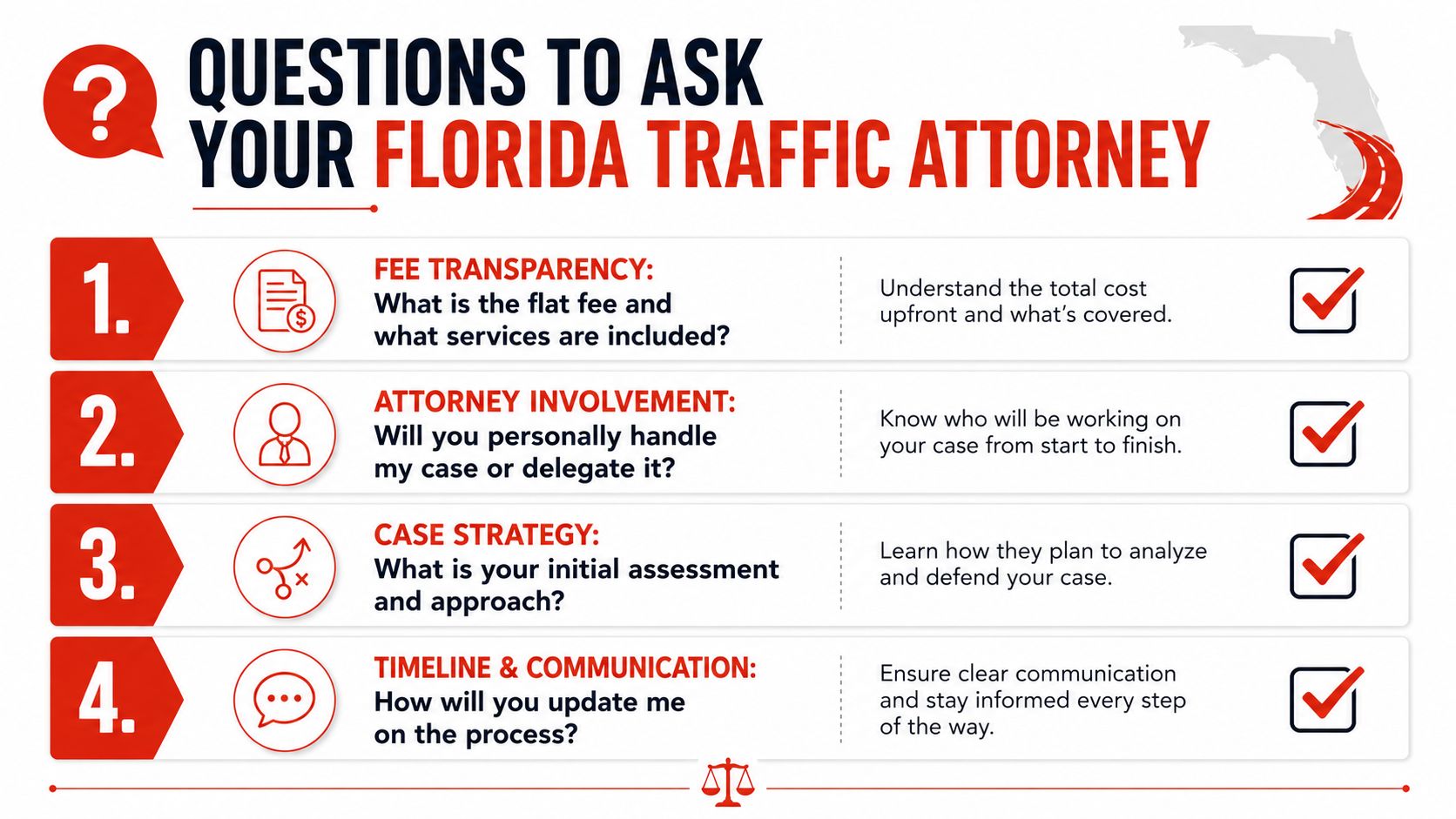
You do not need a legal degree to spot a weak consultation. You need a sharp checklist and five minutes of discipline. Ask the questions that separate a lawyer-led defense from a machine that farms out your file and hopes you won't notice.
Ask about fees before you ask about promises
Start with the money. A good lawyer should tell you whether the case is flat-fee or retainer-based, what that fee includes, and whether court appearances are covered. If the answer is vague, or the office keeps talking around the number, that's your warning sign.
Fee Transparency: Ask what the flat fee covers, and what costs extra.
Attorney Involvement: Ask whether the attorney handling your case is the person you'll reach.
Case Strategy: Ask what the first move is for your exact citation.
Timeline and Communication: Ask how updates happen, by phone, text, or email.
A good answer sounds direct, calm, and specific. A bad answer sounds scripted.
Demand clarity on courtroom handling and communication
You should also ask whether the lawyer will appear for you, whether you need to attend, and how often you'll hear from the office. If the firm makes you chase updates through a portal or a chatbot, that's not service, that's friction. The whole point of hiring counsel is to reduce uncertainty, not move it around.
The same goes for experience in the local courthouse. A Florida traffic attorney who knows the county rhythm is in a better position to read the room and prepare the right approach. If you want a firm that keeps the process direct, Ticket Shield, PLLC is one example of a lawyer-led model built around attorney communication, not layers of staff.
The crisis side matters too. If your ticket came with an arrest or public exposure, these online reputation crisis response steps can help you think about damage control while your defense is underway.
How to Estimate Your Total Ticket Lawyer Cost
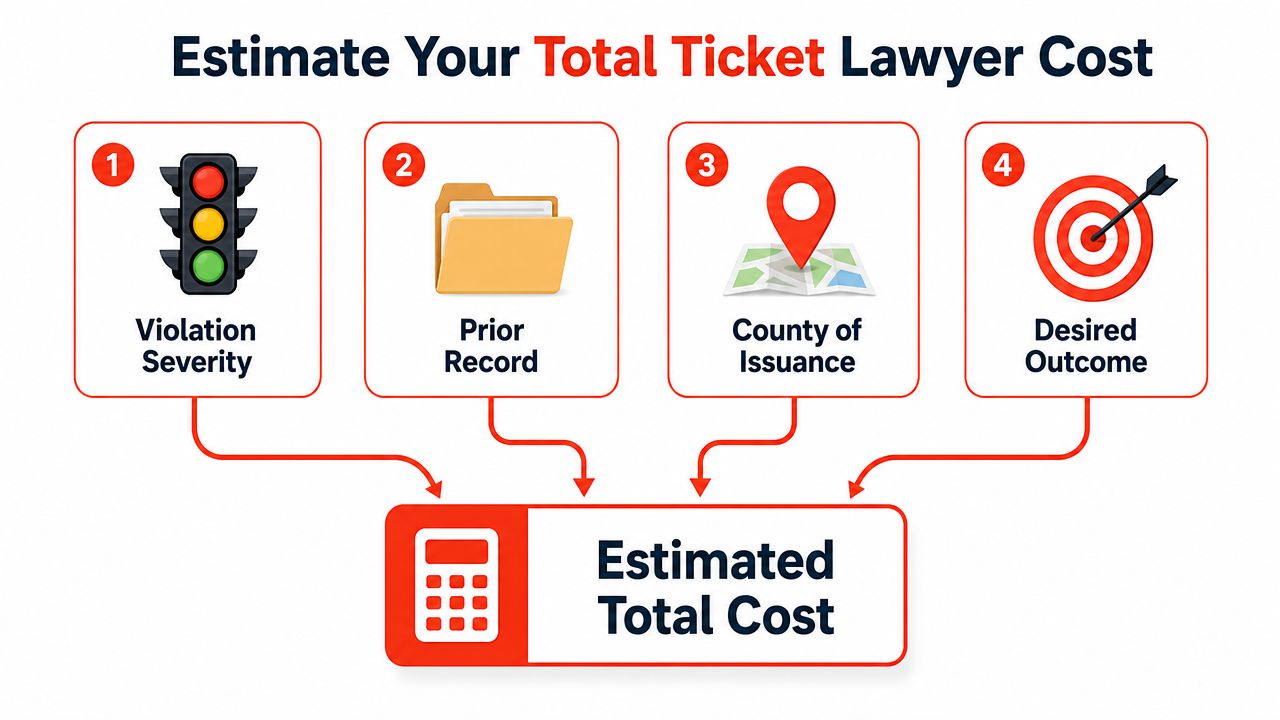
A useful estimate starts with four inputs, violation severity, prior record, county of issuance, and the outcome you want. A first-time speeding case in one county may be a routine flat-fee matter. A red-light ticket with a prior citation, or a DUI, belongs in a different pricing lane entirely.
Build your estimate from the charge, not from hope
Start by identifying whether the citation is minor, moderate, or serious. Then look at whether there's a prior ticket on your record, because repeat issues usually require more work. Add the county because local practice can influence how a lawyer staffs and handles the file. Finally, decide whether you want dismissal, reduction, or a school-related resolution if the option exists.
That framework is how you avoid getting fooled by one-size-fits-all pricing. A quote only means something when it matches the work. A simple citation may stay in flat-fee territory, while a contested or criminal traffic matter can move into the higher ranges already discussed.
Compare the total path, not just the quote
If you want a deeper breakdown of what goes into fighting a citation, review how much it costs to fight a traffic ticket. The choice is not “pay lawyer fee or pay nothing.” It's “pay a known amount now or risk a larger cost later through points, insurance, and license consequences.”
Bottom line: The right estimate is the one that includes both the defense fee and the cost of a bad result.
That is why you should think in outcomes. If a lawyer helps you protect the record, the total value can be far greater than the flat fee. If the case is serious, the estimate should reflect the stakes, not a marketing slogan.
Protect Your License With a Florida Defense Team
The upfront fee is not the actual measure. The actual measure is whether the case ends with No Points, no insurance hit, and no license trouble that follows you for months. A $39.99 starting price means nothing if it leaves you exposed to a costlier result.
A lawyer-led Florida firm gives you judgment that a ticket mill cannot match. Automated legal apps and chatbot-driven services hand out scripted responses. They do not read the room, assess the officer, or tell you what protects the record. You need a real person who knows when a citation should be fought hard and when a practical resolution makes more sense.
If the stop or arrest has spilled into public embarrassment, handle that part fast and carefully. Follow the TheBestReputation crisis response tips, keep your statements tight, and do not let a sloppy response create a second problem on top of the ticket.
Visit Ticket Shield, PLLC for a free consultation and move toward No Points on your license before this ticket turns into a much bigger problem.
Visit Ticket Shield, PLLC for a free consultation. If you want a lawyer-led Florida defense that focuses on No Points, direct attorney communication, and protecting your license, this is the time to act. Do not wait for insurance or DMV consequences to make the decision for you.