Florida Hardship License Hearing: Protect Your Driving
Facing a Florida hardship license hearing? Our guide covers eligibility, forms, prep, and lawyer's role. Protect your driving privilege today!

Your license is suspended, but you may still have a path to drive legally. A Florida hardship license hearing can protect limited driving privileges, but one procedural mistake can kill the request before anyone hears your case. Act fast and treat this like a legal emergency.
You're probably reading this because your ability to drive just got ripped out from under you. Work, school, family obligations, medical appointments, court dates, everything now depends on whether you handle the next steps correctly. Most drivers assume this is just paperwork. It isn't. A Florida hardship license hearing is a narrow administrative process with strict rules, short deadlines, and zero patience for mistakes.
This is also where people get misled. They hear “hearing” and think courtroom. They hear “DUI case” and think one judge decides everything. That's not how Florida works. The driving issue and the criminal case can move on separate tracks. If you don't understand that split early, you can lose time, lose options, and stay off the road longer than necessary.
Under Florida Statute 316.193, DUI charges carry serious consequences, and the driving fallout can hit immediately. If you're dealing with the Bureau of Administrative Reviews in the Tampa area, that process can feel every bit as serious as anything happening near the Edgecomb Courthouse. The difference is that the administrative side often punishes procedural sloppiness faster than a court ever will.
You also need to think beyond today. A suspension can affect insurance, employment, and your long-term driving record. If you need context on the bigger picture, this guide on understanding how violations affect rates is worth reading. Before anything else, confirm your status through this Ticket Shield resource on checking if your Florida license is suspended.
Table of Contents
Your License Is Suspended What Happens Now
First, stop guessing. You need to know whether you're in a waiting period, whether you can apply yet, and what administrative path applies to your suspension. Drivers waste critical time because they rely on what the arresting officer said, what a friend told them, or what they assume a court date will fix.
A hardship hearing can be a lifeline. It can also become a trap if you treat it casually. This process is run through the Bureau of Administrative Reviews, not through the criminal judge handling your DUI charge. That distinction controls everything that follows.
Why panic causes bad decisions
Most unrepresented drivers make one of three mistakes right away:
They wait for court: They assume the criminal case has to move first. Often, that leaves them behind before the administrative side even starts.
They file too early or incompletely: An early filing can be pointless. An incomplete filing can stall the process.
They trust a system they don't understand: Automated apps and ticket mills push forms. They don't build legal strategy. When your license is on the line, middlemen and chatbots are a risk you shouldn't take.
Practical rule: If your right to drive affects your job or your family, legal guidance isn't optional. The administrative process punishes small mistakes harshly.
What you should do today
Use a disciplined approach, not a desperate one.
Confirm your exact suspension status: Don't rely on memory or assumptions from the arrest scene.
Identify the correct track: A hardship request, a challenge to the suspension, or another administrative response may apply depending on your facts.
Start gathering proof of need: Work, school, treatment, and necessary travel all matter.
Keep your phone available: Administrative contact can come with very little room for error.
Get legal help from an actual lawyer: You need direct attorney advice, not intake staff relaying generic answers.
If you speak with a lawyer-led firm, you should be able to text or call your attorney directly. That's how this should work. Anything less creates delay, confusion, and preventable mistakes.
Are You Eligible for a Hardship License
Bad news first. Not everyone can apply immediately, and many drivers aren't eligible the day they think they are. Florida requires some drivers to sit through a mandatory waiting period before hardship eligibility even begins.
According to Ticket Shield's guide on Florida hardship license rules, the process is handled through the Bureau of Administrative Reviews, and the waiting period can be 30 days for a first DUI with a breath-alcohol result over 0.08, 90 days for a first breath-test refusal, and one year for a Habitual Traffic Offender revocation before eligibility begins. The same guide states that DHSMV typically contacts applicants by phone within 21 to 30 days after the application and payment are submitted.
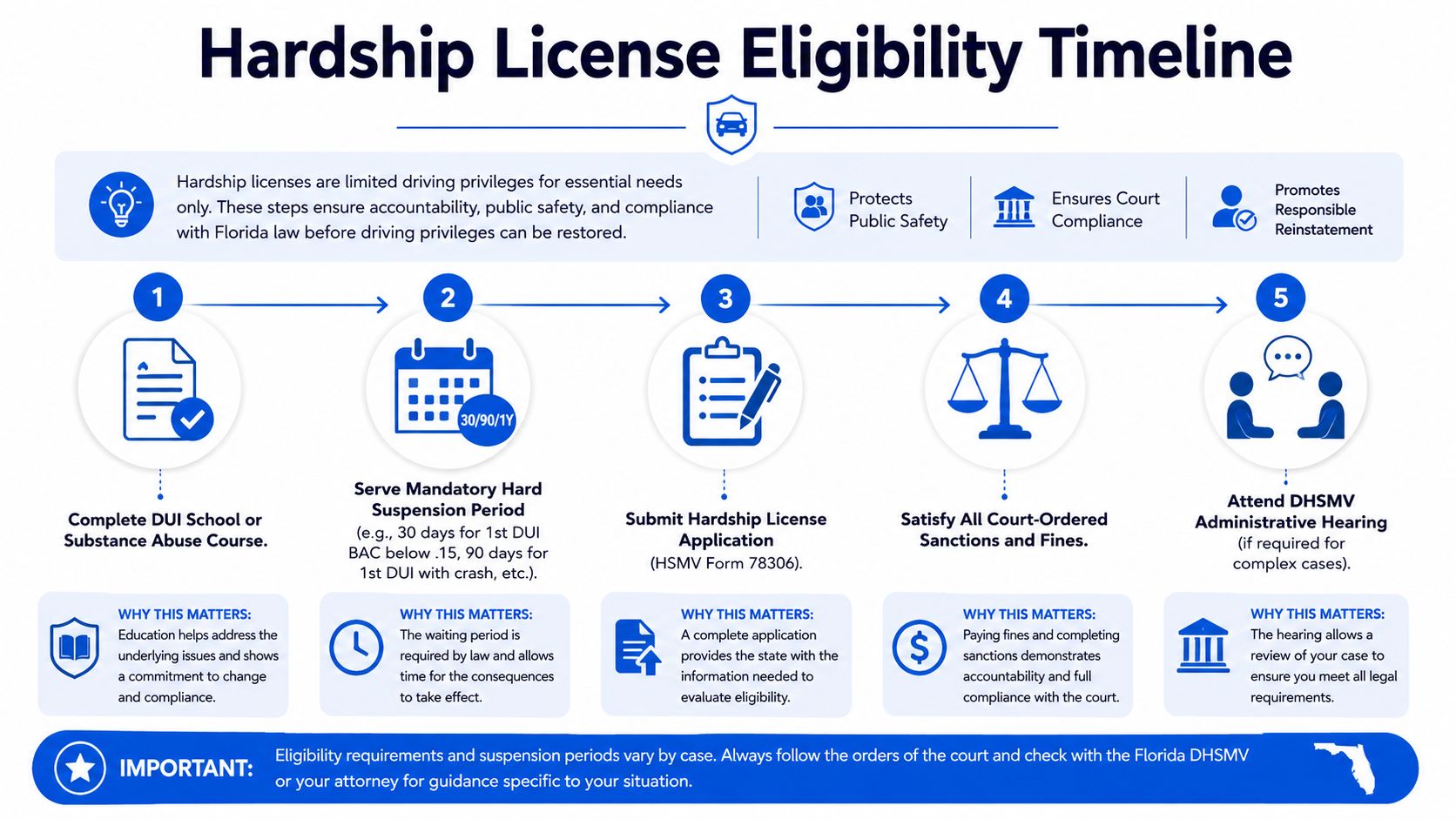
That means two things. First, some drivers legally cannot apply right away. Second, even after you become eligible and file, you still may wait while the administrative process moves.
Which waiting period controls your case
Your timeline depends on the reason for the suspension or revocation. Don't blend categories together.
Situation | When eligibility begins |
|---|---|
First DUI with breath-alcohol result over 0.08 | 30 days |
First breath-test refusal | 90 days |
Habitual Traffic Offender revocation | One year |
Those numbers matter because filing before the waiting period expires doesn't show initiative. It shows you don't understand the rules.
Why timing errors get people denied
The biggest timing mistake is counting only the hard suspension and ignoring the administrative processing that comes after filing. Drivers often tell themselves, “My wait is over, so I should be driving soon.” That's not how this works.
Your legal eligibility date and your practical hearing date are not the same thing.
You need to plan for both. If driving is essential to your income, your schedule, or your family obligations, don't build your life around the earliest possible date and hope the state moves instantly. It won't.
If you need a cleaner breakdown of the prerequisites, Ticket Shield has a separate guide on requirements for a hardship license in Florida. Use it to cross-check your assumptions before you file anything.
The Critical Difference Between Your Court Case and the DHSMV Hearing
A common pitfall for many drivers is this: They think, “If my DUI gets reduced or dismissed, my license issue goes away too.” That assumption is wrong often enough to do real damage.
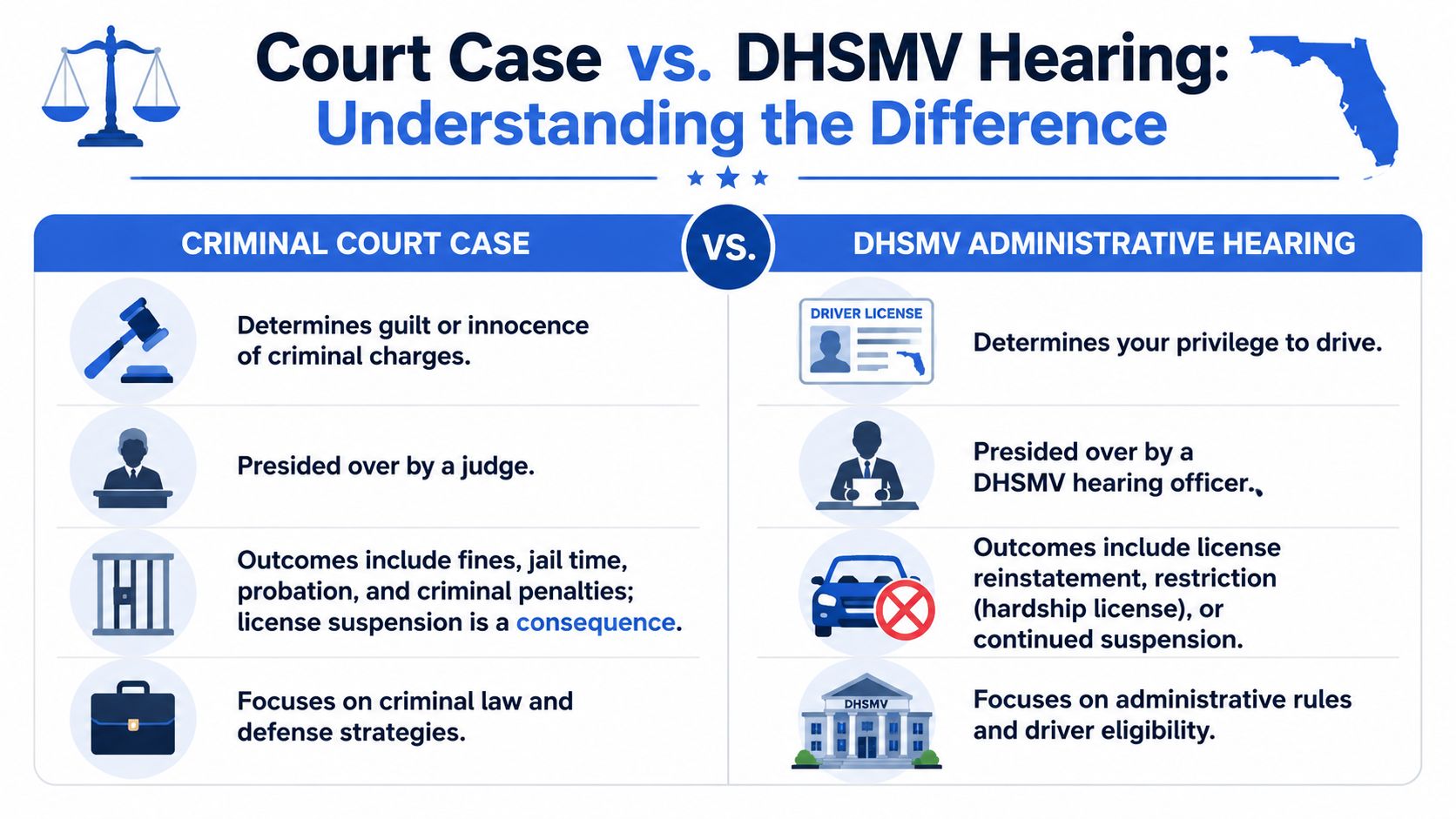
The DHSMV administrative process is separate from the criminal case. A favorable result in criminal court doesn't automatically wipe out the administrative license problem.
Why a court win may not fix your license
A Florida legal Q&A discussing hardship licenses explains that the DMV administrative process stands apart from the criminal matter, and that even if the criminal case is dismissed or reduced, administrative license sanctions can still remain in effect. It also notes that drivers often misunderstand the strategic tradeoff between contesting the suspension and waiving review to pursue restricted driving sooner. You can review that discussion through this Florida hardship license Q&A.
That separation changes how you should think. Court is about the criminal allegation. The administrative side is about your privilege to drive. Those are connected in real life, but they are not resolved in the same room by the same decision-maker.
When strategy matters more than emotion
Some drivers want to fight everything on principle. Others want immediate restricted driving and are tempted to waive review without understanding the consequences. Neither reaction is strategy.
You need to ask the right question: What protects your ability to drive with the least long-term damage?
If you challenge the suspension: You may preserve broader rights, depending on the facts.
If you waive review to pursue hardship sooner: You may get on the restricted-driving path faster, but that choice can carry consequences.
If you guess wrong: You can lose your advantage on the administrative side while your criminal case is still pending.
A Florida hardship license hearing is not just a formality. It's a decision point that can affect both mobility and defense posture.
If you want a comparison point outside Florida, this overview of your options for a Georgia license suspension shows how other states also separate administrative and court processes. Florida drivers need the Florida-specific version of that analysis. For that, review Ticket Shield's page on the administrative license suspension hearing process.
How to Prepare Your Application and Evidence
This is the part where cases fall apart for stupid reasons. Not weak reasons. Not complicated reasons. Stupid reasons. A form isn't completed correctly. The wrong office gets the filing. Proof of enrollment is missing. The call comes in and the driver doesn't answer. Then the state denies the request before the hardship argument even gets real traction.
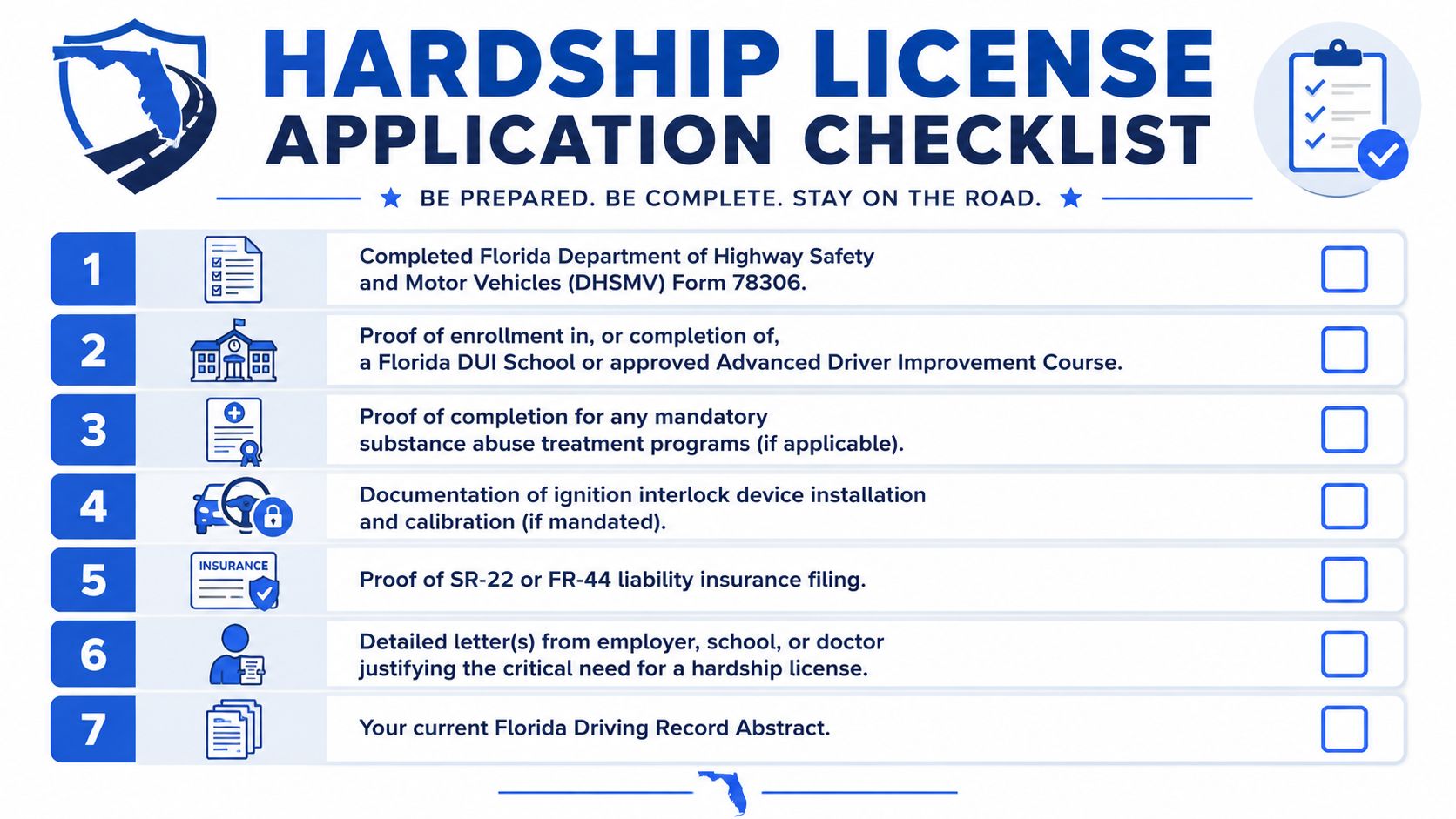
For many Florida hardship matters, applicants typically file Form HSMV 78306 with the Bureau of Administrative Reviews and pay the $25 hearing fee. A Tampa-focused hearing guide also states that the hearing is usually scheduled in roughly 21 to 30 days, the hearing officer commonly calls by phone, and missing all three call attempts can trigger an automatic denial requiring a new application and fee. That discussion is available in this article on what happens at a Florida hardship hearing with the Bureau of Administrative Review.
What must be filed correctly
Start with the basics and treat each one like it matters, because it does.
Form HSMV 78306: This is the application document commonly used to request the hearing.
The hearing fee: If the fee isn't properly handled, you haven't really started.
Course documentation: If DUI school or ADI proof is required in your situation, incomplete proof can stop the case before the hearing officer evaluates hardship.
Correct office routing: Filing in the wrong Bureau of Administrative Reviews office can create delay or derailment.
A driver doing this alone often underestimates the paperwork because none of it looks dramatic. That's why procedural mistakes are so costly. They don't feel serious until they trigger denial.
What usually goes wrong
Here's what I'd warn any client about immediately.
Missed phone contact: If the hearing officer is calling and you miss every attempt, you can lose on procedure alone.
Half-complete enrollment proof: “I signed up” isn't the same as proving proper enrollment.
Wrong assumptions about hardship: Wanting to drive is not enough. You need to justify restricted driving within the actual administrative framework.
Unorganized documents: If your paperwork tells a messy story, the hearing officer won't clean it up for you.
The state won't fix your packet. It will deny it and move on.
That's why lawyer-managed preparation matters. A real attorney reviews the timing, the filing path, the supporting documents, and the hearing setup. An automated service may give you prompts. It won't protect you from a denial caused by a missed call or a filing defect.
One practical option is Ticket Shield, PLLC, which handles Florida traffic and license matters in a lawyer-led format where clients communicate directly with their attorney by phone or text rather than through middlemen. If you're trying to understand the filing path itself, start with this resource on how to apply for a hardship license in Florida.
What to Expect at the Hardship License Hearing Itself
The hearing usually isn't a dramatic courtroom fight. Think of it as a formal administrative interview with high stakes. The officer is evaluating whether you qualify for restricted driving, whether you followed the required process, and whether your claimed hardship is supported.

A lot of these hearings happen by phone. That catches people off guard. They prepare emotionally for a courtroom scene, then perform badly in a short, direct administrative call because they ramble, argue, or sound unprepared.
What the hearing officer wants to hear
The officer is not there to listen to a long story about how unfair the arrest felt. The focus is narrower.
Expect questions aimed at issues like these:
Why you need to drive: Work, business necessity, education, treatment, or other restricted lawful purposes.
Whether you complied: Enrollment, filings, and any required steps.
Whether your documents match your story: If your explanation and paperwork conflict, your credibility drops.
Whether you understand the limits: A hardship license is restricted. It is not full reinstatement.
Keep your explanation tight. Need, compliance, and credibility matter more than outrage.
How to answer without hurting yourself
You should answer like a professional asking for limited relief, not like someone venting about the arrest.
Be specific: Explain where you need to go and why that travel matters.
Be disciplined: Don't volunteer extra facts that create new problems.
Be respectful: Entitlement is poison in an administrative hearing.
Be consistent: Your spoken explanation must align with your paperwork.
This short video gives additional context on the process and restrictions drivers face.
If you want to understand the limits that may apply after approval, review Ticket Shield's guide on Florida hardship license restrictions. Read it before the hearing, not after. You need to know what you're asking for.
After the Hearing and Your Next Steps
Once the hearing ends, you're usually in one of three positions. You're approved for restricted driving. You're denied. Or the officer wants additional information before moving forward. None of those outcomes should surprise you if your case was prepared properly.
If you're approved
Approval is not freedom. It's permission to drive within restrictions. If your hardship relief is limited to business or employment purposes, then treat that limitation seriously in your daily life.
That means you should do all of the following:
Learn the exact scope of the restriction: Don't guess about side trips or personal errands.
Carry yourself carefully: Restricted means restricted.
Stay compliant with every requirement tied to the privilege: Administrative relief can disappear fast if you get casual.
Keep your paperwork organized: If a future issue comes up, records matter.
If you commute through major urban courthouses like the Richard E. Gerstein Justice Building in Miami or the Orange County Courthouse in Orlando, that daily pressure can make it tempting to stretch the rules. Don't. A hardship license helps only if you protect it.
If you're denied
A denial doesn't always mean your underlying hardship was weak. Sometimes it means the process was mishandled. That's an important distinction because it shapes your next move.
Look at the likely cause:
Procedural denial: Missed call attempts, bad filing, incomplete proof, wrong office.
Substantive denial: The officer wasn't convinced the legal standard for restricted driving was met.
Mixed denial: Both the paperwork and the presentation hurt the case.
If you were denied, don't file the same broken case a second time and hope for mercy.
Fix the defect first. Then decide whether reapplication or another legal response makes sense. If the denial came from an avoidable mistake, that should tell you something important. You need tighter control of the process than you had the first time.
The bigger lesson is simple. A Florida hardship license hearing is not hard because the concept is complicated. It's hard because the system is unforgiving. The people who lose often don't lose because they lacked need. They lose because they misunderstood timing, filed carelessly, or assumed the criminal case would solve the license problem for them.
If your license affects your income, your family, or your future, protect it like it matters. Because it does.
If you want a lawyer-led plan focused on protecting your record and pursuing the No Points outcome wherever possible, visit Ticket Shield, PLLC for a free consultation.