Hardship License Rules in Florida: Your Complete Guide
Explore hardship license rules florida: learn eligibility, application steps, and how to regain driving privileges after suspension.
Losing your driver's license in Florida can throw your entire life into chaos. Suddenly, simple tasks like getting to work, picking up your kids, or running to the grocery store become massive logistical problems. If you're in this situation, understanding Florida's hardship license rules is the first step toward getting back on the road—and back to your life.
Think of a hardship license not as a replacement for your regular license, but as a critical lifeline. It’s a restricted permit that allows you to drive for essential reasons, but it comes with strict rules you absolutely have to follow.
Understanding Your Florida Hardship License Options
When the state suspends your license, they do recognize that taking away your ability to drive can create a genuine crisis. That's where the Florida Department of Highway Safety and Motor Vehicles (DHSMV) comes in, offering restricted licenses—what most of us call hardship licenses—to help people stay afloat.
It's a common myth that license suspensions are only for dangerous driving. The reality is that a huge number of suspensions are tied to financial difficulties. A recent analysis revealed that of the 700,000 Florida drivers with suspended licenses, a staggering 75% of those suspensions were for unpaid fines and court fees, not for being a menace on the road. This just goes to show how easily you can lose your driving privileges for reasons that have nothing to do with safety. You can discover more about the economic impact of these suspensions in Florida in this eye-opening report.
Business Purposes vs. Employment Purposes
Florida law splits hardship licenses into two main types, and knowing the difference is crucial. Think of it like a multi-tool versus a single screwdriver—one gives you flexibility for a range of essential jobs, while the other is built for one specific task.
Business Purposes Only (BPO) License: This is the more flexible of the two. A BPO license lets you drive for any reason connected to making a living. That means driving to and from work, driving for work if your job requires it, and even driving for necessary medical appointments or educational classes.
Employment Purposes Only License: This one is much tighter. It only allows you to drive directly to and from your job. That’s it. No stopping for groceries on the way home, no taking the kids to school, and no running to the pharmacy.
Which one you might qualify for depends entirely on why your license was suspended in the first place.
Key Takeaway: A hardship license is not a right; it's a privilege. If you get caught violating its strict limits—like driving outside your approved times or for a non-approved reason—you could face even tougher penalties, including a longer suspension or a criminal charge for Driving While License Suspended (DWLS).
Getting through this process means paying close attention to every detail, from making sure you’re eligible to filing the right paperwork with the Bureau of Administrative Reviews.
To help you get a quick handle on the basics, the table below breaks down the key facts about Florida hardship licenses.
Florida Hardship License Quick Facts
Aspect | Details |
|---|---|
License Types | Business Purposes Only (BPO), which is more flexible, and the highly restrictive Employment Purposes Only license. |
Common Suspension Reasons | DUI, racking up too many points, refusing a breathalyzer, being labeled a Habitual Traffic Offender (HTO), or having unpaid fines. |
General Eligibility | This depends on your specific suspension, completing required courses like ADI or DUI school, and waiting out any mandatory "hard suspension" periods. |
Initial Step | The first thing you need to do is figure out exactly why your license was suspended and find the right Administrative Reviews Office to schedule your hearing. |
This table is just a starting point, of course. The path to getting a hardship license can be complicated, but understanding these core concepts will give you a solid foundation as you move forward.
Determining Your Eligibility For A Hardship License
So, you need a hardship license. Before you even start filling out forms, the very first step is figuring out if you actually qualify under Florida's rules. Not everyone with a suspended license gets a green light, and jumping the gun without knowing the requirements is a surefire way to waste your time and get a rejection letter.
The single most important concept to wrap your head around is the mandatory "hard suspension" period. Think of it as a cooling-off period—a non-negotiable amount of time where you are legally barred from driving for any reason whatsoever. No exceptions. The length of this blackout period depends entirely on why your license was suspended in the first place.
Understanding Mandatory Waiting Periods
These aren't suggestions; they're set in stone by Florida law. For instance, if you're dealing with a first-time DUI conviction, you have to sit out a 30-day hard suspension before you can even think about applying. If you refused to take a breath, blood, or urine test, that waiting period automatically jumps to 90 days.
It's absolutely critical to know these timelines:
First DUI (BAC over .08): You must wait 30 days.
First Breath Test Refusal: You must wait 90 days.
Habitual Traffic Offender (HTO): You have to serve a full one year of your five-year revocation before you're eligible to apply.
Trying to apply a day early will get your application tossed out by the Bureau of Administrative Reviews without a second thought.
Factors That Make You Ineligible
Beyond the waiting periods, some offenses will disqualify you from getting a hardship license, period. The state considers these violations too serious to grant even limited driving privileges. If your suspension is for one of the following reasons, a hardship license is unfortunately not on the table.
Some of the most common deal-breakers include:
Two or More DUI Convictions: Florida is incredibly tough on repeat DUI offenders. A second conviction will lock you out of hardship eligibility for a very long time.
A Second or Subsequent Refusal: If you’ve refused a chemical test before and then do it again, you won’t be eligible for a hardship license.
Certain Drug-Related Offenses: Convictions for trafficking or other specific drug charges often come with a license suspension that offers no hardship option.
Driving While Suspended Causing Death or Serious Injury: If your license was revoked for this felony, you will not be able to get a hardship permit.
Important Note: Getting the eligibility part right is everything. Making the wrong assumption can lead to a lot of frustration. You can learn more by exploring the specific requirements for a hardship license in Florida in our detailed guide.
The Role Of Required Courses
Finally, your eligibility often comes down to completing state-required courses before you even get to your hearing. These are not optional—they are prerequisites. For any alcohol-related suspension, you’ll need to enroll in, and sometimes complete, a DUI school program. If your license was suspended for racking up too many points, you'll likely need to finish a 12-hour Advanced Driver Improvement (ADI) course.
If you show up to your hearing without proof that you’ve enrolled in or completed the right course, the hearing officer at the Administrative Reviews Office will shut your application down on the spot. That's why it is so important to know exactly why you were suspended and get the required coursework knocked out before you even schedule that hearing. An honest look at these factors will tell you whether you can even move forward.
Navigating The Application Process In Miami-Dade County
Knowing you’re eligible is the first big hurdle, but the next phase—the actual application—is where the details really matter. While the core requirements for a hardship license are the same across Florida, looking at the process through the lens of a real location makes it much easier to understand. Let's use Miami-Dade County as our example to walk through the steps from start to finish.
The journey doesn't start at the courthouse. It begins with education. Before you can even think about scheduling a hearing, you have to prove to the state that you're serious about driving responsibly again.
First Step: Complete The Required Courses
The Florida Department of Highway Safety and Motor Vehicles (FLHSMV) won't even look at your application without proof that you've completed the right driver improvement course. This is a non-negotiable first step.
For Point-Based Suspensions: If your license was suspended because you racked up too many points, you must enroll in and complete a 12-hour Advanced Driver Improvement (ADI) course.
For DUI-Related Suspensions: If a DUI is the reason for your suspension, you have to enroll in a state-approved DUI school. For a first offense, proof of enrollment is usually enough; for any subsequent offenses, you'll likely need to show proof of completion.
Hang on to that certificate of completion or proof of enrollment. It's one of the most critical documents you'll need for your hearing.
Gather Your Essential Documents
With your course proof in hand, it's time to assemble your paperwork. Think of it like building a case file for the hearing officer. Showing up unprepared is the fastest way to get your application denied. In Miami-Dade, just like everywhere else in Florida, you'll need to bring several key items.
You will need:
Proof of Course Completion/Enrollment: Your ADI or DUI school certificate.
Application for Hardship License: The official state form, HSMV 78306.
Proof of Identity: A certified copy of your birth certificate, a valid U.S. Passport, or another primary ID.
Proof of Need: This is where you justify why you need to drive. A letter from your employer on company letterhead, your work schedule, or school enrollment forms are all good examples.
Forgetting any one of these documents can lead to an immediate denial, forcing you to reschedule and start the process all over again.
The flowchart below breaks down the initial eligibility check you should perform before you even start gathering these documents.
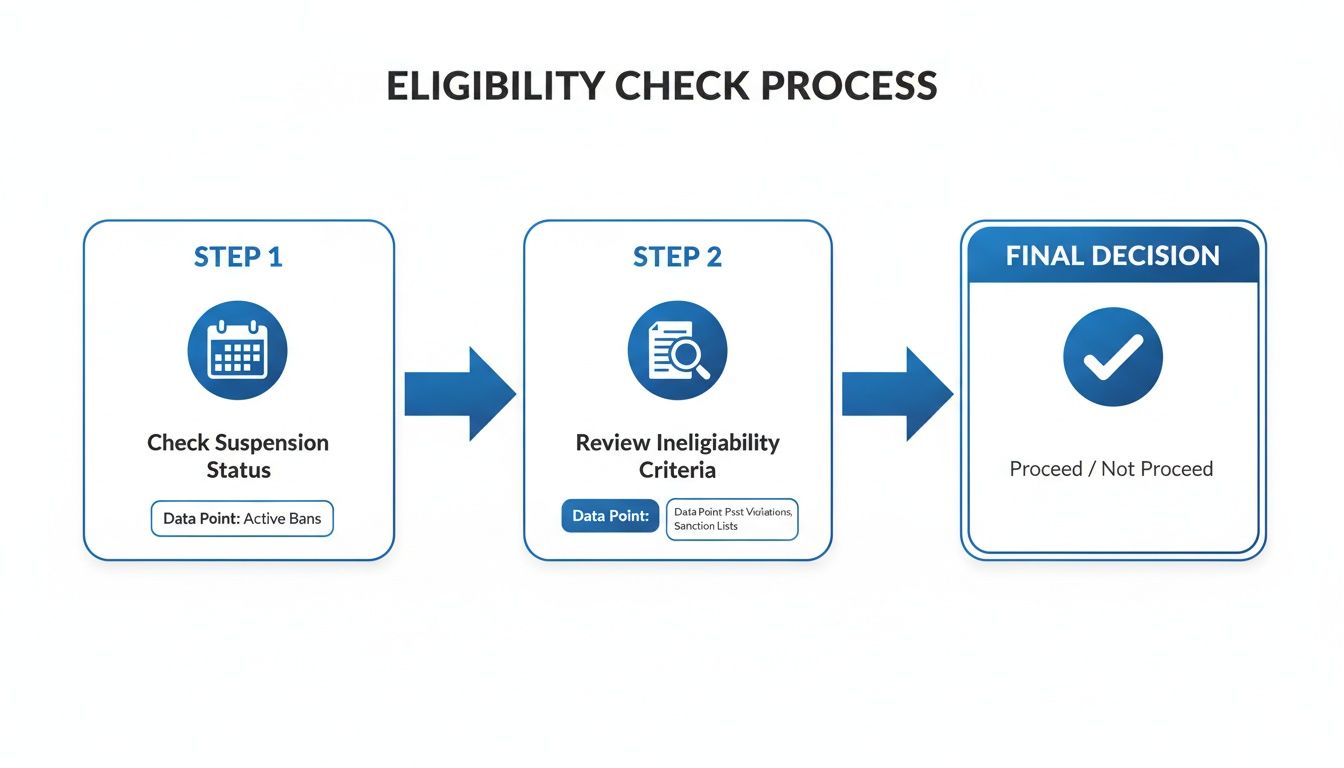
As you can see, verifying your suspension details and making sure you don't fall into an automatic "no" category are the foundational steps you have to take first.
Schedule And Attend Your Hearing
Once your documents are in order, you need to schedule a hearing with the Bureau of Administrative Reviews (BAR). In Miami-Dade, that office is located at 7795 West Flagler Street. You can't just walk in; an appointment is mandatory.
At the hearing, an officer will review your entire file, ask you questions about why you need to drive, and confirm you've met all the requirements. They will also take a close look at your driving record. Be ready to explain your situation clearly and respectfully. You can learn more about what to expect when you apply for a hardship license in Florida in our comprehensive guide on the topic.
Attorney Advertisement: Please be aware that this information is for educational purposes. Submitting information through our website does not create an attorney-client relationship. Our law practice focuses on traffic and DUI defense. Office in Broward.
If the hearing officer approves your application, you'll have to pay the required fees right then and there. This usually includes an administrative fee and a reinstatement fee, which can vary. In some cases, you may also need to take the driver's license exam again.
The whole process demands precision. A single mistake at any stage—from a missing document to a missed deadline—can set you back weeks. And while we've framed these steps around Miami-Dade County, the core requirements are the same statewide, which means careful preparation is key no matter where you live in Florida.
Hardship License Rules After A DUI Conviction
A license suspension from a traffic ticket is one thing. A suspension tied to a DUI conviction is a completely different animal, with its own set of tough, unforgiving rules.
The path back to driving after a DUI is narrow. It’s filled with critical deadlines, mandatory equipment, and tough choices that can determine whether you can drive for the next few months—or even years. Understanding Florida's specific hardship license rules for DUI cases isn't just helpful; it's essential.
Here's a critical point many people miss: after a DUI arrest, you’re actually fighting two separate battles at the same time. There's the criminal court case, of course, but there's also an immediate administrative license suspension from the FLHSMV. That administrative action kicks in long before you ever see a judge, and it’s where the hardship license process begins.
The Critical 10-Day Decision
The clock starts ticking the second you're arrested. You have exactly 10 calendar days to make a pivotal choice that will shape your immediate future. You can either request a formal hearing to fight the administrative suspension, or you can waive that right. Each path has huge consequences.
Requesting a Formal Review Hearing: This is your chance to challenge the suspension head-on. If the challenge is successful, your license gets reinstated. But if it is not, you’re stuck serving the full "hard suspension"—a mandatory blackout period where no driving is allowed whatsoever.
Waiving Your Right to a Hearing: By waiving the hearing, you accept the administrative suspension. The trade-off is that you might become immediately eligible for a BPO hardship license, as long as it's your first offense and you meet all the other strict criteria.
This is a complex decision with no easy answer. A mistake here could leave you without any way to drive for a long time.
First DUI vs. Subsequent Offenses
Florida law draws a very clear line in the sand between a first-time DUI and any later offenses. The requirements for getting a hardship license get exponentially harder with each conviction.
For a first DUI, there’s a pathway back to driving, but it comes with strict wait times. A driver with a BAC over 0.08 must serve a mandatory 30-day "hard suspension" before they can even apply for a hardship license. If you refused the breathalyzer, that waiting period jumps to a grueling 90 days with no driving at all.
However, recent changes in the law offer a lifeline. Some first-time offenders can now get a business-purpose hardship license immediately if they waive their right to a hearing, completely eliminating that painful downtime.
The table below breaks down the key differences in waiting periods for a first offense.
DUI Suspension vs. Refusal Suspension Timelines
Suspension Type (First Offense) | Mandatory 'No Driving' Period | Key Requirement for Hardship License |
|---|---|---|
DUI (BAC over 0.08) | 30 days | Must serve the full 30-day period before applying. |
Breathalyzer Refusal | 90 days | Must serve the full 90-day period before applying. |
As you can see, the choice you make at the time of your arrest has a direct impact on how long you'll be off the road.
And if you have a prior DUI conviction on your record? The wait times get much longer, and eligibility becomes a serious hurdle. Multiple DUIs can make you completely ineligible for a hardship license for several years.
DUI School, Ignition Interlock Devices, And FR-44 Insurance
Beyond the hearing, there are three other components that are absolutely non-negotiable if you want a hardship license after a DUI. Fail to do any one of these, and your application will be dead on arrival.
DUI School Enrollment: You must show proof that you've enrolled in a state-approved DUI program before your hearing. This proves to the FLHSMV that you're taking the situation seriously.
Ignition Interlock Device (IID): For most DUI-related hardship licenses, you'll be required to install an IID in your vehicle at your own expense. This is a small breathalyzer that prevents your car from starting if it detects alcohol.
FR-44 Insurance: This isn't your standard car insurance. It's a special high-risk insurance certificate required after a DUI conviction, proving you carry liability coverage far above the state's minimum requirements.
Attorney Advertisement: This content is for informational purposes. Contacting our firm does not establish an attorney-client relationship. Our practice is focused on traffic and DUI defense matters across Florida. Office in Broward. Past results do not guarantee future outcomes.
Navigating these requirements is a detailed process where every step has to be done perfectly. For a deeper dive into the specifics, you should read our guide on the DUI hardship license in Florida. Our goal is to protect your license and record by making sure you understand every single requirement.
Other Serious Violations And Hardship Licenses
DUI suspensions get a lot of attention, but they’re far from the only reason you might find yourself needing a hardship license in Florida. Plenty of other serious violations can take you off the road, each with its own set of rules and frustrating eligibility requirements that can put your life on hold for years.
Two of the toughest situations involve drivers with a Commercial Driver's License (CDL) and those who've been labeled a Habitual Traffic Offender (HTO). In these cases, the stakes are incredibly high because a license suspension doesn't just disrupt your life—it can destroy your livelihood. It’s critical to understand that the path back to driving here is completely different from a standard suspension.
The Critical CDL Hardship License Rule
For truckers, bus drivers, and anyone who relies on a CDL to make a living, a suspension can be a professional knockout punch. There is one hard-and-fast rule every CDL holder needs to burn into their memory: a Florida hardship license cannot be used to operate a commercial motor vehicle.
That means even if you successfully apply for and receive a "Business Purposes Only" license, its power stops at your personal car. You can drive to the trucking depot, your office, or your place of employment, but you absolutely cannot get behind the wheel of a semi-truck or any other commercial vehicle until your CDL is fully reinstated.
Important Advisory: For a CDL holder, a hardship license is only a partial fix. It gets you back and forth for personal errands, but it does not get you back to work in your truck. Knowing this distinction is vital to managing your expectations—and your career—during the suspension period.
The Long Road for Habitual Traffic Offenders
Getting branded a Habitual Traffic Offender (HTO) by the FLHSMV is one of the most severe administrative penalties a Florida driver can face. An HTO designation triggers a mandatory five-year license revocation. You typically earn this status by racking up either three major traffic convictions (like DUI or Driving While License Suspended) or 15 moving violations within a five-year period.
The law does, however, offer a slim chance to get back behind the wheel sooner. An HTO can become eligible to apply for a hardship license, but only after serving a full one year of that five-year revocation without a single driving offense. You cannot be caught driving at all during that year. If you are, the clock resets, and your odds of getting approved drop to near zero.
Before you can even get a hearing, you must complete a 12-hour Advanced Driver Improvement (ADI) course. Getting your license back after an HTO revocation is a marathon, not a sprint, and it demands absolute compliance. To get a better handle on what leads to these serious suspensions, you can learn more about the reasons for a suspended license in Florida in our detailed guide.
Debt-Based Suspensions and Their Impact
Not every suspension is tied to dangerous driving. A huge number are purely administrative, often stemming from unpaid court costs and fines. This creates a vicious cycle: you can't drive to work to earn the money you need to pay the very fines that got your license suspended in the first place.
This issue has a massive, disproportionate impact across the state. In fact, recent data shows that a staggering 75% of license suspensions in Florida are due to nonpayment of fines, not dangerous driving. The economic fallout is huge, contributing to an estimated $491 million loss in consumer spending in 2019 alone as people were unable to get to work. You can discover more insights about these debt-based license suspension policies and their broader effect on Florida's economy.
How An Experienced Attorney Can Guide You
Trying to get a hardship license in Florida on your own can be a frustrating experience. The process is a minefield of strict deadlines, confusing paperwork, and administrative hearings where one wrong move can get your application flat-out denied. A simple mistake on a form or forgetting a key document could set you back weeks, or even months, leaving you stranded.
An experienced traffic law firm can be your ally. Our entire practice is built around handling traffic and DUI defense matters across Florida. Our goal is to protect your license and your record by making sure every single detail of your application is handled correctly from the very beginning.
Avoiding Common and Costly Pitfalls
It’s unfortunate to see how many people get denied for reasons that were completely avoidable. With the right guidance, they could have been back on the road.
Some of the most common mistakes we see include:
Applying before the mandatory "hard suspension" period is actually over.
Forgetting to complete the required ADI or DUI school before the hearing date.
Not bringing enough proof to show a real need to drive for work.
Failing to understand the unique rules for DUI, HTO, or CDL-related suspensions.
A legal professional can pull your driving record and suspension order to confirm you’re actually eligible and map out a clear plan of action. We can help ensure you’ve checked every box before you walk into that hearing, building the strongest possible case for the hearing officer. Our experience lets us spot potential problems long before they can sink your application.
Attorney Advertisement: This content is for informational purposes only. Contacting our firm via website forms or calls does not establish an attorney-client relationship. Our practice focuses on traffic and DUI defense. Office in Broward. Past results do not guarantee future outcomes.
Building Your Case and Representing You
At your hearing, it’s on you to prove why you absolutely need driving privileges. We help you gather the proof that matters—like letters from your boss or your school schedule—and we prepare you for the exact questions the hearing officer is going to ask. This preparation is key to building a compelling case that clearly shows why a hardship license is essential for you to keep your life on track.
If your situation is more complicated, like dealing with a prior DUI or an HTO revocation, having a professional guide you becomes even more critical. You can learn more about how we help drivers by reading about our services for those with a suspended license in Florida.
Don't leave your ability to drive up to chance. For a Free Consultation, give us a call to talk about your situation.
Frequently Asked Questions
When your driving privileges are on the line, you’re bound to have questions. Getting a clear answer can feel tough, so we’ve gathered some of the most common questions we hear from drivers navigating the hardship license process in Florida.
What Is The Difference Between A Hardship License And A Regular License?
Think of your regular driver's license as a key that opens every door—you can drive pretty much whenever and wherever you want, as long as you follow the rules of the road.
A hardship license, on the other hand, is like a key that only works for a few specific doors. It’s a highly restricted privilege, not a right, that strictly limits when and why you can drive. It’s designed only for essential trips, like getting to work, school, church, or critical medical appointments.
Can I Get A Hardship License If I Live In A Rural Area With No Public Transportation?
Living in an area without buses or other transit options is a very real problem, and it's a central piece of your argument for a hardship license. Your job is to convince the hearing officer at the Bureau of Administrative Reviews that losing your ability to drive would cause a genuine, significant hardship.
A lack of transportation in your area can be a compelling reason, but it doesn't automatically guarantee you'll be approved. You still have to meet all the other eligibility requirements for the license.
How Long Does It Take To Get A Hardship License?
The timeline can vary quite a bit depending on your specific situation. The first hurdle is serving any mandatory "hard suspension" period where you absolutely cannot drive. This could be 30 days for a first DUI or 90 days if it was your first time refusing a breathalyzer test.
Once you’re past that waiting period, you have to schedule your hearing. How quickly that happens depends on the caseload at your local Administrative Reviews Office. The good news? If you are approved at the hearing, you can typically get the physical license issued that very same day.
What Happens If I Violate The Restrictions Of My Hardship License?
Getting caught breaking the rules of your hardship license is a huge mistake with serious consequences. If an officer finds you driving for a non-approved reason—like going to the beach instead of to work—you risk having the hardship license revoked on the spot.
Even worse, you could face a new criminal charge for Driving While License Suspended (DWLS). That can bring on a whole new set of problems, including steep fines, an even longer suspension, and possibly jail time. It makes it incredibly difficult to ever get your full driving privileges back.
Can I Apply For A Hardship License Online?
No, you can't. The application process for a Florida hardship license has to be done in person. You are required to attend a hearing at a Bureau of Administrative Reviews office where a hearing officer will personally review your file, look over your documents, and make the final decision.
Navigating a license suspension requires a solid understanding of the law and careful attention to every detail. At Ticket Shield, PLLC, we focus our entire practice on helping Florida drivers protect their ability to drive. If you're facing a suspension and need help with the hardship license process, contact us for a free, no-obligation consultation to go over your case.