DUI Hardship License Florida: How to Get Your Driving Privileges Back in Broward County
Learn how to obtain a Florida dui hardship license florida: eligibility, timelines, and steps to get back on the road.
Losing your driving privileges after a DUI arrest in Broward County is more than just an inconvenience—it’s a major disruption to your life. Suddenly, getting to work or school becomes a logistical nightmare. A DUI hardship license offers a way back behind the wheel, but only for essential needs, and getting one is a process with strict rules and non-negotiable waiting periods.
Navigating Eligibility for a Florida DUI Hardship License
A DUI arrest in Florida kicks off two separate battles that can take away your license. First, there's the administrative suspension from the Department of Highway Safety and Motor Vehicles (DHSMV), which is immediate. Then, there's the potential for a court-ordered suspension if you're convicted down the road.
To figure out if you can even apply for a DUI hardship license in Florida, you need to know exactly where you stand in both of these processes. The path isn't the same for everyone; it all depends on the specifics of your case, like whether this is your first offense or if you refused to take a breathalyzer.
First-Time DUI vs. Subsequent Offenses
Florida law is crystal clear on one thing: it treats first-time DUI offenders very differently than repeat offenders. This is the single biggest factor that determines how long you'll be completely off the road before you can even think about applying for restricted driving privileges.
If it's your first DUI and you provided a breath, blood, or urine sample, you’ll typically face a 30-day "hard suspension." During this time, there is no driving, period. Once those 30 days are up, you might be eligible to apply for a hardship license, but only if you've already enrolled in a state-approved DUI school.
The rules get much tougher for repeat offenses. A second DUI within five years of a prior conviction, for example, triggers a five-year license revocation. You'll have to sit out a mandatory one-year hard suspension before you can even be considered for a hardship license. A third DUI within ten years? That hard suspension jumps to two years.
Key Takeaway: The mandatory "hard suspension" period is non-negotiable. It's a set amount of time where you are legally barred from driving for any reason. Only after this period ends can the hardship license application process begin.
Florida DUI Hardship License Eligibility Timelines
To make sense of these timelines, it helps to see them laid out clearly. The mandatory "hard suspension" is the critical waiting period you must serve before the state will even look at your application for a hardship license.
Here's a breakdown of the waiting periods based on your DUI history:
DUI Offense | Mandatory 'Hard' Suspension (No Driving) | Eligibility for Hardship License Application |
|---|---|---|
First DUI (with breath/blood/urine test) | 30 days | After 30 days |
First DUI (with test refusal) | 90 days | After 90 days |
Second DUI (within 5 years) | 1 year | After 1 year |
Third DUI (within 10 years) | 2 years | After 2 years |
Fourth or Subsequent DUI | 5 years | After 5 years |
DUI Manslaughter | 3 years (if no prior DUIs) | After 3 years |
These timelines underscore just how seriously Florida treats repeat offenses. The waiting period is designed to be a significant deterrent, and there are no shortcuts.
The sheer volume of DUI cases in Florida highlights why these rules are enforced so strictly. Back in 2011, the state recorded 33,625 DUI convictions and issued over 55,000 DUI-related citations, with Hillsborough County leading the way. This isn't a system with a lot of wiggle room; meeting the exact eligibility criteria is your only path forward.
Understanding License Restrictions
If you do get approved, don't expect to get your old license back. You'll be issued a restricted license that strictly defines where and when you can drive. Florida has two main types:
Business Purposes Only (BPO) License: This is the most common type. It lets you drive to and from your job, perform work-related duties, and make other necessary trips, like going to school, church, or medical appointments.
Employment Purposes Only (EPO) License: This one is much more limited. It only allows you to drive directly to your workplace and straight back home. That’s it.
Think about a nurse in Fort Lauderdale who works odd hours at a hospital. With a BPO license, she could drive to her shift, stop to pick up her child from daycare on the way home, and attend a required training class on her day off. An EPO license, however, would only permit her to drive from her driveway to the hospital parking lot and back—no other stops allowed.
Knowing which license you might qualify for is a key part of the process. For a closer look at the specific conditions and paperwork involved, check out our guide on the requirements for a hardship license in Florida.
The 10-Day Rule: Your First and Most Critical Deadline
After a DUI arrest in Florida, the clock starts ticking—loudly. You have exactly 10 days from the date of your arrest to request a Formal Review Hearing with the Florida Department of Highway Safety and Motor Vehicles (DHSMV).
This isn't a suggestion; it's a hard deadline with no extensions. If you miss this 10-day window, you automatically give up your right to challenge the administrative suspension of your license. Your license will be suspended on the 11th day, period.
Think about it: an arrest on a Friday night in a busy area like Broward County means you have until the following Monday week to get your request filed. Waiting even one extra day closes this door for good, forcing you into a mandatory "hard suspension" period with zero driving privileges.
Why This Hearing Is So Important
The Administrative Review Hearing serves two critical purposes. First, it's your only shot to fight the immediate, administrative suspension of your driver's license. The hearing officer will look at the evidence to see if the arresting officer had probable cause and followed every procedure correctly.
Second, it's a strategic necessity. Even if the suspension is ultimately upheld, requesting this hearing is a required step to become eligible for the DUI hardship license Florida drivers need to get back to work and life. It shows you're taking the situation seriously.
How to Officially Request Your Hearing
You can't just call a number to request this hearing. It's a formal legal process that requires submitting an application to the Bureau of Administrative Reviews (BARS) office in the county of your arrest, along with the required filing fee.
You'll need a few specific things:
The DUI citation itself (this also serves as your temporary 10-day driving permit)
A formal application for the hearing
Payment for the state's filing fee
If you forget any of these items or fill out the paperwork incorrectly, your request can be rejected, causing you to blow past the 10-day deadline without even realizing it. Everything has to be perfect.
The visual below breaks down the general path to getting a hardship license, which all starts with this crucial first step.
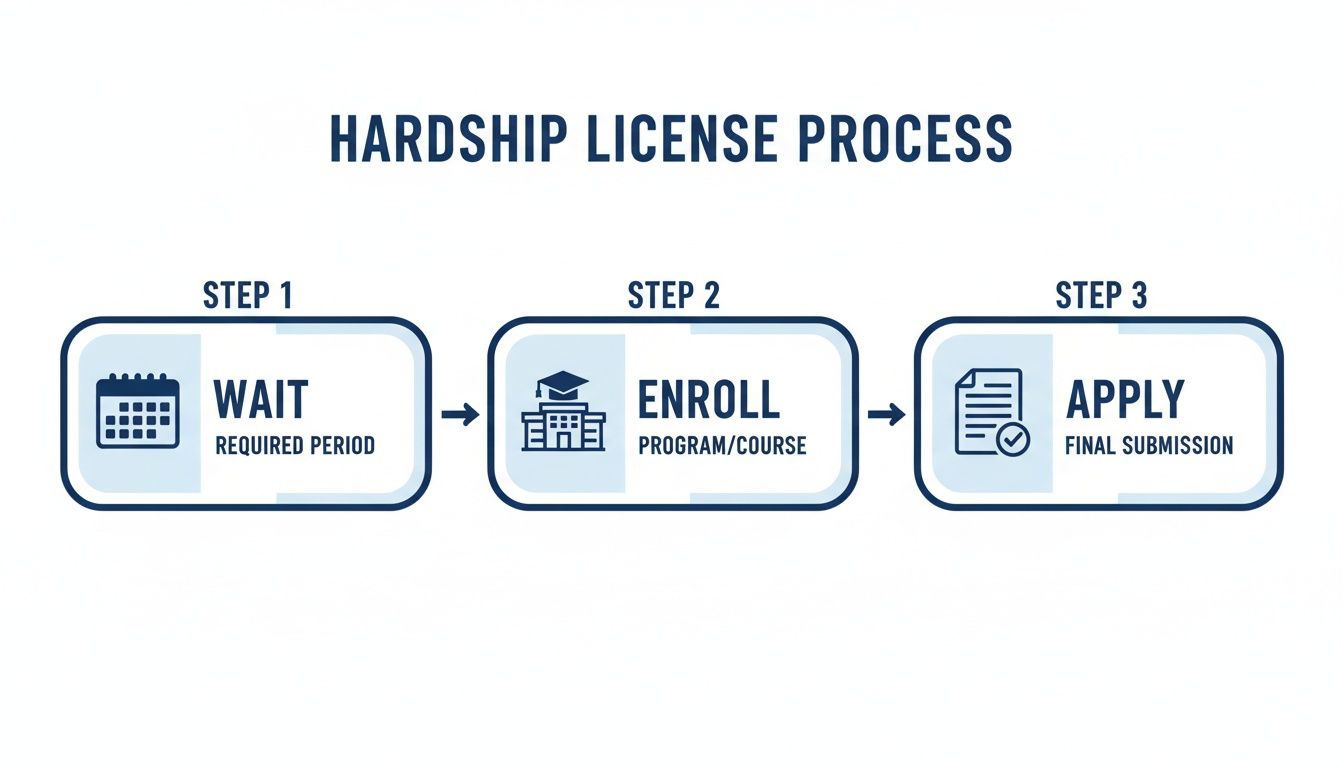
As the diagram shows, after you serve any required waiting period, the core of the process involves enrolling in DUI school and completing the application.
The Waiver Option: A Big Decision for First-Timers
If this is your first DUI and you did not refuse a breath, blood, or urine test, Florida law gives you another path. You can choose to waive your right to a formal review hearing.
By signing the waiver, you accept the license suspension but can immediately apply for a "Business Purposes Only" hardship license. This lets you skip the mandatory 30-day hard suspension you’d otherwise face.
But there's a catch. Waiving the hearing means the administrative suspension for the DUI will be permanently on your driving record. It’s a trade-off: get back on the road faster now versus a cleaner record later. This is a big decision that shouldn’t be made lightly. For more details on the hearing itself, you can get a better understanding of the administrative license suspension hearing and what it involves.
Deciding whether to fight or waive the suspension is complicated. It really comes down to weighing your immediate need to drive against the long-term consequences for your record, and qualified legal advice can help you choose the right path for your specific situation.
Assembling Your Application and Enrolling in DUI School
Once you’ve made it through the initial 10-day window and served any required "hard suspension" time, it's time to shift gears and focus on building your application package. A single missing document or a hastily filled-out form can bring the whole process to a screeching halt, leading to delays or even a flat-out denial of your DUI hardship license Florida application. This is where precision really counts.
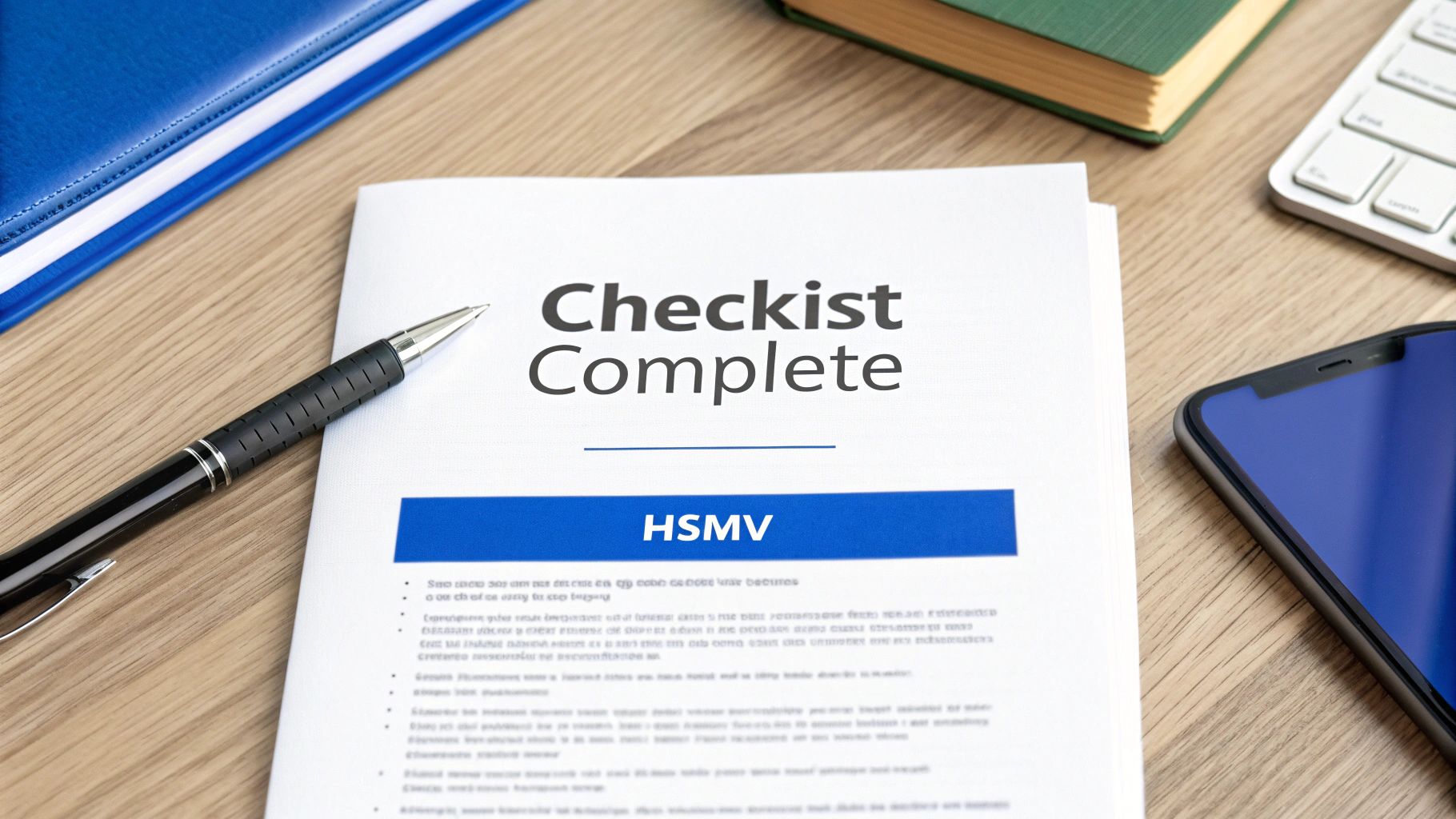
The two most important pieces of your submission are the official application form and proof that you’re already taking steps toward rehabilitation. This means you must enroll in a state-approved DUI school before you submit anything to the Bureau of Administrative Reviews (BARS). Just saying you plan to enroll isn't good enough—you need to hand them official proof.
The Essential Document Checklist
Getting all your paperwork together can feel like a huge task, but breaking it down into a simple checklist makes it manageable. Every single item on this list is non-negotiable, and the BARS hearing officer will be looking for a complete and orderly package.
Here’s what you’ll need to have in hand:
Application for Hardship License (HSMV 78306): This is the official form. Double-check that every single section is filled out completely and accurately.
Proof of DUI School Enrollment: You’ll need a certificate or official receipt showing you’ve paid for and enrolled in an approved program.
Required Identification: Standard stuff here—your birth certificate, Social Security card, and proof of your current residential address.
Payment for Fees: Be ready to pay all the required administrative and reinstatement fees when you go to your hearing.
This isn’t just about checking boxes. A well-organized application shows the hearing officer that you are taking this process seriously, which can make a real difference.
Choosing the Correct DUI School Level
A common trip-up for many people is picking the right DUI school. Florida has two different levels, and signing up for the wrong one will invalidate your application. The right choice depends entirely on your specific DUI history.
Level I DUI School: This 12-hour course is for first-time offenders. The goal is to educate drivers on the serious consequences of driving impaired.
Level II DUI School: This is a more intensive 21-hour program designed for anyone with a prior DUI conviction or for cases with aggravating factors. It almost always includes a substance abuse evaluation.
For example, a driver in Broward County arrested for a first-time DUI with a blood alcohol concentration (BAC) of 0.11% would sign up for the Level I course. But if that same driver had a previous DUI five years ago, they’d be required to complete the Level II program.
Making sure you’ve chosen the right level before you enroll is critical to avoid wasting your time and money. Our firm helps clients get these prerequisites right as part of our practice focus on traffic and DUI defense. You can get a broader view of the entire process in our detailed guide on applying for a hardship license in Florida.
SR-22 Insurance and Ignition Interlock Devices: What You Actually Need to Know
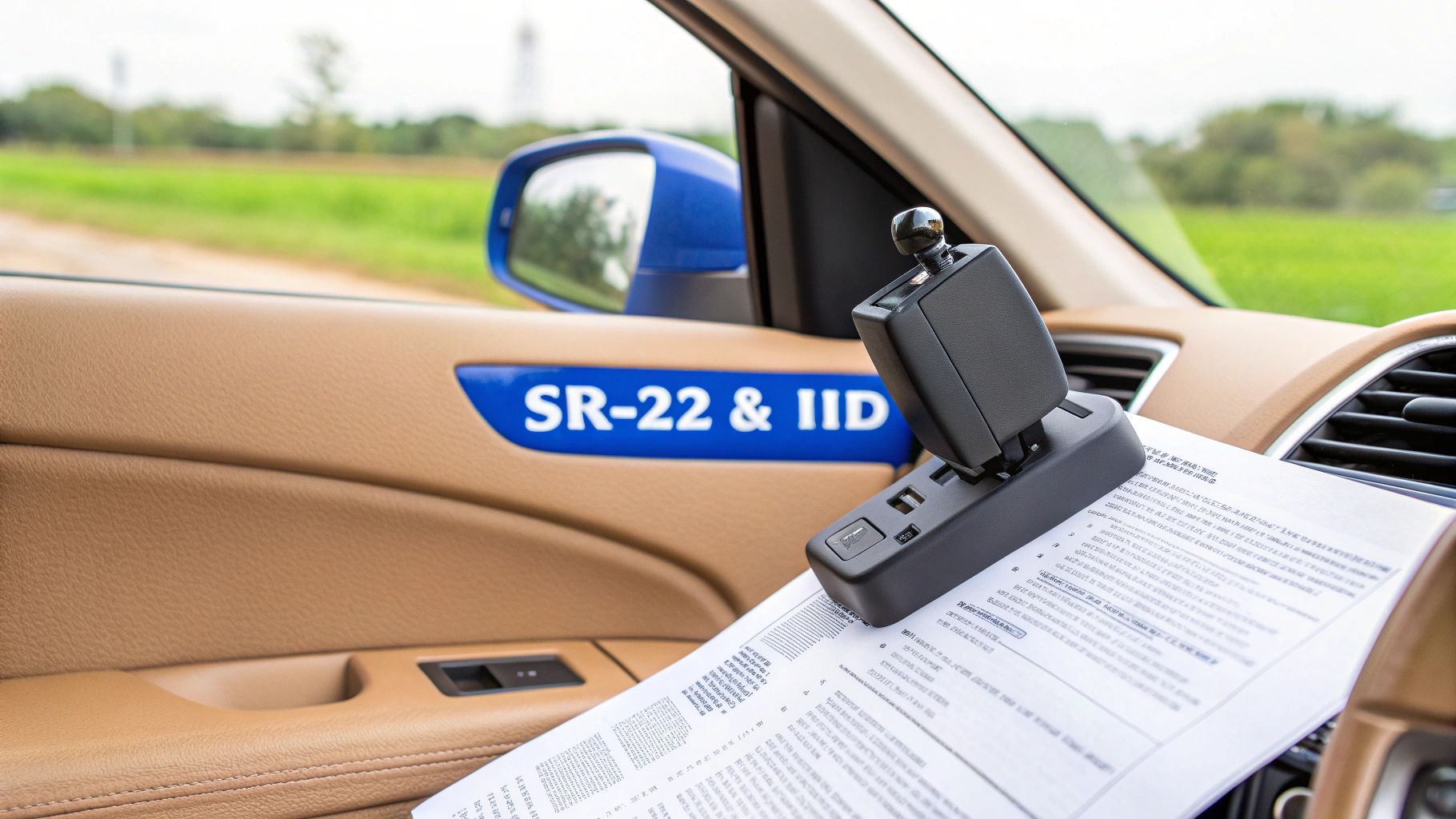
Getting back on the road with a DUI hardship license in Florida means doing more than just filling out forms and sitting through DUI school. You’re going to run into two terms that cause a ton of confusion: SR-22 insurance and the Ignition Interlock Device (IID).
It helps to stop thinking of these as just more penalties. Instead, see them for what they are: mandatory requirements the state uses to make sure you’re driving responsibly while it grants you limited driving privileges. Getting this part right is non-negotiable. One mistake here can get your hardship license yanked and land you in even more legal trouble.
Demystifying SR-22 Insurance
Let's clear up the biggest misconception right away: an SR-22 is not a type of insurance policy. It’s actually a certificate, a form that your insurance company files directly with the Florida DHSMV for you. This form serves one purpose: to prove to the state that you're carrying at least the minimum liability coverage required by law.
Key Insight: The SR-22 doesn't provide coverage; it just proves you have it. Your insurance company is essentially telling the state, "We've got this person covered, and we will tell you the second they stop paying."
Because you're now considered a high-risk driver, filing an SR-22 will almost certainly make your insurance premiums go up. You’ll be required to keep that SR-22 on file for three consecutive years, and it can't have any breaks. If you let your policy lapse—even for a single day—your insurer is legally required to notify the DHSMV, and your license will be suspended all over again.
The Role of the Ignition Interlock Device
While the SR-22 keeps an eye on your insurance, the Ignition Interlock Device (IID) keeps an eye on you. An IID is a small breathalyzer that gets wired directly into your car's ignition system by a professional installer.
Before your car will start, you have to blow into the device. If it picks up any alcohol on your breath over a very low limit (usually around .02 to .025), the engine won’t turn over. Simple as that. The device also makes you perform random "rolling re-tests" while you're driving to ensure you haven’t had anything to drink since you started your trip. If you miss or fail a test, it gets recorded and reported.
Installing an IID isn't always optional. For a DUI hardship license in Florida, it becomes mandatory if:
Your first conviction involved a blood alcohol concentration (BAC) of .15 or higher.
Your first conviction involved having a minor in the vehicle.
This is your second or subsequent DUI conviction.
For example, a driver in Duval County with a first-time DUI and a BAC of .16 will need an IID for at least six months just to be eligible for a hardship license. If it’s a second offense, that requirement jumps to a minimum of one year.
Costs and Compliance Are 100% Your Responsibility
The financial burden and personal responsibility for both the SR-22 and the IID fall squarely on your shoulders.
SR-22: You'll pay your insurance company a one-time filing fee on top of the higher premium rates for the entire three-year period.
IID: You’re on the hook for installation costs, a monthly lease or monitoring fee, and regular calibration fees. All in, this can easily add up to several hundred dollars over a year.
And compliance has to be perfect. Trying to tamper with, bypass, or get someone else to blow into your IID is a serious crime in Florida. It can lead to jail time and the permanent loss of your hardship license. These devices work—state data shows the six-month DUI recidivism rate for first-timers with IIDs was just 0.34%, a massive 81% lower than for those without one.
Think of the SR-22 and IID as tools that allow you to drive legally and safely under the terms of your restricted license. If you need more clarity on insurance rules, check out our guide on providing proof of insurance and registration.
What to Do If Your Hardship License Application Is Denied
It’s a gut punch. After jumping through all the hoops to get your DUI hardship license in Florida, receiving that denial letter feels like a massive setback. You did everything right, but it still wasn't enough. It's discouraging, to say the least.
But this isn't necessarily the end of the road. A denial is frustrating, but it's crucial to understand that it's not the final word. Most of the time, a rejection comes down to specific, identifiable reasons—and sometimes, those reasons can be fixed.
The key is to act fast. You need to figure out why you were denied and what your options are for challenging the decision. Giving up now only guarantees you'll serve the full suspension without any way to get to work or handle your life.
Common Reasons for Hardship License Denials
The Bureau of Administrative Reviews (BARS) doesn't deny applications on a whim. Denials are almost always based on an applicant's failure to meet the very strict requirements laid out in the law. A simple, honest mistake can be enough to get your application tossed out.
Here are some of the most common reasons we see for a rejection:
Incomplete or Inaccurate Paperwork: It sounds simple, but a missing signature on the HSMV 78306 form or a wrong date can trigger an immediate denial.
Failure to Complete DUI School: You have to show proof of enrollment or completion of the right DUI school level. A promise that you're "planning to enroll" just won't cut it.
Missed Deadlines: The timelines here are set in stone. Missing that critical 10-day window to request an administrative review hearing is a common and costly mistake.
Not Meeting Statutory Timelines: The waiting periods are non-negotiable. If you have a second DUI, for example, you have to serve a full one-year "hard suspension" before you're even eligible to apply. Applying on day 364 will get you an automatic rejection.
These timelines are especially critical if you have prior offenses. Florida’s rules have changed over the years, and now there’s even a path for fourth-time offenders who once faced a permanent revocation. They can apply after five years, but only if they’ve completed DUI school and treatment. Similarly, a third DUI within 10 years means you must serve a two-year hard suspension before hardship eligibility even begins. Falling short on these strict conditions is a primary reason for denial.
Your Options After a Denial
If your application gets denied, your main legal option is to appeal the decision. This isn't a do-over where you get to bring in new evidence. It's a formal legal challenge to the hearing officer's decision itself.
This appeal is filed in the circuit court in the county where your hearing was held and is officially called a Petition for Writ of Certiorari.
Important Note: You have a very short window to act. In most cases, you must file this petition with the court within 30 days of the date on your denial letter. Miss that deadline, and you forfeit your right to appeal. Period.
The court's job in a certiorari review is very narrow. A judge isn't going to rehear the facts of your case or listen to your story. Their only role is to review the existing record from your administrative hearing and decide if the hearing officer:
Followed the correct legal procedures.
Applied the law correctly to the facts.
Had enough evidence to support their decision.
This is a technical, legal argument, not an emotional one. For instance, if you can prove the hearing officer completely ignored a key piece of evidence—like your certificate showing you enrolled in DUI school—you might have a strong case for a successful appeal.
Because of the legal complexity and the unforgiving deadlines, this is the point where getting experienced legal help is absolutely critical. Our practice focuses on traffic and DUI defense, and our goal is to protect your license. We handle criminal traffic matters across Florida. For a broader look at license issues, you can learn more about how to reinstate a suspended license in Florida.
Common Questions About Florida Hardship Licenses
When you're dealing with the fallout of a DUI, the questions can feel endless. How do I get to work? What happens next? Here are some straightforward answers to the questions we hear most often about getting a hardship license in Florida. Just remember, this is for your information and isn't a substitute for legal advice on your specific case.
How Soon Can I Apply for a Hardship License After a First DUI?
For a first-time DUI where you gave a breath, blood, or urine sample, you're looking at a mandatory 30-day "hard suspension." This is a non-negotiable period where you cannot drive at all. Period. Once that month is up, you can start the process of applying for a hardship license.
Things get tougher if you refused the chemical test. That refusal triples the mandatory wait time to 90 days before you can even think about applying. For either path, one of the first things you absolutely must do is show proof that you've enrolled in a state-approved DUI school. Also, that initial 10-day window to request your administrative hearing is critical—missing it can seriously complicate your eligibility down the road.
Is a Hardship License Possible for a Second or Third DUI?
Yes, but it's a much steeper climb. The state imposes significantly longer "hard suspension" periods to reflect the seriousness of repeat offenses, meaning you'll be without any driving privileges for a long time before you can even apply.
Second DUI (within 5 years): You must serve a mandatory one-year hard suspension. No driving, no exceptions.
Third DUI (within 10 years): That waiting period doubles to a mandatory two years before you can apply.
On top of the long wait, any hardship license granted for a second or subsequent DUI will absolutely require you to install an Ignition Interlock Device (IID) in your vehicle for at least two years. The rules are complex, and our focus is guiding you through them. Past results do not guarantee future outcomes.
What Driving Does a “Business Purposes Only” License Permit?
A "Business Purposes Only" (BPO) license is strictly for getting you to and from places essential to your life and livelihood. It’s not a green light for your social life.
Think of it as driving for needs, not wants. This generally covers:
Driving to and from work.
Driving as required for your job duties.
Getting to school or educational classes.
Attending necessary medical or dental appointments for you or a dependent.
Traveling to religious services.
It does not cover personal trips like going to the gym, visiting friends, or doing general grocery shopping. The only exception is if a personal errand is incidental to an approved trip, like stopping at the pharmacy on your direct route home from work. Pushing these limits is a bad idea—getting caught can lead to your hardship license being revoked and even new criminal charges.
What Are My Options If My Hardship License Is Denied?
Getting a denial from the Bureau of Administrative Reviews feels like a major setback, but you do have an option to appeal the decision. The formal route is to file a petition for a "writ of certiorari" with the circuit court in the county where your hearing took place, like Broward County.
Critical Deadline: You have only 30 days from the date on the written denial to file this petition. If you miss this deadline, you lose your right to appeal. It’s a hard and fast rule.
The court won't re-hear your case. Instead, a judge will review the record to see if the hearing officer followed the law and proper legal procedures. Given how technical this process is and the tight timeline, this is the point where you should absolutely consult with an attorney. They can review why you were denied and give you a realistic assessment of your chances on appeal. Our goal is to protect your license and record.
Navigating the hardship license process can be a minefield, and one wrong step can set you back months. The attorneys at Ticket Shield, PLLC handle criminal traffic matters across Florida and are here to help. For a free consultation to discuss your case, visit https://www.ticketshield.com.
Attorney Advertisement. Office in Broward. Submitting information via our contact form does not create an attorney-client relationship.