Florida Hardship License Restrictions: A 2026 Guide
Facing a license suspension? Understand the strict Florida hardship license restrictions and how a lawyer can protect your right to drive. Get expert guidance.
TL;DR: A Florida hardship license is not freedom. It's a narrow, state-controlled privilege under § 322.271 that can help you work or handle essentials, but one wrong trip can trigger revocation, arrest, and a worse case.
The suspension notice hits fast. One letter. One stop. One DUI arrest. Suddenly, you can't legally drive to work, get your medication, or handle your family's daily routine.
That panic is justified.
In Florida, losing your license can crush your income in days. Debt-based suspensions make up about 75% of all suspensions in the state, while suspensions tied to dangerous driving account for just 3%, according to Ticket Shield’s review of Florida hardship license rules. This system catches working people and keeps them trapped.
If alcohol or a DUI allegation is part of your case, treatment requirements may also enter the picture. In some cases, a substance abuse evaluation becomes part of the practical path back to compliance and lawful driving.
You need clarity fast. Start by reviewing the suspension issue itself through this Florida driver license suspension guide. Then get strategic. Because florida hardship license restrictions are not simple rules. They are a legal minefield.
Table of Contents
Your License Is Suspended, Now What?
You find out your license is suspended at the worst possible moment. A traffic stop. A shift you cannot miss. A child waiting for pickup. From that moment on, every decision matters.
Drivers get in trouble fast because they treat the suspension like an administrative chore. That is the wrong mindset. A suspension puts you in a controlled legal process where one bad move can cost you the ability to drive for months longer than necessary, or trigger a new criminal charge.
Florida may allow limited driving relief under Florida Statute § 322.271. That relief is narrow, heavily conditioned, and easy to lose. If your case involves alcohol, drugs, or a DUI-related suspension under § 316.193, the state will scrutinize your record, your paperwork, and your timing. If treatment is part of the file, even a substance abuse evaluation can become a pressure point if you handle it sloppily.
Why urgency matters
The state does not give you extra grace because you are confused.
A hardship hearing is a screening process. The hearing officer decides whether you qualify, whether your documents support the request, and whether your history gives the state a reason to keep you off the road. Drivers who walk in planning to "tell their side" usually learn too late that explanations do not fix missing proof, bad timing, or the wrong filing strategy.
Practical rule: If you drive before you know your exact restrictions in writing, you are handing the state new evidence against you.
What your next move should be
Start with the cause of the suspension. That answer controls everything. A DUI suspension, points suspension, refusal case, unpaid court obligation, or prior revocation each creates a different path and a different risk level. If you are unsure what triggered the suspension, review the common reasons a Florida license gets suspended before you file anything.
Then get strategic. You need three answers immediately:
Why the state suspended you: The legal basis determines eligibility, waiting periods, and what kind of restricted privilege you can request.
Whether a blackout period applies: Some drivers can seek relief quickly. Others are barred for a set period no matter how urgent their need is.
What proof will carry the case: Employer letters, school records, treatment documents, FR-44 or other insurance filings, and your driving history often decide the outcome.
Handling this alone is where drivers sabotage themselves. They file too early, bring weak documents, admit facts they did not need to admit, or ask for broader driving privileges than the law allows. A lawyer approaches the same suspension differently. We identify the fastest lawful route, close gaps before the hearing officer sees them, and protect you from making statements that limit what you can recover.
Waiting and hoping is a mistake. So is guessing. Get the record, get the strategy right, and move before the suspension gets worse.
What Exactly Is a Florida Hardship License?
A Florida hardship license gives you limited permission to drive while your normal driving privilege is still suspended, revoked, or canceled. Under Florida Statute § 322.271, the state can grant restricted driving for narrowly approved reasons. If you want the bigger picture first, review this overview of Florida hardship licenses.
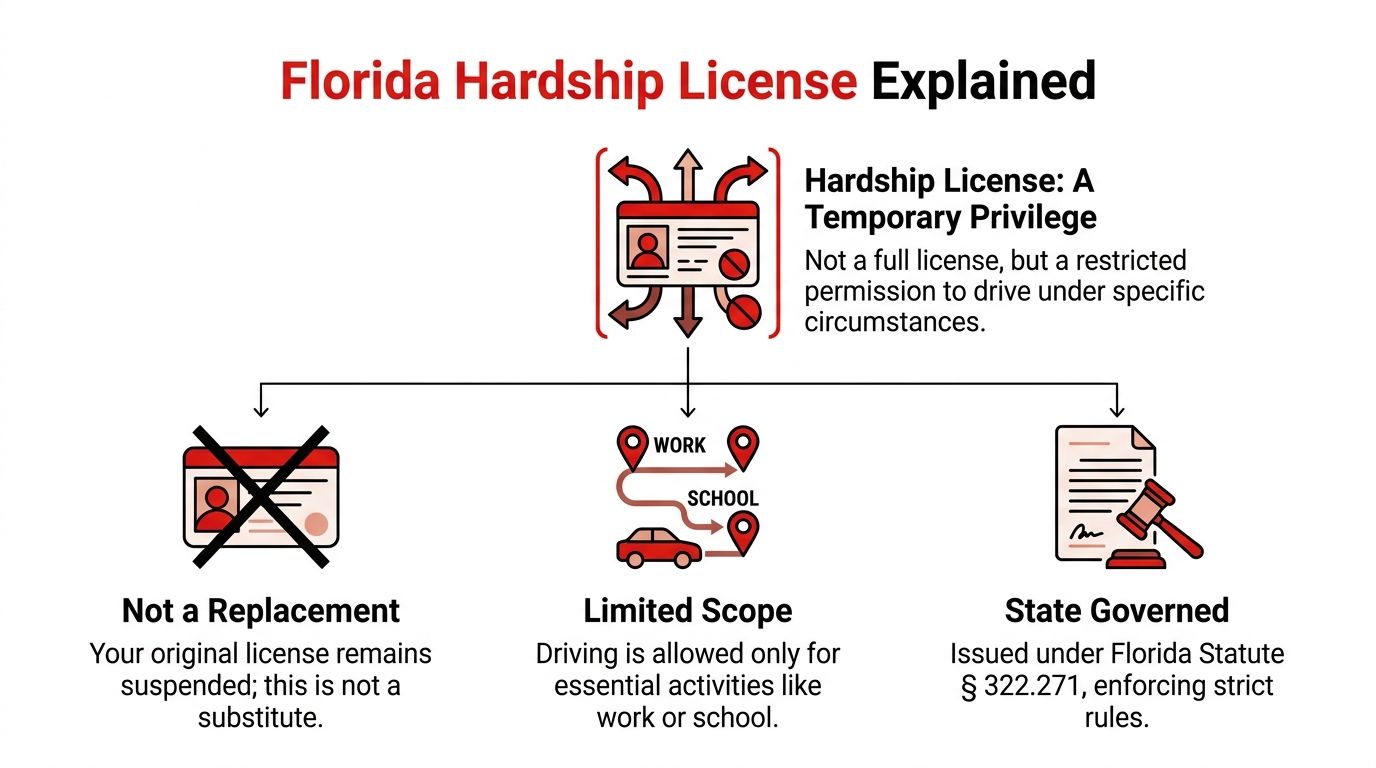
That legal distinction is where drivers make expensive mistakes.
Drivers often act as if a hardship license puts them back on the road with a few minor limits. It does not. The state is giving you a narrow exception to a suspension, and hearing officers treat that exception like a privilege that can be denied, restricted further, or lost again. If you apply without understanding that, you ask for the wrong relief, bring the wrong proof, and box yourself into tighter driving terms than you may have needed.
Florida grants hardship relief to keep a person working, getting medical care, attending school, or handling other approved life functions. It does not grant open-ended personal use. In DUI-related cases under § 316.193, the scrutiny gets stricter, and careless statements can do real damage.
A hardship license works like conditional permission under supervision. If your driving falls outside the condition, you are exposed.
The two main types of hardship licenses
Florida generally issues hardship licenses in two restricted categories.
License type | What it allows | How restrictive it is |
|---|---|---|
Business Purposes Only (BPO) | Driving tied to livelihood maintenance, including work, school, church, and medical needs | Broader than EPO, but still limited to approved purposes |
Employment Purposes Only (EPO) | Driving only to and from work and for direct job duties | The narrowest form of hardship driving |
A BPO license, often called a “C” restriction, allows more categories of necessary travel. A BPO holder may be allowed to drive for work, school, church, and medical needs if the trip fits the restriction and can be supported with records if questioned.
An EPO license is tighter. It usually limits you to commuting to work and carrying out direct employment duties. If you have EPO, a stop for groceries on the way home can become a violation problem, even if the detour felt harmless at the time. That is the kind of mistake drivers make when they rely on common sense instead of the actual restriction.
Why the wording matters
The label on the license controls your real freedom.
A driver handling this alone often focuses on getting any hardship license approved as fast as possible. That is short-term thinking. The smarter approach is to build the record for the broadest lawful restriction available, because the difference between BPO and EPO affects your job options, family logistics, medical appointments, and daily exposure to new charges.
If law enforcement stops you, your explanation, route, timing, and documents all need to fit the restriction. Close enough is not good enough. Smart drivers do not guess what their hardship license covers. They know, they carry proof, and they avoid trips that create unnecessary risk.
Who Can and Cannot Get a Hardship License?
Eligibility is where people get blindsided.
They assume hardship eligibility is based on need. It's not. It's based first on the legal reason for the suspension. Your hardship is relevant, but your record controls the gate.

If you need the baseline requirements in one place, start with this guide to requirements for a hardship license in Florida.
Eligibility depends on why you were suspended
Some non-DUI suspensions create a faster path. Point suspensions may allow immediate action. Other suspensions don’t.
A first-time DUI is different. For many drivers, that means a mandatory 30-day hard suspension before any hardship application can move forward. During that hard suspension, you are not allowed to drive.
If your case involves a breath test refusal, things get more dangerous from a strategy standpoint.
The strategic trap in DUI and refusal cases
For first-time DUI offenders, a 30-day waiting period applies. For breath test refusal cases, the rules are murkier. Some sources describe a 90-day wait, while others indicate House Bill 7125 may have removed that waiting period for some first-time refusal cases if the driver waives the right to a formal hearing, creating a strategic gap that requires careful legal judgment, as noted in Musca Law’s discussion of Florida hardship license eligibility.
That isn’t a minor detail. It’s a fork in the road.
If you challenge the suspension, you may preserve one set of rights. If you waive and pursue immediate hardship eligibility, you may gain speed but lose strategic advantage. A driver who chooses without understanding that tradeoff can lock themselves into months of avoidable damage.
If your case involves refusal, don’t let urgency push you into the wrong election.
Who usually faces harder barriers
Some drivers run into more serious eligibility problems, including people with:
Prior DUI history: Repeat records draw heavier scrutiny.
Habitual Traffic Offender status: That label can alter timing and eligibility.
Prior violations while suspended: Hearing officers view these as a trust issue.
Serious underlying offenses: Certain fact patterns can block relief entirely.
The state also pays close attention to whether you’ve followed prior rules. If you drove during a no-driving period, missed a compliance requirement, or kept collecting violations, you’ve given the state a reason to say you can’t be trusted with restricted privileges.
What you should do with uncertain eligibility
Don’t self-disqualify. But don’t self-certify either.
A lot of drivers assume they have no chance because a clerk told them something broad. Others assume they’re eligible because a friend “got one.” Both mistakes are expensive.
Your eligibility should be analyzed like a defense problem. Suspension basis. prior history. timing. hearing strategy. supporting proof. Those details decide the outcome.
What Are the Specific Restrictions on Your Driving?
Florida hardship license restrictions become brutally real here.
If the state grants you a hardship license, every drive needs a lawful reason. Not a decent reason. Not a sympathetic reason. A lawful one that fits the restriction on your record.

What BPO usually allows
A Business Purposes Only license can allow driving tied to livelihood maintenance, including work, education, church, or medical needs. The category itself does not impose fixed time-of-day limits, but enforcement depends on officer discretion and your ability to prove the trip was necessary under the restriction.
That means these trips are often defensible if they fit your approved circumstances:
Work travel: Commuting to and from your job.
Job-duty travel: Driving during work when your duties require it.
School-related travel: Going to class if your approved hardship includes education.
Medical travel: Appointments, treatment, and necessary care.
Church travel: Religious attendance where covered by the restriction.
What about side issues, like stopping on the way home?
That’s where drivers get careless. A stop that is incidental and tied to an essential route may be explainable in some situations. A separate personal errand, social visit, leisure outing, or recreational trip is different. If the stop breaks the logic of your restricted purpose, you’ve created risk.
What gets drivers arrested
A hardship license is not a “mostly okay” license.
These are common danger zones:
Social driving: Dinner with friends, a movie, a date, a beach trip.
Unapproved family trips: Taking relatives around unless the trip clearly fits the restriction.
Leisure detours: Shopping, entertainment, or personal convenience stops.
Loose explanations: Saying “I was just out” or “I was on my way somewhere important.”
If an officer stops you, your license restriction is only the beginning. The officer may ask where you’re going, where you came from, why you’re on that road, and whether the trip matches work, school, church, or medical necessity.
Your answer matters. So do your documents.
What you should keep in the car
A restricted driver should carry proof that matches the trip.
Keep a practical file with:
Employer letter: Current role, hours, and need to travel.
Work schedule: Printed or digital, but accessible.
Class schedule: If school is part of the restriction.
Medical appointment proof: Confirmation texts or paperwork.
Program paperwork: DUI school or treatment records if relevant.
This doesn’t guarantee you avoid arrest. But it puts you in a better defensive position if an officer questions the trip.
A quick explanation of how these issues play out in real life can help:
Why EPO is even tighter
With Employment Purposes Only, the state gives you almost no breathing room. You are usually limited to work commutes and direct work duties.
That means no built-in school, church, or medical flexibility unless the facts and supporting documentation bring those issues into the record in a way the state accepts. If you have EPO, assume the rule is narrow until your attorney confirms otherwise.
The safest mindset is simple. If the trip isn’t clearly work-related or explicitly covered, don’t drive it.
What Special Conditions Apply to Hardship Licenses?
You can follow every driving restriction and still lose the license.
That is the mistake drivers make when they handle this alone. They focus on where they can drive and miss the separate compliance rules attached to the hardship privilege itself. In DUI-based cases, that oversight is expensive. Florida often ties hardship relief to conditions under § 316.193 and § 322.271, and one missed requirement can put you back on the sidelines fast.
The conditions that usually trigger problems
The state often expects more than a clean trip log. It expects ongoing proof that you are doing exactly what your case requires.
Common conditions in DUI-related hardship cases include:
DUI school enrollment or completion: You often need proof before relief is granted and sometimes while the case remains under review.
Advanced Driver Improvement: Some drivers must complete added coursework before keeping restricted privileges.
SR-22 insurance: Financial responsibility issues can follow you the entire time the hardship license is active.
Ignition Interlock Device: Some drivers must install, maintain, and properly service an interlock unit.
If an interlock may be part of your case, read this guide on the ignition interlock device requirements in Florida.
The practical problem is simple. These are not side tasks. They are conditions of survival. Drivers who apply without counsel often treat them like paperwork, then get blindsided by a missed enrollment date, a service lapse, or insurance trouble that could have been prevented with proper planning.
Where self-represented drivers get trapped
The hearing process rewards precision. Drivers going in alone usually make the same avoidable errors. They assume enrollment is enough when proof is required. They assume a device appointment can wait a week. They assume a coverage lapse will be forgiven if they fix it later.
Those assumptions cost licenses.
A lawyer approaches this differently. The job is not just to ask for restricted driving. The job is to build a compliance system around the client before the state finds a weakness. That means confirming every condition, matching it to deadlines, and closing gaps before they become violations.
How to protect the privilege once you get it
Treat the hardship license like supervised release on wheels. Sloppy compliance gets punished.
Use a simple control system:
Calendar every deadline: Class dates, interlock service dates, insurance renewals, and review requirements.
Keep proof of everything: Receipts, certificates, enrollment confirmations, and service records matter when the state says you failed.
Do not switch vehicles casually: Interlock cases become a mess when drivers move cars without approval or proper installation.
Fix issues before they grow: A missed document or service problem is easier to solve early than after a violation notice.
Why this section matters
A hardship license does not give you breathing room. It puts you under a microscope.
That pressure gets worse if your case also involves treatment, probation terms, or court-ordered rehab. Problems in one area can spill into another. This overview of the legal implications of court-mandated treatment helps explain how compliance failures can affect more than your right to drive.
The drivers who keep their hardship licenses are usually the ones who stop guessing, stop improvising, and start treating every condition like a legal trigger. That is the right approach.
How Do You Apply for a Hardship License?
You miss work for a week because your license is suspended. Then you walk into a hardship hearing with the wrong paperwork, say too much, and leave with nothing.
That happens because drivers treat this like a form-filing problem. It is not. It is a record-building problem. The state wants clean eligibility, clean documents, and a clean explanation that stays inside the narrow relief allowed by your suspension.
If you need the procedural steps, start with this guide on how to apply for a hardship license in Florida. Then stop assuming the checklist is the strategy.
What the hearing officer looks for
The hearing officer is screening for defects.
They want to see whether your suspension category allows hardship relief, whether any waiting period is over, whether required classes or treatment are completed or underway, and whether your documents support the exact driving privilege you are requesting. A driver asking for broad relief with narrow proof creates an easy denial.
They also listen for admissions that damage the case. A loose answer about driving after suspension, missed treatment, or inconsistent work needs can turn a manageable file into a denial.
Expect questions about:
Why you need to drive under the permitted hardship category
Your work, school, business, or medical schedule
Prior suspensions, violations, or missed requirements
Proof of enrollment, completion, insurance, or treatment
Any driving that happened while your privilege was suspended
One bad answer can expand the hearing. It can also expose problems you should have handled before you walked in.
What to do before you file
Start by pulling your driving record and reading it like the hearing officer will. Do not rely on memory. Suspensions overlap, reinstatement requirements stack up, and old issues keep resurfacing.
Then build the file with documents that match your legal theory, not just your personal hardship. That usually means employer letters with specific hours, school schedules, proof of enrollment in required programs, insurance filings, and treatment records when treatment is part of the case. If rehab or counseling is tied to your suspension, probation, or eligibility, the legal implications of court-mandated treatment can affect the license outcome.
Keep your explanation tight. If the document says you need to drive to work from 8 to 5, do not start talking about helping friends, side jobs, or flexible personal errands. Drivers lose ground when their story gets wider than the relief the law allows.
Where drivers make the worst mistakes
The biggest mistake is going in unprepared and trying to improvise honesty.
Honesty matters. Undisciplined talking gets people denied.
Drivers hurt themselves by submitting vague employer letters, showing up without proof of class enrollment, failing to check whether they are even eligible yet, or asking for a driving privilege their paperwork does not support. Another common mistake is choosing the wrong timing. In some cases, filing too early creates a denial that could have been avoided with proper sequencing.
That is why lawyer-led preparation matters. A lawyer does not just collect papers. A lawyer tests the record for weak points, controls what gets presented, and prepares you for the questions that can trigger new restrictions or a flat denial. Ticket Shield, PLLC provides that kind of factual case preparation and direct communication by phone or text, which is very different from handing your future to a generic intake system.
Why Navigating This Process Alone Is a Critical Mistake
Drivers talk themselves into denial hearings every week.
They think the hearing officer will appreciate effort. They think a stack of papers is enough. They think if they explain their hardship with emotion, the state will bend.
It won’t.
The state is not there to help you
The hearing officer’s job is enforcement. Not coaching. Not advocacy. Not damage control.
If you miss a required document, that hurts you. If your timeline doesn’t make sense, that hurts you. If you describe a driving need that falls outside the restriction you’re requesting, that hurts you.
Automated apps can’t fix that. Ticket mills can’t stand in your shoes strategically. Middlemen can’t protect your record when the hearing turns on one answer.
You don’t need software. You need judgment.
Why lawyer-led strategy matters
A real attorney sees the pressure points early.
They spot the contradiction between your work schedule and your proposed route. They catch the missing proof before the hearing officer does. They decide whether the case should push for BPO, accept EPO, or hold off because the timing election in a refusal case could backfire.
That’s the difference between legal defense and clerical help.
A strong hardship strategy usually includes:
Pre-hearing review of your record
Tight control over documents
Preparation for likely questions
Protection against unnecessary admissions
A plan for compliance after approval
This is especially important if your driving problem overlaps with treatment conditions, criminal allegations, or professional licensing concerns. A mistake in one lane can bleed into the others fast.
Frequently Asked Questions About Hardship Restrictions
A lot of drivers lose their hardship license after approval, not because they were denied, but because they guessed wrong about what the license allowed. That mistake is avoidable.
Can I drive my kids to school on a hardship license?
Do not assume family errands are covered.
On a BPO license, school drop-off may be allowed if it is directly tied to your work schedule or another approved business purpose and your order supports that route. On an EPO license, the answer is usually no unless the restriction specifically permits it.
If you start adding stops that are not clearly within the approved purpose, you hand the state a violation.
What happens if I’m caught driving outside my restrictions?
You can lose the hardship privilege fast. You can also face a new criminal charge for Driving While License Suspended or Revoked.
That is where drivers hurt themselves. They treat a hardship license like limited freedom instead of a tightly controlled exception. The hearing officer and the court will not grade that mistake on a curve. If your route, time, or purpose falls outside the restriction, the state can treat you as unlicensed for that trip.
How long does a hardship license last?
Only as long as the underlying suspension or revocation period allows, and only while you stay in full compliance.
It does not clear your suspension. It gives you narrow driving authority during that period. Miss a condition, pick up a new violation, or break the terms, and that privilege can disappear before your case is over.
Can I get a hardship license for my CDL?
No for commercial driving.
Florida does not give hardship privileges for operating a commercial motor vehicle. If relief is available, it applies to non-commercial driving only. Drivers who try to solve a CDL problem with a standard hardship application often waste time, make admissions they did not need to make, and still end up unable to work.
If your license is on the line, don’t guess. Get a lawyer-led plan built for one goal: protecting your record and pushing for the No Points outcome wherever the law allows. Visit TicketShield.com for a free consultation.