Ignition Interlock Device Florida: A Guide for DUI Cases
Understand the ignition interlock device Florida requirements after a DUI. Learn about costs, installation, and how legal defense can impact your case.
If you’ve been charged with a DUI in Florida, one of the biggest questions looming is whether you'll have to get an ignition interlock device, or IID, installed in your car. This isn't just a minor hassle; it's a court-ordered measure that will impact your daily life and your finances.
An IID is a small, handheld breathalyzer that’s wired directly into your vehicle’s ignition system. Think of it as a gatekeeper for your car. Before the engine will even turn over, you have to blow into the device to provide a clean, alcohol-free breath sample.
If the IID detects a blood alcohol concentration (BAC) above a pre-set low limit—usually 0.025%—your car simply won't start. It doesn't stop there, either. The device will also require you to perform random "rolling re-tests" while you're driving to ensure you remain sober on the road.
Decoding Florida's Ignition Interlock Device Rules
So, when does an IID become mandatory? Not every DUI conviction automatically comes with an IID order. However, Florida law is very specific about the circumstances that trigger this requirement, and the rules get stricter with each offense.
The mandate for an IID is typically based on the severity of the DUI and your prior driving record. This is why building a sound defense from the very beginning is so critical. For example, if a high BAC reading in a first-time DUI case can be successfully challenged, it may be possible to have the mandatory IID condition removed entirely. Past results do not guarantee future outcomes.
This flowchart breaks down the decision process for a first-time DUI offense in Florida, showing how a couple of key factors can change everything.
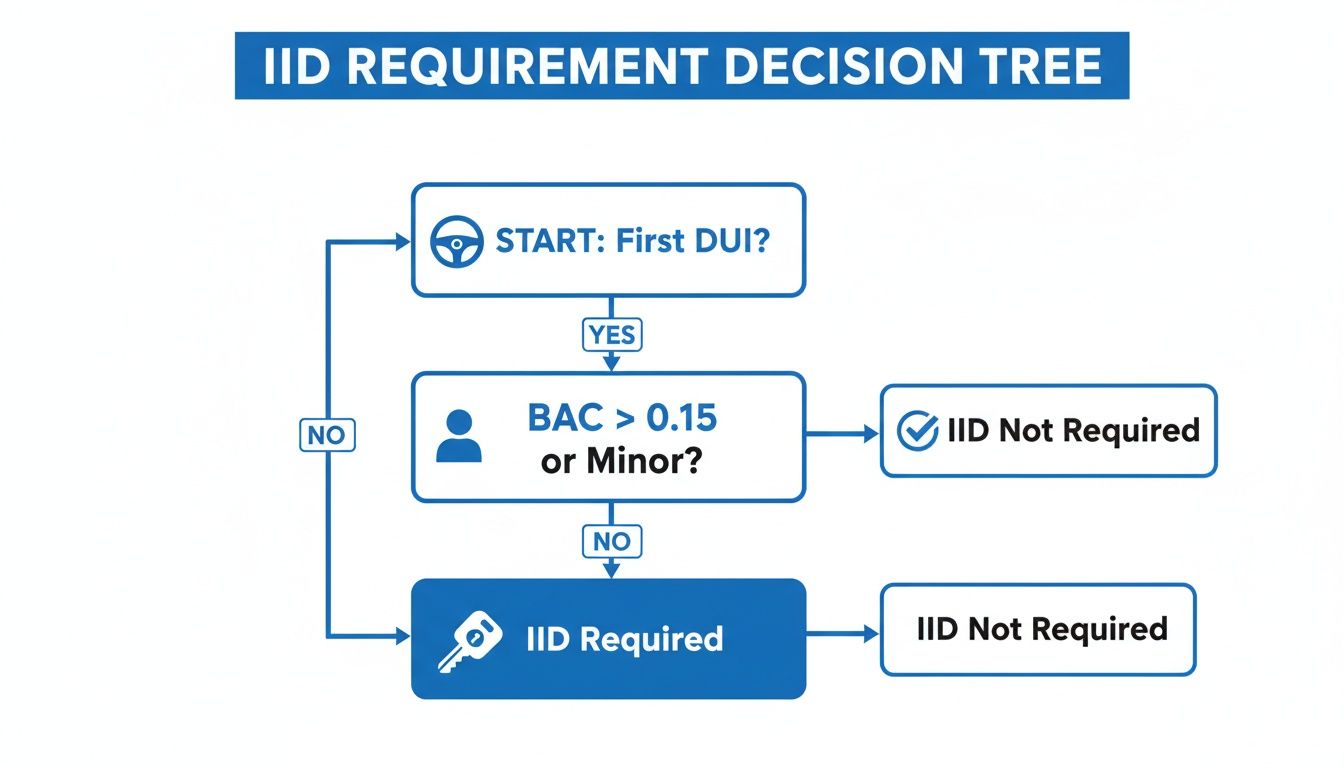
As you can see, for a first offense, it all comes down to those aggravating factors—a high BAC or having a minor in the car. That's the line that triggers a mandatory installation.
Specific IID Requirements By Offense
Florida’s statutes don't leave much room for interpretation when it comes to how long you'll have the device. While a first-time offender with a standard BAC might avoid it, the rules change fast if certain factors are present.
For a first-time DUI, an IID is only required if your BAC was 0.15 or higher, or if a child under 18 was in the vehicle with you. If either of those apply, you’re looking at a minimum of six months with the device.
For repeat offenders, the stakes get much higher. A second DUI conviction automatically means at least one year with an IID. If that second offense also involved a high BAC or a minor in the car, the requirement jumps to two years. For a third or subsequent DUI, you could be dealing with the device for up to five years.
Here’s a quick summary to make sense of the mandatory IID periods in Florida.
Florida DUI Ignition Interlock Device Requirements at a Glance
DUI Offense | Mandatory IID Period | Notes |
|---|---|---|
First DUI Conviction | At least 6 months | Only if BAC was 0.15 or higher, or a minor was present. |
Second DUI Conviction | At least 1 year | This is the standard minimum for any second offense. |
Second DUI with High BAC/Minor Present | At least 2 years | Aggravating factors double the standard time. |
Third DUI Conviction | At least 2 years | This period can be extended depending on the case specifics. |
These periods represent a serious commitment of both time and money. It's crucial to remember that the IID is just one piece of the puzzle. It often goes hand-in-hand with other consequences, like a lengthy driver's license suspension.
For a deeper dive into that topic, you can check out our guide on navigating a DUI license suspension in Florida. Our firm's practice focuses on DUI defense, and our goal is to protect your license and your record by exploring every legal option available.
Getting Your Ignition Interlock Device Installed in Miami-Dade County
When a court orders you to install an ignition interlock device in Florida, the process can feel overwhelming, particularly in a large metropolitan area like Miami-Dade County. But knowing the exact steps makes it a whole lot more manageable. Let’s walk through the procedure from start to finish, using Miami-Dade as our real-world example.
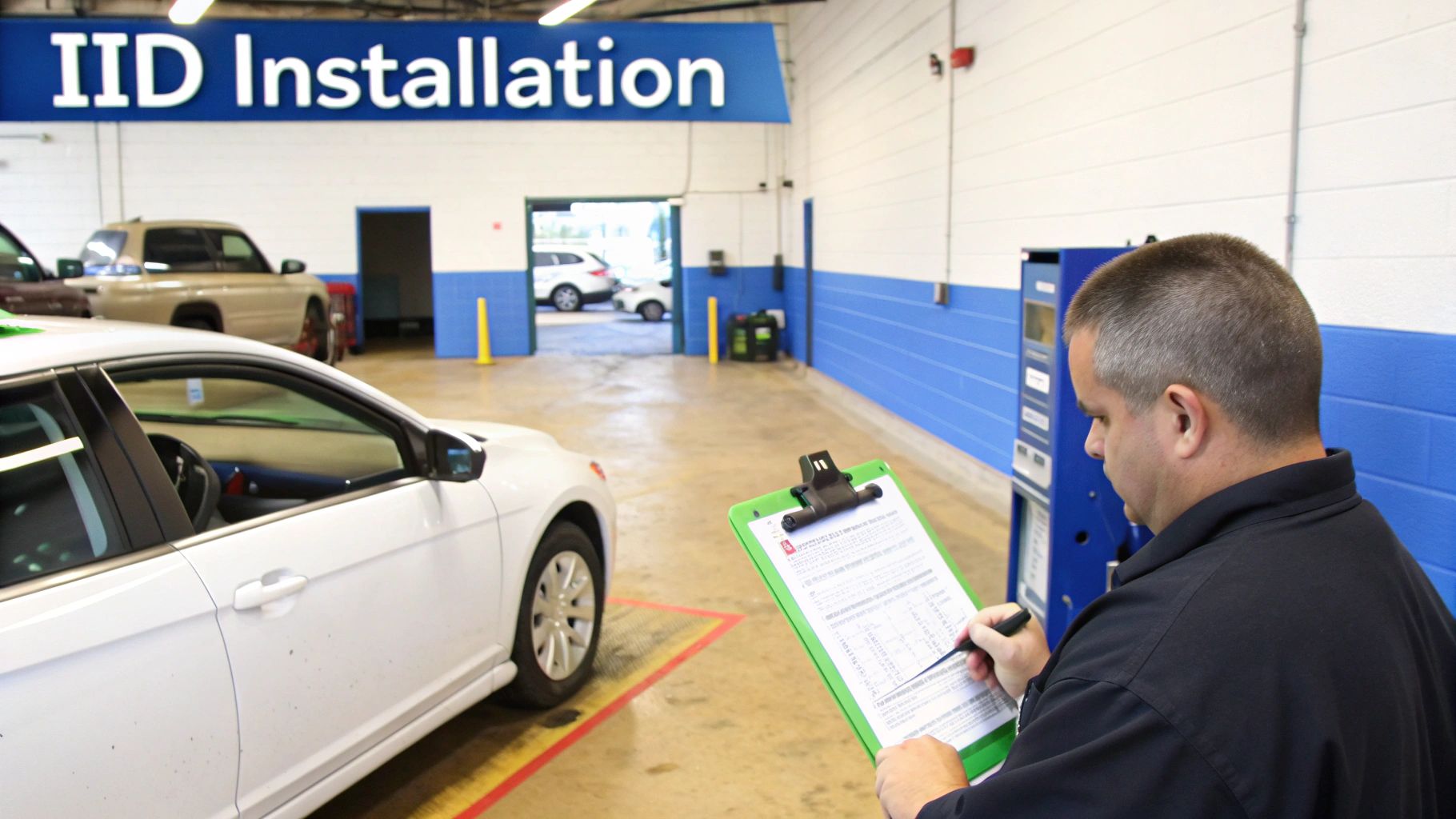
The moment you get that official order, the clock starts ticking. You can't just head to your local mechanic; you are required to use a service center certified by the Florida Department of Highway Safety and Motor Vehicles (FLHSMV). This is a critical step you absolutely can't skip.
Finding a State-Approved Vendor in South Florida
Your first move is to find a certified IID provider. The FLHSMV keeps an official list of approved vendors, and these companies have service centers all over the state, including plenty of options in and around Miami-Dade County. Using an uncertified installer is a complete waste of time and money—it simply won't satisfy your legal requirements.
These approved shops are trained to install the devices according to strict state guidelines, ensuring the tech is tamper-proof and works correctly. They're also the ones who handle the data reporting the court and FLHSMV need to see that you're staying compliant.
Choosing the right vendor in the Miami-Dade area usually boils down to a few practical things:
Location Convenience: You’ll be going back for regular calibration appointments, so find a service center that’s easy to get to.
Pricing Structure: Costs are pretty standard across the board, but some vendors might offer different payment plans or initial deals.
Customer Reviews: A quick scan of recent reviews can tell you a lot about their customer service and how efficient their installation and maintenance process is.
Once you’ve picked a provider, you'll need to schedule your installation. Be ready to give them your case information, court order, and vehicle details.
What to Expect on Installation Day
The installation appointment is more than just getting a device wired into your car; it’s your orientation for living with an IID. The whole thing usually takes a few hours, so block out a decent chunk of your day.
Crucial Documentation for Your IID Appointment To make sure things go smoothly, bring your driver's license or photo ID, vehicle registration, and a copy of the court order or FLHSMV letter that requires the IID. Forgetting these will cause delays and could force you to reschedule.
A certified technician will professionally install the IID into your vehicle's ignition system. They’re trained to do this without messing with your car's existing electronics.
After the physical install comes the most important part of the visit: your training. The technician will give you a complete rundown of how to use the device. This training will cover:
Proper Blowing Technique: You'll learn how to give a steady, consistent breath sample to ensure you get an accurate reading every time.
Understanding the Prompts: The device uses different beeps, lights, and screen messages to communicate. You’ll learn what each one means.
Handling Rolling Re-Tests: The technician will show you the correct and safe way to provide a breath sample while the car is running.
Identifying Violation Lockouts: You'll see what happens if you fail a test or miss a re-test and learn what to do if your vehicle goes into lockout mode.
You’ll walk out of the service center with a user manual and, most importantly, a certificate of installation. This certificate is your official proof that you've complied with the court's order. You must get this proof to the right authorities to start the process of getting your driving privileges back. Our firm's goal is to protect your license and record, and successfully handling these administrative hurdles is a key part of that process.
Understanding the Full Cost of an Ignition Interlock Device
When you're told you need an ignition interlock device in Florida, it's easy to fixate on the installation day and how long you'll have it. But the real financial hit stretches far beyond that first appointment. This isn't a one-and-done deal; it's a sustained financial commitment where, under Florida law, every single penny of the cost falls squarely on you.
Getting a clear picture of the total expense is crucial for anyone navigating a DUI charge. The fees aren't just a single payment. They're a series of recurring bills that can easily stack up to thousands of dollars over the required period.
Breaking Down the Direct IID Expenses
The most obvious costs are the ones you'll pay directly to the state-approved IID vendor. These fees cover everything from the hardware itself to the software, monitoring, and regular maintenance needed to stay compliant.
Here's a typical breakdown of what you can expect to pay out of pocket:
Installation Fee: This is the upfront, one-time charge to get the device professionally wired into your vehicle. It usually runs from $75 to $150, though it can be more depending on the provider and the complexity of your car's electronics.
Monthly Leasing and Monitoring Fee: You don't actually own the IID; you lease it. This monthly fee covers the use of the device and, more importantly, the data monitoring service that reports back to the authorities. Plan on this costing between $70 and $100 every single month.
Calibration Fees: Your IID needs regular check-ups to make sure it’s working correctly. You'll have to bring your vehicle to a service center every 30 to 60 days for calibration. Some companies roll this into the monthly fee, but many charge separately—often around $20 to $30 per visit.
Removal Fee: Once you've successfully finished your required time, there's one last fee to have the device professionally taken out. This cost is usually in the same ballpark as the installation, typically between $75 and $150.
The Hidden Costs and Financial Penalties
Beyond the standard fees, a whole host of other potential costs can pop up and dramatically increase your financial burden. These are almost always triggered by a mistake or a compliance issue.
A single slip-up, like a failed breath test from using mouthwash in the morning or missing a rolling re-test while driving, can lock you out of your vehicle. Getting a technician to perform an unscheduled reset can cost an extra $50 to $100 or more, hitting you with an immediate financial penalty for a simple error.
Other surprise expenses can include:
Lockout Fees: As mentioned, if the device locks you out, you’ll be paying a premium for a reset code or an in-person service call to get your car started again.
Damage Fees: If the device is damaged, lost, or stolen, you're on the hook for the full replacement cost, which can be substantial.
Early Termination Fees: Trying to remove the device before your court-ordered term is up can trigger hefty contractual penalties from the provider.
The Broader Financial Aftermath of a DUI
The costs don't stop with the IID vendor. A DUI conviction sends ripples through your finances, especially when it comes to your auto insurance. Insurers see a DUI as a major red flag, and your premiums are almost guaranteed to skyrocket. Many drivers watch their rates double or even triple, a financial consequence that can stick with you for years.
When you add it all up—IID fees, court fines, and ballooning insurance premiums—the total financial strain becomes painfully clear. This is where a sound legal defense proves its value. Investing in experienced legal help isn't just about fighting the charge; it's about pushing back against these severe, long-term financial penalties. To get a better sense of how that investment compares to the alternative, you can learn more about the average DUI lawyer fees. Our goal is to protect your record and minimize the heavy financial burden that a DUI conviction can bring.
What It's Really Like Living with an IID (And How to Avoid Common Violations)
Let's be honest: adapting to an ignition interlock device in Florida is a major shift in your daily routine. It’s not just an extra step before you start your car—it’s a constant responsibility that demands your full attention. Every time you get behind the wheel, the process starts with you providing a clean breath sample before the engine will even think about turning over.
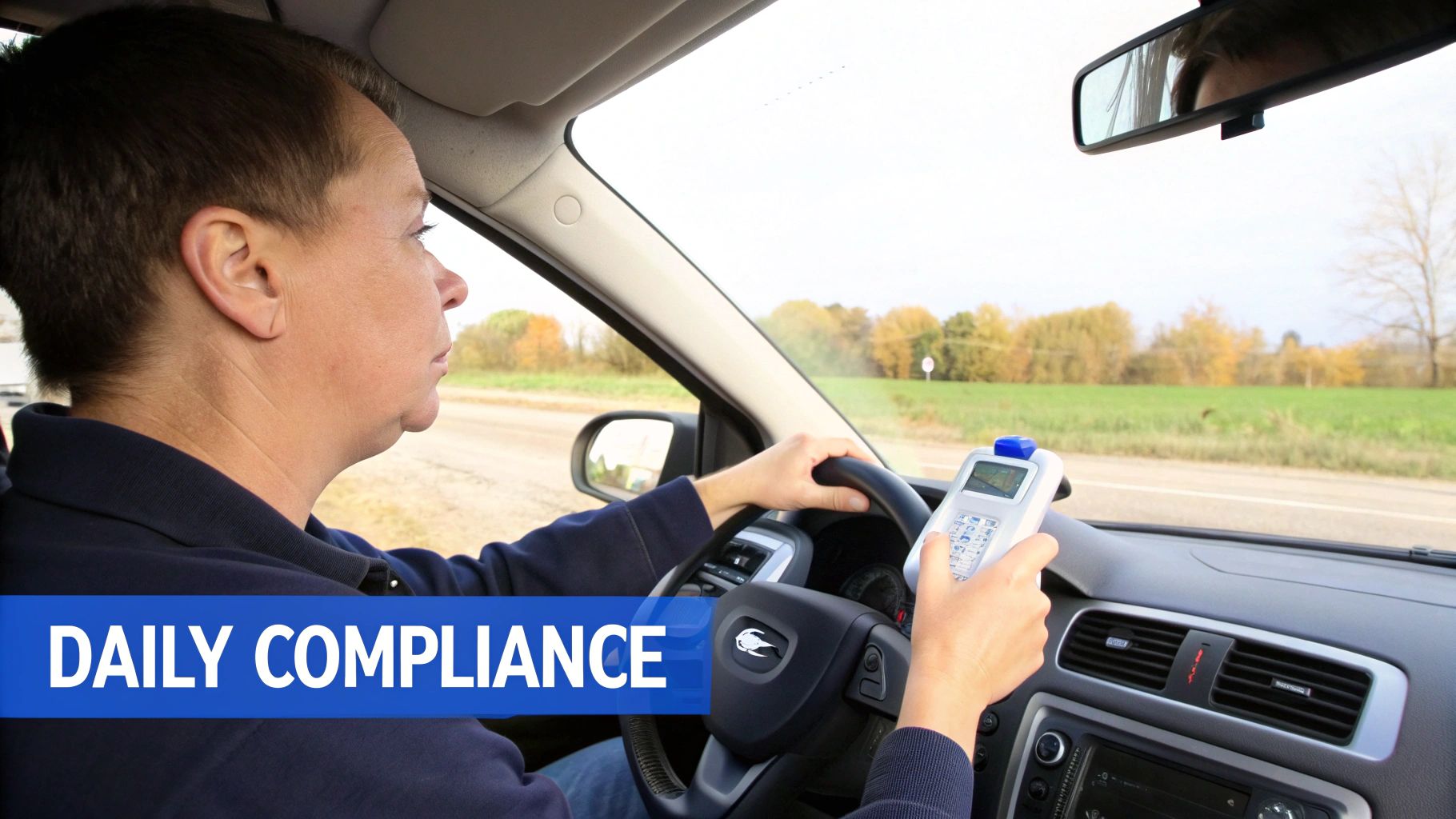
But that initial test is just the beginning. The device will also hit you with "rolling re-tests" at random times while you're driving. Think of it as a safety check-in to make sure you're still sober for the entire trip. You’ll have a few minutes to pull over somewhere safe and provide another quick breath sample.
Getting through your required IID period without any issues comes down to successfully managing these daily procedures. One simple mistake, however, can trigger a violation and a world of serious consequences.
Understanding IID Violations and What's at Stake
An IID violation is logged anytime you don't follow the device's rules to the letter. And this thing is a meticulous record-keeper. Every breath sample, every startup attempt, and every missed test is recorded. All of that data gets downloaded and reviewed by the authorities when you go in for your regular calibration appointments.
Make no mistake, Florida takes these violations very seriously. The most common actions that will get you flagged include:
A Failed Breath Test: If you blow a sample with a Blood Alcohol Concentration (BAC) over the limit (usually 0.025% in Florida), your car won't start, and it's logged as a violation. Simple as that.
Skipping a Rolling Re-Test: Failing to blow into the device within the time limit while driving is a huge red flag for the authorities.
Tampering with the Device: Any attempt to disconnect, bypass, or mess with the IID is strictly forbidden. Getting caught doing this brings immediate and severe penalties.
Missing a Calibration Appointment: You’re required to take your car to a certified service center every 30-60 days for maintenance. Skipping this appointment is a major compliance failure.
The fallout from a violation isn't a slap on the wrist. It can range from your vehicle being immediately locked out (requiring a pricey service call) to a formal report being sent straight to the court or the FLHSMV. This could easily lead to your IID requirement being extended or, worse, having your driving privileges revoked completely. You can learn more about the tough penalties in our article covering DUI probation violation consequences.
Common Mistakes That Can Cause a False Positive
One of the most maddening parts of having an IID is the dreaded "false positive." Certain everyday products have trace amounts of alcohol that can trip up the device's sensor, causing a failed test even if you haven't had a single alcoholic drink.
A Proactive Tip: Get into the habit of rinsing your mouth with water and waiting 10-15 minutes after eating or drinking anything (other than water) before you provide a breath sample. This one simple step can save you from a ton of unnecessary stress and expense.
Be extra careful with these common culprits:
Mouthwash: Many popular brands have a surprisingly high alcohol content.
Energy Drinks: Some formulas can trigger a positive reading on the device.
Certain Foods: Things that ferment, like very ripe fruit, or contain yeast, like fresh pizza dough, can sometimes cause a positive reading.
Medications: Some liquid cold medicines and even certain breath sprays contain alcohol.
The safest bet is to just avoid these items right before you need to drive. While it’s a hassle, the IID program's effectiveness is well-documented. A study by the CDC showed that IIDs, when paired with treatment programs, led to 45 fewer DUI arrests and a major drop in crashes and injuries. This is exactly why Florida is so strict about mandating IIDs for repeat offenders, often for one to five years. Staying compliant isn't just a legal hoop to jump through; it's part of a proven system that keeps our roads safer for everyone.
How a DUI Defense Strategy Can Influence IID Requirements
Getting pulled over for a DUI in Florida can make you feel like you're on a one-way street to a conviction and the dreaded ignition interlock device Florida drivers have to deal with. But an arrest isn't a conviction, and the IID is far from a foregone conclusion. A proactive, smart legal defense can completely change the trajectory of your case, often creating a path to avoid the IID mandate entirely.
The key is realizing that the IID requirement is directly bolted to the specific DUI charge you're convicted of. If a conviction hits certain legal triggers—like a high BAC or a prior offense—the judge’s hands are tied, and they must order the device. The most effective strategy, then, isn't to fight the IID itself, but to attack the very foundation of the DUI charge.
Our firm's practice is built around DUI and traffic defense across the state. We dig into every detail of your case to protect your license and your record from the massive burden an IID represents. While past results don't guarantee future outcomes, a thorough defense is always your strongest play.
Challenging the Evidence to Avoid an IID
The prosecution’s entire case usually balances on two critical pillars: the reason for the traffic stop and the results of your BAC test. A skilled defense strategy involves putting both of those pillars under a microscope. If one can be knocked down, the whole case against you can weaken, opening the door to a much better outcome.
For instance, a police officer needs a valid, legal reason—what’s known as reasonable suspicion—to even pull you over. If the stop was unlawful from the get-go, any evidence they collected afterward, including breathalyzer results, can be thrown out by the court. Without that evidence, the state might be forced to reduce the charge to something that doesn't come with a mandatory IID.
Likewise, the machines used for breath tests are governed by incredibly strict rules for administration and calibration. Any slip-up in procedure, machine maintenance, or officer training can make those BAC results unreliable and inadmissible in court. Successfully challenging those results can be the difference between a high-BAC DUI conviction that requires an IID and a lesser charge that doesn't.
Negotiation and Reducing Charges
Even when the evidence looks solid, an experienced defense attorney can often find leverage to negotiate with the prosecutor for a reduction in charges. This is especially true for first-time offenders, who might be eligible for a plea to a less serious offense like reckless driving—sometimes called a "wet reckless."
Here’s the bottom line: a conviction for reckless driving does not trigger a mandatory IID installation under Florida law. This outcome lets you sidestep the daily hassle, constant monitoring, and steep costs that come with the device. Getting this kind of result requires showing the weaknesses in the state's case or presenting compelling personal factors about your situation. This is where having a legal team dedicated to traffic and DUI defense becomes essential. For a closer look at these strategies, check out our comprehensive guide on strategies for fighting a DUI charge.
Florida's stance on ignition interlock laws has consistently earned a four-star rating from MADD, but it stops short of making the device mandatory for every single offender, which is something many other states do. While Florida uses tough measures like sobriety checkpoints, it has not adopted an all-offender IID law. By 2019, 32 states plus D.C. had already taken that step, requiring IIDs for any driver with a .08 BAC or higher who wanted their license back. To learn more about this, you can read about Florida's efforts in preventing drunk driving.
Attorney Advertisement: This blog post is for informational purposes only and does not constitute legal advice. Submitting information through any form on this site does not create an attorney-client relationship. Our office is in Broward, and we handle criminal traffic matters across Florida.
A Few Common Questions About Florida Ignition Interlock Devices
Life with an ignition interlock device in Florida brings up a lot of practical, "what if" scenarios. While an attorney should always be your go-to for legal advice on your specific case, let's clear up some of the most common questions people have once an IID is part of their daily routine.
Can I Drive Someone Else’s Car If I Have An IID Requirement?
Absolutely not. This is a huge misconception that can land you in serious legal trouble. If a Florida court has ordered you to use an ignition interlock device, that order applies to any vehicle you operate. Period.
Getting behind the wheel of a car without an IID is a direct violation of your court order. If you get caught, the penalties are severe—think probation violations, a longer IID sentence, or even having your license revoked completely. While there are some extremely rare exceptions for work vehicles, they have to be formally approved by the court. Never just assume you’re covered; it must be spelled out in your legal documents.
What Happens If A Passenger Has Been Drinking?
This is a smart question and a common worry. The good news is that the device is designed to measure the breath of the person blowing directly into it, not the ambient air in the car. Fumes from a passenger shouldn't be concentrated enough to trigger a failed test if you're sober.
That said, the responsibility for every single breath sample is 100% yours. To avoid any doubt, especially during a rolling re-test, it’s a good idea to take a deep breath of fresh air before you blow. If you ever feel unsure, pull over to a safe spot to complete the test without any distractions.
Important Note: You are solely responsible for every sample given to the device. Never, ever let a passenger blow into the IID for you. This is considered tampering, and it’s a major violation that will get you in serious trouble.
Is It Possible To Get The Ignition Interlock Device Removed Early?
The short answer is almost always no. The IID requirement is a mandatory part of your sentence set by the court, and Florida law is very strict about completing the full term. You have to finish the entire required period without any major violations before you can even think about getting it removed.
Early removal of an ignition interlock device in Florida just isn't a realistic option for the vast majority of people. The only real exception might be if there was a clear legal mistake in the original sentence, which would require going back to court to fix it. For everyone else, the only way forward is to successfully complete the program exactly as the judge ordered. If you have a strong reason to believe the IID was ordered in error, you need to speak with a defense attorney right away.
For more answers to common questions, feel free to check out our general traffic law FAQs.
Facing a DUI charge can be overwhelming, but you don't have to navigate it alone. Our practice focuses on traffic and DUI defense, and our goal is to protect your driving record and explore every available defense to minimize the impact on your life. For a free consultation to discuss your case, contact us today at https://www.ticketshield.com.