DUI Lawyer Cape Coral: Your Defense Starts Here
Dui lawyer cape coral - Charged with DUI in Cape Coral? Learn what penalties you face, how a local defense attorney builds your case, and the steps to take

You got stopped last night, and now the message on your phone is probably the same one I hear from drivers all over Lee County. You're worried about the license, the court date, the insurance, and whether one bad stop just became a long problem.
That worry is justified. A Cape Coral DUI arrest puts two separate systems in motion, and they do not wait on each other. One is the criminal case under Florida Statutes § 316.193. The other is the administrative license process through the Florida Department of Highway Safety and Motor Vehicles. If you miss the wrong deadline, you can lose driving privileges even while the criminal case is still unresolved.
Table of Contents
A Cape Coral DUI Stop Sets Two Tracks in Motion
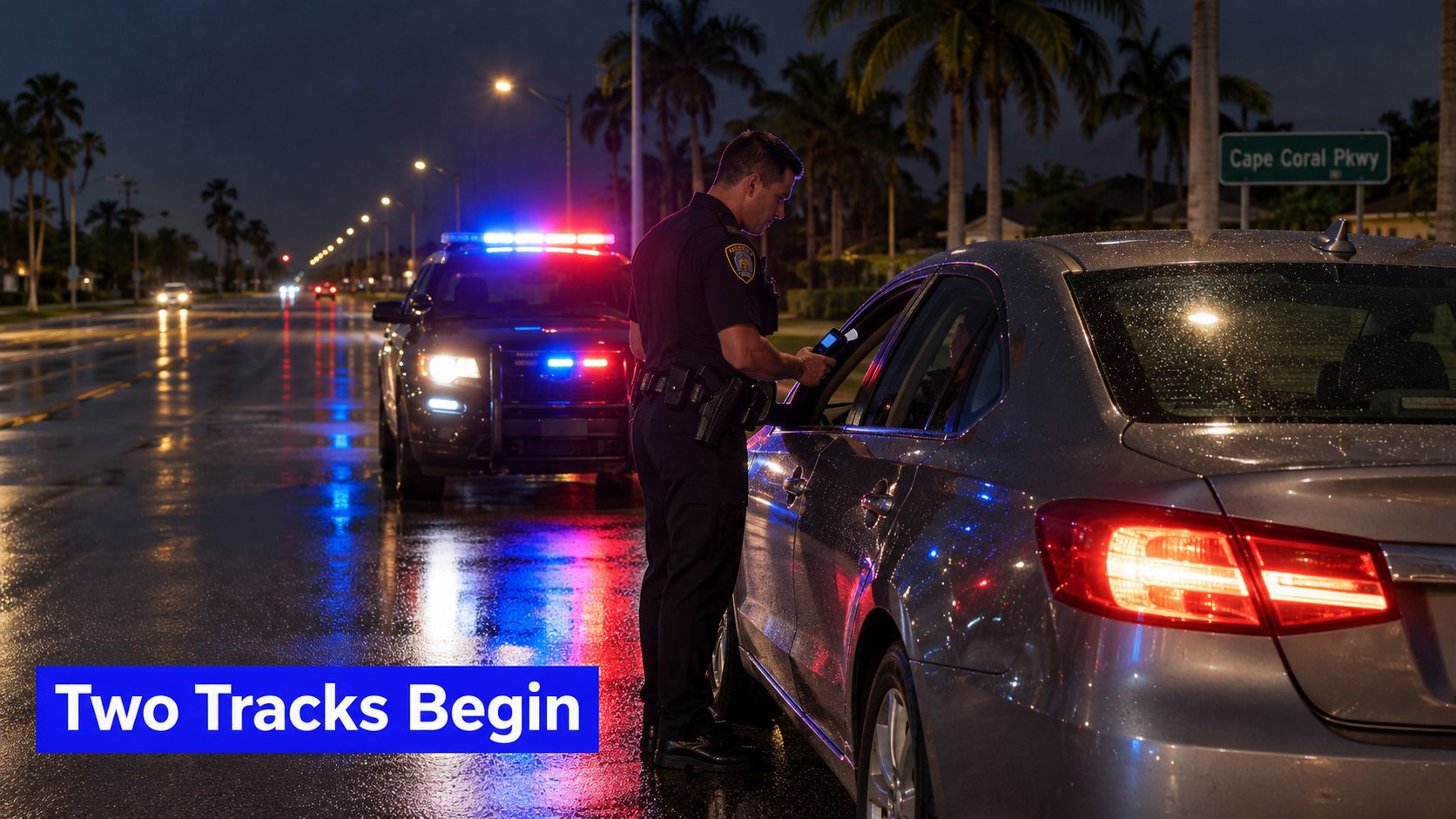
The stop usually feels simple at first. Blue lights flash, the officer asks where you've been, then comes the roadside exercises, the breath test request, and maybe a ride to the Lee County Jail. By the time you're released, the problem has already split into two tracks, and each one has its own clock.
The criminal case is only half the fight
Florida treats DUI as a state offense, not a city ordinance issue. That matters because the charge is prosecuted under statewide law, and the evidence has to fit the elements the statute requires. A lawyer handling a DUI Lawyer Cape Coral case has to look at the stop, the testing, the arrest decision, and anything that happened before and after the officer made contact.
The mistake I see is drivers focusing only on the courtroom side. That's the slow half. The faster half is the license action, and it starts immediately after arrest or refusal.
Practical rule: If you wait to “see what happens in court,” you may already have lost the chance to contest the suspension.
The right move is to treat the stop as a deadline event, not a traffic inconvenience. That means pulling the paperwork, checking the implied-consent warning, and figuring out whether the state's evidence can support both the criminal charge and the administrative suspension.
The point is simple. One bad night can affect your license, insurance, and record, but only if you let the deadlines pass. Florida's DUI process rewards speed and punishes delay.
What Florida Statute 316.193 Actually Means
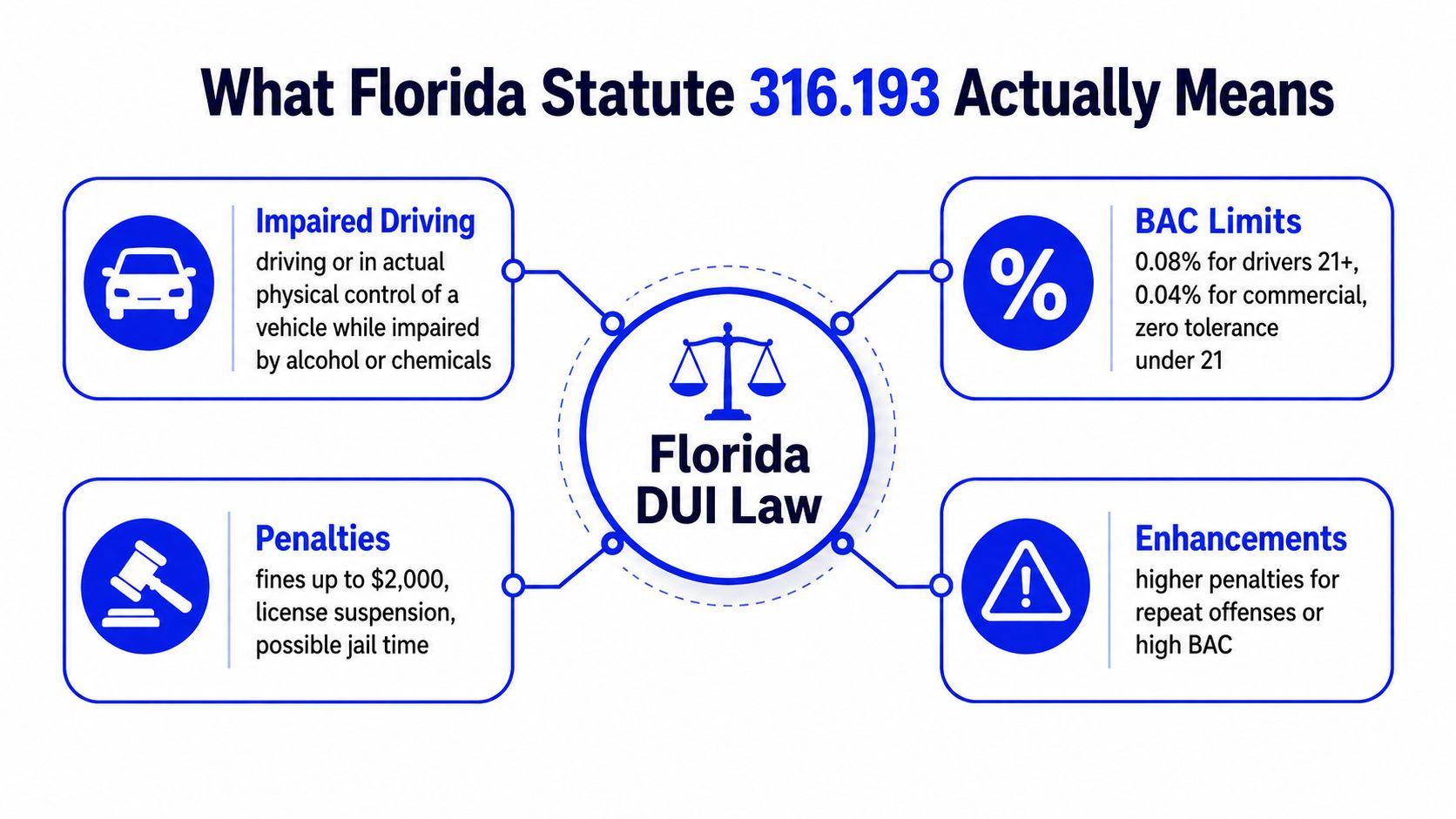
Florida Statutes § 316.193 defines the offense in plain terms. It covers driving or being in actual physical control of a vehicle while impaired by alcohol, a controlled substance, or another chemical substance, or while having an unlawful blood- or breath-alcohol level. The statewide alcohol threshold is 0.08, and the statute applies in Cape Coral exactly as it does anywhere else in Florida.
Impairment and alcohol concentration are different theories
A prosecutor can try to prove impairment even if the breath or blood result is disputed. That's why field sobriety exercises, body-cam footage, and the officer's observations matter so much. They're not just background details, they're the evidence the state uses to say your normal faculties were impaired.
The other path is the unlawful alcohol-concentration theory. That route focuses on chemical testing and the accuracy of the sample, the machine, and the procedure. For a driver looking up avoiding impaired driving charges, avoiding impaired driving charges is a useful starting point because it explains why officers and prosecutors often build the case from multiple angles instead of relying on one test alone.
Florida law is statewide, so the defense isn't about finding a Cape Coral-only loophole. It's about testing whether the state can prove each element with reliable evidence. That's why I use the statute as the starting point, then work backward to the stop, the test request, and the arrest report.
If you're comparing resources, the cleanest local overview is the firm's own explanation of Florida DUI statutes. That's the legal foundation every serious defense has to confront.
Penalties a Cape Coral Driver Actually Faces
The numbers matter because they tell you what's at stake if the case ends in conviction. For a standard first Florida DUI conviction, the statutory exposure includes a $500 to $1,000 fine and up to six months' imprisonment. A second conviction raises that to a $1,000 to $2,000 fine, up to nine months' imprisonment, and at least one year of ignition-interlock installation when the person qualifies for a permanent or restricted license Florida Statutes § 316.193.
Florida DUI Conviction Exposure at a Glance | Fine Range | Maximum Jail Time | Ignition Interlock |
|---|---|---|---|
First conviction | $500 to $1,000 | Up to 6 months | Not stated in the verified data |
Second conviction | $1,000 to $2,000 | Up to 9 months | At least 1 year when eligible for a permanent or restricted license |
The real cost is bigger than the court fine
A DUI conviction does not stop at the sentence. You're also looking at DUI school, possible probation terms, interlock-related costs, and insurance fallout that follows the conviction onto your record. That's why a case should never be evaluated only by the arrest charge.
The legal classification matters just as much as the evidence. A case that gets reduced or reclassified can change the jail exposure, the fine, and the license conditions. That is the difference between a manageable court outcome and a long-term driving problem.
The statute also treats repeat offenses and cases involving serious bodily injury or death much more harshly. That's why prior convictions and their dates must be checked carefully, not guessed at from memory or treated as a minor detail.
If you want a plain-language explanation of how treatment and recovery issues can intersect with a defense strategy, the guide to outpatient addiction care is a useful general resource, but the legal consequences in Florida still turn on the conviction level and the statute.
A conviction is where the financial damage starts, but it's not where it ends.
The 10-Day Window That Decides Your License
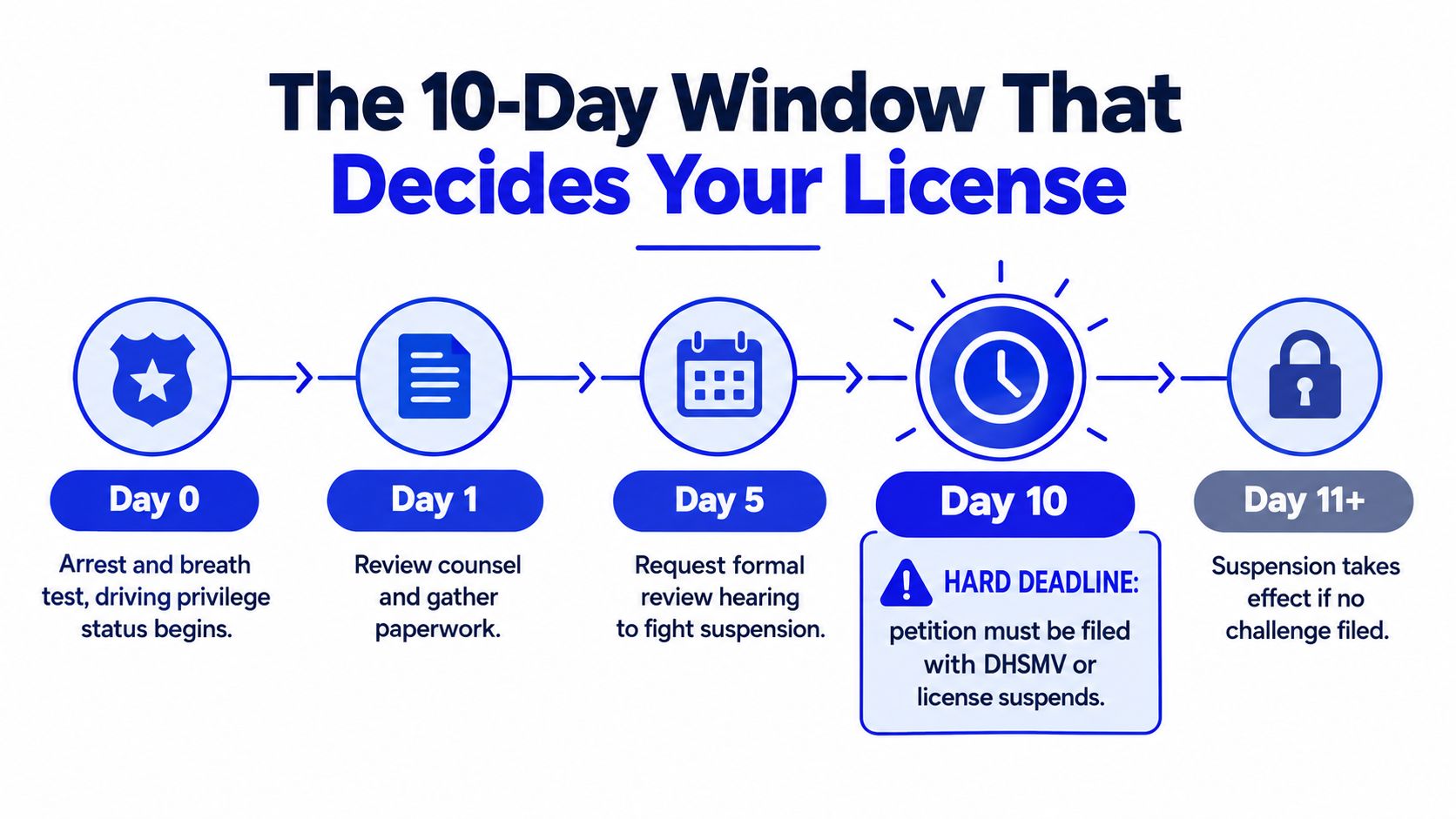
The biggest mistake drivers make is assuming the criminal case controls everything. It doesn't. In Florida, the first 10 days after a Cape Coral DUI arrest are an administrative-license emergency. That deadline runs from the suspension notice, and the request for a formal or informal review does not automatically pause the suspension.
What happens during the review period
Florida law lets you request a formal or informal review within 10 days of the suspension notice, and a formal review must generally be scheduled within 30 days Florida Statutes § 322.2616. If the state misses that scheduling requirement, the suspension must be invalidated. That makes timing more than important, it makes timing decisive.
Statements you submit for the administrative review are not admissible in the related DUI trial, and the criminal case outcome does not control the suspension. Those are separate proceedings. You cannot assume a dismissal in court will fix the license problem on its own.
A smart day-by-day approach looks like this:
Day 0 to Day 1: Gather the citation, arrest paperwork, and implied-consent warning.
Day 2 to Day 4: Decide whether the facts support a formal hearing, informal review, or restricted-license path.
Day 5 to Day 9: File the challenge and get the paperwork in order.
Day 10: Treat this as the hard cutoff.
Day 11 and after: If nothing was filed, the suspension can take effect.
For a clean local breakdown of the process, the firm's article on DUI license suspension in Florida is worth reading right away. The official state process is technical, and the deadline is not forgiving.
Lawyer-Led Defense Versus Apps and Ticket Mills
A DUI case is not a form-filling exercise. You need someone who can look at the stop, preserve evidence, file the license challenge, and speak for you in court if the case gets that far. That's why the difference between a lawyer-led defense and an automated app matters so much.

Real attorney access changes the strategy
When you hire a lawyer-led firm, you should be able to talk to the attorney directly by phone or text. That matters because the facts of a Cape Coral arrest can turn on small details, like the warning language, the timing of the stop, or whether the officer extended the detention without good reason.
Automated apps and ticket mills are built for volume. They route you through middlemen, call centers, or chatbot scripts that treat a DUI like a parking citation. That is the wrong model for a criminal charge with license consequences.
Bottom line: If the response is generic, your defense will be generic too.
Ticket Shield, PLLC is one example of a lawyer-led Florida traffic defense option that works this way, with direct attorney communication instead of a corporate relay system. If you're comparing providers, read the firm's own explanation of why a local lawyer is better than apps before you hand your case to software.
The right choice is experienced, strategic, and dedicated counsel. Not anonymous support. Not an automated intake path. Not a system that waits until business hours while your deadline keeps running.
Common DUI Defenses That Actually Get Tested
A defense only matters if it attacks something the state must prove. That's how a real Cape Coral DUI lawyer should think. The question is not whether the officer wrote a report. The question is whether the stop, the observations, and the test results hold up when they're examined closely.
Stop, testing, and evidence
The first issue is the stop itself. If the traffic stop lacked legal support, or if the officer kept the detention going after the original violation was handled, that can matter. A lawyer should also review whether the officer had a lawful basis to move from a traffic stop into a DUI investigation.
The next issue is field sobriety testing. Officer training, the way the exercises were explained, the environment, and any medical issues all affect how much weight those clues should get. What looked like “bad balance” on a report may be something else entirely.
Breath testing needs the same scrutiny. Calibration records, maintenance logs, and machine performance all matter, and so does whether outside interference or timing issues could have affected the result. The defense may also look at whether the alcohol level was still rising when the test was taken.
For a deeper technical overview, the firm's article on breathalyzer test accuracy is the right companion piece. That's where the machine-focused fight usually starts.
Video and witnesses matter more than reports
Body-cam footage, dash-cam video, dispatch audio, and nearby surveillance can support the defense or expose gaps in the officer's version. Witnesses can do the same. If the video contradicts the report, that's a real issue, not a technicality.
The defense is built by comparing the state's story against the actual evidence. That's what turns a charge into a challenge instead of a confession.
How a Cape Coral DUI Case Actually Moves
A DUI case doesn't resolve in one hearing. It moves through a sequence, and every stage gives your lawyer a different chance to change the outcome. After arrest and release, the case heads toward first appearance or arraignment in Lee County, then into discovery, motions, and negotiation with the State Attorney's Office.
What outcomes are realistic
The outcome can be dismissal, reduction to reckless driving, a withhold of adjudication in a qualifying non-DUI resolution, or trial. Each one carries different consequences for points, insurance, and future license risk. The point is not just winning in theory, it's choosing the result that protects your driving record in practice.
A strategic defense often resolves without the client standing in court at every step. Ticket Shield says more than 99% of its Florida clients never appear in court, but Cape Coral DUI matters can still require personal appearance when the charge and the court setting demand it. That's one reason local procedure matters.
Get the documents together before the consultation. The case moves faster when the facts are organized.
Bring the arrest paperwork, citation, any license suspension notice, the officer's report if you have it, and any notes you wrote right after the stop. If you have proof of work obligations or a travel schedule, bring that too. A lawyer can't use what you don't hand over.
Driving to Work, Insurance, and Other Pressing Questions
You're probably asking the same practical questions everyone asks the morning after arrest. Can you drive to work? Can you get a restricted license? What happens if your license is from another state? What's this going to do to insurance?
Restricted driving is limited, not free
Florida's restricted-license pathway depends on the type of suspension, DUI-school enrollment, deadlines, and whether you're eligible for review or hardship relief. The state's restricted-license application identifies six months for an unlawful alcohol-level suspension and one year for a refusal, requires proof of DUI-school enrollment, and says the restricted license can be cancelled if the school isn't completed within 90 days FLHSMV restricted-license form. Florida also allows a temporary business-purpose permit through the scheduled review date when the driver is otherwise eligible.
That restricted privilege is not a blank check. It does not mean you can drive anywhere, anytime. It is tied to the reason for the travel and the conditions on the permit.
Out-of-state drivers need to take this seriously too. A Florida suspension can create problems with reciprocity and with the home-state license status, so you should not assume your other license will shield you. The administrative action can travel farther than people expect.
Insurance is the other hit. A conviction can trigger a high-risk policy or nonrenewal, and the damage often lasts for years. Florida's point system adds another layer, since 12 points in 12 months can result in a 30-day suspension, and points remain on the driving record for at least five years from disposition FLHSMV points and point suspensions.
For a direct explanation of that insurance fallout, the firm's DUI and car insurance guide is a good place to understand the long tail.
Visit TicketShield.com for a free consultation if you want a lawyer-led defense focused on No Points on your license, not a guilty plea that leaves you paying for this stop long after the case ends. Ticket Shield, PLLC gives you direct communication with your attorney by phone or text, and that matters when the 10-day deadline is already running. If you were stopped in Cape Coral, the cost-effective move is to act inside the window and force the state to prove its case.
Visit Ticket Shield, PLLC for a free consultation today. Ticket Shield, PLLC handles Florida traffic and DUI defense with direct attorney communication by phone or text, and the goal is clear, No Points on your license and a faster path to putting this stop behind you.