
DUI Arrests Today: Florida Info & License Protection
Find info on DUI arrests today in Florida. Verify arrest data & learn immediate steps to protect your license. Get legal help now.

A DUI arrest in Florida is serious, but it is not the final result. Your next 10 days matter most. Move fast to protect your license, stop avoidable damage, and get a lawyer involved before the system starts moving without you.
You're probably reading this on almost no sleep. Your car may still be somewhere you need to recover. Your paperwork may be sitting on a kitchen table while you search for DUI arrests today, trying to figure out whether your name is online, whether your license is gone, and whether this just wrecked your job.
That panic is normal. It's also dangerous, because panic makes people freeze.
The first thing you need to understand is simple. An arrest creates a problem. It does not decide your future. What you do in the next few hours and the next 10 days will shape what happens to your license, your court case, and your record.
Table of Contents
What Happens After a DUI Arrest in Florida
Last night probably felt like a blur. Flashing lights. Questions on the roadside. A tow. A booking photo. Release paperwork. Then silence. Now you're trying to piece together what happened and what comes next.
That's the moment when many people start searching DUI arrests today. They want certainty. They want to know whether this is routine or catastrophic. In Florida, it is common, and it is serious.

This situation is more common than you think. In 2024 alone, Florida accounted for 315,030 DUI arrests, representing 6.5% of the entire nation's total and making it the state with the highest volume of DUI arrests according to SafeHome's DUI statistics page.
That number should tell you two things. First, you are not alone. Second, Florida processes these cases constantly, which means the system won't slow down just because you're overwhelmed.
What hits first after the arrest
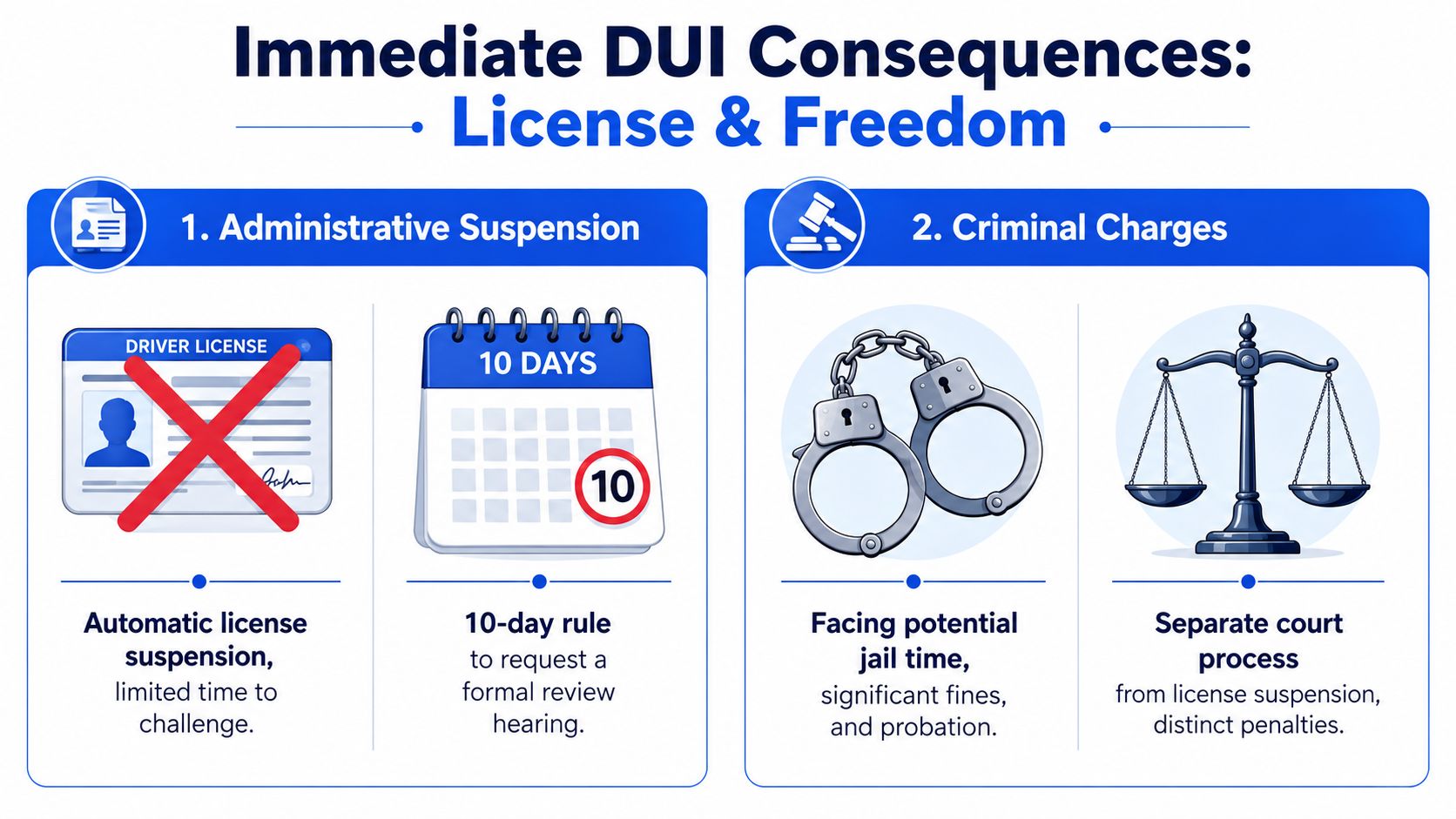
Your case usually splits into two tracks almost immediately. One track involves your driver's license. The other involves the criminal case itself. Those tracks move on separate timelines, and people get hurt when they focus on only one.
If you want a fuller breakdown of the first stage, review what happens after a DUI arrest in Florida.
Practical rule: Don't spend your first day obsessing over shame, social fallout, or worst-case scenarios. Spend it protecting deadlines, paperwork, and your license.
What you should focus on this morning
Start with control, not fear. Find your citation, your notice of suspension if one was issued, your bond papers, and any property receipt. Put everything in one place.
Then stop talking about the facts of your case with friends, coworkers, or anyone messaging you for details. People think they're helping. They usually are not.
Your immediate job is to get organized and act fast. The law cares about deadlines, not how shaken you feel.
What Do Online DUI Arrest Records Really Show
If you found your name on a sheriff's site, a jail log, or a media blotter, take a breath. That posting does not mean you've been convicted. It means an arrest occurred and an agency created an entry.
That distinction matters. An arrest is an accusation. It is not a finding of guilt.
Why online arrest logs cause so much panic
Online lists flatten everything. They strip away context, legal issues, defenses, and factual disputes. They don't tell you whether the stop was lawful, whether the officer's observations were accurate, whether testing will be challenged, or whether the charge will hold up in court.
They also don't tell you what your case file will look like once it reaches the formal court system.
In high-volume jurisdictions, these entries are routine administrative records. In 2022, Florida recorded over 33,000 DUI arrests. Aggressive enforcement in major areas like Tampa means Hillsborough County consistently ranks among the highest statewide for DUI citations handled at the Edgecomb Courthouse, as noted by Florida DUI statistics discussed by Futures Recovery Healthcare.
What those records are and are not
Here's the cleanest way to look at them:
They are preliminary. They often reflect booking information, not the final charging decision.
They are limited. They don't show your defenses or weaknesses in the State's case.
They are public-facing. That makes them embarrassing, but not legally conclusive.
They are not a conviction. That's the point many people miss in the first 24 hours.
If you're worried about what employers may eventually see, read whether a DUI shows up on a background check.
Seeing your name in an online arrest record feels final. It isn't. The court process has not finished speaking.
That's why I tell people not to let a blotter define how they respond. Your energy belongs on official records, deadlines, and defense strategy.
Where Can You Find Official Florida Arrest Information
Skip the gossip sites and database scrapers. If you want reliable information, use official Florida sources tied to your county and your case. Third-party pages often lag behind, omit key details, or display stale data.
The records that matter are the ones generated by the agencies and courts handling your case.
Official Florida DUI Information Sources
Resource | Information You Can Find | Why It's Important |
|---|---|---|
County Clerk of Court portal | Case number, filed charge, court dates, docket entries | This is where you confirm the actual court case and track what has been filed |
Sheriff's Office or county jail database | Booking record, arrest date, release status, basic charge listing | This helps verify the arrest record and custody information |
Bond paperwork and citation documents in your possession | Arresting agency, cited charge, court location, dates, conditions of release | Your own paperwork often gives the fastest starting point before online records update |
State Attorney filing reflected in court records | The formal charge pursued in court | What was alleged at arrest can change. The filed case is what must be defended |
What to check first
Start with your county clerk portal. That's where you're most likely to find the official case number and scheduled appearances once the case is entered. If you were arrested in a major metro area, the courthouse handling the matter matters too. In Orlando, for example, DUI cases move through the Orange County Courthouse, and local procedure affects how quickly information appears.
Then compare the clerk information with your arrest paperwork. Names get misspelled. Dates get entered incorrectly. Charges may be abbreviated in ways that confuse people. Precision matters.
Why official records beat search results
Third-party sites make money from your stress. They want clicks, not accuracy.
Official sources help you answer the questions that matter:
What county is handling the case
Whether a formal case number exists
What charge has been filed
When you must appear
Whether bond conditions apply
If the online information doesn't make sense, that's not a reason to guess. It's a reason to verify, document, and get legal guidance before you make a bad move.
What Happens to Your License and Freedom Right Now
A DUI arrest in Florida under Florida Statute 316.193 is not just a traffic problem. It puts your driving privilege and your liberty into separate fights at the same time.
One is administrative. One is criminal. Both need attention now.
Why the 10 day deadline controls your next move
You have 10 calendar days from the date of arrest to act to protect your license through the administrative process. Miss that window, and you can lose the chance to challenge the suspension in time.
That deadline is where many avoidable mistakes happen. People focus on court, assume the judge will handle everything, and ignore the driver's license side until it's too late.
For a closer explanation of the administrative process, review Florida DUI license suspension rules and hearing issues.
The 10-day window is short by design. Florida expects you to react immediately, even when you're still trying to understand the arrest.
What Florida Statute 316193 puts at risk
Florida's DUI law carries real penalties. For a first-time DUI conviction in Florida, mandatory fines range from $500 to $2,000. If your BAC is 0.15% or higher, that fine can escalate to a minimum of $2,000, plus other mandatory penalties, according to Florida DUI penalty information published by the State of Florida guide.
The criminal side can include consequences such as:
Fines and court costs tied to the level of the charge
Probation requirements that can restrict your time and movement
Possible jail exposure depending on the facts and how the case is charged
Vehicle-related penalties that can complicate daily life
A criminal record issue that can affect work, licensing, and reputation
Historical context matters here. DUI enforcement didn't become this aggressive by accident. It was built over decades. The law now treats these cases as serious criminal matters, and you should too.
How Do You Begin Your DUI Defense Immediately
Panic wastes time. Action protects you.
Right after release, individuals make one of two mistakes. They talk too much, or they do nothing. Both hurt the defense.
Immediate Steps to Take
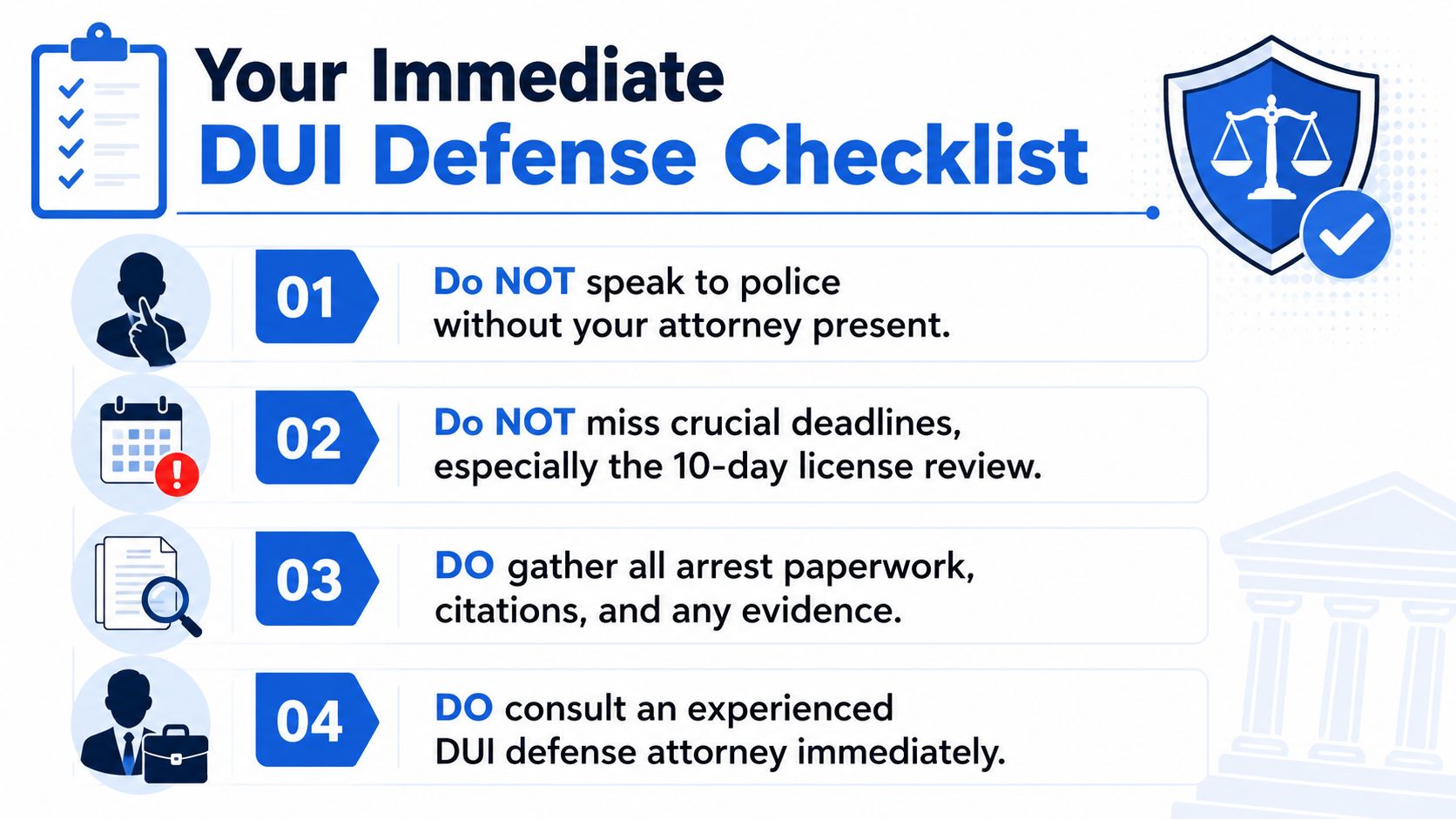
Use this checklist today.
Stop discussing the facts. Don't explain the stop to police, coworkers, your boss, or people in text threads. Keep your statements for your lawyer.
Protect the 10-day deadline. Put the deadline in your phone right now. Missing it can damage your license position before the criminal case even gets moving.
Gather every document. Pull together your citation, bond paperwork, towing information, property receipt, and any notice related to your license.
Write your own timeline. Record where you were, why you were stopped, what the officer said, what tests were requested, and what happened after arrest. Do it while your memory is still fresh.
You should also preserve practical details that people forget quickly, such as where your vehicle was left, what witnesses were with you, and whether any business receipts or phone records may later help establish timing.
If you want direct legal information about building the defense, review Florida DUI defense strategies and case handling.
A short video can help you frame the first moves correctly:
Why direct attorney access matters if your income depends on driving
If you drive for Uber, Lyft, or DoorDash, the fallout can hit before the court does. The consequences of a DUI arrest are especially severe for gig economy drivers, as an arrest can trigger automatic account deactivation, creating a one-strike policy that requires an immediate and aggressive legal defense to protect your job, as discussed in PPIC's analysis of arrests in California.
That's why I strongly favor lawyer-led defense over automated apps or ticket mills. In a DUI case, you don't need a chatbot, a call center, or a middleman relaying messages. You need direct answers from the lawyer handling the file.
Ticket Shield, PLLC operates as a lawyer-led Florida defense firm where clients communicate directly with their attorney by phone or text. That model fits DUI work because deadlines are short, facts change quickly, and small details can matter.
A DUI defense starts with communication. If you can't reach the lawyer responsible for your case, you're already behind.
Why Is a Lawyer-Led Defense Your Strongest Shield
A DUI case is too serious for volume processing. That's the blunt truth.
Automated apps are built for scale. Ticket mills are built for churn. DUI defense under Florida Statute 316.193 requires judgment, fast review of facts, and direct strategy decisions based on your stop, your paperwork, your testing issues, and your license deadline.
Why this isn't the case to hand off to a system
A real defense asks hard questions early. Was the stop valid. What did the officer observe. What does the paperwork say. What must be attacked first. Those are lawyer questions.
That need for serious defense didn't appear overnight. Historical data from the Bureau of Justice Statistics shows DUI enforcement surged in the late 20th century, transforming it from a minor offense into a serious criminal charge, as described in the Bureau of Justice Statistics publication on drunk driving.
If you're wondering what a defense lawyer should do for you, review what a criminal defense lawyer does in a Florida case.
The right approach is personal, fast, and strategic. You should know who is handling your case. You should be able to reach that person. And you should have a plan focused on protecting your license, challenging the evidence, and minimizing long-term damage.
If you were arrested and you're searching DUI arrests today because you need real answers now, visit Ticket Shield, PLLC for a free consultation. Move quickly, protect your license, and fight for the outcome that matters most in Florida traffic court: No Points.
