
What Is Substance Abuse Evaluation: Florida DUI Guide 2026
Facing a Florida DUI in 2026? Learn what is substance abuse evaluation, what to expect, & how to prepare for your evaluation. Get guidance!

You were arrested. You posted bond. Now someone tells you to get a substance abuse evaluation. That sounds clinical. It isn't. In a Florida DUI case, this is a legal checkpoint that can shape what the court thinks about your risk, your license, and your future.
If your case is moving through a courthouse like the Richard E. Gerstein Justice Building in Miami, you need to treat this evaluation seriously from the start. Every answer matters. Every inconsistency matters. And if you rely on automated apps, ticket mills, or a middleman instead of speaking directly with your attorney by phone or text, you're putting yourself at a disadvantage when precision is paramount.
Table of Contents
What Happens After a Florida DUI Arrest
TL;DR: A substance abuse evaluation is a formal review of your alcohol or drug history that Florida DUI courts use to decide treatment, probation conditions, and license-related consequences. It's not just paperwork. It's evidence, and you need to approach it strategically.
Right after a DUI arrest, most drivers focus on the obvious problems. The court date. The license issue. The embarrassment. The job risk. Then the evaluation requirement shows up, and many people make a dangerous mistake. They treat it like routine admin work.
It's not routine.
A substance abuse evaluation can become part of the record that shapes how the court sees you. The state isn't asking for it because it cares about your comfort. The system wants a documented opinion about your substance use, your risk level, and whether you should be pushed into education, treatment, or tighter supervision.
That changes how you should think about it. You're not walking into a casual appointment. You're stepping into a process that can affect the rest of your case.
Why drivers get blindsided
For many charged with DUI, this is an unfamiliar process. They assume honesty alone solves the problem. Honesty matters, but so does judgment. You need to understand what's being asked, why it's being asked, and how your own words can be interpreted.
If you want a practical overview of the timeline after arrest, read what happens after a DUI arrest in Florida. Then come back to this issue with the right mindset.
Practical rule: Treat the evaluation like you would treat any other part of your defense. Prepare for it. Don't improvise.
Why lawyer access matters immediately
The distinction between a lawyer-led defense and a machine-driven service is readily apparent. If your case is being pushed through by a chatbot, a call center, or a middleman, you're not getting real preparation. You're getting delay and generic talking points.
You need direct access to your attorney by phone or text. Fast. Clear. Personal.
That's especially true if you drive for work, hold a professional license, serve in the military, or support a family that depends on your license staying intact. The evaluation isn't the whole case, but it can make the rest of the case harder if you handle it poorly.
A DUI case moves quickly. Your strategy should too.
What Exactly Is a Substance Abuse Evaluation?
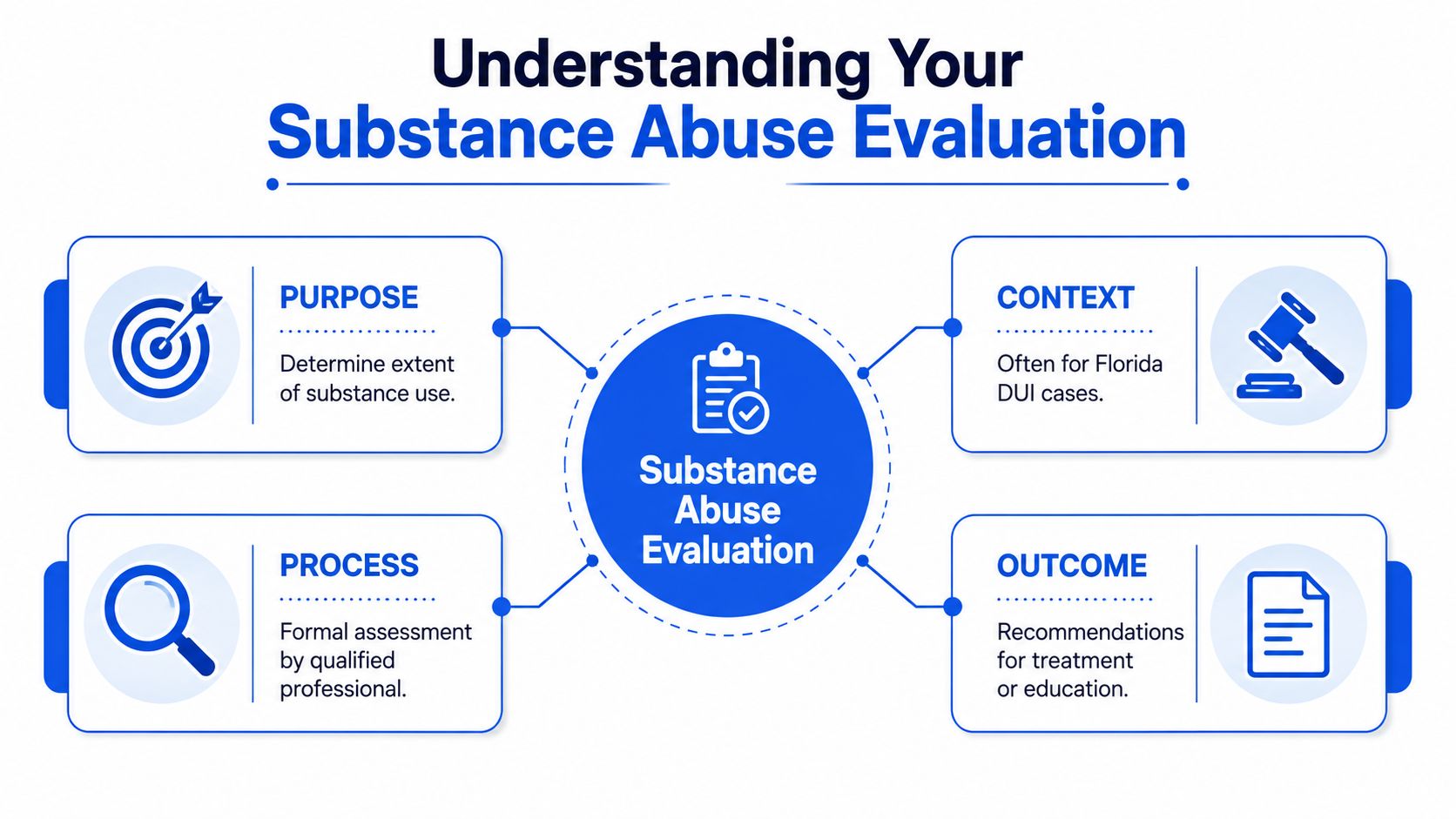
The short answer to what is substance abuse evaluation in a Florida DUI case is this: it's a formal process used to examine your substance use history and decide whether the court should view you as needing education, treatment, monitoring, or more.
It has structure. It has consequences. And it is not the same as a quick online quiz or a casual conversation.
What are the two stages
A substance abuse evaluation is a two-stage process. First, a 10 to 15 minute screening checks whether a potential disorder may exist. If that screening is positive, a 40 to 60 minute assessment follows to define the nature of the problem, establish a formal diagnosis, and recommend a specific level of care, according to this explanation of the screening and assessment structure.
Think of it this way. Screening asks whether there may be smoke. Assessment tries to determine where it's coming from, how serious it is, and what the evaluator thinks should happen next.
That distinction matters because many drivers assume the process starts and ends with a simple intake form. It doesn't. A positive first step opens the door to a deeper review.
What is the evaluator trying to decide
The evaluator is trying to classify your situation. In plain terms, are you presenting as someone with an isolated lapse, or someone the system should treat as a continuing substance-related risk?
That's why the questions often go beyond the arrest itself. The evaluator may ask about your past use, frequency, prior incidents, blackouts, medications, family history, work disruption, and whether substances have affected daily functioning. Tools such as AUDIT, DAST, or SASSI-4 may be part of that process.
The court doesn't order this process just to gather background. It orders it to generate recommendations.
If you need a broader legal framework around DUI charges, review Florida DUI laws and penalties. It helps to know where this evaluation fits inside the larger case.
Why this definition matters in practice
Clients often ask whether this is “just for treatment.” No. It may recommend treatment, but in a DUI case its practical function is much broader. It creates a written record. That record can influence probation terms, school requirements, and how aggressively the court manages your case.
So if you've been asking what is a substance abuse evaluation, stop thinking of it as a wellness exercise. In your case, it's a legal document in the making.
What Happens During the Evaluation Process?
By the time the appointment is set, most drivers are nervous for the wrong reason. They worry about sounding bad. The main issue is understanding the process before you walk in.
A Florida substance abuse evaluation typically takes 45 to 60 minutes, and a licensed professional conducts a clinical screening to evaluate your substance use history and determine if you meet the criteria for a substance use disorder, as described in this Florida evaluation overview.

What the appointment usually looks like
The appointment often starts with intake paperwork. You'll provide identifying details and background information. Then the evaluator will move into direct questions about alcohol or drug use, prior treatment, prescription medications, past arrests, and the facts surrounding your DUI.
That conversation is not casual. The evaluator is listening for consistency, severity, and warning signs. If your written answers and verbal answers don't line up, that can create problems.
Common topics include:
Use history: When you started, what you use, and how often.
Incident context: What happened before the DUI arrest.
Life impact: Whether substance use has affected work, home, driving, or relationships.
Mental health concerns: Anxiety, depression, trauma, or other symptoms that may overlap.
Prior interventions: Counseling, classes, meetings, or treatment history.
What tools may be used
Some evaluators use structured questionnaires. Others rely heavily on interview style. In either case, your answers are being filtered through clinical tools and professional judgment.
You may also hear terms like motivational interviewing. That approach is designed to assess readiness for change and how you respond to discussion about use patterns. If you want a plain-English look at that method, MI for substance abuse recovery gives a useful background explanation.
You don't need a script. You need preparation. Scripts fall apart. Preparation holds.
What happens after the interview
At the end, the evaluator prepares recommendations. Those can range from no treatment recommendation to education classes or more intensive care if the evaluator believes it's clinically necessary.
That's why drivers shouldn't walk in cold. If your case may qualify for alternatives or structured outcomes, it helps to understand programs that can affect sentencing and supervision. A good starting point is Florida DUI diversion program information.
The process is human. That's exactly why automated guidance fails here. A machine can't prepare you for how a real evaluator hears tone, hesitation, minimization, or inconsistency.
What Are the Legal Consequences of Your Evaluation Report?
This is the part many drivers realize too late. The report doesn't just disappear into a file. It can directly affect what the court orders.
At the Orange County Courthouse and courts across Florida, the evaluation report can shape probation conditions, education requirements, treatment demands, and how the judge views your level of risk. Under Florida Statute 316.193(5), a DUI conviction requires the court to place you on probation and order you to complete a psychosocial evaluation conducted by a licensed DUI program to assess your substance use and determine the necessity of treatment.
That statute matters because it gives the evaluation legal force. This isn't optional after conviction. And it isn't cosmetic.
Why the report can hurt you
If the report paints you as high risk, the consequences get heavier. More education. More treatment. More supervision. More opportunities to violate conditions. More strain on your schedule, work, and finances.
The report can also push the case narrative in a bad direction. Instead of a one-time event, you may be framed as someone with an ongoing problem that requires active court management. Once that impression is in the file, your case gets tougher.
How evaluators build the record
In high-stakes matters, an evaluation can involve more than your own statements. It may integrate toxicology, collateral interviews, and review of outside records. That gives the final report more weight because it looks less like opinion and more like compiled evidence.
Here's the practical danger. If outside information conflicts with what you said, the inconsistency can damage your credibility.
A bad report doesn't just recommend programs. It can shape how every decision-maker in your case reads you.
Florida DUI School Levels and Requirements
Requirement | Level I DUI School | Level II DUI School |
|---|---|---|
Who it generally fits | First-time DUI cases | Repeat or more serious DUI-related circumstances |
Purpose | Education-focused response | More intensive intervention and monitoring |
Court impact | Can support a less severe compliance path | Can signal elevated court concern |
Time and burden | Lower overall burden | Higher overall burden |
Related treatment pressure | May stay at education level | More likely to lead to treatment recommendations |
The exact placement can depend on the facts of your case and the evaluation outcome. That's why the report matters so much. It often becomes the bridge between the arrest and the sentence.
If you want a fuller picture of what judges can impose beyond the evaluation itself, review Florida DUI sentencing consequences.
Why you should think like a defense client, not a patient
The system may describe this process in clinical language, but the effect is legal. Your report can influence how much control the court exerts over your life. You should approach it with the same seriousness you'd bring to testimony, records production, or any other evidence-related event.
That doesn't mean being evasive. It means being prepared, careful, and strategic.
How Should You Prepare for Your Evaluation?
Preparation isn't about gaming the process. It's about avoiding careless damage.
In high-stakes cases, evaluations can integrate toxicology, collateral interviews with family or employers, and reviews of criminal and medical records to build an evidentiary chain about whether substance use impairs safe functioning, according to this discussion of evidence-focused evaluations. That should tell you everything you need to know about the stakes.

Immediate Steps to Take
Confirm the appointment details: Know the date, time, location, and any documents you're expected to bring.
Review your own history carefully: Be ready to discuss the DUI incident, prior use, prescriptions, and any past counseling or classes.
Be truthful, but stay concise: Answer the question asked. Don't volunteer a long, emotional narrative that creates confusion.
Avoid casual minimization: If you sound dismissive, defensive, or inconsistent, the evaluator may read that as a red flag.
Show respect and self-control: Your demeanor matters. The evaluator is assessing more than words.
Get legal guidance before you go: This is the step drivers skip, and it costs them.
What not to do
Don't treat the appointment like therapy. It isn't confidential in the way many people assume. Don't arrive angry. Don't guess if you don't remember something clearly. Don't try to outsmart the evaluator with rehearsed lines.
And don't rely on canned internet advice.
Why attorney preparation matters
A lawyer can help you understand the legal meaning of the process before you sit down with the evaluator. That includes identifying sensitive areas, correcting misconceptions, and helping you present accurate information without making your situation look worse than it is.
Lawyer access is crucial. If you're stuck dealing with a chatbot, an app, or a ticket mill built around volume, you won't get strategic preparation customized for your facts. You need direct communication with your attorney by phone or text. Fast answers. Real context. No middleman.
Protective advice: The evaluation may be mandatory. Walking into it unprepared is not.
Your Next Step Is Your Most Important One
A substance abuse evaluation in a Florida DUI case is not just a box to check. It is a legal event with real consequences. The report can affect probation, treatment demands, and how the court measures your risk.
That means your job isn't just to attend. Your job is to protect yourself while complying.
If the evaluation points toward education or treatment, take that seriously and handle it proactively. For some people, structured support can become part of the path forward. If you want to understand one example of a treatment setting people sometimes explore, Cedar Hill's group therapy for addiction offers a useful overview of how group support is typically framed.
But don't confuse treatment planning with legal protection. They are related, not identical. The court is focused on compliance and risk management. You need to be focused on your record, your license, and the long-term impact of every step you take.
If you're facing this process in Florida, act early. Get clear on the court timeline. Get clear on the evaluation. And get clear on who is protecting you. If you need help understanding the larger role of counsel in these cases, review Florida DUI attorneys and your defense options.
You don't need generic reassurance. You need strategy. The right move now can protect your ability to drive, work, and move forward.
If you want a lawyer-led defense focused on protecting your license and pursuing the No Points goal wherever possible, visit Ticket Shield, PLLC for a free consultation. Speak directly with your attorney by phone or text. No middlemen. No automated apps.
