DUI Sentencing Florida: Penalties & Legal Help 2026
Facing dui sentencing florida? Understand 2026 penalties, hidden costs, and how an experienced attorney can protect your license and future. Get help now.

TL;DR: Florida DUI sentencing is harsh, permanent, and often more expensive than people expect. Under Florida Statute § 316.193, penalties can mean jail, license loss, ignition interlock, and years of insurance damage. Get a real Florida DUI lawyer involved immediately.
You were likely released with a stack of papers, no clear answers, and a court date that suddenly feels too close. Your car may be impounded. Your license may already be at risk. You're trying to figure out whether this is “just a first DUI” or the kind of mistake that follows you for years.
Treat it like the second one.
In Florida, DUI cases move fast at the beginning and stay with you long after the courtroom is done. The shock hits first. Then the practical questions show up. Can you still drive? Will you go to jail? What happens to your job? What does this do to your record? Those are the right questions. The wrong move is trying to handle this like a traffic ticket or trusting an automated app that routes you through intake staff and canned updates.
You need legal strategy early. You need someone looking at the traffic stop, the breath test, the timeline, the officer's report, and any enhancement issue under Chapter 316, especially § 316.193. That's how you protect your license, your record, and your advantage.
Table of Contents
Your Guide to Navigating a Florida DUI Charge
The first night after a DUI arrest is always the same. You replay the stop. You replay what you said. You replay whether you should've taken a test, refused one, or asked more questions. By the next morning, you're not thinking like the officer or the prosecutor. You're thinking like someone who has a job, bills, a family, and a driver's license to protect.
That's exactly why you need to get grounded fast.
A DUI charge in Florida isn't something you should try to manage through guesswork. It's a criminal case with sentencing rules, enhancement triggers, and separate license consequences. If your case is in Miami, for example, the process may run through the Richard E. Gerstein Justice Building, but the courthouse is only one part of the problem. The state wants the conviction. The DMV wants to deal with your driving privilege. You need a response to both.
Practical rule: In a DUI case, early silence and early legal action are usually smarter than early explanations.
The question isn't whether the situation is serious. It is. The question is whether you'll respond strategically or casually. Casual gets people trapped in preventable outcomes. Strategic means getting the facts organized, protecting the license issue quickly, and having a lawyer evaluate the state's evidence before you make decisions that can't be undone.
If you want a broader overview of the charge itself before you focus on sentencing, read this guide to DUI charges in Florida.
What matters in the first days
Your timeline matters: What happened from the stop through release can shape your defense.
Your paperwork matters: The citation, notice of suspension, and court date all need review.
Your statements matter: Anything you said can become part of the prosecution story.
Your prior record matters: Even older incidents can affect how the prosecutor evaluates exposure.
What Are Florida's Standard DUI Penalties
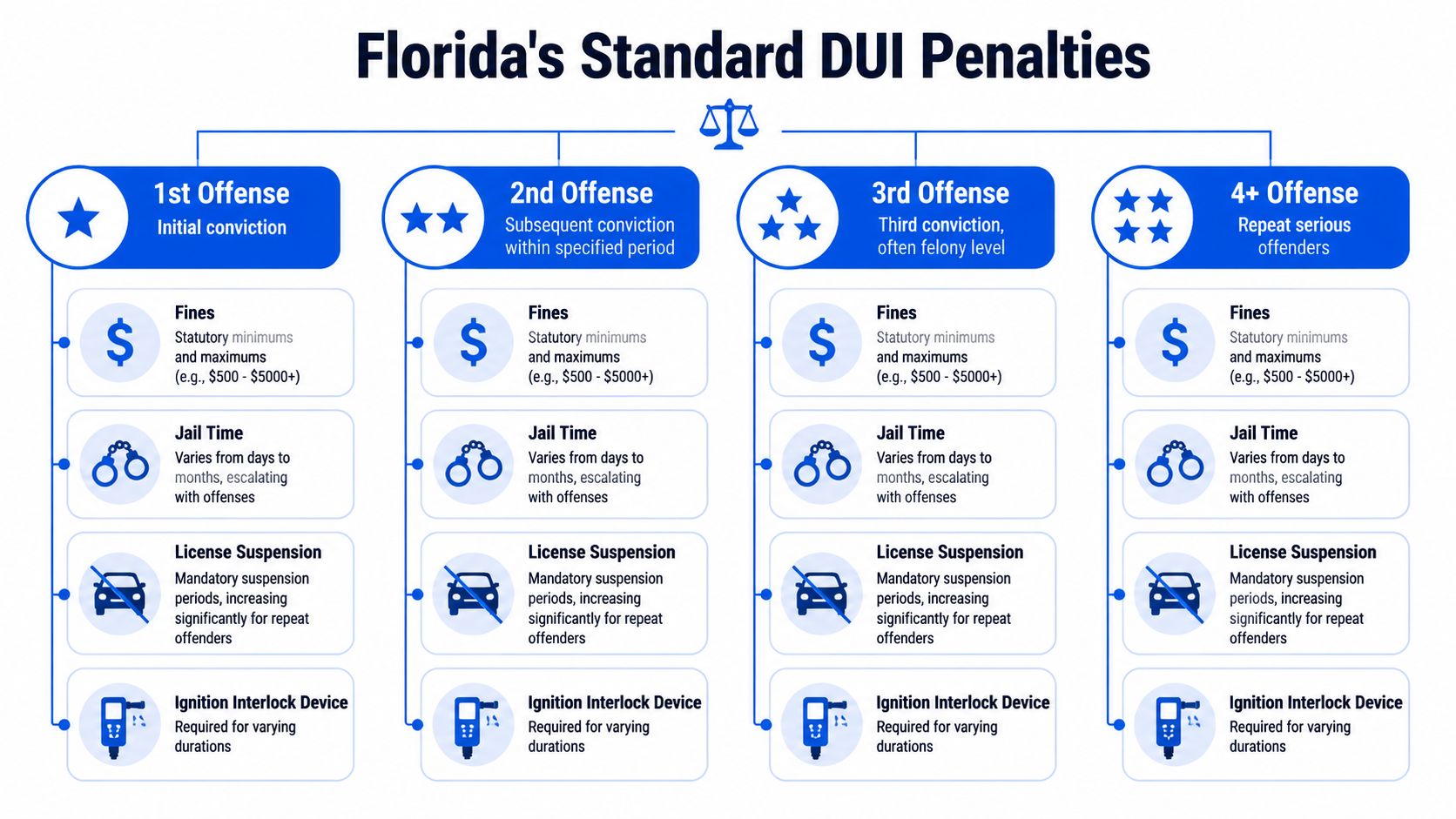
You get arrested for DUI, sleep a few hours, then start searching penalty charts. That is how people underestimate this case. Florida DUI sentencing is built to punish fast, and the actual damage is not limited to the fine listed on a website.
Under Florida Statute § 316.193, the court looks at the offense number, the timing of any prior convictions, and aggravating facts tied to the arrest. Some penalties are discretionary. Others are built into the statute and can sharply limit what the judge can do. That is why a DUI case needs strategy early. A lawyer is not there to read the chart to you. A lawyer is there to challenge the facts that trigger the chart in the first place.
What does a first conviction usually bring
For a first DUI conviction, Florida law allows:
Penalty category | Baseline exposure |
|---|---|
Fine | $500 to $1,000 |
Jail | Up to 6 months |
License suspension | At least 180 days |
That chart looks manageable until it hits your real life. A suspended license can disrupt work. Court requirements take time and money. Insurance consequences often outlast the sentence itself.
If this is your first arrest, do not talk yourself into complacency. First-offense cases still carry jail exposure, a criminal conviction, and a record that follows you. They also often present the best opportunity to challenge the stop, the arrest, the testing, or the officer's observations before the case hardens against you. For a closer look at Florida first-time DUI penalties, review the offense-specific breakdown.
When do repeat offenses become much more dangerous
Repeat DUI sentencing gets harsher quickly because Florida treats repeat conduct as a public safety problem, not a one-time lapse in judgment.
Here is the practical breakdown:
Second DUI within 5 years: Florida law includes a mandatory minimum of 10 days in jail.
Third DUI within 10 years: The charge can become a third-degree felony.
A fourth DUI: Florida law treats it as a felony, regardless of when the earlier convictions occurred, according to the Florida Senate's summary of DUI penalties under section 316.193.
The date of an earlier conviction matters. So does whether the state can prove it the right way. That is not clerical trivia. It can change whether jail is optional, required, or measured in prison exposure instead of days.
Penalty charts also hide the long tail of a conviction. A repeat DUI can damage employment options, professional licensing, background checks, and insurance costs for years. That is why smart defense work focuses on more than the sentence announced in court. The goal is to protect your record, your license position, and your future prospects before the prosecutor locks the case into a harsher category.
What Factors Make DUI Sentencing Worse
The starting penalty chart is only the base layer. A significant danger in many DUI cases comes from enhancements. These are the facts the prosecutor uses to push the sentence higher and to reduce the judge's room to go easy on you.
Florida DUI sentencing is threshold-driven. A first conviction can mean up to 6 months in jail, but this rises to 9 months if your BAC was 0.15+ or a minor was present. A second conviction within 5 years includes a mandatory minimum of 10 days in jail, according to this Florida DUI penalty chart analysis.

Which facts trigger harsher punishment
Some aggravating facts are obvious. Others are buried in the paperwork or in the way the state frames the case.
Common sentencing escalators include:
High BAC allegation: If the state claims a BAC of 0.15 or higher, your sentencing exposure increases.
Minor in the vehicle: A child passenger creates a harsher sentencing range even on a first case.
Repeat offense timing: The date of any prior conviction matters. So does whether it falls inside the statutory lookback period.
Ignition interlock exposure: Some enhancement facts can trigger interlock requirements that continue after court.
Why prior history changes everything
Prior offenses change plea posture, sentencing influence, and how seriously the court views your case. That includes older matters and, in many cases, out-of-state history if it qualifies under Florida law. Consequently, DIY defense falls apart. You can't negotiate intelligently if you don't know what the prosecutor believes counts against you.
At the Orange County Courthouse in Orlando or anywhere else in Florida, judges look at the legal category in front of them, not the explanation you wish they'd hear. If the state can prove an enhancement, sentencing gets harder. If your lawyer can challenge the stop, the testing, the timeline, or the prior-offense theory, the pressure can change quickly.
A DUI case isn't only about what happened that night. It's also about what the state can actually prove, and what it can't.
That distinction is where good sentencing defense lives.
What Are the Hidden Financial Costs of a DUI
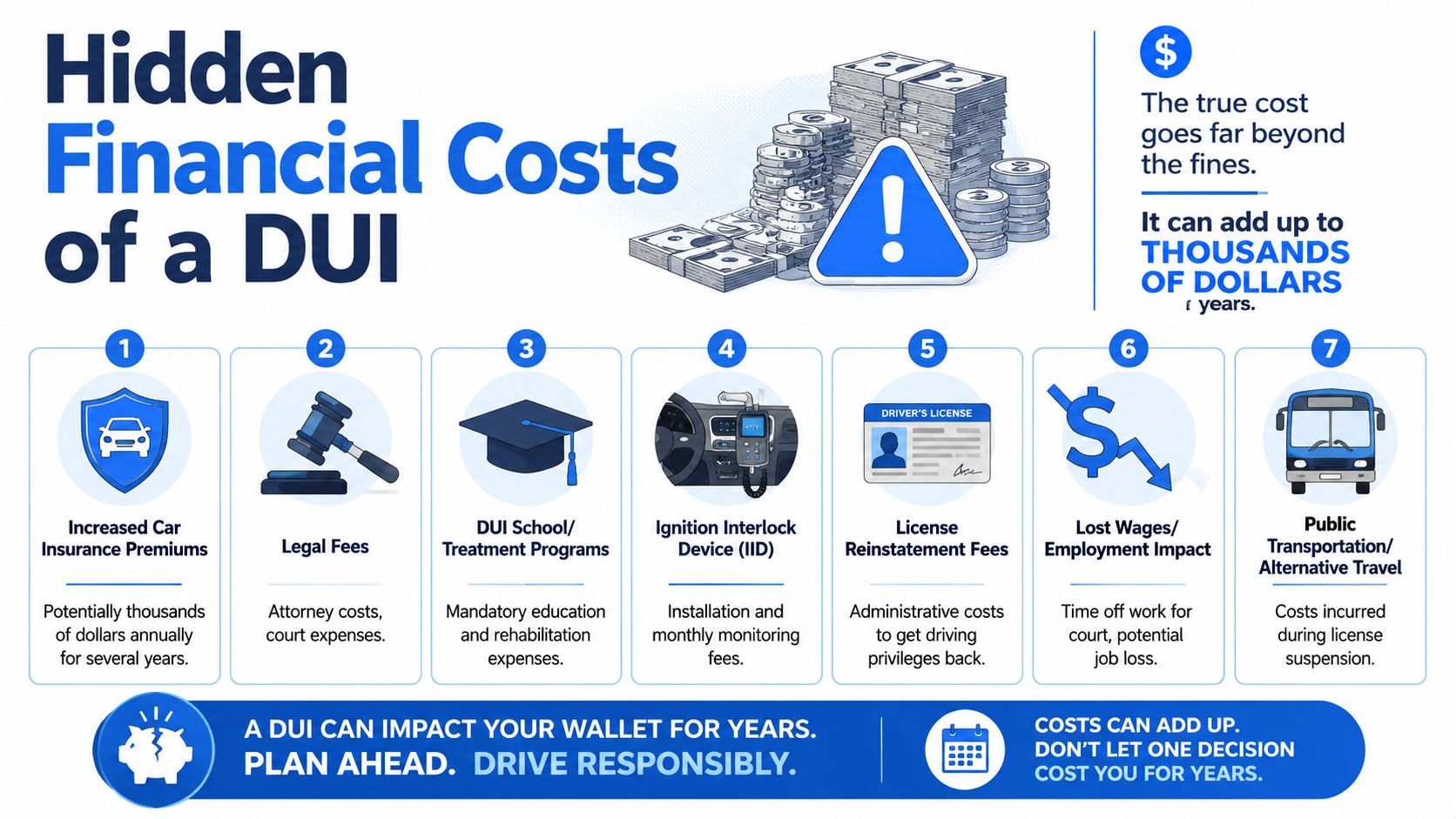
The immediate focus is often on the court fine because it's printed clearly. That's the wrong place to stop. The fine is visible. The long-term cost is what really hurts.
Why the court fine is only the beginning
After a DUI, Florida drivers can expect car insurance costs to jump to an average of $306 per month for full coverage, and they must carry FR-44 insurance for 3 years after license reinstatement, according to Florida DUI insurance cost data from Insurify.
That changes the math of your case.
A lot of drivers walk into court worried about avoiding jail and assume that if they stay out of custody, they've won. Not necessarily. A result that avoids jail but leaves you with the conviction can still cost you heavily for years through insurance, reinstatement issues, and driving restrictions.
If you're trying to understand the insurance side in plain language, this guide on affordable DUI auto insurance Florida is a useful practical reference.
Here's a closer look at total cost exposure after conviction:
Insurance increase: Usually the biggest long-tail hit.
FR-44 requirement: Not optional if you want lawful reinstatement.
Ignition interlock costs: Installation and monitoring come out of your pocket when ordered.
Reinstatement fees and compliance costs: These add up even after the criminal case is finished.
For a fuller breakdown of the financial side, read how much a DUI can cost in Florida.
What costs continue after the case ends
This video gives a useful overview of the financial fallout many drivers miss until it's too late.
The point is simple. A DUI sentence doesn't end when the judge speaks. It keeps billing you.
That's why smart defense strategy isn't limited to “Can we keep you out of jail?” It also asks, “Can we prevent the conviction that triggers years of downstream cost?”
Why Do I Have Both a DMV and a Court Case
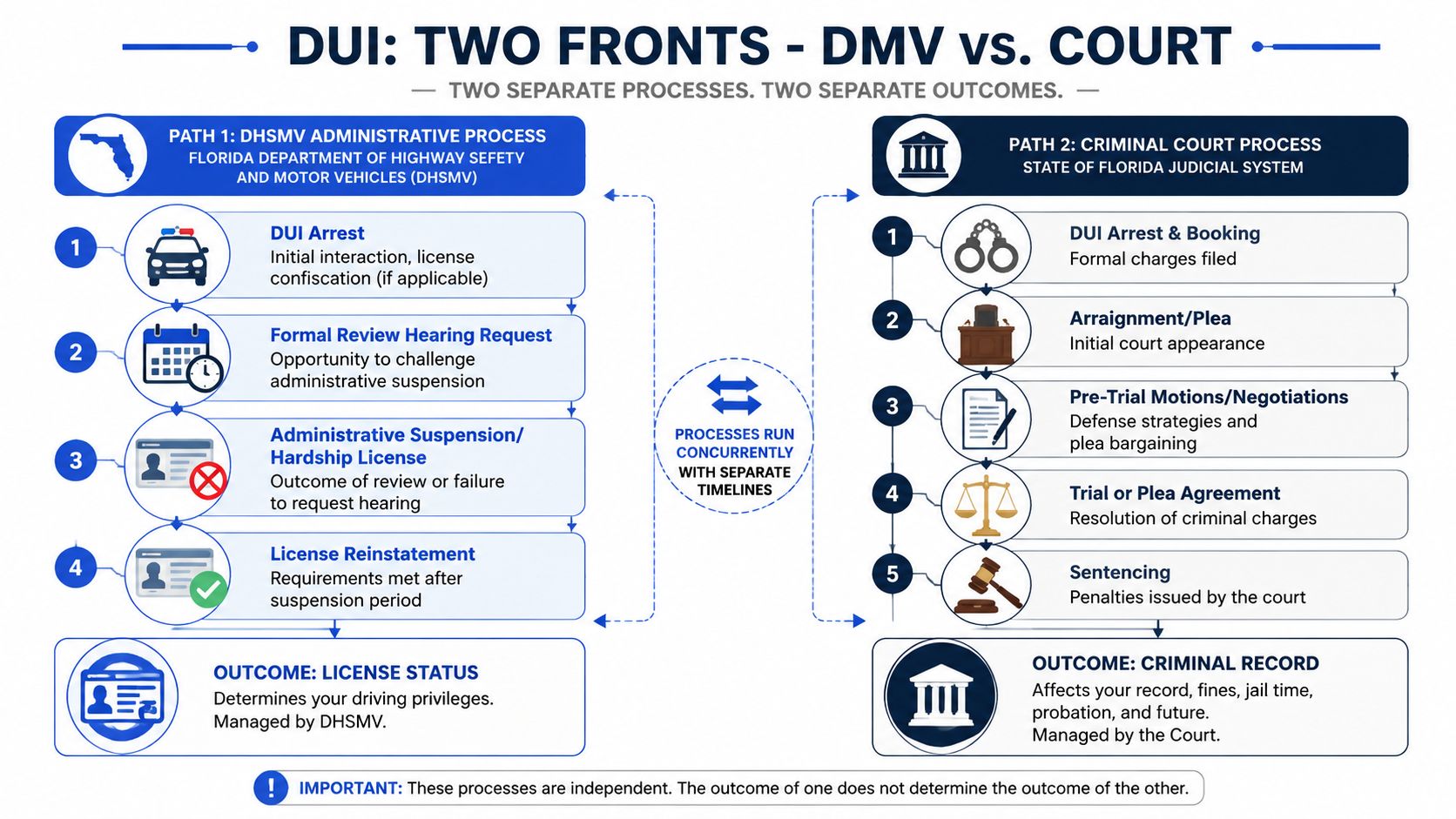
This confuses almost everyone. You're not dealing with one problem. You're dealing with two separate proceedings moving at the same time.
One is administrative. The other is criminal.
What the DMV side is really about
The DMV side is about your driving privilege. It is not about whether you are criminally guilty beyond a reasonable doubt. It is a separate administrative process tied to the license suspension that follows a DUI arrest.
The biggest mistake here is delay. The deadline arrives fast. If you miss it, you can lose options that might have helped preserve your ability to drive.
If you need a focused explanation of that license process, review Florida's administrative license suspension hearing process.
What the criminal court side is really about
The court case is where the state tries to convict you under § 316.193. That process can involve arraignment, motion practice, negotiations, and possibly trial. If your case is in Tampa, that may mean appearances tied to the Edgecomb Courthouse, but the location doesn't change the core reality. The prosecutor's job is to prove the offense. Your lawyer's job is to attack proof, suppress bad evidence where possible, and improve the outcome.
Keep these two tracks straight:
Track | Main issue | Main risk |
|---|---|---|
DMV | Your license | Suspension and reinstatement burdens |
Criminal court | The DUI charge | Conviction, sentence, and permanent record consequences |
You can't assume success in one track fixes the other. It doesn't.
That's why DUI sentencing in Florida has to be approached as a coordinated defense, not a single hearing.
How Can an Attorney Fight Harsh DUI Sentencing
You get arrested for DUI, spend the night worrying about jail, and assume sentencing is decided by the number on the breath test. That is how people walk into avoidable penalties. In Florida, harsh DUI sentencing often turns on something far less obvious: whether the state can use the evidence it collected, whether an enhancement holds up, and whether your lawyer starts attacking the case early enough to change the outcome.
A real defense lawyer is not there to make excuses for bad facts. The job is to keep bad facts from turning into automatic punishment. That means challenging mandatory minimums, blocking weak enhancements, and limiting the long-term damage to your record, your license, your employment, and your bank account.
What a lawyer examines before sentencing is even on the table
Sentencing defense starts months before anyone talks about punishment. If your attorney waits until the hearing to get serious, you are already behind.
A lawyer should be testing every pressure point in the case:
The stop: If the officer lacked a lawful reason to pull you over, key evidence may be thrown out.
The arrest decision: An officer still needs legal grounds to arrest you, even if the report sounds confident on paper.
Field sobriety exercises: These tests are subjective, often poorly instructed, and easy to challenge.
Breath or blood evidence: Maintenance records, operator mistakes, collection issues, and rule violations matter.
Enhancement allegations: Prior convictions, prior dates, injuries, property damage, minors in the car, and high BAC claims all need proof. You do not concede any of that without review.
When police got evidence in violation of the law, your attorney may file a motion to keep it out. If you want to understand how that works, read what a motion to suppress evidence means in a Florida case.
That kind of legal work can change everything. It can weaken the prosecutor's bargaining position, remove an aggravating factor, or put the state in a position where a reduction becomes possible.
Good DUI defense is also financial defense
Clients fixate on fines. That is too narrow.
A harsh DUI sentence can trigger ignition interlock costs, higher insurance premiums, alcohol treatment expenses, probation fees, missed work, towing bills, and repeat-driver sanctions that follow you for years. A conviction can also lock a permanent DUI record into place, which is a serious problem for anyone with a professional license, a job that requires driving, or an employer that runs background checks.
That is why an experienced lawyer does more than argue over a sentence recommendation. The lawyer works to prevent the kind of outcome that keeps costing you long after court ends.
Why direct attorney strategy matters
You do not need a call center. You do not need software pretending to practice law. You need a lawyer who can read the reports closely, spot what the prosecutor is overstating, and make disciplined decisions about motions, negotiations, and trial risk.
Ticket Shield, PLLC handles Florida traffic and DUI defense as a lawyer-led firm, with direct attorney communication by phone or text. That matters because DUI cases move fast, enhancement issues get missed, and small details often decide whether you are facing standard penalties or something much worse.
The right approach is simple. Attack the proof. Challenge the enhancements. Protect the record. Reduce the fallout wherever the facts and law allow.
What Are Your Immediate Next Steps After a DUI Arrest
You get out of jail, look at the paperwork, and assume the court date is the next thing that matters. That mistake costs people their license, weakens their defense, and turns a bad arrest into a long-term record problem.
Speed matters here. Florida DUI cases split fast into a license problem, a court problem, and a financial problem. If you sit on the paperwork, you give up options. If you start talking, posting, or guessing, you hand the state evidence.
What you need to do now
Deal with the license issue immediately: The administrative deadline comes fast after a DUI arrest. If you miss it, you can lose the chance to challenge the suspension early.
Write out everything that happened: Do it today. Note where you were stopped, what you drank, when you drank, what the officer asked, whether field exercises were requested, and whether you gave breath, blood, or urine.
Stop discussing the case: Do not explain it to friends, coworkers, your employer, or on social media. Prosecutors use loose statements. Insurance companies and licensing boards can also be affected by what gets documented.
Preserve every document: Keep the citation, temporary permit, bond papers, towing receipt, impound paperwork, and any notice tied to your license or court date in one place.
Get a Florida DUI lawyer involved now: Early review matters. A lawyer needs time to examine the stop, the arrest basis, the testing process, and any facts the state may try to use to push for harsher sentencing.
This is not just about avoiding a fine. A DUI can create insurance increases, interlock costs, treatment requirements, probation expenses, missed work, and a record that keeps causing problems after the case ends. If you hold a professional license, drive for work, serve in the military, or rely on a clean background check, the risk is even higher.
Do not try to manage this like a traffic ticket. DUI sentencing in Florida is loaded with mandatory rules, enhancement arguments, and record consequences that a phone app will not catch. A real attorney looks for pressure points early, before deadlines pass and before the prosecution locks in its version of the facts.
Ticket Shield, PLLC handles Florida traffic and DUI defense with direct attorney communication by phone or text. If you want a lawyer-led defense focused on protecting your license, record, and insurance exposure, visit Ticket Shield, PLLC for a free consultation. If your goal is preventing this from becoming a long-term record and cost problem, ask what outcome the facts and law support, including whether a No Points result is possible.