
Navigate DUI Florida Laws: Protect Your Future
Arrested for DUI in Florida? Understand DUI Florida laws, penalties, and your rights. An attorney can protect your license. Get a free consultation.

A Florida DUI arrest triggers two fights at once. You can face a criminal case under Florida Statute § 316.193 and a separate license threat. Act immediately. Fast, lawyer-led decisions protect your license, record, and advantage.
You were likely released a few hours ago. Your car may still be impounded. Your license situation is unclear. You're replaying every word the officer said and trying to figure out whether this is “just a first DUI” or something that can derail your job, insurance, and future.
It can get serious quickly. But panic helps the state, not you.
Florida DUI cases move fast, and they do not run on one track. You're dealing with a criminal prosecution and a separate license problem at the same time. Most drivers misunderstand that point, wait too long, and give away options they could have preserved. If you were arrested anywhere from Miami to Orlando, or you're headed into a courthouse like the Richard E. Gerstein Justice Building, the first priority is control. Not excuses. Not internet myths. Control.
Table of Contents
What Legally Defines a DUI in Florida
You can be arrested for DUI in Florida after a short stop that felt ordinary. A turn the officer did not like. A red light. A call from another driver. Minutes later, the officer is asking about drinking, watching your eyes, and building two separate problems for you. One is the criminal case. The other is your license. Drivers often miss that split at the start, and that mistake costs them time they do not have.
What counts as a DUI under Florida law
Florida gives the state two ways to pursue a DUI. Prosecutors can argue your normal faculties were impaired by alcohol or drugs. Or they can rely on a chemical test result at or above the legal limit.
For adult drivers, that legal limit is 0.08%. Commercial drivers face a lower threshold, and drivers under 21 face license consequences at a much lower level. If you want the threshold rules explained plainly, read Ticket Shield's guide to the legal blood alcohol level in Florida.
That legal definition matters for one reason. A DUI case is not decided by whether you felt fine to drive. It is decided by what the officer wrote down, what the video shows, how the tests were handled, and whether the state can prove impairment at the relevant time.
A real defense starts there. It does not start with panic, and it does not start with an automated form that treats every arrest the same.
Can you get a DUI without driving
Yes. Florida also allows a DUI charge based on actual physical control of a vehicle.
That catches people off guard. You can be parked. You can be on the shoulder. You can be sitting in the driver's seat with the keys close enough for the officer to claim you could operate the car. Those facts do not prove guilt by themselves, but they do give the state an opening.
Your lawyer should press the details hard:
Where exactly were the keys
Was the engine on
Were you in control of the vehicle
When did the officer first observe you
Does the timeline support impairment while you were in control
Those are defense questions. They require judgment, investigation, and speed.
Does private property protect you
Usually, no.
An arrest in a gated community, apartment complex, private road, or parking area does not make the case disappear. Drivers cling to that idea because it sounds logical. It is usually a dead end. A stronger defense attacks the stop, the officer's observations, the field sobriety exercises, the breath or blood evidence, and the state's claim that you were in actual physical control.
That is also why the first days after arrest matter so much. You are not dealing with one simple accusation. You are dealing with Florida's two-track DUI system from the start. The criminal court case will move on its own schedule, while the DHSMV side starts putting pressure on your license immediately. If you rely on an app, a call center, or a document service, you miss strategy at the exact moment strategy matters.
Get a lawyer involved early. A real Florida DUI defense is built by a person who can spot weaknesses fast, protect your license position, and shape the criminal case before the state gets too far ahead.
What Are the Penalties for a Florida DUI
You were just arrested. You are worried about jail, fines, your job, and whether this will follow you for years. That reaction is normal. But do not make the mistake of treating a first DUI like a small, fixable traffic case. Florida uses DUI penalties to create pressure fast, and prosecutors use that pressure to push bad decisions before your defense is ready.
What a first second or third DUI can bring
A first DUI conviction can mean fines, probation, classes, a vehicle impound, and possible jail. A second conviction raises the stakes sharply. A third DUI within 10 years can be charged as a felony, which changes the case in a serious way and puts far more at risk than money.
That escalation is the point. Florida is built to punish repeat allegations harder and to make early plea decisions feel urgent.
Here's the visual most drivers need to see early:
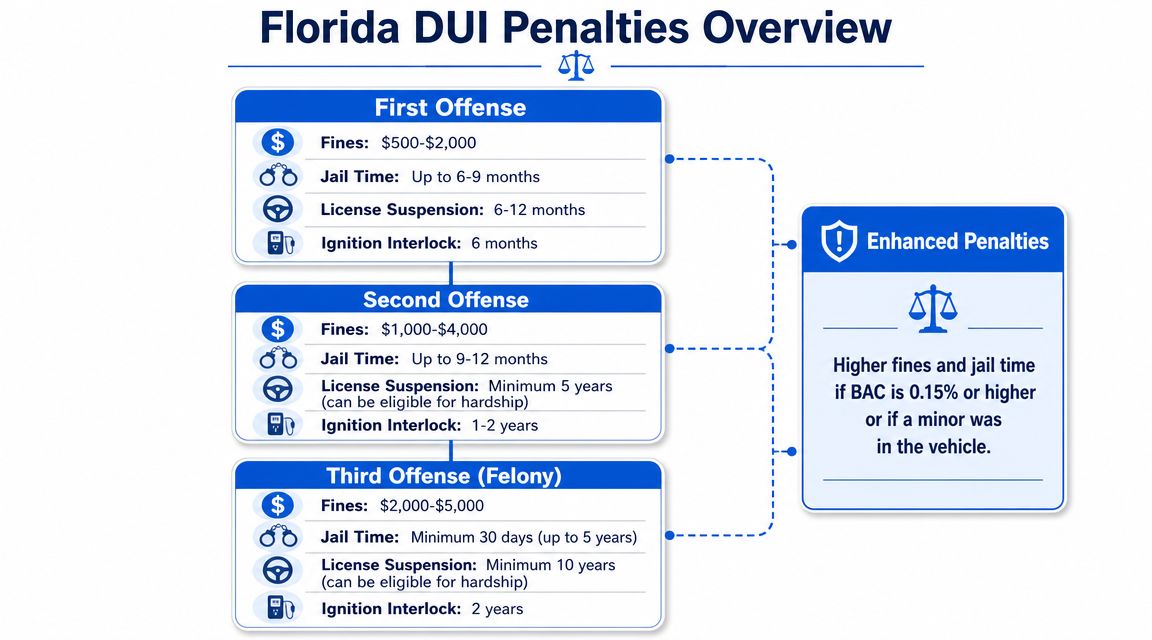
A short summary helps:
Offense level | Statutory consequence cited here |
|---|---|
First conviction | Fine and possible jail |
Second conviction | Higher fine exposure and harsher sentencing risk |
Third within 10 years | Can become a felony |
For a fuller breakdown of Florida DUI penalties by offense level, review Ticket Shield's guide.
When penalties get worse fast
Some facts make the case more dangerous immediately. A high breath reading or an allegation that a minor was in the vehicle can increase the punishment range and the pressure to plead early. Property damage, injury, or a prior record can also change how the state charges the case and how the judge views it.
Sentencing exposure matters. It is not the whole fight.
A significant danger is that drivers focus only on the criminal penalty chart and miss what is happening around it. A Florida DUI starts on two tracks. One track is the criminal case. The other is the DHSMV action affecting your license. Those tracks move on different deadlines, and confusion about that split causes avoidable damage in the first days after arrest.
You need a lawyer who treats the penalty issue as part of a defense plan, not as a scare tactic. Automated services and generic document platforms do not cross-examine officers, test breath procedures, or build a strategy that protects your position on both tracks. A real lawyer does that. If the stop was weak, the observations were overstated, or the testing was flawed, the case can improve substantially. If the evidence is difficult, disciplined lawyering still matters because charge negotiations, motion practice, and mitigation can change the outcome.
Do not let fear of the listed penalties push you into a fast plea. Get a defense in place while there is still time to shape the case.
What Happens to Your License Immediately After a DUI Arrest
Your DUI case didn't start and end with handcuffs. The moment of arrest can trigger a separate threat to your license through the Florida Department of Highway Safety and Motor Vehicles. In this separate process, drivers often lose ground because they assume the court date controls everything.
It doesn't.
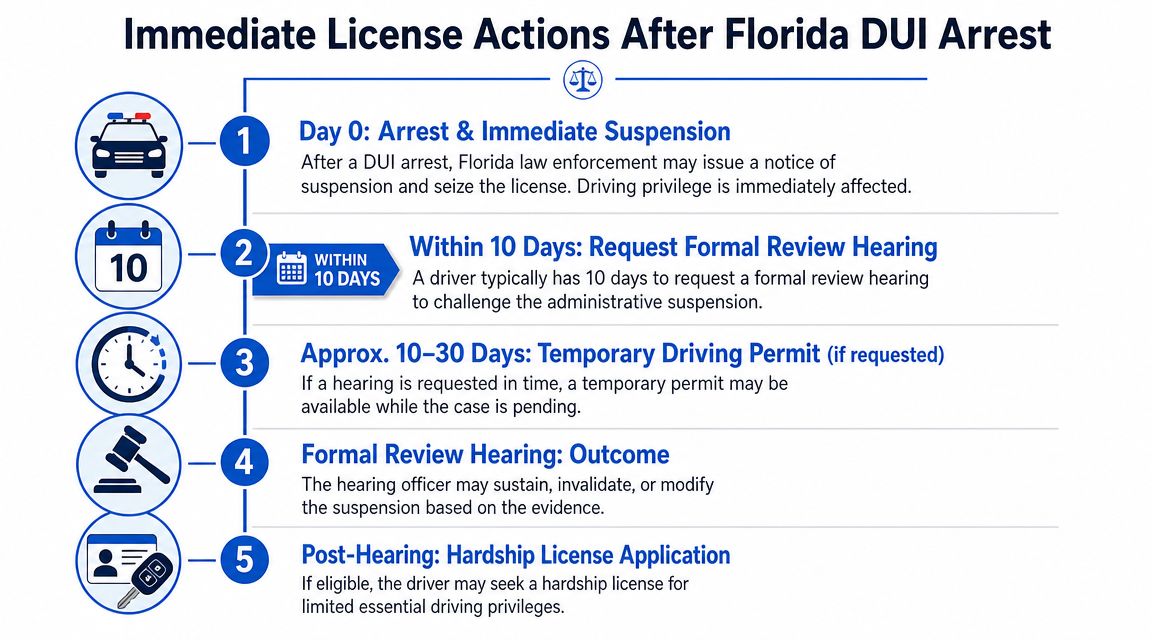
Here is the immediate license timeline drivers need to understand:
Why the first 10 days matter most
You have a 10-day window after arrest to challenge the administrative suspension of your license. Miss that deadline and you can lose the chance to fight for your driving privilege through the administrative process. This is a commonly misunderstood deadline, and it's the one that causes the most preventable damage.
That's why the first question after a DUI arrest should be simple. What day are you on right now?
If you need a straightforward explanation of the administrative issue, review Ticket Shield's DUI license suspension in Florida guide.
This short video gives a useful overview before you speak with counsel:
Why waiting is the worst move
The DHSMV side is separate from the criminal case. That means you can still face license consequences even if the criminal case later improves, gets reduced, or falls apart. Drivers who “wait to see what the judge says” usually discover too late that they let the wrong deadline pass.
Use this checklist immediately:
Confirm the arrest date: Count the days correctly. Don't guess.
Preserve every paper you received: Citation, notice, bond sheet, tow paperwork, and any temporary permit matter.
Stop talking about the facts casually: Text messages to friends can become problems.
Get legal help before the deadline expires: Strategy starts at this stage, not concludes.
Urgent point: Your license battle starts before your criminal case is resolved. Treat it that way.
How Does the Criminal Court Process Differ from the DHSMV Hearing
Most arrested drivers think there is one case. There are really two proceedings with two different purposes. One deals with criminal liability. The other deals with your driving privilege. If you don't separate them mentally, you'll make bad decisions in both.
These are separate fights with separate goals
The criminal court case asks whether the state can prove the DUI charge and impose criminal penalties. The DHSMV hearing deals with the administrative suspension of your license. They overlap in facts, but they are not the same contest.
This side-by-side view helps:
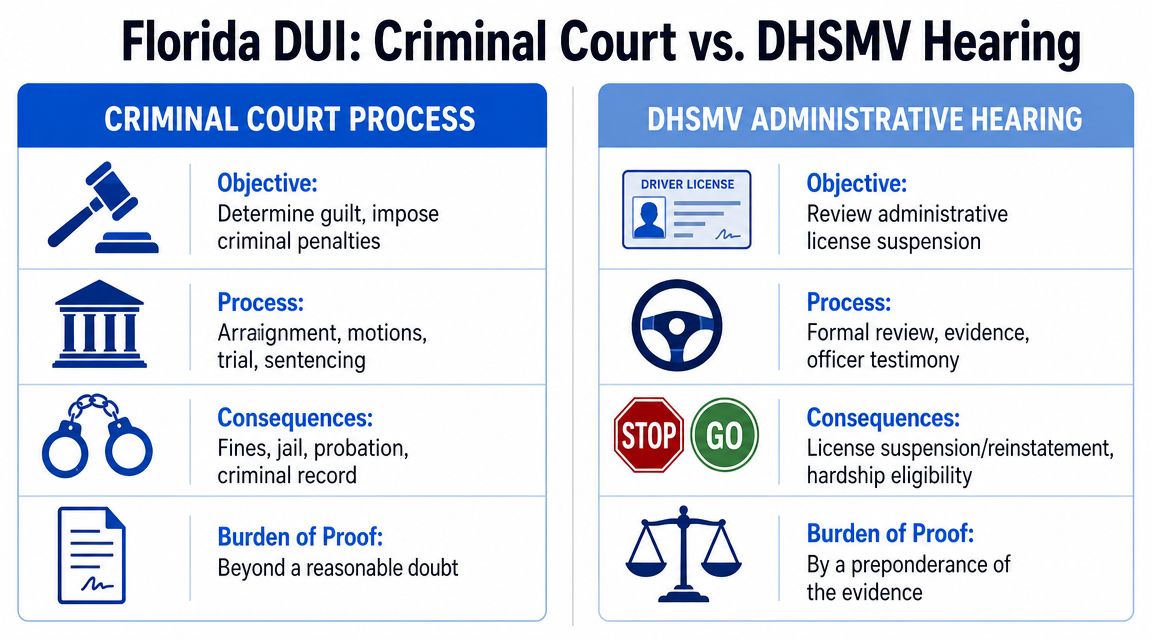
Process | Core issue | Immediate risk |
|---|---|---|
Criminal court | Whether the state proves the charge | Record, fines, probation, possible jail |
DHSMV hearing | Whether the suspension stands | Loss of driving privilege |
If you want a focused explanation of the administrative side, read Ticket Shield's overview of the administrative license suspension hearing.
What changes in a busy Florida courthouse
This difference becomes very real in high-volume jurisdictions. Florida sees annual DUI arrest totals that commonly exceed 30,000, and one public summary reported more than 32,000 DUI arrests in 2018 with 814 deaths tied to DUI that same year, according to this Florida DUI statistics summary. The same summary notes that Miami-Dade County has 4,200+ annual DUI arrests, with major activity also reported in Broward and Palm Beach.
That volume matters because crowded dockets pressure people into fast resolutions. In a courthouse like the Richard E. Gerstein Justice Building, your case is not the only one moving. The system keeps moving whether you are ready or not.
So be clear-eyed about the strategy:
Court defense is about testing guilt and criminal exposure.
DHSMV defense is about protecting your license.
A good result in one doesn't guarantee a good result in the other.
You need both handled at once.
What Are Common Defenses Against a DUI Charge
You do not beat a Florida DUI by repeating, “I wasn't drunk.” You beat it by forcing the state to prove every step, every observation, and every test with reliable evidence. That is where cases break.
A DUI report often looks polished because officers use familiar language. “Bloodshot eyes.” “Odor of alcohol.” “Swaying.” “Failed exercises.” Those phrases sound convincing on paper. They are often far less convincing once the video, timing, testing records, and real-world conditions are examined.

A real defense starts with one question. What is the weakest point in the state's chain of proof? In many Florida DUI cases, it is one of these:
The traffic stop: The officer needed a lawful reason to stop you. If the stop was weak, the rest of the case can weaken with it.
Probable cause to arrest: Nervousness, fatigue, red eyes, or the smell of alcohol do not automatically prove impairment.
Field sobriety exercises: These are subjective. Bad instructions, uneven pavement, weather, footwear, injuries, age, weight, and anxiety all matter.
Breath or blood testing: Machine records, observation periods, maintenance history, sample handling, and timing can all create real challenges.
Officer credibility and video: Reports are often written to sound stronger than the footage shows. Video review is mandatory, not optional.
Strong DUI defense is detail work. You are looking for contradictions, missing steps, shortcut procedures, and exaggerated conclusions. One bad assumption by the officer can infect the whole case.
People arrested on private property often chase the wrong issue. As noted earlier, Florida's DUI law is not limited to public highways, so “it happened in a parking lot” is usually not the winning argument. Better defenses usually focus on questions like these:
Were you driving, or merely near the vehicle
Were you in physical control
Did the officer confuse alcohol consumption with legal impairment
Did the test result match the relevant time, not just a later time
Did medical conditions, fatigue, or stress explain what the officer called impairment
Here is the part many drivers miss. Your defense is happening on two tracks at once. The criminal case tests whether the charge can be proved. The license case can turn on different facts, different documents, and different deadlines. A lawyer who handles both tracks can use early evidence review to protect your license position and your court defense at the same time. An automated service cannot do that. A real lawyer can.
That difference matters fast. If your case has a defect, it needs to be identified early, preserved correctly, and used in the right forum. Delay costs options.
What Are the First Steps You Must Take After a DUI Arrest
The first day after a DUI arrest is usually chaos. You're tired, embarrassed, and getting bad advice from people who aren't going to court with you. Ignore the noise. Take clean, defensive steps.
Immediate steps to take
Write down everything now: Record where you were, what you drank if anything, when you last ate, what the officer said, whether there was video, and when any testing happened. Memory fades fast.
Save your documents in one place: Keep the notice of suspension, bond papers, towing receipt, property receipt, and court paperwork together.
Protect your phone data: Don't delete messages, ride receipts, maps, photos, or call logs. Sometimes that material helps your timeline.
Track the 10-day deadline carefully: If you don't know how many days are left, find out today.
Do not explain the case publicly: Not on social media. Not in group texts. Not at work unless you must.
Get a defense lawyer involved immediately: DUI cases are evidence cases. The earlier counsel gets involved, the more can be preserved and challenged.
A few things also need to stop right away. Stop assuming a polite attitude during the arrest will carry the case. Stop assuming “first offense” means an automatic break. Stop relying on internet comments from people who were never in your county, in your courtroom, with your facts.
Your job now is simple. Preserve facts. Protect your license options. Prepare your defense before the state gets comfortable.
Why a Lawyer-Led Defense Is Critical for a DUI
A DUI charge is not the place for middlemen, automated apps, or chatbots pretending to be legal strategy. You need direct access to the lawyer handling the case because the decisions come fast and the consequences are personal.
Why direct attorney access matters
You need someone who can answer questions like these in real time:
Should you request the administrative hearing now
What facts matter from the arrest
What should be preserved immediately
Whether the state's proof appears chemical, observational, or both
How your county's court culture may shape the first moves
That kind of defense is not interchangeable with a ticket-mill workflow. A DUI requires judgment. It requires review of reports, video, timing, testing issues, and courtroom posture. It also requires communication. If you can't reach the lawyer who is supposed to protect your license and record, you're already behind.
One Florida option is Ticket Shield's DUI defense in Florida service, where clients communicate directly with their attorney by phone or text instead of being routed through a call-center style system. That model fits DUI defense because the case moves too quickly for impersonal handling.
You do not need false reassurance. You need a plan. A strategic defense is possible. But it requires immediate action, disciplined evidence review, and someone who understands both sides of the Florida DUI process.
If you've been arrested for DUI in Florida, act now. Protect the license first, protect the record next, and pursue the strongest available result, including the No Points goal where applicable. Visit Ticket Shield, PLLC for a free consultation.
