What Is a Field Sobriety Test? Know Your Rights Now
Pulled over in Florida? Learn exactly what is a field sobriety test, its accuracy, and your right to refuse. Protect your license with a strategic defense.

A field sobriety test is a series of voluntary roadside exercises officers use to build probable cause for a DUI arrest, not to prove you can't drive. In Florida, you can politely refuse these tests without an automatic license suspension.
You're driving home. Lights hit your mirror. Your stomach drops. The officer walks up, asks a few questions, then tells you to step out of the car.
That moment matters.
If you're asking what is a field sobriety test, you need the actual facts, not a sanitized version. These aren't neutral roadside diagnostics. They are tools officers use during a DUI investigation to gather observations they can later describe as signs of impairment. In Florida, that distinction matters under Chapter 316, especially Florida Statute 316.193 governing DUI and Florida Statute 316.1932 governing implied consent for chemical testing.
If you're dealing with a stop right now, or cleaning up the damage after an arrest, start with a clear understanding of your rights during a Florida traffic stop. Calm helps. Silence helps more.
Table of Contents
What Should You Do During a DUI Stop in Florida
The first job is simple. Don't help the state build its case against you.
When an officer asks you to step out, they're already evaluating everything. Your speech. Your balance. How fast you respond. Whether you look confused, nervous, irritated, or overly eager to cooperate. They are collecting observations tied to Florida Statute 316.193.
What should you say and do
Be polite. Be brief. Hand over your license, registration, and proof of insurance if requested. Don't argue on the roadside. Don't explain where you came from, what you drank, when you drank, or whether you “feel fine.”
Practical rule: Give required documents. Decline casual conversation. Stay respectful.
Officers often sound conversational because they want admissions. “Had anything to drink tonight?” is not small talk. It's evidence gathering.
Immediate Steps to Take
Pull over safely: Use your signal, stop in a secure location, and keep your hands visible.
Stay calm: Nervous movement gets described later as suspicious behavior.
Provide documents only: Give the required paperwork. Nothing more.
Don't answer incriminating questions: You don't need to estimate your drinks or explain your evening.
Don't volunteer to perform tests: Wait. Listen carefully. Respond deliberately.
Ask if you're free to leave: If you're not, say you want to remain silent and speak with a lawyer.
A lot of drivers think cooperation will end the stop. Sometimes it does. In a DUI investigation, it often just creates more evidence.
What should you avoid doing
Don't joke. Don't flirt. Don't try to talk your way out of it. Don't say, “I only had two.” That statement hurts people every day in Florida courtrooms.
Also, don't treat the officer like your audience. The body camera is running. The report is being written in real time.
If an officer wants roadside performance, your safest assumption is that they're not looking for a clean score. They're looking for clues.
What Are Field Sobriety Tests Really For
A field sobriety test sounds medical. It sounds scientific. It sounds like a fair check.
That's not what it is.
The primary legal function of FSTs is to create probable cause for arrest, not to measure alcohol levels, as noted in this explanation of field sobriety testing. They are divided attention tests. That means the officer asks you to split your focus between balance, memory, counting, physical movement, and instructions, usually on the side of a road, at night, under stress.
Why officers use them
An officer doesn't need a roadside test to be perfect. The officer needs enough observations to justify the next step. That step is usually arrest.
If you sway, pause, ask for the instructions again, start too soon, miscount, lift your arms, or look unsteady, those details go into the report. Later, the prosecutor presents them as a pattern.
Why the setup favors the officer
These tests happen in bad conditions. Headlights flash. Patrol lights strobe. Traffic passes. Asphalt slopes. Your heart is pounding. You're trying to stay calm while an armed officer watches your feet and eyes.
That setting isn't neutral.
A sober person can look bad under pressure. A person with a bad knee, back pain, vertigo, anxiety, fatigue, or poor footwear can look worse. None of that stops the officer from writing “clues of impairment.”
What is a field sobriety test in plain English
It's a roadside exercise battery used during a DUI stop so the officer can say, “I saw enough to arrest.”
That's the answer clients need. Not the brochure version.
These tests don't exist to clear you. They exist to create a record the state can use.
Once you understand that purpose, your decisions get sharper. You stop seeing the request as a chance to prove you're okay. You start seeing it as a legal trap built around subjective observations.
What Are the Standardized Field Sobriety Tests in Florida
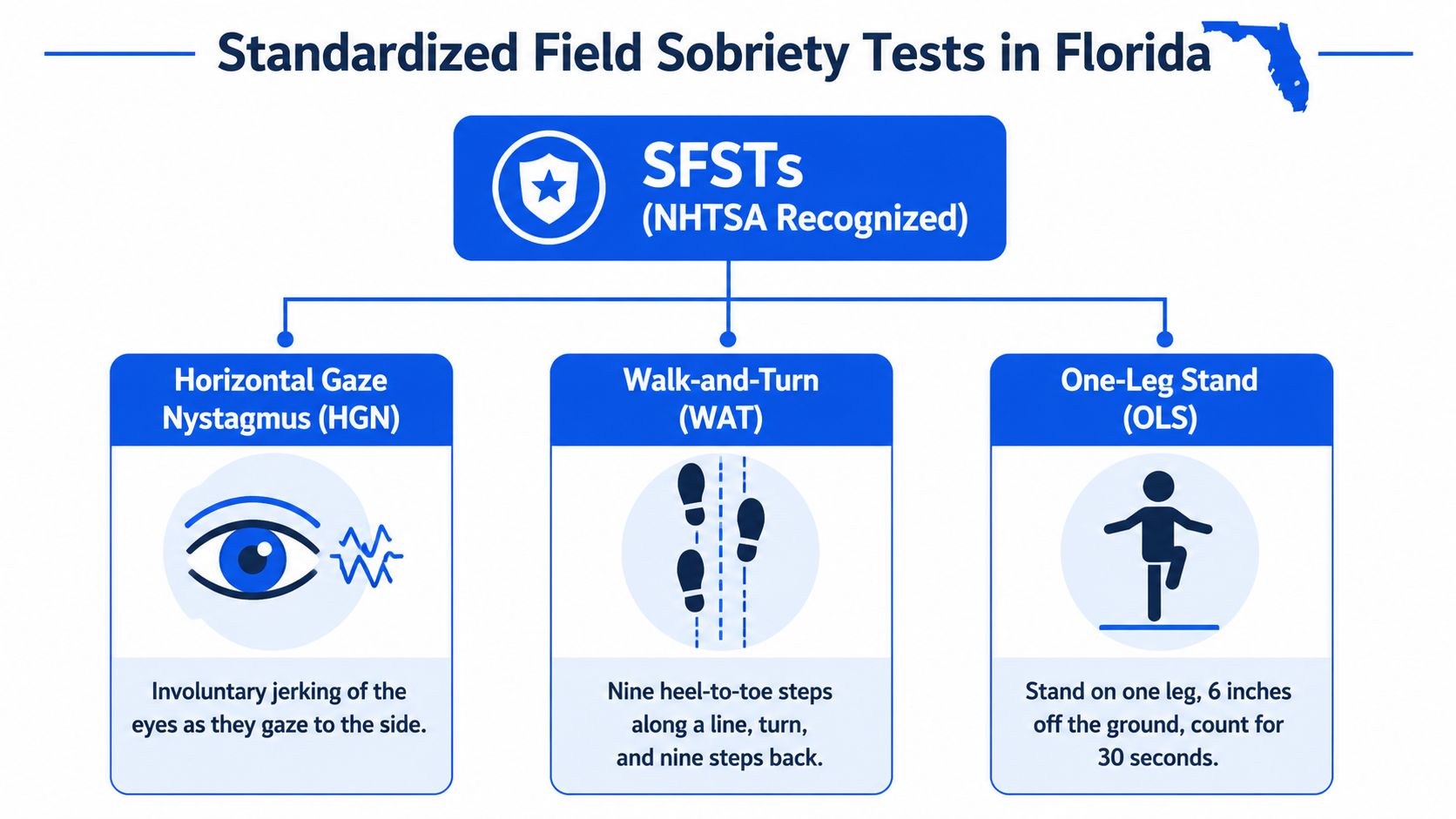
An officer in Florida will usually ask you to perform three standardized roadside tests. They are the Horizontal Gaze Nystagmus, the Walk-and-Turn, and the One-Leg Stand. These are the three tests recognized in the standard DUI training materials described in this breakdown of the standardized tests.
The label "standardized" sounds scientific. Do not let that fool you. Standardized means officers are taught a set script and a scoring method. It does not mean the result is objective, fair, or hard to challenge.
Horizontal Gaze Nystagmus (HGN)
In the HGN test, the officer moves a pen, finger, or small light in front of your face and watches your eyes track it. The officer is looking for specific eye movements that police training treats as clues.
From a defense standpoint, this test gives the officer enormous control. The speed of the pass, the distance from your face, the angle, the lighting, your medical history, and even whether you naturally have eye issues can affect what the officer claims to see. You cannot measure any of that from the shoulder of the road.
Walk-and-Turn (WAT)
In the Walk-and-Turn, you are told to stand in a starting position, listen to a sequence of instructions, take heel-to-toe steps along a line, turn in a particular way, and walk back. Officers are trained to mark errors such as stepping off the line, starting too soon, missing heel-to-toe contact, using your arms for balance, turning incorrectly, or taking the wrong number of steps.
This test is really a divided-attention exercise dressed up as a balance test. The officer is not watching for perfection because perfection proves sobriety. The officer is watching for mistakes that can be written down as clues. If you want a closer look at how police and courts treat those clues, review this explanation of field sobriety test accuracy.
One-Leg Stand (OLS)
In the One-Leg Stand, the officer tells you to raise one foot off the ground, keep your balance, look where instructed, and count aloud until told to stop. Officers usually score swaying, hopping, putting the foot down, or raising the arms.
That sounds simple until you put a real person on a roadside at night. Age, weight, fatigue, nerves, shoes, prior injuries, and uneven pavement all matter. The officer still gets to treat ordinary difficulty as evidence.
What these three tests have in common
Each test is built around officer observation. Each one gives the officer multiple chances to mark a clue. Each one turns normal human stress into something that can be used in a report.
Here is what the officer is trying to collect:
Test | What the officer asks | What the officer writes down |
|---|---|---|
HGN | Follow an object with your eyes | Claimed eye movements the officer treats as clues |
WAT | Walk heel-to-toe, turn, and return | Balance issues, instruction mistakes, and step errors |
OLS | Stand on one leg and count aloud | Swaying, hopping, foot down, or arm movement |
If you understand these tests for what they are, your position gets clearer. They are not roadside tools built to clear you. They are arrest-building tools that let the officer say you showed signs of impairment.
Are Field Sobriety Tests Reliable or Accurate
Prosecutors like to present these tests as dependable. The data doesn't support that kind of confidence.
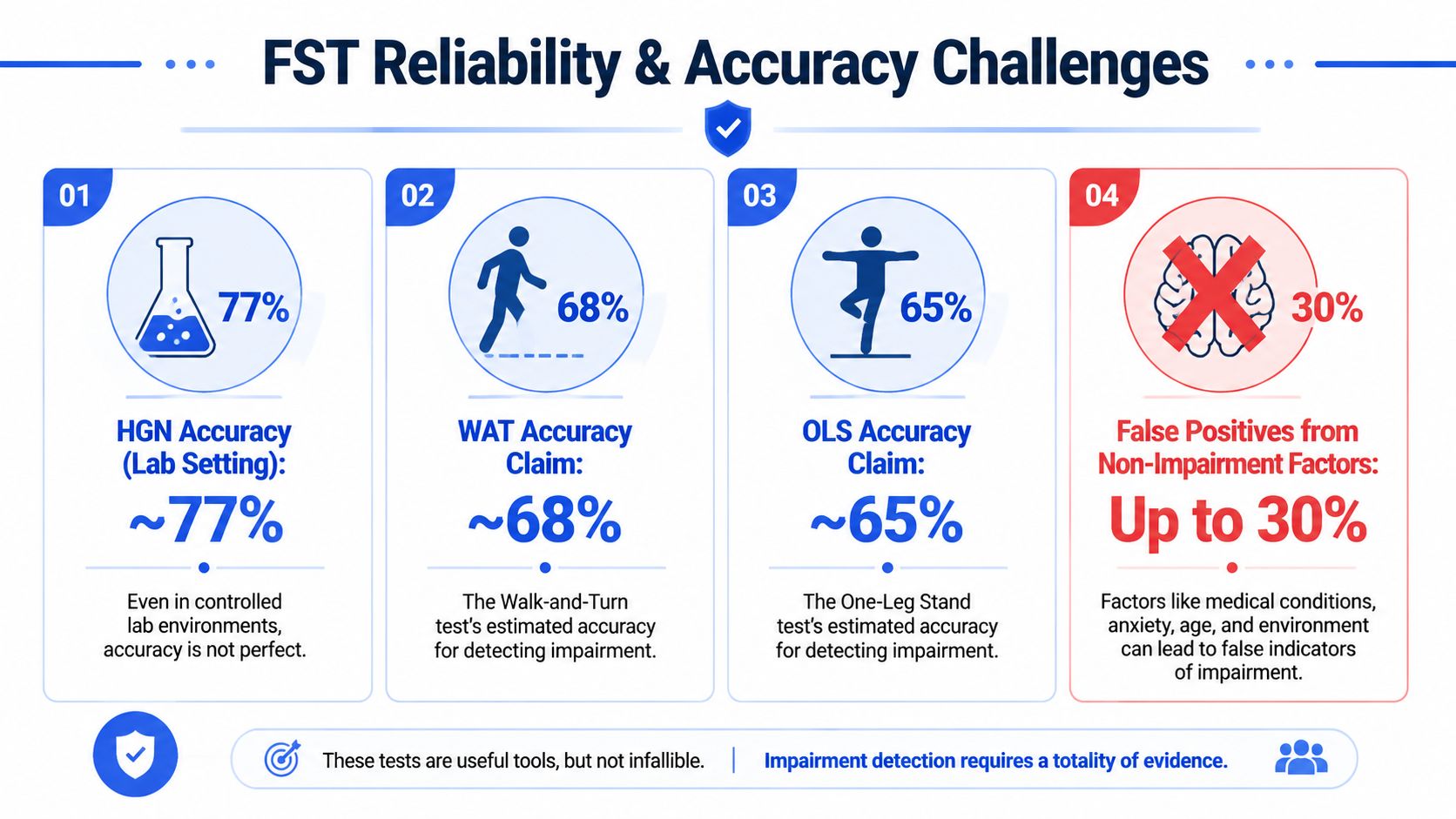
According to this analysis of NHTSA field sobriety test accuracy, the National Highway Traffic Safety Administration standardized the three core tests after studies found 77% accuracy for HGN alone, 68% for Walk-and-Turn alone, and 65% for One-Leg Stand alone. When all three were administered together in a standardized manner, the reported accuracy rose to 82% for detecting people with BAC above 0.10 g/dL. But the same source states that officers' on-scene BAC estimates were only 47% accurate under controlled conditions.
That should change how you think about roadside “failure.”

Why the numbers don't settle the issue
These figures don't prove the tests measure whether you were driving safely. They are tied to alcohol indicators and officer interpretation. That is not the same thing as proving actual driving impairment.
Scientific discussion in the same accuracy review also notes that the tests were not scientifically proven to measure driving ability itself. That distinction is critical in a defense.
If you want a deeper look at the weaknesses in roadside testing, review this discussion of field sobriety test accuracy in Florida cases.
Why sober people still “fail”
Now add the actual factors that don't show up neatly in a police report:
Medical issues: Inner ear problems, knee injuries, back pain, or neurological conditions can affect balance and eye movement.
Normal human limits: One Florida DUI source states the average unimpaired person can hold the One-Leg Stand position for only about 26 seconds, even though the instructions call for 30 seconds, according to this Florida discussion of refusing field sobriety tests.
Road conditions: Gravel, sloped pavement, poor lighting, and passing traffic can all interfere.
Stress response: Nervousness changes how people speak, move, and process instructions.
Footwear and clothing: Dress shoes, work boots, heels, tight clothing, and fatigue all matter.
Here's a useful reminder before you watch how officers frame these tests:
A roadside mistake is not the same as legal guilt.
That matters in every DUI defense. A bad performance can be explained. An officer's interpretation can be challenged. Video can contradict the written report.
Can You Legally Refuse a Field Sobriety Test in Florida
Yes. In Florida, field sobriety tests are voluntary.
That is the direct answer.
Under Florida DUI practice, the roadside exercises are different from chemical testing under Florida Statute 316.1932, the implied consent law. According to this Florida DUI explanation of voluntary field sobriety tests, field sobriety tests are 100% voluntary in Florida, and refusing them does not trigger the automatic one-year license suspension tied to refusing a chemical test such as breath, blood, or urine.
What refusal does and does not do
Refusing an FST does not mean the officer has to let you go. It does mean you avoid giving the officer a live roadside performance to narrate later in court.
Refusing a chemical test is different. Florida's implied consent law carries immediate license consequences for that refusal. If you need that distinction explained clearly, read about Florida implied consent law and license consequences.
How to refuse the right way
Your tone matters. Don't be combative. Don't lecture the officer. Don't turn the stop into an argument.
Use simple language:
Be respectful: “Officer, I want to be polite and cooperative.”
Be clear: “I do not want to perform any field sobriety tests.”
Don't explain too much: Extra words create extra evidence.
Repeat if needed: Calmly restate your refusal if the officer asks again.
Stay physically compliant: If told where to stand or place your hands, comply with safety commands.
“Officer, on advice of counsel, I respectfully decline any field sobriety exercises.”
That sentence is strong because it's polite and limited.
Why refusal is usually the better strategy
These tests are subjective. The officer scores them. The officer writes the report. The officer testifies.
You don't gain much by trying to “pass.” You risk giving the state more details to use against you. A respectful refusal limits the evidence.
That doesn't end the investigation. It does protect you from one of the most misleading parts of a Florida DUI stop.
How Are FST Results Used Against You in Court
The roadside stop ends. The courtroom fight begins.
In places like Miami's Richard E. Gerstein Justice Building, prosecutors regularly use FST evidence to tell a clean, simple story. The officer saw bloodshot eyes. The officer smelled alcohol. The driver swayed. The driver missed heel-to-toe. The driver put a foot down. The driver seemed confused. The driver refused tests because of “consciousness of guilt.”
That final point is a common problem. According to this discussion of DUI field sobriety test challenges, officers often use FST refusal as a proxy for consciousness of guilt to justify an arrest or to seek a warrant for a mandatory chemical test.
How the state builds the narrative
The prosecutor doesn't need perfect facts. The prosecutor needs a narrative that sounds reasonable. FSTs help create that narrative because they turn ordinary human behavior into suspicious behavior.
A pause becomes confusion.
A wobble becomes impairment.
A refusal becomes guilt.
How a defense lawyer attacks that evidence
A serious defense doesn't accept the officer's wording at face value. It dissects everything:
Training and administration: Did the officer follow standardized procedures?
Location conditions: Was the surface level, dry, and appropriate?
Physical limitations: Did injury, age, fatigue, or medical conditions affect performance?
Video review: Does bodycam or dashcam support the report, or undercut it?
Suppression issues: Was the stop lawful, and was the evidence obtained properly?
Many DUI cases turn on procedural mistakes and credibility gaps. That's why motions matter. If you want to understand how courts exclude bad evidence, review how a motion to suppress evidence works in Florida traffic and DUI cases.
Court is where the officer's conclusions stop being assumptions and start facing scrutiny.
An Arrest Is Not a Conviction What To Do Now
If you were arrested after a field sobriety test, or after refusing one, don't assume the case is over. It isn't.
A DUI arrest feels immediate because the consequences hit fast. Your license, your job, your insurance, your reputation. But the state still has to prove its case, and roadside observations are often weaker than people think.
Immediate Steps to Take
Write down everything: Time of stop, weather, road conditions, what the officer said, and what you said.
Preserve your footwear and clothing: They may matter if balance becomes an issue in the case.
Identify witnesses: Passengers or bystanders can help.
Request records quickly: Bodycam, dashcam, and dispatch material don't preserve themselves forever.
Track license deadlines: Administrative deadlines move fast after a DUI arrest.
Get legal advice early: Delay helps the state, not you.
If your license is at risk, learn how the administrative license suspension hearing process can affect your ability to keep driving while the case is pending.
Why your next move matters
Drivers make avoidable mistakes after arrest. They post online. They call the officer. They talk to friends in text messages. They keep explaining. Every one of those choices can create evidence.
Do the opposite. Be quiet. Be organized. Get strategic.
And choose real legal help. Not an automated app. Not a ticket mill where you never speak to the lawyer handling your case. When your license and criminal record are on the line, middlemen and chatbots aren't enough.
A proper DUI defense is personal. It requires direct communication, fast action, and a lawyer who can challenge probable cause, attack the roadside investigation, and push for the outcome that protects your record.
An arrest is not a conviction. A failed roadside exercise is not the end of the case. It's the start of the defense.
If you want a lawyer-led defense from a Florida firm where you speak directly with your attorney by phone or text, visit Ticket Shield, PLLC for a free consultation. Protect your license, fight the charge, and push for the No Points goal now.