
Your Tampa Florida DUI Lawyer for 2026 Defense
Arrested for a DUI in Tampa? Get expert defense. A Tampa Florida DUI lawyer protects your rights. Act now to save your license.

You're home. Your car may be impounded. Your phone is blowing up. You're worried about jail, your license, your job, and what happens when your boss or your app account finds out. That panic is normal. It's also dangerous, because the first mistake after a Tampa DUI arrest is waiting.
A DUI case in Tampa moves on two tracks at once. One track can hit your license almost immediately. The other moves through the criminal courts in Hillsborough County. If you treat this like a normal traffic ticket, you put yourself behind before your defense even starts.
Table of Contents
You Were Arrested for a DUI in Tampa What Happens Now
A Tampa DUI arrest is not the end of your case, but the clock is already running. Protect your license immediately, stay silent about facts, and get a lawyer involved now because both the DMV process and the court case can hurt you fast.
If you called me at 3 AM, I'd tell you this first. Stop guessing. Stop explaining. Stop trying to “clear it up” with anyone except your lawyer.
Tampa is not a casual DUI venue. The Tampa Police Department made 2,087 DUI arrests in 2016, and the same reporting context listed 55,722 Florida DUI citations statewide in that period, which tells you this is a system with heavy volume and repeat procedures, not an unusual one-off event for police, prosecutors, or judges in this area. You can review those figures on this Tampa DUI statistics page. High-volume systems reward preparation, not panic.
What you should understand tonight
A DUI arrest usually creates two immediate threats. First, your driver's license. Second, your criminal case.
Those are connected, but they are not the same thing. That distinction matters because people often focus on court and ignore the license deadline. That's backwards.
Practical rule: The first hours after a DUI arrest are about damage control, not storytelling.
Under Florida Statute § 316.193, the state can prosecute a driver for DUI based on alleged impairment or alleged unlawful breath or blood alcohol level. That statute gives the state its framework. Your lawyer's job is to test whether police followed the law, whether the evidence is reliable, and whether the government can prove what it claims.
What not to do
A lot of good people make their case harder in the first day. Don't do that.
Don't post about it: Social media is not therapy. It becomes evidence.
Don't call the officer or agency: You won't talk your way out of this.
Don't assume refusing details helps later: Every statement can box you in.
Don't hire an automated app or ticket mill: A DUI is not a form submission problem. It requires legal judgment.
If you want a deeper breakdown of how a Tampa DUI defense starts, review this guide on a DUI defense attorney in Tampa.
What to do instead
Start acting like your license, record, and job all matter. Because they do.
Write down what happened while it's fresh. Save paperwork. Keep the temporary permit or citation documents in one place. Make a timeline of where you were, what you drank if anything, who was with you, and whether there was a crash, field sobriety testing, or a breath test request.
That doesn't replace legal advice. It helps your lawyer find weak points before the state locks in its version of events.
Why You Only Have 10 Days to Save Your License
Florida gives you almost no room for delay after a DUI arrest. This is the part many drivers miss, and it causes avoidable damage.
Florida law is direct on this point. You have exactly 10 days from the date of your arrest to request a formal review hearing to challenge the administrative suspension of your license. If you miss that deadline, the suspension goes into effect automatically. That deadline is explained in this Hillsborough County DUI attorney guide.
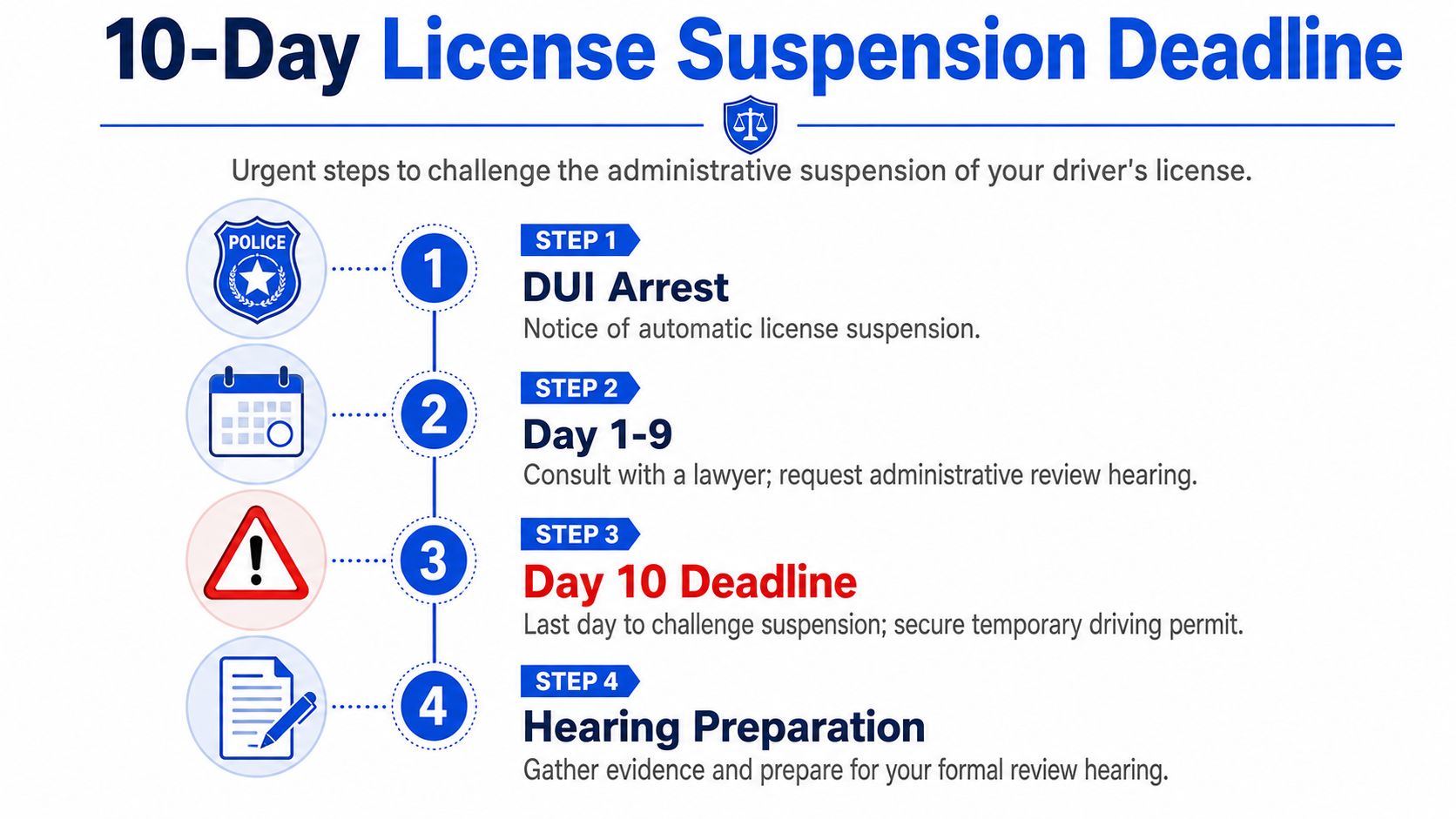
Why this deadline matters more than most drivers realize
The administrative license process is separate from the criminal prosecution. You can still be fighting the DUI in court while your license problem gets worse because no one challenged the suspension in time.
That's why I tell people not to “wait for the first court date.” Waiting is the mistake.
A formal review hearing does more than challenge the suspension. It can also give your lawyer an early chance to look at the state's evidence, identify witnesses, and start testing the government's version of events before the criminal case matures.
If driving keeps your life together, this deadline isn't paperwork. It's a priority.
You can read more about that process in this explanation of Florida DUI license suspension.
Immediate steps to take
Here's the short list. Do these now.
Check the arrest date: The count starts from the date of arrest, not when you feel ready.
Secure every document: Hold on to the citation, notice of suspension, bond papers, tow sheet, and any temporary permit.
Write down the timeline: Include the stop, the officer's statements, field exercises, testing requests, and whether there was a crash.
Protect your ability to work: If you drive for income, tell your lawyer immediately so license strategy comes first.
Stay off the phone about facts: Friends, employers, and family can all repeat what you said.
What this hearing is really about
A license hearing isn't just about driving privileges. That's too narrow. It's also an evidence fight.
If the stop was flawed, if the paperwork is weak, or if the officer can't support the suspension basis, that matters. A lawyer who acts quickly can use that early stage to shape the whole defense.
And if you're searching for a Tampa Florida DUI lawyer, this is one of the first things you should judge. Did the lawyer immediately ask about the 10-day deadline? If not, keep looking.
What Is the Criminal Case Timeline in Hillsborough County
The criminal case feels confusing because people hear legal terms without context. You don't need vague answers. You need a roadmap.
In Tampa, your DUI case will generally move through the Hillsborough County court system, often centered around the Edgecomb Courthouse. That building is where a lot of drivers first realize this isn't a traffic inconvenience. It's a criminal case with deadlines, hearings, prosecutors, and consequences.

What happens first at the Edgecomb Courthouse
After arrest, some drivers deal with a first appearance or bond-related process very early. That stage is often about release conditions, not final guilt or innocence.
Next comes the filing and scheduling process. Then the formal court dates begin. The names can vary by courtroom, but the usual sequence includes:
Arraignment: The charge is formally addressed, and a not guilty plea is often entered.
Pretrial dates: These hearings let the court monitor the case while lawyers exchange discovery, evaluate evidence, and discuss possible resolutions.
Motion hearings: If your lawyer challenges the stop, testing, statements, or evidence collection, the judge may hear those legal issues before any trial.
Trial setting or resolution: Some cases resolve through negotiation. Others need to be tried.
A good lawyer uses each stage for a purpose. Arraignment is not just a formality. Pretrial is not dead time. Motion practice is where weak cases can start to crack.
The court calendar is not your defense. Your lawyer's use of that calendar is your defense.
What your lawyer is doing between court dates
Clients often think “nothing is happening” because they aren't physically in court every week. In reality, the serious work usually happens between settings.
Your lawyer may be:
reviewing body camera or dash camera footage
checking whether the officer had legal grounds for the stop
examining field sobriety exercise instructions and performance notes
requesting maintenance or calibration records tied to breath testing
comparing reports for contradictions
deciding whether a motion should be filed
negotiating from a position of strength, not panic
That last part matters. Negotiation only works when the state believes your lawyer is ready to litigate.
Why you should not read too much into one hearing
Drivers often leave one short hearing and assume the case is either getting better or worse. That's not how this works.
One reset doesn't mean your lawyer is stalling. One firm offer doesn't mean it's the final offer. One confident prosecutor doesn't mean the evidence is clean. DUI cases often turn on details that don't show up until records, video, or witness issues are fully reviewed.
What matters is whether your lawyer has a plan, whether deadlines are being protected, and whether the defense theory fits the actual facts.
The criminal case is slower than the license fight
That timing difference throws people off. The criminal case can take time. The license problem does not wait. That's why drivers need to treat the first days seriously even if their first meaningful court date is later.
If you keep that one idea in mind, the process becomes less mysterious. The state moves on its schedule. Your lawyer has to move on yours.
How Does a Lawyer Fight a Tampa DUI Charge
A Tampa DUI defense is built by attacking proof. Not by hoping the officer doesn't show up. Not by filling out a generic intake form. And not by handing your case to a chatbot or a non-lawyer case manager.

One Florida DUI defense source explains that strong cases often focus on technical weaknesses like an unlawful stop, improper field sobriety test administration, breathalyzer maintenance errors, or blood chain-of-custody defects, all of which can weaken or suppress key evidence. That analysis appears in this Hillsborough DUI defense discussion.
The stop can be attacked
Police need a lawful basis to stop your vehicle. If the stop was not supported, the case can change fast.
That doesn't mean every stop is bad. It means every stop must be tested. The officer's report is only one version. Video, timestamps, dispatch records, and witness accounts can tell a different story.
A lawyer may ask:
Was there an actual traffic infraction?
Did the officer describe driving behavior clearly?
Did a crash investigation blend into a DUI investigation improperly?
Do the videos match the written report?
If the stop falls apart, the rest of the case may become much harder for the state to use. That's why motions matter. If you want to understand that tool better, read this plain-English guide on what a motion to suppress evidence means.
The testing can be attacked
Field sobriety exercises are not magic. They are supposed to be administered in a certain way. Weather, footwear, road surface, fatigue, injury, anxiety, and poor instructions can all matter.
Breath testing also has weak points. Maintenance, calibration, observation procedures, and operator conduct all deserve scrutiny. Blood evidence raises another set of issues, especially chain of custody and handling.
Here's a short explanation that matches how we approach these cases:
A DUI charge is often presented as airtight in the arrest report. It rarely stays that simple once the records come in.
Why direct access to your lawyer matters
Firms distinguish themselves. A real DUI defense requires decisions that change as facts come in. You need to ask questions when your employer calls, when your platform account changes, when a court date moves, or when police paperwork doesn't match what happened.
That's why I don't recommend automated apps or ticket mills for a DUI. A DUI is not a parking citation problem. It's dynamic.
Ticket Shield, PLLC is one Florida option that connects drivers with lawyer-led traffic and DUI defense and allows direct communication with the attorney by phone or text, rather than pushing clients through middlemen. That model fits DUI cases better because legal decisions often need to be made quickly and personally.
If you're hiring a Tampa Florida DUI lawyer, ask one blunt question. “When I have a problem next week, do I get my lawyer, or do I get a system?” The answer tells you a lot.
What Are the Penalties for a Florida DUI Conviction
If you want the legal anchor, start with Florida Statute § 316.193. That statute sets out Florida's DUI offense structure and the penalty framework courts use when there is a conviction.
You should know the risks without sugarcoating them. A DUI conviction can trigger fines, probation, jail exposure, license consequences, DUI school, and ignition interlock issues depending on the facts and prior record. Some cases also involve aggravated allegations, such as crash injuries or other enhancements, which can raise the stakes further.
Why the statute matters
People often focus only on “will I go to jail?” That's too narrow.
For many drivers, the practical pain comes from losing the ability to drive freely, dealing with court conditions, managing insurance fallout, and carrying a criminal record. Those consequences can hit your routine long after the arrest itself.
And Hillsborough County is not a place for complacency. One Tampa legal analysis cites a 79.6% DUI conviction rate in Hillsborough County, which it contrasts with a 60% statewide figure for DUI citations resulting in a DUI or reckless driving conviction in the referenced dataset. You can review that local comparison in this Hillsborough County conviction rate analysis. In plain English, a passive defense is risky here.
Florida DUI penalties at a glance
The details depend on your facts, prior record, and whether there are aggravating allegations. This table is a practical overview, not a substitute for case-specific advice.
Penalty | First Conviction | Second Conviction |
|---|---|---|
Criminal classification | DUI under Florida Statute § 316.193 | DUI under Florida Statute § 316.193 |
Fines | Court may impose fines under the statute | Higher exposure than a first conviction under the statute |
Jail exposure | Possible, depending on facts and court handling | Greater exposure than a first conviction |
Probation | Common in many cases | Common, often with tighter conditions |
License consequences | Significant impact on driving privileges | More serious impact on driving privileges |
DUI school | Often required | Often required |
Ignition interlock | May apply depending on facts | More likely to be part of the outcome |
For a more detailed breakdown of how sentencing issues are evaluated, see this guide to Florida DUI sentencing.
The right takeaway isn't fear. It's urgency. You don't wait to see whether a criminal case in Hillsborough County somehow gets easier on its own. It usually doesn't.
How Does a DUI Affect Gig Drivers Military or CDL Holders
Most DUI articles stop at criminal penalties. That's incomplete. A lot of drivers don't just need a license for convenience. They need it to get paid, stay deployable, keep a clearance, or remain employable.
One Florida legal directory notes a major gap in DUI guidance for working drivers and also highlights a hard truth. For gig workers, a DUI arrest can mean app deactivation, and for military members, it can create security-clearance problems before any conviction. That practical employment impact is discussed on this Tampa DUI legal directory page.
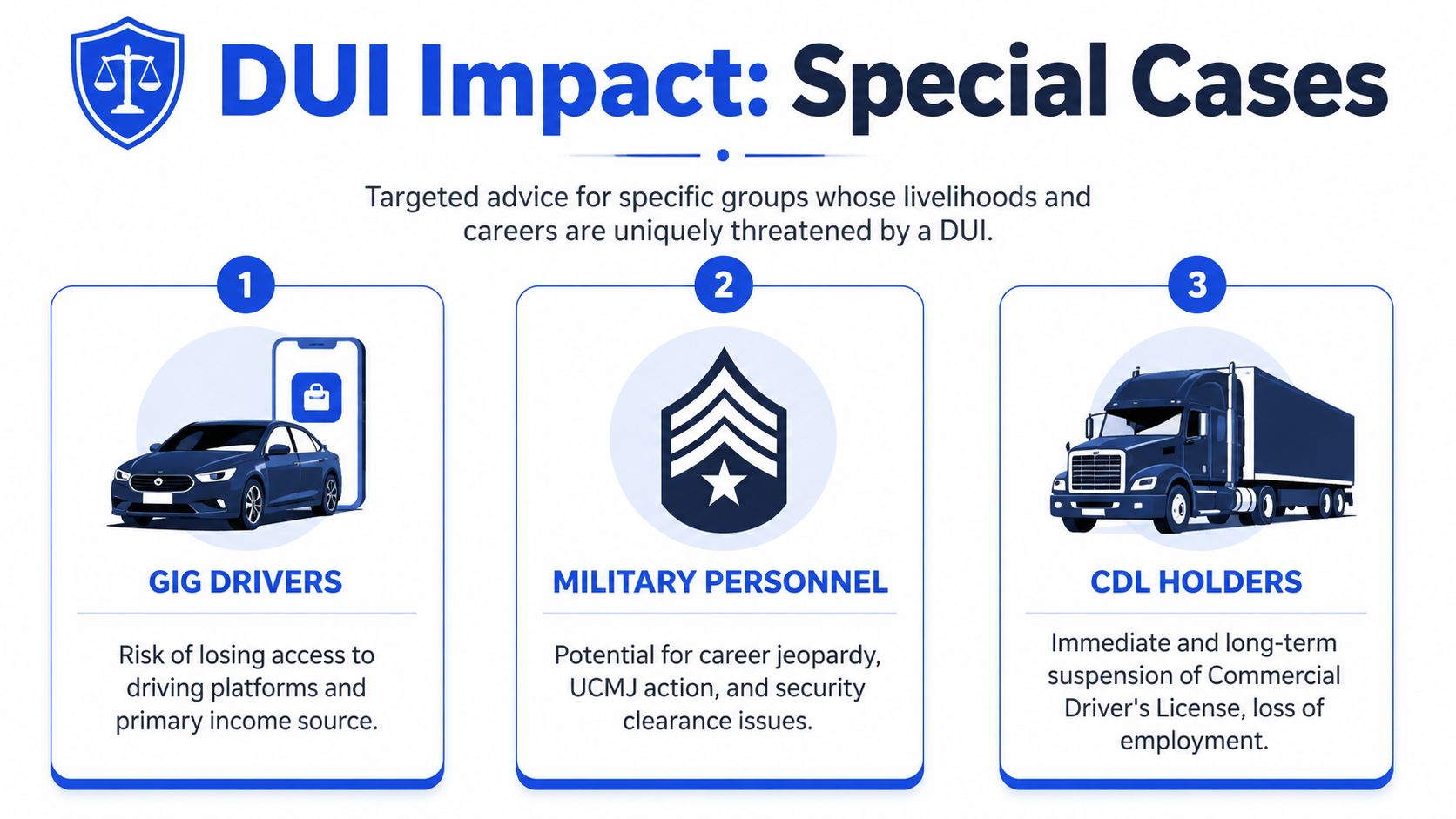
Gig drivers can lose income fast
If you drive for Uber, Lyft, DoorDash, or another platform, a DUI arrest can create a business emergency before your first court date. That's why gig workers need a legal plan and a work plan immediately.
You need to think about:
Platform status: Review account notices and preserve screenshots.
Income continuity: Identify whether you need a non-driving work backup right away.
Communication discipline: Don't send long explanations through an app portal without legal guidance.
License strategy first: If you drive to earn, preserving lawful driving options becomes urgent.
A generic DUI defense misses this. Your case strategy has to match your livelihood.
Military members face problems before court ends
If you serve at MacDill Air Force Base or elsewhere in Florida, a DUI allegation can become more than a county court problem. Command notification issues, base access concerns, administrative consequences, and security-clearance questions can start early.
That means timing and communication matter. You need legal advice before you start trying to explain the arrest up the chain.
Bring your lawyer into the problem before your employer, command, or platform defines the problem for you.
Every branch and command environment is different, but one rule stays the same. Don't assume “it's only an arrest” means your career is insulated.
CDL holders face a different kind of risk
Commercial drivers should treat a DUI arrest as a threat to their profession, not just their personal license. A CDL issue can ripple through hiring, retention, insurance, and route assignments even before the criminal case finishes.
Your lawyer needs to know right away:
whether you hold a CDL now
whether the arrest involved a commercial vehicle or personal vehicle
whether your employer requires immediate disclosure
whether your route, delivery schedule, or work duties depend on uninterrupted driving
For CDL holders, legal advice has to account for both the courtroom and the job site. That is where many generic DUI pages fail. They talk about criminal court in broad terms but give almost no practical guidance for preserving a career built around driving.
What Should You Ask Before Hiring a Tampa DUI Lawyer
Hiring the wrong lawyer for a DUI usually looks fine on day one. The problem shows up later, when you can't reach anyone, when no one explains the license issue clearly, or when your case gets treated like volume work.
Ask direct questions.
Ask these before you hire anyone
Will I speak directly with my lawyer: If the answer is vague, that's a warning.
Who handles my license deadline: You want a precise answer, not a sales answer.
How do you communicate: Phone and text access matters when your work and court dates are moving.
What is your first defense step in my case: A real lawyer should talk about facts, records, and evidence, not slogans.
Will you review the stop and testing process closely: DUI defense often turns on those details.
How do you approach motions and negotiations: You want someone ready to challenge the state, not just process paperwork.
You should also pay attention to how the firm presents itself online. A polished website doesn't prove legal skill, but it does tell you whether the firm thinks clearly about client communication. If you're curious how law firms shape trust and visibility online, this article on law firm marketing strategies is a useful outside perspective.
For a stronger screening list, review these questions to ask your attorney.
The right Tampa Florida DUI lawyer should sound calm, specific, and ready to act. Not evasive. Not automated. Not scripted.
If you've been arrested for DUI in Tampa, act now. Protect your license, protect your record, and protect your no-points goal by getting real legal advice immediately. Visit Ticket Shield, PLLC for a free consultation.
