Substance Abuse Evaluation Florida: Your 2026 Guide
Navigate your required substance abuse evaluation florida with our 2026 guide. Learn about the process, costs, and result impact on your case today.

You just walked out of court, and now you're holding an order for a substance abuse evaluation. You're worried about your license, your case, your job, and what happens if you get this wrong. That reaction is justified. In Florida DUI cases, this evaluation can shape what the judge requires, what the prosecutor argues for, and how fast you can get back on the road.
A lot of drivers make the same mistake. They treat the evaluation like routine paperwork. It isn't. It's a legal pressure point. What you do before, during, and after that appointment can affect your probation terms, treatment requirements, and your ability to legally drive again.
Table of Contents
Your Guide to the Florida Substance Abuse Evaluation
A substance abuse evaluation in Florida is a mandatory clinical assessment for DUI offenders to determine if treatment is needed. The results directly impact your court sentence, probation terms, and your ability to get your driver's license back. You must take it seriously.
If you've been ordered to get one, you're at a fork in the road. One path leads to unnecessary delays, added conditions, and avoidable damage to your DUI case. The other leads to a more controlled outcome because you understood what the evaluation meant before you walked in.

Why this process carries real weight
Florida doesn't order these evaluations in a vacuum. Over 7,579 drug overdose deaths were reported in Florida in 2020, making it the second-highest state for overdose fatalities, according to Florida substance abuse statistics. Courts view evaluations as an early intervention tool after DUI arrests because they want a clinical answer to a legal problem.
That means your evaluation isn't just about health. It becomes part of the decision-making around your case.
Practical rule: If the court ordered the evaluation, assume every delay, missed document, and careless answer can create problems you didn't need.
Why drivers get blindsided
Individuals often focus on the arrest, the court date, and the license suspension. Then this evaluation order shows up and feels secondary. It isn't secondary. It often becomes one of the documents that shapes plea discussions, probation structure, and reinstatement steps.
If you're still trying to get your bearings on the broader DUI process, start with this Florida DUI overview. Then come back to this evaluation issue and handle it with the attention it deserves.
Why Was I Ordered to Get a Substance Abuse Evaluation
Because Florida law requires it in DUI cases. This is not optional, and it is not something you can talk your way around.
What Florida law requires
Under Florida Statute §316.193, a DUI conviction mandates that all offenders complete a substance abuse evaluation and a psychosocial assessment through a licensed DUI program as an integral part of their court-ordered probation, as stated in Florida Statute 316.193. That statute sits in Chapter 316, which is the section of Florida law that governs motor vehicle offenses.
If your case is moving through the Broward County Judicial Complex in Fort Lauderdale, the same rule applies there as it does anywhere else in Florida. Judges want a formal evaluation from an approved source. They don't want your personal opinion that this was a one-time mistake.
The court may require the evaluation as part of sentencing. In some situations, the issue also comes up earlier, during compliance discussions, probation planning, or negotiations about how your case should resolve.
Why the DMV side matters too
There's also the driving privilege issue. Even when people focus on the criminal case, the license problem keeps moving. Florida treats the right to drive and the court case as related but separate problems. If you want a hardship path or reinstatement progress, you usually need to satisfy the evaluation requirement through the proper DUI program channel.
That's why waiting hurts you. The longer you sit on the order, the more pressure builds from both sides.
The evaluation is one of those DUI requirements that feels administrative until it starts blocking the result you need.
If you're also dealing with license consequences tied to refusal or testing issues, review Florida's implied consent law. That part of the case can collide with the evaluation timeline faster than many drivers expect.
What Happens During the Evaluation Process
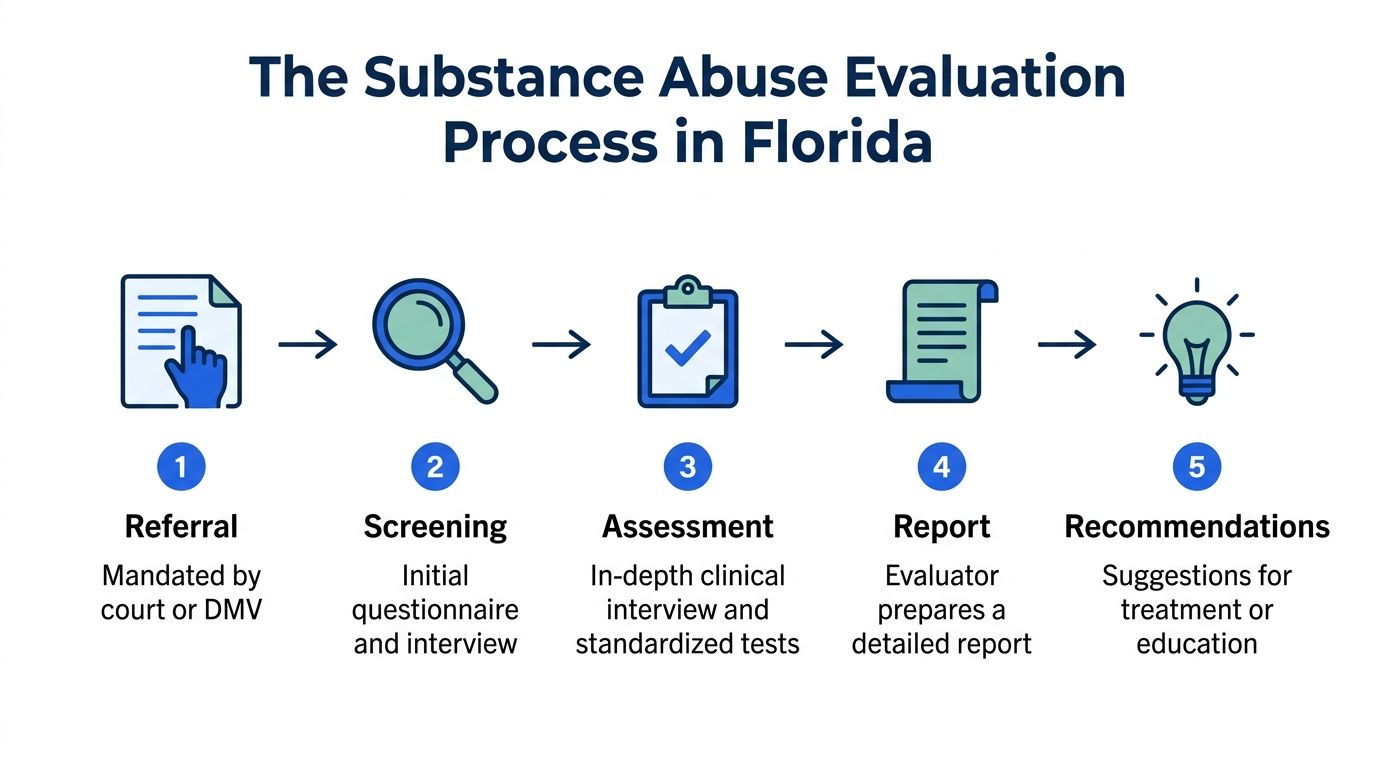
A Florida substance abuse evaluation is not a pass or fail exam. It's a structured clinical process that produces a report. That report can help you or hurt you depending on what it finds and how it reads.
A Florida substance abuse evaluation is a two-stage process: an initial screening to determine risk, followed by a diagnostic assessment based on DSM-5 criteria using tools like the AUDIT (Alcohol Use Disorders Identification Test). This process typically lasts 45–90 minutes, according to R&R Tampa's explanation of Florida substance abuse evaluations.
What the screening looks for
The first stage is the screening. This is the initial filter. The evaluator uses recognized tools such as the AUDIT and may also use the DAST to identify whether your history and current facts suggest a substance-related risk.
Expect direct questions about:
Alcohol use pattern during a typical week and around the arrest
Drug use history if any, even if your case only involved alcohol
Prior incidents involving driving, arrests, or treatment
Functional impact on work, family, finances, or daily life
Short answers help. Honest answers matter. Rambling, minimizing, and guessing usually create problems.
What the full assessment decides
If the screening indicates concern, the evaluator moves into a deeper assessment. That part is broader and more personal. The counselor is trying to determine whether a Substance Use Disorder exists under DSM-5 criteria and, if so, what level of care gets recommended.
You may be asked about your family environment, mental health, medical history, prior counseling, and the circumstances around the DUI. The evaluator is not there to litigate guilt or innocence. The evaluator is there to classify risk and recommend action.
A typical process looks like this:
Referral arrives from the court or licensing process.
Paperwork is reviewed before or at the appointment.
Screening tools are administered to identify risk.
Clinical interview follows if more detail is needed.
Written recommendations are issued for education, treatment, or no treatment.
Don't confuse being polite with being strategic. You need to understand what the evaluator is measuring before you answer sensitive questions.
If your lawyer is exploring alternatives to a standard conviction path, this guide to Florida DUI diversion options can help you understand why the evaluation report matters so much.
Who Performs the Evaluation and How Do I Prepare
You can't just pick any counselor and hope the court accepts it. That mistake wastes time and money.
Who can legally do it
In Florida, evaluations are conducted by licensed addiction professionals or counselors at court-approved agencies. They use a structured clinical interview that reviews use patterns, medical history, and social environment, and approximately 60–90% of traffic-related evaluations result in a treatment referral, according to Gulf Breeze Recovery's discussion of Florida evaluations.
That referral rate should get your attention. A lot of drivers assume they'll walk in, say this was isolated, and walk out clean. Many do not.
If your case is in Tampa, the Edgecomb Courthouse will expect compliance with the same approved-program structure used statewide. The court wants a valid report from a recognized provider, not something informal from a general therapist who doesn't handle DUI reporting requirements.
What to bring to the appointment
Preparation changes the tone of the meeting. Show up disorganized, and you look careless. Show up ready, and you give the evaluator a cleaner factual record to work with.
Bring these items:
Arrest report so the evaluator can compare your account with the official allegation
Seven-year driving history from the state record the program requires
Court paperwork showing the order, case status, or reporting instructions
Valid photo ID to verify identity at intake
Any prior treatment records if they exist and are relevant
Medication information if current prescriptions matter to your history
Here's the blunt advice. Review the arrest facts before you attend. Don't invent details. Don't guess. Don't contradict documents you know the evaluator may review.
A well-prepared driver looks more credible than a driver who shows up late, confused, and defensive.
What Are the Costs and Does Insurance Pay
Money matters. You're already dealing with bond, towing, missed work, court costs, and the financial drag that follows a DUI. The evaluation adds another required expense.
What you should expect to pay
The cost of a court-approved alcohol and drug evaluation in Florida is standardized at $165, and that amount is explained by AACS Counseling's Florida evaluation page. That fee is tied to the state-driven legal requirement under §316.193.
Treat that cost as fixed and necessary. Don't waste time shopping for a bargain that won't satisfy the court's requirements.
A quick view:
Item | What to know |
|---|---|
Evaluation fee | $165 for the court-approved Florida alcohol and drug evaluation |
Why it matters | The report supports compliance with DUI case requirements |
Who must perform it | A licensed substance abuse professional through the proper channel |
Why insurance usually doesn't help
Drivers often assume health insurance should cover any clinical appointment. In this setting, that assumption usually fails. The reason is simple. This evaluation is being ordered because of a legal case or licensing requirement, not because you scheduled routine medical care.
That means you should plan for an out-of-pocket payment unless the provider specifically tells you otherwise. Build it into your DUI budget now, not the week your deadline expires.
If you're trying to map out the larger financial fallout, review this breakdown of how much a DUI costs in Florida. The evaluation fee is only one part of the damage.
How Do the Evaluation Results Impact My DUI Case and License
The substance abuse evaluation in Florida can be a legal weapon or a legal problem. The report doesn't sit in a file cabinet doing nothing. It affects one's legal advantage.

What a favorable result can do
The better outcome is straightforward. The evaluation concludes that no treatment is recommended, or that the facts support a limited educational response rather than deeper treatment. That doesn't erase the DUI, but it can make the case easier to manage.
At places like the Richard E. Gerstein Justice Building in Miami, a favorable evaluation can give your defense lawyer something concrete to use in negotiations. If the report undercuts the idea that you present an ongoing substance-related driving risk, that can support arguments for reduced penalties, tighter probation terms, or access to alternative resolutions where available.
A favorable report also helps on the license side because it removes one major obstacle from the compliance chain.
What an unfavorable result can trigger
If the evaluator recommends treatment, the case changes. You're no longer just dealing with the DUI charge itself. Now you're dealing with additional tasks, monitoring, and proof-of-completion issues that can affect probation and reinstatement timing.
Treatment recommendations may include:
Outpatient counseling with attendance requirements
Intensive outpatient programming if the evaluator sees a higher level of concern
Follow-up monitoring through the DUI program
Additional documentation before the court or agency considers you compliant
That can affect how the prosecutor views risk, how the judge structures probation, and how long it takes you to satisfy every condition needed to move forward.
A DUI evaluation report is evidence. It may not decide the whole case, but it can absolutely shape the outcome.
There's another practical issue. After an evaluation, some drivers struggle to find timely follow-up services. That problem can be worse in the Orlando area because local treatment capacity can affect post-evaluation access, as noted in Orange County treatment gap research from UCF. If your case is moving through the Orange County Courthouse, don't wait until the last minute to line up recommended services.
And if your driver's license is already under separate pressure, learn how the administrative license suspension hearing fits into the broader defense timeline.
What Should I Do After the Evaluation
You walk out of the evaluation thinking you checked the box. You did not. Now the report can affect plea talks, probation terms, treatment demands, and how quickly you can clear the path to reinstatement.
The next 48 hours matter.
Get the report. Read every recommendation. Then get it in front of your lawyer immediately. Do not assume the evaluator's wording is harmless or that the court will treat the report as routine paperwork. In a DUI case, paperwork fast provides an advantage.
Immediate Steps to Take
Get a copy of the report right away.
Send it to your attorney immediately for legal review.
Confirm every recommendation in writing, including treatment, classes, follow-up visits, and deadlines.
Put every deadline on your calendar for court, probation, DMV requirements, and provider intake.
Save proof of every step you complete, including receipts, sign-in sheets, certificates, and discharge paperwork.
If the report recommends treatment or follow-up services, start at once. Delay can be framed as denial, lack of insight, or noncompliance. Those labels can hurt you with the prosecutor, the judge, and probation.
Why legal review after the report is issued can change the case
A good defense lawyer does more than collect the report and file it. Your lawyer should read it like opposing counsel and the judge will read it. Does the language create risk. Does it support a better plea position. Does it call for quick compliance before the next court date. Does it need context so one bad phrase does not define the whole case.
That is the strategic point many guides miss. The evaluation is not only a clinical document. It can shape how the state measures risk and how the court decides what to require from you.
There is also a practical problem after referral. Some drivers are told to start services quickly and then run into delays getting placed. For opioid-related treatment in Florida Medicaid, follow-through after diagnosis is a known problem, according to a Recovery Research Institute summary on Florida's OUD treatment pipeline. If your report recommends treatment, do not wait around for the system to work perfectly. Document every call, every intake attempt, and every scheduling issue so your lawyer can show the court you acted promptly.
Watch this short video if you want a clearer sense of what strong traffic and DUI defense should look like in practice.
If you just finished the evaluation, treat the report like evidence, because that is exactly what it is. Get legal advice now, get organized now, and make sure your next move helps your case instead of adding another problem.
If you want a lawyer-led defense focused on the No Points goal and protecting your license, visit Ticket Shield, PLLC for a free consultation. With Ticket Shield, you speak directly to your attorney by phone or text. Not a middleman. Not an automated app.