Stop Sign Violations in Florida: Penalties and Defenses
Facing stop sign violations in Florida? Learn the statutes, penalties, points, and how Ticket Shield can help you fight for a no-points outcome.

You're sitting in your car with a citation on the windshield, trying to decide whether paying it is easier than fighting it. That decision can affect more than your immediate budget. A stop sign violation can create problems involving your driving record, insurance profile, and future license status, especially when similar conduct happens again.
Florida law also treats a stop as more than a momentary slowdown. You must stop at the legally required location and yield when entering the intersection. If the citation is inaccurate, incomplete, or based on conditions the officer couldn't clearly observe, you should examine your options before accepting the consequences.
Table of Contents
The Real Cost of a Florida Stop Sign Ticket
Most drivers view a stop sign ticket as a minor inconvenience. They pay it online, assume the matter is finished, and move on. That approach can be costly because payment may resolve the citation administratively while leaving the underlying record consequences in place.
The safety context deserves attention. A major U.S. crash analysis found that nearly 700,000 police-reported motor-vehicle crashes occur annually at stop signs, and about one-third involve injuries. The same analysis reported that stop sign violations accounted for about 70% of crashes at stop-controlled intersections. Those findings show why a citation isn't merely a technical paperwork issue. The crash analysis is available through PubMed.
The ticket can outlast the traffic stop
A conviction can place points on your license, depending on the violation and how Florida processes it. Points can become more serious when combined with other moving violations. Your insurer may also review the conviction when evaluating your policy, and any resulting surcharge can cost more than the original citation over time.
You also need to consider whether the citation reflects an isolated mistake or a driving pattern. A rolling stop at an empty intersection isn't identical, from a risk perspective, to failing to stop where pedestrians, cyclists, or cross traffic are present. The legal system still evaluates the specific allegation, but the surrounding facts can matter when deciding how aggressively to defend the ticket.
Protective advice: Don't treat the amount printed on the citation as the full cost of the case. The record consequences may matter more than the initial payment.
Before you pay, review the details of the charge, the stated location, the required response date, and whether the ticket alleges failure to stop, failure to yield, or both. A practical overview of the financial issue appears in this guide to stop sign ticket prices, but your own citation and driving history determine the appropriate response.
Understanding Florida Statute 316.123
Florida Statute 316.123 governs the duties of drivers approaching stop sign intersections. The statute requires you to stop at a clearly marked stop line. If there isn't a stop line, you must stop before the crosswalk. If neither exists, you must stop at the point nearest the intersecting roadway where you can see approaching traffic before entering the intersection. Florida's Chapter 316 statutes provide the governing text.
That sequence matters. Stopping several feet beyond the line may not satisfy the law if the vehicle has already moved into a crosswalk or intersection. Conversely, a faded line, unusual roadway design, obstructed sign, or poor visibility can affect how the facts should be evaluated.
A full stop is only the first duty
Florida law imposes a separate obligation after you stop. You must yield to a vehicle already in the intersection or to a vehicle approaching closely enough to create an immediate hazard while you're moving across or within the intersection. In other words, stopping doesn't give you automatic permission to proceed.
The allegation may therefore involve two different questions:
Where did the vehicle stop? The relevant point may be the stop line, crosswalk, or nearest point of visibility.
Was it safe to proceed? You may still have to wait for approaching traffic that creates an immediate hazard.
The difference between a legal stop and a rolling stop is straightforward. A legal stop brings the vehicle to a complete halt at the required location. Slowing down, checking both directions, and continuing without fully stopping can support a citation even if no collision occurred.
Why the wording on the citation matters
Read the exact statute or description listed on your ticket. An officer's observation may focus on the wheels never stopping, the vehicle stopping too far forward, or the driver entering when another vehicle had priority. Those facts require different responses.
You should also identify whether the officer had a clear view of the stop line, the vehicle's wheels, the intersection, and approaching traffic. The statute's requirements are specific, so a defense should be specific too. This explanation of Florida's stop requirement can help you organize the facts before discussing the citation with counsel.
Penalties and Points on Your License
A stop sign conviction can produce immediate obligations and longer-term consequences. The exact fine, court costs, points, eligibility for a driving course, and insurance effect depend on the citation, county, disposition, and your record. Don't assume that paying the ticket is neutral. Payment can be treated as accepting responsibility, and that may expose you to record consequences you were trying to avoid.
Florida's rule also includes the duty to yield after stopping. The statute requires you to yield to a vehicle already in the intersection or one approaching closely enough to create an immediate hazard. The statutory language on yielding is important because a case may turn on right of way rather than the stop itself.
Compare the decisions before choosing one
Factor | Paying the Fine | Hiring Ticket Shield |
|---|---|---|
Immediate response | You pay the amount required by the citation and comply with the listed instructions. | A lawyer reviews the citation and discusses available defense or resolution options with you. |
Record impact | You may accept a disposition that can affect your driving record. | The defense focuses on protecting your record and pursuing an outcome that avoids points when legally available. |
Court involvement | You handle the response yourself and remain responsible for deadlines. | Counsel may handle eligible proceedings and communications on your behalf. |
Insurance exposure | A record entry may affect how an insurer evaluates your policy. | The strategy is designed to reduce avoidable record consequences. |
Personal attention | You manage the process without direct legal advice. | You can communicate directly with the attorney by phone or text. |
The comparison isn't a promise of a particular result. No lawyer can guarantee dismissal or a no-points outcome without reviewing the evidence and procedural posture. It does show why the cheapest-looking choice at the beginning may not be the most cost-effective choice overall.
If points have already appeared on a driving record, you may also need broader record-management information. For general background outside Florida, how to clean your MVR in Georgia provides a separate resource, but it doesn't replace Florida-specific legal advice.
This overview of stop sign points explains why you should evaluate the record consequences before making an election. Check the deadline immediately. Missing it can remove options that were available when the citation was first issued.
Strategic Defenses for Stop Sign Citations
A citation isn't an automatic conviction. The state still has to establish the alleged violation, and the strength of that case depends on what the officer observed, what the roadway looked like, and what evidence exists.
Examine the observation
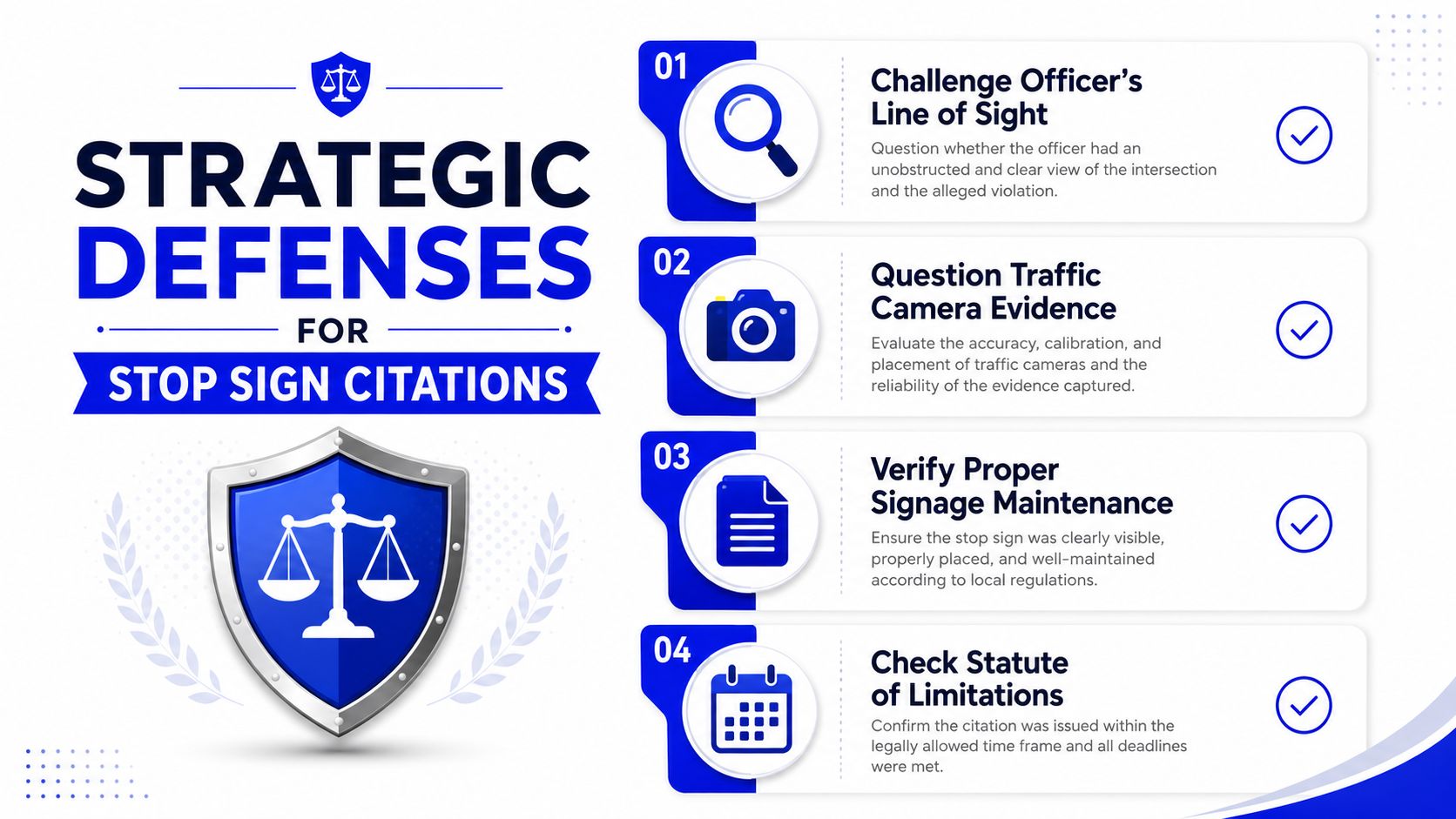
Start with the officer's line of sight. Could the officer see the vehicle's wheels? Could the officer see the stop line and crosswalk clearly? Was the observation made from a position where the sign, traffic, or roadway geometry blocked part of the event?
Roadway conditions can also matter. FHWA materials discuss how improved STOP-sign retroreflectivity, enhanced visibility, and pavement markings can improve compliance. The cited material reports statistically significant rear-end crash reductions after increased retroreflectivity in South Carolina and describes a Winston-Salem retrofit package that reduced total crashes by about 55% and injuries by about 70% per year. Review the FHWA-related stop-sign compliance material.
That evidence doesn't automatically dismiss your ticket. It does support a practical point: sign visibility and roadway design can affect driver decisions. A sign obscured by vegetation, damaged pavement markings, glare, poor lighting, or an unusual approach deserves careful review.
Build the defense around the facts
A lawyer may examine several issues:
Officer's line of sight: Determine whether the observation supports the specific allegation.
Sign condition: Document obstruction, damage, placement, or limited visibility with photographs taken safely.
Stop-line location: Check whether the line or crosswalk was visible and where the driver was required to stop.
Intersection layout: Review lane direction, sight distance, traffic flow, and nearby obstructions.
Camera evidence: Test whether footage identifies the vehicle, captures the complete approach, and shows the legally relevant stopping point.
Procedural details: Confirm the citation, service, filing, and court information are internally consistent.
The reference to speed-detection calibration belongs only in a case where speed equipment affected the allegation. It shouldn't be inserted into a stop sign defense without a factual basis.
You can also watch the embedded video for additional context before you discuss the evidence with counsel.
Don't create evidence after the fact or make statements that contradict the citation. Take photographs, preserve messages and documents, and let counsel determine which facts matter. This guide to seeking dismissal of a stop sign ticket can help you prepare for that conversation.
Why Direct Attorney Access Matters
A traffic defense service can be convenient and still leave you without meaningful legal access. Automated apps and high-volume ticket operations often route questions through intake staff, corporate answering services, or chat systems. You may receive status updates without ever speaking with the attorney responsible for the case.
That model creates a problem when the facts are unusual. A faded stop line, an obstructed sign, a disputed yield, or a camera record may require judgment rather than a scripted response. You need someone who can listen to what happened, identify the legally significant details, and explain the available choices.
Ask who will answer your questions
Before retaining any traffic lawyer or service, ask direct questions:
Will I communicate with an attorney or only with staff?
Can I call or text the lawyer handling my citation?
Who will review the officer's description and any available evidence?
What outcome is being pursued, and what risks remain?
What deadlines and documents require my attention?
Ticket Shield, PLLC uses a lawyer-led model in which clients can communicate directly with their attorney by phone or text. That differs from a system built around middlemen and automated chatbots. Direct communication doesn't guarantee a result, but it gives your lawyer the information needed to make a case-specific decision.
Client-centered rule: If the service can't explain who is handling your ticket, you don't have enough information to trust the process.
The right defense may involve contesting the citation, negotiating a lawful resolution, or evaluating an available alternative that protects your record. Those choices depend on the evidence and your history. You shouldn't make them based on a generic message generated for someone else's case.
Protect Your Record with Ticket Shield
Ignoring a stop sign citation won't protect your license. Paying without understanding the disposition may also create avoidable consequences. The safer approach is to review the charge promptly, preserve the relevant facts, and get Florida-specific advice before selecting a response.
Ticket Shield, PLLC handles Florida traffic matters through a lawyer-led service with direct phone and text communication. Its stop sign ticket lawyer service gives drivers a place to discuss the citation, the alleged conduct, and the record-protection options that may be available.
You should also be careful about what you post online after receiving any traffic-related citation. For general online reputation guidance, TheBestReputation crisis management guide offers practical precautions. Keep your public statements limited, preserve your documents, and avoid arguing about the facts on social media.
The goal is clear: pursue a lawful outcome that protects your driving record and avoids points when the facts and procedure support it. Don't let a seemingly minor stop sign violation become a larger insurance or licensing problem because you waited too long to act.
Visit Ticket Shield, PLLC for a free consultation about your Florida stop sign ticket. You'll communicate with a lawyer by phone or text, review your defense options, and pursue the ultimate goal of No Points on your license.